Question
If suddenly the gravitational force of attraction between the earth and a satellite revolving around it becomes zero, what will happen to the satellite?

Answer

Satellite will move tangentially with constant speed equal to its orbital velocity at the time the force ceases to act.

Need a full question paper?

Generate a complete, print-ready paper with questions like this in minutes — across 16+ boards, with answer keys.
Start Generating Free

Similar questions

Calculate the torque on the square plate of the previous problem if it rotates about a diagonal with the same angular acceleration.
The shells of crabs found around a particular coastal location in Japan seem mostly to resemble the legendary face of a Samurai. Given below are two explanations of this observed fact. Which of these strikes you as a scientific explanation?
  1. A tragic sea accident several centuries ago drowned a young Samurai. As a tribute to his bravery, nature through its inscrutable ways immortalised his face by imprinting it on the crab shells in that area.
  2. After the sea tragedy, fishermen in that area, in a gesture of honour to their dead hero, let free any crab shell caught by them which accidentally had a shape resembling the face of a Samurai. Consequently, the particular shape of the crab shell survived longer and therefore in course of time the shape was genetically propagated. This is an example of evolution by artificial selection.
[Note: This interesting illustration taken from Carl Sagan’s ‘The Cosmos’ highlights the fact that often strange and inexplicable facts which on the first sight appear ‘supernatural’ actually turn out to have simple scientific explanations. Try to think out other examples of this kind].
The distance of a galaxy is of the order of $10^{25}m$. Calculate the order of magnitude of time taken by light to reach us from the galaxy.
Two satellites A and B go around a planet Pin circular orbits having radius 4R and R respectively. If the speed of the satellite A is 3V, find the speed of the satellite B.
Calculate the difference between two principal specific heats of 1g of helium gas at N.T.P. Molecular weight of helium = 4u and $J = 4.186Jcal^{-1}$ and $R = 8.31 J ~mole^{-1} K^{-1}$.
If the initial velocity of a particle is $u$ and the acceleration in the same direction changes with time as $\alpha t$, then what will be the velocity at time $t$ ?
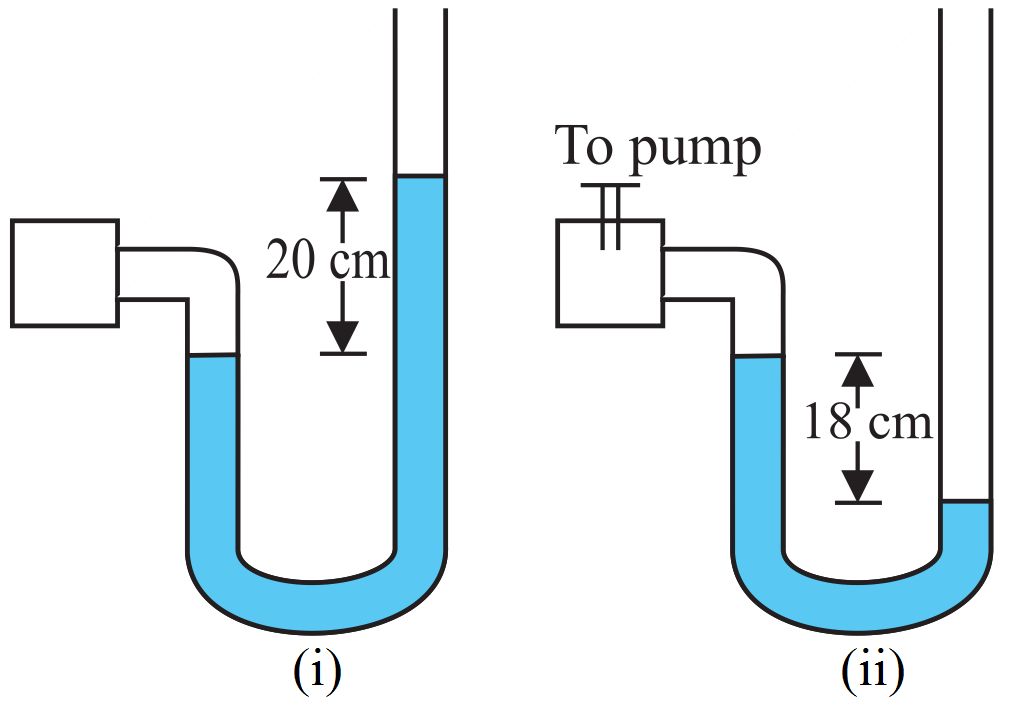
A manometer reads the pressure of a gas in an enclosure as shown in Fig.$(a)$ When a pump removes some of the gas, the manometer reads as in Fig. $(b)$ The liquid used in the manometers is mercury and the atmospheric pressure is $76\ cm$ of mercury. Give the absolute and gauge pressure of the gas in the enclosure for cases $(i)$ and $(ii)$ in units of cm of mercury. How would the levels change in case $(i)$ if $13.6\ cm$ of water $($immiscible with mercury$)$ are poured into the right limb of the manometer? $($Ignore the small change in volume of the gas.$)$
The wavelength à associated with a moving particle depends upon its mass m, its velocity v and Planck's constant h. Show dimensionally the relationship between them.
A horse, applying a force of 40 N at an angle of $60^{\circ}$ to the horizontal to pull a cart tied behind it with velocity of $7.2 km / h$. Then, (i) how much total work did this horse do in 10 minutes (ii) what is the power of horse?
A wire of length 2.00m is stretched to a tension of 160N. If the fundamental frequency of vibration is 100Hz, find its linear mass density.