Question
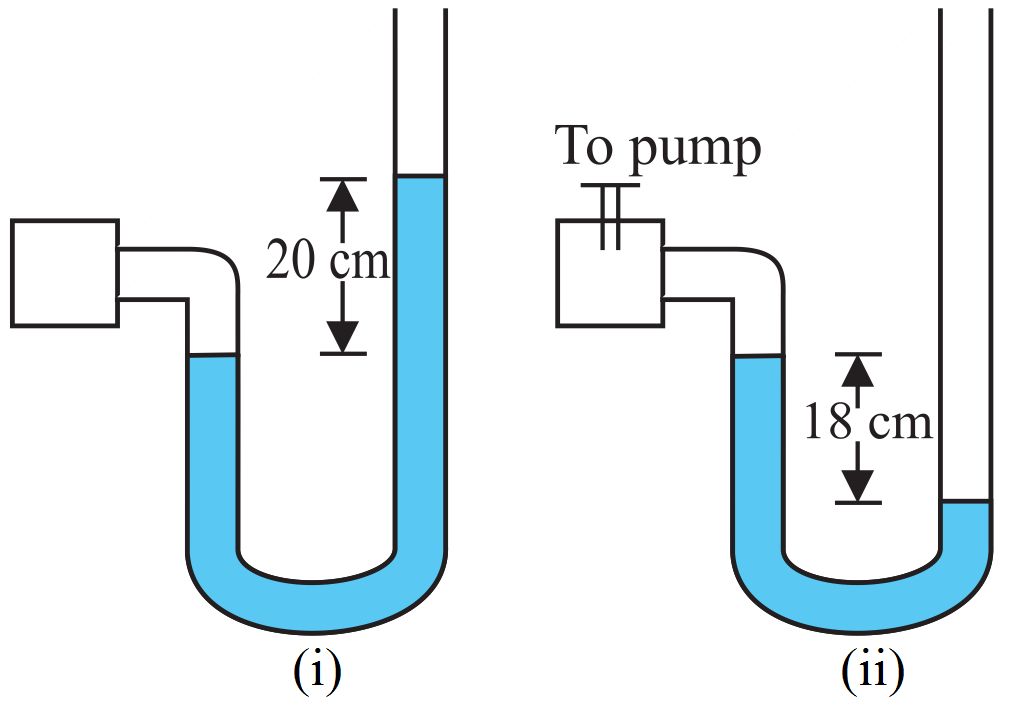
A manometer reads the pressure of a gas in an enclosure as shown in Fig.$(a)$ When a pump removes some of the gas, the manometer reads as in Fig. $(b)$ The liquid used in the manometers is mercury and the atmospheric pressure is $76\ cm$ of mercury. Give the absolute and gauge pressure of the gas in the enclosure for cases $(i)$ and $(ii)$ in units of cm of mercury. How would the levels change in case $(i)$ if $13.6\ cm$ of water $($immiscible with mercury$)$ are poured into the right limb of the manometer? $($Ignore the small change in volume of the gas.$)$
Answer

  1. Given : Atmospheric pressure,
$P_0=6 \mathrm{~cm}$ of $\mathrm{Hg}$
In figure $(i)$ pressure head,
$\mathrm{h}_1=+20 \mathrm{~cm}$ of $\mathrm{Hg} .$
Absolute pressure $( P )$ of the gas is greater than the $\mathrm{P}_0$ i.e.,
$P=P_0+h_1 p g$
$=76 \mathrm{~cm}$ of $\mathrm{Hg}+20 \mathrm{~cm}$ of $\mathrm{Hg}$
$=96 \mathrm{~cm}$ of $\mathrm{Hg}$
Gauge pressure is the difference between the absolute pressure and the atmospheric pressure. $\frac{1}{2}$ It means,
Gauge pressure $=P-P_0$
$=96 \mathrm{~cm}$ of $\mathrm{Hg}-76 \mathrm{~cm} \text { of } \mathrm{Hg}$
$=20 \mathrm{~cm}$ of $\mathrm{Hg} .$
In figure $(ii),$ pressure head,
$h_2=-18 \mathrm{~cm}$ of $\mathrm{Hg} \text {. }$
$\therefore$ The absolute pressure of the gas is lesser than the atmospheric pressure is given by
$P=P_0+h_2 p g$
$=76 \mathrm{~cm}$ of $\mathrm{Hg}+(-18 \mathrm{~cm}) \text { of } \mathrm{Hg}$
$=58 \mathrm{~cm}$ of $\mathrm{Hg}$
Gauge pressure $=$ Absolute pressure $-$ Atmospheric pressure
$=58 \mathrm{~cm}$ of $\mathrm{Hg}-76 \mathrm{~cm} \text { of } \mathrm{Hg}$
$=-18 \mathrm{~cm}$ of $\mathrm{Hg}$
It means, Gauge pressure is simply equal to $h \ cm$ of $Hg .$
  1. Given : $13.6\ cm$ of water added in the right limb is equivalent to $\frac{13.6}{13.6}=1\text{cm}$ of $Hg$ column i.e., $h = 1\ cm$ of $Hg$ column, which can be calculated as follows
$\text{h}_{\omega}=13.6\text{Cm}$ of water
Suppose $h_m =$ height of $Hg$ column equivalent to $13.6\ cm$ of water, thus equilibrium.
$\text{h}_{\text{m}}\rho_{\text{m}}\text{g}=\text{h}_{\omega}\rho_{\omega}\text{g}.$
$\text{h}_{\text{m}}=\text{h}_{\omega}\frac{\rho_{\omega}}{\rho_{\text{m}}}=\frac{\text{h}_{\omega}}{\Big(\frac{\rho_{\text{m}}}{\rho_{\omega}}\Big)}$
$=\frac{13.6}{13.6}=1\text{cm}$ of $hg$
The mercury will rise in the left limb such that the difference in the height of $Hg$ column in the two limbs.
$= 20\ cm - 1m$
$= 19 \ cm$ of $Hg$ column.

Need a full question paper?

Generate a complete, print-ready paper with questions like this in minutes — across 16+ boards, with answer keys.

Start Generating Free

Similar questions

The volume of a given mass of a gas at 27°C, 1 atm is 100cc. What will be its volume at 327°C?
Does the change in gravitational potential energy of a body between two given points depend upon the nature of path followed, why?
Two waves of wavelength 50 cm and 50.5 cm produce 6 pulse per second. Find the velocity of solution in gas
The peak power consumed by a resistive coil, when connected to an AC source, is 80W. Find the energy consumed by the coil in 100 seconds, which is many times larger than the time period of the source.
A block of mass 250g slides down an incline of inclination 37° with a uniform speed. Find the work done against the friction as the block slides through 1.0m.
Two vessels made of two different metals are identical in all respects. They are completely filled with ice at 0°C. The ice in one is melted in 30 minutes and that in another in 10 minutes by heat coming from outside. Compare the thermal conductivities of metals.
The displacement of the particle at x = 0 of a stretched string carrying a wave in the positive x-direction is given by $\text{f(t)}=\text{a}\sin\Big(\frac{\text{t}}{\text{T}}\Big).$ The wave speed is v. Write the wave equation.
What do you mean by the "phases" of a substance?
A person is painting his house walls. He stands on a ladder with a bucket containing paint in one hand and a brush in other. Suddenly the bucket slips from his hand and falls down on the floor. If the bucket with the paint had a mass of 6.0kg and was at a height of 2.0m at the time it slipped, how much gravitational potential energy is lost together with the paint?
The separation between a node and the next antinode in a vibrating air column is 25cm. If the speed of sound in air is 340m/s, find the frequency of vibration of the air column.