MCQ
If $T$ is the surface tension of soap solution, the amount of work done in blowing a soap bubble from a diameter $D$ to a diameter $2D$ is:
  • A
    $2\pi\text{D}^2\text{T}$
  • B
    $4\pi\text{D}^2\text{T}$
  • $6\pi\text{D}^2\text{T}$
  • D
    $8\pi\text{D}^2\text{T}$

Answer

Correct option: C.
$6\pi\text{D}^2\text{T}$
A soap bubble has two free surfaces.
Therefore increase in area of soap bubble
$\therefore\frac{656.5}{1425}=1.25\text{e}^{-\frac{\text{y}}{8000}}$
$\text{e}^{-\frac{\text{y}}{8000}}=\frac{656.5}{14.25\times1.25}$
$\text{e}^{-\frac{\text{y}}{8000}}=\frac{1425\times1.25}{656.5}=2.7132$
Taking $\log$ on both sides,
$\frac{\text{y}}{8000}=\log\text{e }2.7132=2.3026\log102.7132$
$=2.3026\times0.4335\approx1$
$\text{y}=8000\times1$
$=8000\text{m}$
$=8\text{km}$
$=2\Big[\frac4\pi\frac{(2\text{D})^2}{4}-\text{4}\pi\frac{\text{D}^2}{4}\Big]$
$=6\pi\text{D}^2$
Work done $=6\pi\text{D}^2\text{T}$

Need a full question paper?

Generate a complete, print-ready paper with questions like this in minutes — across 16+ boards, with answer keys.

Start Generating Free

Similar questions

A sample of a liquid has an initial volume of $1.5\,L$ . The volume is reduced by $0.2\,mL$ , when the pressure increases by $140\,kP$ . What is the bulk modulus of the liquid
A Spherical ball of radius $1 mm$ and density $10.5 g / cc$ is dropped in glycerine of coefficient of viscosity $9.8$ poise and density $1.5 g / cc$. Viscous force on the ball when it attains constant velocity is $3696 \times 10^{-x} N$. The value of $x$ is $\text { (Given, } g =9.8 m / s ^2 \text { and } \pi=\frac{22}{7} \text { ) }$
The work done against gravity in taking $10 \,kg$ mass at $1\,m$ height in 1sec will be....$J$
If the equation for the displacement of a particle moving on a circular path is given by $(\theta) = 2t^3 + 0.5$, where $\theta$ is in radians and $t$ in seconds, then the angular velocity of the particle after $2\, sec$ from its start is    ......... $rad/sec$
A mercury drop of radius 1cm is sprayed into ${10^6}$drops of equal size. The energy expended in joules is (surface tension of Mercury is $460 \times {10^{ - 3}}N/m)$
$250\,gm$ of water and an equal volume of alcohol of mass $200\,gm$ are placed successively in the same calorimeter and cools from $60^{\circ}\,C$ to $55^{\circ}\,C$ in $130\,sec$ and $67 sec$ respectively. If the water equivalent of the calorimeter is $10\,gm$. , then the specific heat of alcohol in cal/gm $cal / gm ^{\circ}\,C$ is
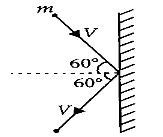
A rigid ball of mass $m$ strikes a rigid wall at $60^o $ and gets reflected without loss of speed as shown in the figure. The value of impulse imparted by the wall on the ball will be
A wooden cube (density of wood $'d'$ ) of side $'l'$ floats in a liquid of density $'\rho '$ with its upper and lower surfaces horizontal. If the cube is pushed slightly down and released, it performs simple harmonic motion of period $'T'$. Then, $'T'$ is equal to
The equation of a progressive wave is $y = 0.02\,\sin \,2\pi \left[ {\frac{t}{{0.01}} - \frac{x}{{0.30}}} \right]$ Here $x$ and $y$ are in metre and $t$ is in second. The velocity of propagation of the wave is .... $ms^{-1}$
A ball of mass $1 \;kg$ is thrown vertically upwards and returns to the ground after $3\; seconds$. Another ball, thrown at $60^{\circ}$ with vertical also stays in air for the same time before it touches the ground. The ratio of the two heights are