MCQ
If $\tan \theta = \frac{{ - 4}}{3},$ then $\sin \theta = $
  • A
    $-4/5$ but not $4/5$
  • $-4/5 $ or $4/5$
  • C
    $4/5$ but not $-4/5$
  • D
    None of these

Answer

Correct option: B.
$-4/5 $ or $4/5$
b
(b) Since ${\rm{cose}}{{\rm{c}}^2}\theta = 1 + {\cot ^2}\theta = 1 + \frac{9}{{16}} = \frac{{25}}{{16}}$

$\left( \because   {\tan \theta  =  - \frac{4}{3}} \right)$

${\sin ^2}\theta = \frac{1}{{{\rm{cose}}{{\rm{c}}^2}\theta }} = \frac{{16}}{{25}} $

$\Rightarrow \sin \theta = \pm \frac{4}{5},$ 

Both the values are acceptable, since $\tan \theta = - \frac{4}{3}\,\,$ 

$\,i.e.,\theta $ lies in ${2^{nd}}$ or ${4^{th}}$ quadrant.

Need a full question paper?

Generate a complete, print-ready paper with questions like this in minutes — across 16+ boards, with answer keys.
Start Generating Free

Similar questions

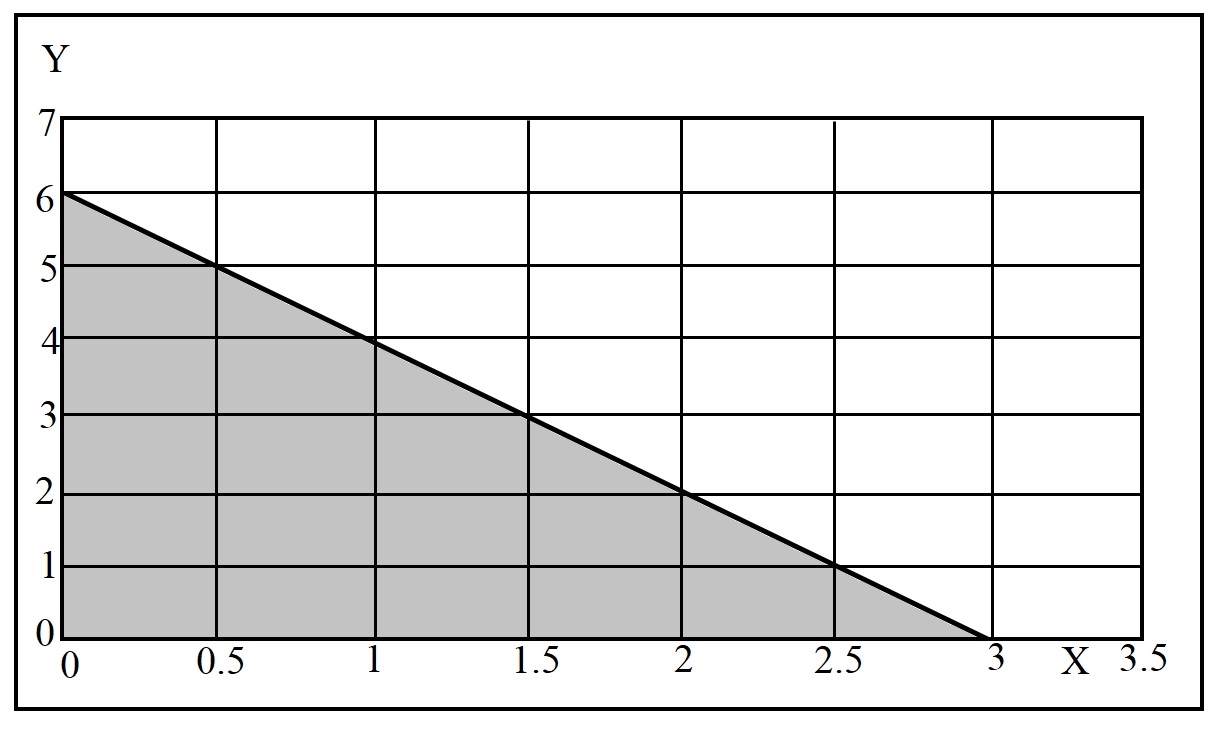
Inequations involved in the given region are____________?
​​​​​​​
The arithmetic mean of first $n$ natural number
Two concentric circles are such that the smaller divides the larger into two regions of equal area. If the radius of the smaller circle is $2$ , then the length of the tangent from any point $' P '$ on the larger circle to the smaller circle is :
The students $S _{1}, S _{2}, \ldots \ldots, S _{10}$ are to be divided into $3$ groups $A , B$ and $C$ such that each group has at least one student and the group $C$ has at most $3$ students. Then the total number of possibilities of forming such groups is ........ .
Five balls of different colours are to be placed in three boxes of different sizes. Each box can hold all five balls. In how many ways can we place the balls so that no box remains empty
If p → (p ∧ ~q) is false, then the truth values of p and q are respectively∼.
Given sum of the first $n$ terms of an $A.P.$ is $2n + 3n^2.$ Another $A.P.$ is formed with the same first term and double of the common difference, the sum of $n$ terms of the new $A.P.$ is
Let $a_1, a_2 , a_3,.....$ be an $A.P$, such that $\frac{{{a_1} + {a_2} + .... + {a_p}}}{{{a_1} + {a_2} + {a_3} + ..... + {a_q}}} = \frac{{{p^3}}}{{{q^3}}};p \ne q$. Then $\frac{{{a_6}}}{{{a_{21}}}}$ is equal to
From any point on the circle ${x^2} + {y^2} = {a^2}$ tangents are drawn to the circle ${x^2} + {y^2} = {a^2}{\sin ^2}\alpha $, the angle between them is
If $\frac{{{a^{n + 1}} + {b^{n + 1}}}}{{{a^n} + {b^n}}}$ be the $A.M.$ of $a$ and $b$, then $n=$