MCQ 11 Mark
If for real values of $x,\cos \theta = x + \frac{1}{x},$ then
- A
$\theta $ is an acute angle
- B
$\theta $ is a right angle
- C
$\theta $ is an obtuse angle
- ✓
No value of $\theta $ is possible
AnswerCorrect option: D. No value of $\theta $ is possible
d
(d) The quadratic equation is ${x^2} - x\cos \theta + 1 = 0$
But $x$ is real, therefore ${B^2} - 4AC \ge 0$
$ \Rightarrow {\cos ^2}\theta \ge 4(1)(1) \Rightarrow {\cos ^2}\theta \ge 4$, which is impossible.
View full question & answer→MCQ 21 Mark
The equation ${(a + b)^2} = 4ab\,{\sin ^2}\theta $ is possible only when
- A
$2a = b$
- ✓
$a = b$
- C
$a = 2b$
- D
AnswerCorrect option: B. $a = b$
b
(b) We have ${(a + b)^2} = 4ab{\sin ^2}\theta $
$ \Rightarrow {\sin ^2}\theta = \frac{{{{(a + b)}^2}}}{{4ab}} \le 1 $
$\Rightarrow {(a + b)^2} - 4ab \le 0$
$ \Rightarrow {(a - b)^2} \le 0 $
$\Rightarrow a = b.$
View full question & answer→MCQ 31 Mark
$(m + 2)\sin \theta + (2m - 1)\cos \theta = 2m + 1,$ if
- A
$\tan \theta = \frac{3}{4}$
- ✓
$\tan \theta = \frac{4}{3}$
- C
$\tan \theta = \frac{{2m}}{{{m^2} + 1}}$
- D
AnswerCorrect option: B. $\tan \theta = \frac{4}{3}$
b
(b) Squaring the given relation and putting $\tan \theta = t,$
${(m + 2)^2}\,{t^2} + 2(m + 2)\,(2m - 1)t + {(2m - 1)^2} = {(2m + 1)^2}\,(1 + {t^2})$
$ \Rightarrow \,3\,(1 - {m^2})\,{t^2} + (4{m^2} + 6m - 4)\,t - 8m = 0$
$ \Rightarrow \,(3t - 4)\,[(1 - {m^2})\,t + 2m] = 0$,
which is true, if $t = \tan \theta = \frac{4}{3}$ or $\tan \theta = \frac{{2m}}{{{m^2} - 1}}$.
View full question & answer→MCQ 41 Mark
If $\sin A,\cos A$ and $\tan A$ are in $G.P.$, then ${\cos ^3}A + {\cos ^2}A$ is equal to
Answera
(a) We have $\sin A,\,\cos A$ and $\tan A$ are in $G.P.$
${\cos ^2}A = \sin A\,\tan A = \frac{{{{\sin }^2}A}}{{\cos A}}\, $
$\Rightarrow \,{\cos ^3}A - {\sin ^2}A = 0$
Hence ${\cos ^3}A + {\cos ^2}A = {\sin ^2}A + {\cos ^2}A = 1$
View full question & answer→MCQ 51 Mark
If $\tan \theta + \sec \theta = {e^x},$ then $\cos \theta $ equals
- A
$\frac{{({e^x} + {e^{ - x}})}}{2}$
- ✓
$\frac{2}{{({e^x} + {e^{ - x}})}}$
- C
$\frac{{({e^x} - {e^{ - x}})}}{2}$
- D
$\frac{{({e^x} - {e^{ - x}})}}{{({e^x} + {e^{ - x}})}}$
AnswerCorrect option: B. $\frac{2}{{({e^x} + {e^{ - x}})}}$
b
(b) $\tan \theta + \sec \theta = {e^x}$…..$(i)$
$\therefore \,\,\,\sec \theta - \tan \theta = {e^{ - x}}$…..$(ii)$
From $(i)$ and $(ii),$
$\,2\sec \theta = {e^x} + {e^{ - x}}\,$
$\Rightarrow \,\cos \theta = \frac{2}{{{e^x} + {e^{ - x}}}}.$
View full question & answer→MCQ 61 Mark
If $\cos \theta - \sin \theta = \sqrt 2 \sin \theta ,$ then $\cos \theta + \sin \theta $ is equal to
AnswerCorrect option: A. $\sqrt 2 \cos \theta $
a
(a) We have $\cos \theta - \sin \theta = \sqrt 2 \,\sin \theta $
$ \Rightarrow \,\cos \theta = (\sqrt 2 + 1)\,\sin \theta \, $
$\Rightarrow \,(\sqrt 2 - 1)\cos \theta = \sin \theta $
$ \Rightarrow \,\sqrt 2 \,\cos \theta - \cos \theta = \sin \theta $
$\Rightarrow \,\sin \theta + \cos \theta = \sqrt 2 \,\cos \theta .$
View full question & answer→MCQ 71 Mark
$\frac{{1 + \sin A - \cos A}}{{1 + \sin A + \cos A}} =$
- A
$\sin \frac{A}{2}$
- B
$\cos \frac{A}{2}$
- ✓
$\tan \frac{A}{2}$
- D
$\cot \frac{A}{2}$
AnswerCorrect option: C. $\tan \frac{A}{2}$
c
(c) $\frac{{1 + \sin A - \cos A}}{{1 + \sin A + \cos A}}$
$ = \frac{{2\,{{\sin }^2}\frac{A}{2} + 2\,\sin \frac{A}{2}\cos \frac{A}{2}}}{{2\,{{\cos }^2}\frac{A}{2} + 2\,\sin \frac{A}{2}\cos \frac{A}{2}}}$
$ = \frac{{2\,\,\sin \frac{A}{2}\,\left( {\sin \frac{A}{2} + \cos \frac{A}{2}} \right)}}{{2\,\,\cos \frac{A}{2}\,\left( {\cos \frac{A}{2} + \sin \frac{A}{2}} \right)}}$
$= \tan \frac{A}{2}$.
Trick : Put $A = {60^o}.$
$\frac{{1 + (\sqrt 3 /2) - (1/2)}}{{1 + (\sqrt 3 /2) + (1/2)}} = \frac{{1 + \sqrt 3 }}{{3 + \sqrt 3 }} = \frac{1}{{\sqrt 3 }}$
which is given by option $(c)$,
$i.e.$ $\tan \frac{{{{60}^o}}}{2} = \frac{1}{{\sqrt 3 }}$
View full question & answer→MCQ 81 Mark
The value of the expression $1 - \frac{{{{\sin }^2}y}}{{1 + \cos \,y}} + \frac{{1 + \cos \,y}}{{\sin \,y}} - \frac{{\sin \,\,y}}{{1 - \cos \,y}}$ is equal to
- A
$0$
- B
$1$
- C
$\sin \,y$
- ✓
$\cos \,y$
AnswerCorrect option: D. $\cos \,y$
d
(d) The expression can be written as
$\frac{{1 + \cos y - {{\sin }^2}y}}{{1 + \cos y}} + \frac{{(1 - {{\cos }^2}y) - {{\sin }^2}y}}{{\sin y\,(1 - \cos y)}}$
$ = \frac{{\cos y\,(1 + \cos y)}}{{1 + \cos y}} + 0 = \cos y.$
View full question & answer→MCQ 91 Mark
If $2y\,\cos \theta = x\sin \,\theta {\rm{ and }}2x\sec \theta - y\,{\rm{cosec}}\,\theta = 3,$ then ${x^2} + 4{y^2} = $
Answera
(a) Given that $2y\,\,\cos \theta = x\,\sin \theta $…..$(i)$
and $2x\,\sec \theta - y\,\,{\rm{cosec}}\,\theta = 3$…..$(ii)$
$ \Rightarrow \,\,\frac{{2x}}{{\cos \theta }} - \frac{y}{{\sin \theta }} = 3$
$ \Rightarrow \,\,2x\,\sin \theta - y\,\cos \theta - 3\,\sin \theta \cos \theta = 0$…..$(iii)$
Solving $(i)$ and $(iii)$,
we get $y = \sin \theta $ and $x = 2\,\,\cos \theta $
Now, ${x^2} + 4{y^2} = 4\,\,{\cos ^2}\theta + 4\,\,{\sin ^2}\theta $
$ = 4\,({\cos ^2}\theta + {\sin ^2}\theta ) = 4$.
View full question & answer→MCQ 101 Mark
If $x = \sec \,\phi - \tan \phi ,y = {\rm{cosec}}\phi + \cot \phi ,$ then
- A
$x = \frac{{y + 1}}{{y - 1}}$
- ✓
$x = \frac{{y - 1}}{{y + 1}}$
- C
$y = \frac{{1 - x}}{{1 + x}}$
- D
AnswerCorrect option: B. $x = \frac{{y - 1}}{{y + 1}}$
b
(b) We have $xy = (\sec \phi- \tan \phi)\,\,{\rm{(cosec}}\,\,\phi+ \cot \,\,\phi)$
$ = \frac{{1 - \sin \,\phi}}{{\cos \,\phi}}\,.\,\frac{{1 + \cos \,\phi}}{{\sin \,\phi}}$
$ \Rightarrow \,xy + 1 = \frac{{1 - \sin \,\phi+ \cos \,\phi- \sin \,\phi\,\cos \,\phi+ \sin \phi \cos \phi}}{{\cos \phi\sin \phi}}$
$= \frac{{1 - \sin \,\phi+ \cos \,\phi}}{{\cos \,\phi\sin \,\phi}}$…..$(i)$
$x - y = (\sec \,\phi- \tan \,\phi) - (\cos ec\,\phi+ \cot \,\phi)$ $ = \frac{{1 - \sin \,\phi}}{{\cos \,\phi}} - \frac{{1 + \cos \,\phi}}{{\sin \,\phi}}$
$= \frac{{\sin \,\phi- {{\sin }^2}\phi- \cos \,\phi- {{\cos }^2}\phi}}{{\cos \,\phi\,\sin \,\phi}}$
$ = \frac{{\sin \,\phi - \cos \,\phi- 1}}{{\cos \,\phi \,\sin \,\phi}}$…..$(ii)$
Adding $(i)$ and $(ii)$ we get, $xy + 1 + (x - y) = 0$
$ \Rightarrow x = \frac{{y - 1}}{{y + 1}}$.
View full question & answer→MCQ 111 Mark
If $p = \frac{{2\sin \,\theta }}{{1 + \cos \theta + \sin \theta }}$, and $q = \frac{{\cos \theta }}{{1 + \sin \theta }},$ then
- A
$pq = 1$
- B
$\frac{q}{p} = 1$
- C
$q - p = 1$
- ✓
$q + p = 1$
AnswerCorrect option: D. $q + p = 1$
d
(d) $p = \frac{{2\,\sin \theta }}{{1 + \cos \theta + \sin \theta }},\,\,q = \frac{{\cos \theta }}{{1 + \sin \theta }}$
$ \Rightarrow \,\,p + q = \frac{{\cos \theta }}{{1 + \sin \theta }} + \frac{{2\,\sin \theta }}{{1 + \sin \theta + \cos \theta }}\,$
$\Rightarrow \,p + q = 1.$
View full question & answer→MCQ 121 Mark
If $\tan \theta = \frac{a}{b},$ then $\frac{{\sin \theta }}{{{{\cos }^8}\theta }} + \frac{{\cos \theta }}{{{{\sin }^8}\theta }} = $
- ✓
$ \pm \frac{{{{({a^2} + {b^2})}^4}}}{{\sqrt {{a^2} + {b^2}} }}\left( {\frac{a}{{{b^8}}} + \frac{b}{{{a^8}}}} \right)$
- B
$ \pm \frac{{{{({a^2} + {b^2})}^4}}}{{\sqrt {{a^2} + {b^2}} }}\left( {\frac{a}{{{b^8}}} - \frac{b}{{{a^8}}}} \right)$
- C
$ \pm \frac{{{{({a^2} - {b^2})}^4}}}{{\sqrt {{a^2} + {b^2}} }}\left( {\frac{a}{{{b^8}}} + \frac{b}{{{a^8}}}} \right)$
- D
$ \pm \frac{{{{({a^2} - {b^2})}^4}}}{{\sqrt {{a^2} - {b^2}} }}\left( {\frac{a}{{{b^8}}} - \frac{b}{{{a^8}}}} \right)$
AnswerCorrect option: A. $ \pm \frac{{{{({a^2} + {b^2})}^4}}}{{\sqrt {{a^2} + {b^2}} }}\left( {\frac{a}{{{b^8}}} + \frac{b}{{{a^8}}}} \right)$
a
(a) Given that $\tan \theta = \frac{a}{b}$
and $\cos \,2\theta = \frac{{1 - {{\tan }^2}\theta }}{{1 + {{\tan }^2}\theta }} = \frac{{{b^2} - {a^2}}}{{{b^2} + {a^2}}}$
$\therefore $ $\sin \theta = \pm \frac{a}{{\sqrt {{a^2} + {b^2}} }},\,\,\cos \,\theta = \pm \frac{b}{{\sqrt {{a^2} + {b^2}} }}$
Now, $\frac{{\sin \,\theta }}{{\cos {\,^8}\theta }} + \frac{{\cos \,\theta }}{{{{\sin }^8}\theta }}$
$= \frac{{\left( {\frac{a}{{\sqrt {{a^2} + {b^2}} }}} \right)}}{{{{\left( {\frac{b}{{\sqrt {{a^2} + {b^2}} }}} \right)}^8}}} + \frac{{\left( {\frac{b}{{\sqrt {{a^2} + {b^2}} }}} \right)}}{{{{\left( {\frac{a}{{\sqrt {{a^2} + {b^2}} }}} \right)}^8}}}$
$ = \frac{{a\,{{({a^2} + {b^2})}^4}}}{{{b^8}\,{{({a^2} + {b^2})}^{1/2}}}} + \frac{{b\,{{({a^2} + {b^2})}^4}}}{{{a^8}\,{{({a^2} + {b^2})}^{1/2}}}}$
$ = \pm \frac{{{{({a^2} + {b^2})}^4}}}{{\sqrt {{a^2} + {b^2}} }}\,\left( {\frac{a}{{{b^8}}} + \frac{b}{{{a^8}}}} \right)$.
View full question & answer→MCQ 131 Mark
If $\cos x + {\cos ^2}x = 1,$ then the value of ${\sin ^2}x + {\sin ^4}x$ is
Answera
(a) $\cos x + {\cos ^2}x = 1\,\,$
$\Rightarrow \,\,\cos x = {\sin ^2}x$
$\therefore \,\,{\sin ^2}x + {\sin ^4}x = \cos x + {\cos ^2}x = 1$.
View full question & answer→MCQ 141 Mark
If $\sin x + {\sin ^2}x = 1,$ then ${\cos ^8}x + 2{\cos ^6}x + {\cos ^4}x = $
Answerd
(d) We have $\sin x + {\sin ^2}x = 1\,\,$
$\Rightarrow \,\,\sin x = {\cos ^2}x$
$\therefore$ ${\cos ^8}x + 2{\cos ^6}x + {\cos ^4}x $
$= {\sin ^4}x + 2{\sin ^3}x + {\sin ^2}x$
$ = {(\sin x + {\sin ^2}x)^2} = 1$.
View full question & answer→MCQ 151 Mark
If $x{\sin ^3}\alpha + y{\cos ^3}\alpha = \sin \alpha \cos \alpha $ and $x\sin \alpha - y\cos \alpha = 0,$ then ${x^2} + {y^2} = $
Answerc
(c) We have $x\,{\sin ^3}\alpha + y\,{\cos ^3}\alpha = \sin \,\alpha \,\cos \,\alpha $…..$(i)$
and $x\,\sin \,\alpha - y\,\cos \,\alpha = 0$…..$(ii)$
Now from $(ii)$, $x\,\sin \,\alpha = y\,\cos \,\alpha $
Putting in $(i),$ we get
$ \Rightarrow \,\,y\,\cos \alpha \,{\sin ^2}\alpha + y\,{\cos ^3}\alpha = \sin \,\alpha \,\cos \,\alpha $
$ \Rightarrow \,\,y\,\cos \alpha \,\left\{ {{{\sin }^2}\alpha + {{\cos }^2}\alpha } \right\} = \sin \,\alpha \,\cos \,\alpha $
$ \Rightarrow \,\,y\,\cos \,\alpha = \sin \,\alpha \,\cos \,\alpha \, $
$\Rightarrow \,\,y = \sin \,\alpha $ and $x = \cos \,\alpha $
Hence, ${x^2} + {y^2} = {\sin ^2}\alpha + {\cos ^2}\alpha = 1.$
View full question & answer→MCQ 161 Mark
If $\tan \theta - \cot \theta = a$ and $\sin \theta + \cos \theta = b,$ then ${({b^2} - 1)^2}({a^2} + 4)$ is equal to
Answerd
(d) Given that $\tan \theta - \cot \theta = a$…..$(i)$
and $\sin \theta + \cos \theta = b$…..$(ii)$
Now ${({b^2} - 1)^2}({a^2} + 4)$
$ = {\left\{ {{{(\sin \theta + \cos \theta )}^2} - 1} \right\}^2}\left\{ {{{(\tan \theta - \cot \theta )}^2} + 4} \right\}$
$ = {[1 + \sin 2\theta - 1]^2}[{\tan ^2}\theta + {\cot ^2}\theta - 2 + 4]$
$ = {\sin ^2}2\theta ({\rm{cose}}{{\rm{c}}^2}\theta + {\sec ^2}\theta )$
$ = 4{\sin ^2}\theta {\cos ^2}\theta \left[ {\frac{1}{{{{\sin }^2}\theta }} + \frac{1}{{{{\cos }^2}\theta }}} \right] = 4$.
Trick : Obviously the value of expression ${({b^2} - 1)^2}({a^2} + 4)$ is independent of $\theta $,
therefore put any suitable value of $\theta $.
Let $\theta = 45^\circ $, we get $a = 0,\;b = \sqrt 2 $
so that ${[{(\sqrt 2 )^2} - 1]^2}$ $({0^2} + 4) = 4.$
View full question & answer→MCQ 171 Mark
If $\alpha = 22^\circ 30',$ then $(1 + \cos \alpha )(1 + \cos 3\alpha )$ $(1 + \cos 5\alpha )(1 + \cos 7\alpha )$ equals
Answera
(a) We know, $\sin 22\frac{{{1^o}}}{2} = \frac{1}{2}\sqrt {2 - \sqrt 2 } $
and $\cos 22\frac{{{1^o}}}{2} = \frac{1}{2}\sqrt {2 + \sqrt 2 } $
$\therefore \left( {1 + \cos 22\frac{{{1^o}}}{2}} \right)\,\left( {1 + \cos 67\frac{{{1^o}}}{2}} \right)\,\left( {1 + \cos 112\frac{{{1^o}}}{2}} \right)$
$\left( {1 + \cos 157\frac{{{1^o}}}{2}} \right)$
$ = \left( {1 + \frac{1}{2}\sqrt {2 + \sqrt 2 } } \right)\,\left( {1 + \frac{1}{2}\sqrt {2 - \sqrt 2 } } \right)\,\left( {1 - \frac{1}{2}\sqrt {2 - \sqrt 2 } } \right)\,$
$\left( {1 - \frac{1}{2}\sqrt {2 + \sqrt 2 } } \right)$
$ = \left[ {1 - \frac{1}{4}(2 + \sqrt 2 )} \right]\,\left[ {1 - \frac{1}{4}(2 - \sqrt 2 )} \right]$
$ = \frac{{(4 - 2 - \sqrt 2 )(4 - 2 + \sqrt 2 )}}{{16}}$
$ = \frac{{(2 - \sqrt 2 )(2 + \sqrt 2 )}}{{16}} = \frac{{4 - 2}}{{16}} = \frac{1}{8}$.
View full question & answer→MCQ 181 Mark
The value of $6({\sin ^6}\theta + {\cos ^6}\theta ) - 9({\sin ^4}\theta + {\cos ^4}\theta ) + 4$ is
Answerc
(c) $6({\sin ^6}\theta + {\cos ^6}\theta ) - 9({\sin ^4}\theta + {\cos ^4}\theta ) + 4$
$ = 6[{({\sin ^2}\theta + {\cos ^2}\theta )^3} - 3{\sin ^2}\theta {\cos ^2}\theta ({\sin ^2}\theta + {\cos ^2}\theta )]$
$ - 9[{({\sin ^2}\theta + {\cos ^2}\theta )^2} - 2{\sin ^2}\theta {\cos ^2}] + 4$
$ = 6[1 - 3{\sin ^2}\theta {\cos ^2}\theta ] - 9\,[1 - 2{\sin ^2}\theta {\cos ^2}\theta ] + 4$
$ = 6 - 9 + 4 = 1$.
View full question & answer→MCQ 191 Mark
If $\theta $ and $\phi $ are angles in the $1^{st}$ quadrant such that $\tan \theta = 1/7$ and $\sin \phi = 1/\sqrt {10} $.Then
- A
$\theta + 2\phi = 90^\circ $
- B
$\theta + 2\phi = 60^\circ $
- C
$\theta + 2\phi = 30^\circ $
- ✓
$\theta + 2\phi = 45^\circ $
AnswerCorrect option: D. $\theta + 2\phi = 45^\circ $
d
(d) Given, $\tan \theta = \frac{1}{7},\sin \phi = \frac{1}{{\sqrt {10} }}$
$\sin \theta = \frac{1}{{\sqrt {50} }},\,\,\cos \theta = \frac{7}{{\sqrt {50} }},\,\,\cos \phi = \frac{3}{{\sqrt {10} }}$
$\therefore \,\,\cos 2\phi = 2{\cos ^2}\phi - 1 = 2.\frac{9}{{10}} - 1 = \frac{8}{{10}}$
$\sin 2\phi = 2\sin \phi \cos \phi = 2 \times .\frac{1}{{\sqrt {10} }} \times \frac{3}{{\sqrt {10} }} = \frac{6}{{10}}$
$\therefore \cos (\theta + 2\phi ) = \cos \theta \cos 2\phi - \sin \theta \sin 2\phi $
$ = \frac{7}{{\sqrt {50} }} \times \frac{8}{{10}} - \frac{1}{{\sqrt {50} }}.\frac{6}{{10}}$
$ = \frac{{56 - 6}}{{10\sqrt {50} }} = \frac{{50}}{{10\sqrt {50} }} = \frac{{5\sqrt 2 }}{{10}} = \frac{1}{{\sqrt 2 }}$
$\therefore \theta + 2\phi = {45^o}$.
View full question & answer→MCQ 201 Mark
The value of ${\sin ^2}{5^o} + {\sin ^2}{10^o} + {\sin ^2}{15^o} + ... + $ ${\sin ^2}{85^o} + {\sin ^2}{90^o}$ is equal to
- A
$7$
- B
$8$
- C
$9$
- ✓
$9\frac{1}{2}$
AnswerCorrect option: D. $9\frac{1}{2}$
d
(d) Given expression is
${\sin ^2}{5^o} + {\sin ^2}{10^o} + {\sin ^2}{15^o} + ..... + {\sin ^2}{85^o} + {\sin ^2}{90^o}.$
We know that $\sin {90^o} = 1$ or ${\sin ^2}{90^o} = 1$.
Similarly, $\sin {45^o} = \frac{1}{{\sqrt 2 }}{\rm{or}}\,{\rm{si}}{{\rm{n}}^{\rm{2}}}{45^o} = \frac{1}{2}$
and the angles are in $A.P. $ of $18$ terms.
We also know that ${\sin ^2}{85^o} = {[\sin ({90^o} - {5^o})]^2}$$ = {\cos ^2}{5^o}.$
Therefore from the complementary rule, we find
$\therefore$ ${\sin ^2}{5^o} + {\sin ^2}{85^o} = {\sin ^2}{5^o} + {\cos ^2}{5^o} = 1.$
Therefore,
${\sin ^2}{5^o} + {\sin ^2}{10^o} + {\sin ^2}{15^o} + ... + {\sin ^2}{85^o} + {\sin ^2}{90^o}$
$ = (1 + 1 + 1 + 1 + 1 + 1 + 1 + 1) + 1 + \frac{1}{2} = 9\frac{1}{2}$.
View full question & answer→MCQ 211 Mark
Let $A, B$ and $C$ are the angles of a plain triangle and $\tan \frac{A}{2} = \frac{1}{3},\,\,\tan \frac{B}{2} = \frac{2}{3}$. Then $\tan \frac{C}{2}$ is equal to
Answera
(a) $A + B + C = \pi $
$\therefore \,\,\,\tan \left( {\frac{{A + B}}{2}} \right) = \tan \left( {\frac{\pi }{2} - \frac{C}{2}} \right)$
==> $\frac{{\tan \frac{A}{2} + \tan \frac{B}{2}}}{{1 - \tan \frac{A}{2}.\tan \frac{B}{2}}} = \cot \frac{C}{2} $
$\Rightarrow \frac{{\frac{1}{3} + \frac{2}{3}}}{{1 - \frac{1}{3}.\frac{2}{3}}} = \frac{9}{7} = \cot \frac{C}{2}$
$\therefore \,\, \tan \frac{C}{2} = \frac{7}{9}$.
View full question & answer→MCQ 221 Mark
The value of $k$, for which ${(\cos x + \sin x)^2} + k\,\sin x\cos x - 1 = 0$ is an identity, is
Answerb
(b) Given, ${(\cos x + \sin x)^2} + k\sin x\cos x - 1 = 0,\,\forall \,x$
==> ${\cos ^2}x + {\sin ^2}x + 2\cos x\sin x + k\sin x\cos x - 1 = 0,\,\forall \,x$
==> $(k + 2)\cos x\sin x = 0,\,\forall \,x$ ==> $k + 2 = 0$ ==> $k = - 2$.
View full question & answer→MCQ 231 Mark
If $\tan \,(A - B) = 1,\,\,\,\sec \,(A + B) = \frac{2}{{\sqrt 3 }},$ then the smallest positive value of $B$ is
- A
$\frac{{25}}{{24}}\pi $
- ✓
$\frac{{19}}{{24}}\pi $
- C
$\frac{{13}}{{24}}\pi $
- D
$\frac{{11}}{{24}}\pi $
AnswerCorrect option: B. $\frac{{19}}{{24}}\pi $
b
(b) $\tan (A - B) = 1 \Rightarrow A - B = \frac{\pi }{4}$…..(i)
and $\sec (A + B) = \frac{2}{{\sqrt 3 }} \Rightarrow A + B = \frac{{11\pi }}{6}$…..(ii)
from (i) and (ii),
$ \Rightarrow B = \frac{{19\pi }}{{24}}$.
View full question & answer→MCQ 241 Mark
If $sin\theta_1 + sin\theta_2 + sin\theta_3 = 3,$ then $cos\theta_1 + cos\theta_2 + cos\theta_3=$
Answerd
Since $\sin \theta_{1}+\sin \theta_{2}+\sin \theta_{3}=3$
$\therefore \quad \sin \theta_{1}=\sin \theta_{2}=\sin \theta_{3}=1$
$\Rightarrow \quad \theta_{1}=\theta_{2}=\theta_{3}=\frac{\pi}{2}$
$ \therefore \quad \cos \theta_{1}=\cos \theta_{2}=\cos \theta_{3}=0 $
$ \therefore \quad \cos \theta_{1} =\cos \theta_{2}=\cos \theta_{3}=0 $
View full question & answer→MCQ 251 Mark
$tan\,\, 20^o + tan\,\, 40^o + \sqrt 3\,\, tan\,\, 20^o tan\,\, 40^o$ is equal to
- A
$\frac{{\sqrt 3 }}{2}$
- B
$\frac{{\sqrt 3 }}{4}$
- ✓
$\sqrt 3$
- D
$1$
AnswerCorrect option: C. $\sqrt 3$
c
$ \sqrt{3} =\tan 60^{\circ}=\tan \left(40^{\circ}+20^{\circ}\right) $
$=\frac{\tan 40^{\circ}+\tan 20^{\circ}}{1-\tan 40^{\circ} \tan 20^{\circ}} $
$ \therefore \sqrt{3}-\sqrt{3} \tan 40^{\circ} \tan 20^{\circ}=\tan 40^{\circ}+\tan 20^{\circ} $
Hence $\tan {40^\circ } + \tan {20^\circ } + \sqrt 3 \tan {40^\circ }\tan {20^\circ }$
$=\sqrt{3}$
View full question & answer→MCQ 261 Mark
If $\sin x + \sin y = 3(\cos y - \cos x),$ then the value of $\frac{{\sin 3x}}{{\sin 3y}}$ is
Answerb
(b) We have $\sin x + \sin y = 3\,(\cos y - \cos x)$
$ \Rightarrow \,\sin x + 3\cos x = 3\cos y - \sin y$…..$(i)$
$ \Rightarrow \,r\cos \,(x - \alpha ) = r\cos \,(y + \alpha ),$
where $r = \sqrt {10} ,\,\tan \alpha = \frac{1}{3}$
$ \Rightarrow \,x - \alpha = \pm (y + \alpha )\, $
$\Rightarrow \,x = - y$ or $x + y = 2\alpha $
Clearly, $x = - y$ satisfies $(i); $
$\therefore \;\frac{{\sin \,3x}}{{\sin \,3y}} = \frac{{ - \sin \,3y}}{{\sin \,3y}} = - 1$.
View full question & answer→MCQ 271 Mark
The value of $\cos y\cos \left( {\frac{\pi }{2} - x} \right) - \cos \left( {\frac{\pi }{2} - y} \right)\cos x$ $ + \sin y\cos \left( {\frac{\pi }{2} - x} \right) + \cos x\sin \left( {\frac{\pi }{2} - y} \right)$ is zero, if
AnswerCorrect option: D. $x = n\pi - \frac{\pi }{4} + y,\,\,(n \in I)$
d
(d) The expression is equal to $\sin (x - y) + \cos (x - y) = \sqrt 2 \left\{ {\sin \left( {\frac{\pi }{4} + x - y} \right)} \right\}$,
which is zero, if, $\sin \left( {\frac{\pi }{4} + x - y} \right) = 0$
$i.e.$, $\frac{\pi }{4} + x - y = n\pi (n \in I)$
$\Rightarrow x = n\pi - \frac{\pi }{4} + y$.
View full question & answer→MCQ 281 Mark
If $\pi < \alpha < \frac{{3\pi }}{2}$, then $\sqrt {\frac{{1 - \cos \alpha }}{{1 + \cos \alpha }}} + \sqrt {\frac{{1 + \cos \alpha }}{{1 - \cos \alpha }}} $=
- A
$\frac{2}{{\sin \alpha }}$
- ✓
$ - \frac{2}{{\sin \alpha }}$
- C
$\frac{1}{{\sin \alpha }}$
- D
$ - \frac{1}{{\sin \alpha }}$
AnswerCorrect option: B. $ - \frac{2}{{\sin \alpha }}$
b
(b) $\sqrt {\frac{{1 - \cos \alpha }}{{1 + \cos \alpha }}} + \sqrt {\frac{{1 + \cos \alpha }}{{1 - \cos \alpha }}} $
$= \frac{{1 - \cos \alpha + 1 + \cos \alpha }}{{\sqrt {1 - {{\cos }^2}\alpha } }}$
$ = \frac{2}{{ \pm \sin \alpha }}$
$ = \frac{2}{{ - \sin \alpha }},\,\,\left( {{\rm{since \,\,}}\pi < \alpha < \frac{{{\rm{3}}\pi }}{{\rm{2}}}} \right).$
View full question & answer→MCQ 291 Mark
If $\sin A + \sin B = C,\cos A + \cos B = D,$ then the value of $\sin (A + B) = $
- A
$CD$
- B
$\frac{{CD}}{{{C^2} + {D^2}}}$
- C
$\frac{{{C^2} + {D^2}}}{{2\,CD}}$
- ✓
$\frac{{2\,CD}}{{{C^2} + {D^2}}}$
AnswerCorrect option: D. $\frac{{2\,CD}}{{{C^2} + {D^2}}}$
d
(d) As given $\frac{{\sin A + \sin B}}{{\cos A + \cos B}} = \frac{C}{D}$
$ \Rightarrow \,\,\frac{{2\,\,\sin \frac{{A + B}}{2}.\cos \frac{{A - B}}{2}}}{{2\cos \frac{{A + B}}{2}.\cos \frac{{A - B}}{2}}} = \frac{C}{D}$
$ \Rightarrow \,\,\tan \frac{{A + B}}{2} = \frac{C}{D}$
Thus, $\sin \,(A + B) = \frac{{2\,\,\tan \frac{{A + B}}{2}}}{{1 + {{\tan }^2}\frac{{A + B}}{2}}}$
$ = \frac{{2\,\frac{C}{D}}}{{1 + \frac{{{C^2}}}{{{D^2}}}}} = \frac{{2CD}}{{({C^2} + {D^2})}}$.
View full question & answer→MCQ 301 Mark
If $\sin A = \sin B$ and $\cos A = \cos B,$ then
- ✓
$\sin \frac{{A - B}}{2} = 0$
- B
$\sin \frac{{A + B}}{2} = 0$
- C
$\cos \frac{{A - B}}{2} = 0$
- D
$\cos (A + B) = 0$
AnswerCorrect option: A. $\sin \frac{{A - B}}{2} = 0$
a
(a) We have $\sin A = \sin B$ અને $\cos A = \cos B$
$\frac{{\sin A}}{{\sin B}} = \frac{{\cos A}}{{\cos B}}\,$
$ \Rightarrow \,\,\sin A\,\cos B - \cos A\,\sin B = 0$
$ \Rightarrow \,\,\sin \,(A - B) = 0$
Hence, $\sin \,\left( {\frac{{A - B}}{2}} \right) = 0.$
View full question & answer→MCQ 311 Mark
$\tan 20^\circ + \tan 40^\circ + \sqrt 3 \tan 20^\circ \tan 40^\circ = $
AnswerCorrect option: B. $\sqrt 3 $
b
(b) We know that
$\tan \,({20^o} + {40^o}) = \frac{{\tan \,{{20}^o} + \tan \,{{40}^o}}}{{1 - \tan \,{{20}^o}\,\tan \,{{40}^o}}}$
$ \Rightarrow \,\,\,\sqrt 3 = \frac{{\tan \,{{20}^o} + \tan \,{{40}^o}}}{{1 - \tan \,{{20}^o}\,\tan \,{{40}^o}}}$
$ \Rightarrow \,\,\sqrt 3 - \sqrt 3 \,\tan \,{20^o}\,\tan \,{40^o} = \tan \,{20^o} + \tan \,{40^o}$
$ \Rightarrow \,\,\tan \,{20^o} + \tan \,{40^o} + \sqrt 3 \,\tan \,{20^o}\,\tan \,{40^o} $
$= \sqrt 3 .$
View full question & answer→MCQ 321 Mark
If $A + B = 225^\circ ,$ then $\frac{{\cot A}}{{1 + \cot A}}.\frac{{\cot B}}{{1 + \cot B}} = $
Answerd
(d) $\frac{{\cot A}}{{1 + \cot A}}\,.\,\frac{{\cot B}}{{1 + \cot B}} $
$= \frac{1}{{(1 + \tan A)\,(1 + \tan B)}}$ $ = \frac{1}{{\tan A + \tan B + 1 + \tan A\tan B}}$ $[\,\because \tan (A + B) = \tan {225^o}]$
$ \Rightarrow \,\tan \,A + \tan \,B = 1 - \tan \,A\,\tan B$
$ = \frac{1}{{1 - \tan A\,\tan B + 1 + \tan A\tan B}} $
$= \frac{1}{2}$.
View full question & answer→MCQ 331 Mark
If $\sin A = \frac{4}{5}$ and $\cos B = - \frac{{12}}{{13}},$ where $A$ and $B$ lie in first and third quadrant respectively, then $\cos (A + B) = $
- A
$\frac{{56}}{{65}}$
- B
$ - \frac{{56}}{{65}}$
- C
$\frac{{16}}{{65}}$
- ✓
$-\frac{{16}}{{65}}$
AnswerCorrect option: D. $-\frac{{16}}{{65}}$
d
(d) We have $\sin A = \frac{4}{5}$ and $\cos B = - \frac{{12}}{{13}}$
Now, $\cos \,(A + B) = \cos A\,\cos B - \sin A\,\sin B$
$ = \sqrt {1 - \frac{{16}}{{25}}} \,\left( { - \frac{{12}}{{13}}} \right) - \frac{4}{5}\sqrt {1 - \frac{{144}}{{169}}} $
$ = - \frac{3}{5} \times \frac{{12}}{{13}} - \frac{4}{5}\,\left( { - \frac{5}{{13}}} \right)$
$= - \frac{{16}}{{65}}$
(Since $A$ lies in first quadrant અને $B$ lies in third quadrant).
View full question & answer→MCQ 341 Mark
If $A + B = \frac{\pi }{4},$ then $(1 + \tan A)(1 + \tan B) = $
Answerb
(b) Given that $A + B = \frac{\pi }{4}\,$
$\Rightarrow \,\tan \,(A + B) = \tan \,\frac{\pi }{4}$
$ \Rightarrow \,\,\frac{{\tan A + \tan B}}{{1 - \tan A\,\tan B}} = 1$
$ \Rightarrow \,\,\tan A + \tan B + \tan A\,\tan B = 1$
$ \Rightarrow \,\,(1 + \tan A)\,(1 + \tan B) = 2$.
View full question & answer→MCQ 351 Mark
If $\cos \theta = \frac{8}{{17}}$ and $\theta $ lies in the $1^{st}$ quadrant, then the value of $\cos (30^\circ + \theta ) + \cos (45^\circ - \theta ) + \cos (120^\circ - \theta )$ is
- ✓
$\frac{{23}}{{17}}\left( {\frac{{\sqrt 3 - 1}}{2} + \frac{1}{{\sqrt 2 }}} \right)$
- B
$\frac{{23}}{{17}}\left( {\frac{{\sqrt 3 + 1}}{2} + \frac{1}{{\sqrt 2 }}} \right)$
- C
$\frac{{23}}{{17}}\left( {\frac{{\sqrt 3 - 1}}{2} - \frac{1}{{\sqrt 2 }}} \right)$
- D
$\frac{{23}}{{17}}\left( {\frac{{\sqrt 3 + 1}}{2} - \frac{1}{{\sqrt 2 }}} \right)$
AnswerCorrect option: A. $\frac{{23}}{{17}}\left( {\frac{{\sqrt 3 - 1}}{2} + \frac{1}{{\sqrt 2 }}} \right)$
a
(a) Since $\cos \theta = \frac{8}{{17}}$ and $0 < \theta < \frac{\pi }{2}$
$ \Rightarrow \,\,\sin \theta = \sqrt {1 - \frac{{{8^2}}}{{{{17}^2}}}} = \frac{{15}}{{17}}$
The value of the given expression
$ = \cos \,\,{30^o}\,.\,\cos \theta - \sin \,\,{30^o}\sin \theta + \cos \,\,{45^o}\cos \theta $
$ + \sin \,\,{45^o}\sin \theta + \cos \,\,{120^o}\cos \theta + \sin \,\,{120^o}\sin \theta $
$ = \cos \theta \,\left( {\frac{{\sqrt 3 }}{2} + \frac{1}{{\sqrt 2 }} - \frac{1}{2}} \right) - \sin \theta \,\left( {\frac{1}{2} - \frac{1}{{\sqrt 2 }} - \frac{{\sqrt 3 }}{2}} \right)$
$ = \frac{8}{{17}}\,\left( {\frac{{\sqrt 3 }}{2} + \frac{1}{{\sqrt 2 }} - \frac{1}{2}} \right) + \frac{{15}}{{17}}\,\left( {\frac{{\sqrt 3 }}{2} + \frac{1}{{\sqrt 2 }} - \frac{1}{2}} \right)$
$ = \frac{{23}}{{17}}\,\left( {\frac{{\sqrt 3 - 1}}{2} + \frac{1}{{\sqrt 2 }}} \right)$.
View full question & answer→MCQ 361 Mark
The value of $\sin {47^o} + \sin 61^\circ - \sin 11^\circ - \sin 25^\circ = $
- A
$\sin 36^\circ $
- B
$\cos 36^\circ $
- C
$\sin 7^\circ $
- ✓
$\cos 7^\circ $
AnswerCorrect option: D. $\cos 7^\circ $
d
(d) $\sin \,\,{47^o} + \sin \,\,{61^o} - (\sin \,\,{11^o} + \sin \,\,{25^o})$
$= 2 sin 54^\circ cos 7^\circ - 2 sin 18^\circ cos 7^\circ$
$ = \,\,2\,\,\cos \,\,{7^o}\,(\sin \,\,{54^o} - \sin \,\,{18^o})$
$ = \,\,2\,\,\cos \,\,{7^o}\,\,.\,\,2\,\,\cos \,\,{36^o}\,\,.\,\,\sin \,\,{18^o}$
$ = \,\,4.\,\cos \,\,{7^o}.\,\frac{{\sqrt 5 + 1}}{4}.\frac{{\sqrt 5 - 1}}{4} = \cos \,\,{7^{o.}}$.
View full question & answer→MCQ 371 Mark
If $\frac{\pi }{2} < \alpha < \pi ,\,{\rm{ }}\pi < \beta < \frac{{3\pi }}{2};$ $\sin \alpha = \frac{{15}}{{17}}$ and $\tan \beta = \frac{{12}}{5}$, then the value of $\sin (\beta - \alpha )$ is
- A
$-171/221$
- B
$-21/221$
- C
$21/221$
- ✓
$171/221$
AnswerCorrect option: D. $171/221$
d
(d) Given, $\sin \alpha = \frac{{15}}{{17}},\tan \beta = \frac{{12}}{5}$
$ \Rightarrow \cos \alpha = \frac{8}{{17}},\sin \beta = \frac{{12}}{{13}}$
and $\cos \beta = - \frac{5}{{13}}$
==> $\pi < \beta < \frac{{3\pi }}{2}$,
$\therefore \cos \beta = - \frac{5}{{13}}$
$\sin (\beta - \alpha ) = \sin \beta \cos \alpha - \cos \beta \sin \alpha $ = $\frac{{171}}{{221}}$.
View full question & answer→MCQ 381 Mark
$\sec {50^o} + \tan {50^o}$ is equal to
- A
$\tan {20^o} + \tan {50^o}$
- B
$2\tan {20^o} + \tan {50^o}$
- ✓
$\tan {20^o} + 2\tan {50^o}$
- D
$2\tan {20^o} + 2\tan {50^o}$
AnswerCorrect option: C. $\tan {20^o} + 2\tan {50^o}$
c
(c) $\sec {50^o} + \tan {50^o}$
==> $\tan ({70^o} - {20^o}) = \frac{{\tan {{70}^o} - \tan {{20}^o}}}{{1 + \tan {{70}^o}\tan {{20}^o}}}$
==> $\tan {50^o} + \tan {70^o}\tan {20^o}\tan {50^o} = \tan {70^o} - \tan {20^o}$
==> $\tan {50^o} + \tan {50^o} = \tan {70^o} - \tan {20^o}$
$[\,\because \tan {70^o} = \cot {20^o}]$
==> $2\tan {50^o} + \tan {20^o} = \tan {70^o}$
==> $2\tan {50^o} + \tan {20^o} = \tan {50^o} + \sec {50^o}$.
View full question & answer→MCQ 391 Mark
The expression $2\cos \frac{\pi }{{13}}.\cos \frac{{9\pi }}{{13}} + \cos \frac{{3\pi }}{{13}} + \cos \frac{{5\pi }}{{13}}$ is equal to
Answerb
(b) $2\cos \frac{\pi }{{13}}.\cos \frac{{9\pi }}{{13}} + \cos \frac{{3\pi }}{{13}} + \cos \frac{{5\pi }}{{13}}$
$ = 2\cos \frac{\pi }{{13}}.\cos \frac{{9\pi }}{{13}} + 2\cos \frac{{4\pi }}{{13}}\cos \frac{\pi }{{13}}$
$ = 2\cos \frac{\pi }{{13}}\left[ {\cos \frac{{9\pi }}{{13}} + \cos \frac{{4\pi }}{{13}}} \right]$
$ = 2\cos \frac{\pi }{{13}}\left[ {2\cos \frac{\pi }{2}.\cos \frac{{5\pi }}{{26}}} \right] = 0$,. $\left[ \because {\cos \frac{\pi }{2} = 0} \right]$
View full question & answer→MCQ 401 Mark
If $\cos A = m\cos B,$ then
- ✓
$\cot \frac{{A + B}}{2} = \frac{{m + 1}}{{m - 1}}\tan \frac{{B - A}}{2}$
- B
$\tan \frac{{A + B}}{2} = \frac{{m + 1}}{{m - 1}}\cot \frac{{B - A}}{2}$
- C
$\cot \frac{{A + B}}{2} = \frac{{m + 1}}{{m - 1}}\tan \frac{{A - B}}{2}$
- D
AnswerCorrect option: A. $\cot \frac{{A + B}}{2} = \frac{{m + 1}}{{m - 1}}\tan \frac{{B - A}}{2}$
a
(a) Given that $\cos A = m\,\,\cos B\, \Rightarrow \,\,\frac{m}{1} = \frac{{\cos A}}{{\cos B}}$
$ \Rightarrow \,\,\frac{{m + 1}}{{m - 1}} = \frac{{\cos A + \cos B}}{{\cos A - \cos B}} $
$= \frac{{2\cos \left( {\frac{{A + B}}{2}} \right)\cos \left( {\frac{{B - A}}{2}} \right)}}{{2\sin \left( {\frac{{A + B}}{2}} \right)\sin \left( {\frac{{B - A}}{2}} \right)}}$
$ = \cot \,\left( {\frac{{A + B}}{2}} \right)\,\cot \,\left( {\frac{{B - A}}{2}} \right)$
Hence, $\cot \,\left( {\frac{{A + B}}{2}} \right) = \frac{{m + 1}}{{m - 1}}\tan \frac{{B - A}}{2}$.
View full question & answer→MCQ 411 Mark
$\sin 12^\circ \sin 24^\circ \sin 48^\circ \sin 84^\circ = $
AnswerCorrect option: A. $\cos 20^\circ \cos 40^\circ \cos 60^\circ \cos 80^\circ $
a
(a) $\sin \,\,{12^o}\,\,\sin \,\,{24^o}\,\,\sin \,\,{48^o}\,\,\sin \,\,{84^o}$
$ = \frac{1}{4}\,(2\,\,\sin \,\,{12^o}\,\sin \,\,{48^o})\,\,(2\,\,\sin \,\,{24^o}\,\,\sin \,\,{84^o})$
$ = \frac{1}{2}(\cos \,\,{36^o} - \cos \,\,{60^o})\,\,(\cos \,\,{60^o} - \cos \,\,{108^o})$
$ = \frac{1}{4}\,\left( {\cos \,\,{{36}^o} - \frac{1}{2}} \right)\,\,\left( {\frac{1}{2} + \sin \,\,{{18}^o}} \right)$
$ = \frac{1}{4}\left\{ {\frac{1}{4}(\sqrt 5 + 1) - \frac{1}{2}} \right\}\,\left\{ {\frac{1}{2} + \frac{1}{4}(\sqrt 5 - 1)} \right\} = \frac{1}{{16}}$
and $\cos \,\,{20^o}\,\cos \,\,{40^o}\,\,\cos \,\,60\,\,\cos \,\,{80^o}$
$ = \frac{1}{2}[\cos \,({60^o} - {20^o})\,\cos \,\,{20^o}\,\cos \,({60^o} + {20^o})]$
$ = \frac{1}{2}\,\left[ {\frac{1}{4}\cos \,\,3\,\,({{20}^o})} \right] = \frac{1}{8}\cos \,\,{60^o} = \frac{1}{2} \times \frac{1}{8} = \frac{1}{{16}}$.
View full question & answer→MCQ 421 Mark
The value of ${\cos ^2}\frac{\pi }{{12}} + {\cos ^2}\frac{\pi }{4} + {\cos ^2}\frac{{5\pi }}{{12}}$ is
AnswerCorrect option: A. $\frac{3}{2}$
a
(a) ${\cos ^2}\frac{\pi }{{12}} + {\cos ^2}\frac{\pi }{4} + {\cos ^2}\frac{{5\pi }}{{12}}$
$ = 1 - {\sin ^2}\left( {\frac{\pi }{{12}}} \right) + {\left( {\frac{1}{{\sqrt 2 }}} \right)^2} + {\cos ^2}\left( {\frac{{5\pi }}{{12}}} \right)$
$ = 1 + \frac{1}{2} + \left( {{{\cos }^2}\frac{{5\pi }}{{12}} - {{\sin }^2}\frac{\pi }{{12}}} \right)$
$ = \frac{3}{2} + \cos \left( {\frac{{5\pi }}{{12}} + \frac{\pi }{{12}}} \right)\cos \left( {\frac{{5\pi }}{{12}} - \frac{\pi }{{12}}} \right) $
$= \frac{3}{2} + \cos \frac{\pi }{2}\cos \frac{\pi }{3}$
$ = \frac{3}{2} + 0.\frac{1}{2} = \frac{3}{2}$.
View full question & answer→MCQ 431 Mark
The value of $\sin \frac{\pi }{{16}}\sin \frac{{3\pi }}{{16}}\sin \frac{{5\pi }}{{16}}\sin \frac{{7\pi }}{{16}}$ is
AnswerCorrect option: B. $\frac{{\sqrt 2 }}{{16}}$
b
(b) We have $\sin \frac{\pi }{{16}}.\sin \frac{{3\pi }}{{16}}.\sin \frac{{5\pi }}{{16}}.\sin \frac{{7\pi }}{{16}}$
$ = \frac{1}{4}\left[ {2\sin \frac{\pi }{{16}}\sin \frac{{3\pi }}{{16}}.2\sin \frac{{5\pi }}{{16}}\sin \frac{{7\pi }}{{16}}} \right]$
$ = \frac{1}{4}\left[ {\left( {\cos \frac{\pi }{8} - \cos \frac{\pi }{4}} \right)\left( {\cos \frac{\pi }{8} - \cos \frac{{3\pi }}{4}} \right)} \right]$
$ = \frac{1}{4}\left[ {\left( {\cos \frac{\pi }{8} - \frac{1}{{\sqrt 2 }}} \right)\left( {\cos \frac{\pi }{8} + \frac{1}{{\sqrt 2 }}} \right)} \right]$
$ = \frac{1}{4}\left[ {\left( {{{\cos }^2}\frac{\pi }{8} - \frac{1}{2}} \right)} \right] $
$= \frac{1}{8}\left[ {2{{\cos }^2}\frac{\pi }{8} - 1} \right]$
$ = \frac{1}{8}\left[ {\cos \frac{\pi }{4}} \right] $
$= \frac{1}{8} \times \frac{1}{{\sqrt 2 }} $
$= \frac{{\sqrt 2 }}{{16}}$.
View full question & answer→MCQ 441 Mark
${\cos ^2}{76^o} + {\cos ^2}{16^o} - \cos {76^o}\cos {16^o} = $
Answerd
(d) ${\cos ^2}{76^o} + {\cos ^2}{16^o} - \cos {76^o}\cos {16^o}$
$ = \frac{1}{2}\left[ {1 + \cos {{152}^o} + 1 + \cos {{32}^o} - \cos {{92}^o} - \cos {{60}^o}} \right]$
$ = \frac{1}{2}\left[ {2 - \frac{1}{2} + \cos {{152}^o} + \cos {{32}^o} - \cos {{92}^o}} \right]$
$ = \frac{1}{2}\left[ {\frac{3}{2} + 2\cos {{92}^o}\cos {{60}^o} - \cos {{92}^o}} \right]$
$ = \frac{1}{2}\left[ {\frac{3}{2} + \cos {{92}^o} - \cos {{92}^o}} \right]$
$ = \frac{3}{4}$.
View full question & answer→MCQ 451 Mark
${\cos ^2}\alpha + {\cos ^2}(\alpha + 120^\circ ) + {\cos ^2}(\alpha - 120^\circ )$ is equal to
Answera
(a) ${\cos ^2}\alpha + {\cos ^2}(\alpha + {120^o}) + {\cos ^2}(\alpha - {120^o})$
$ = {\cos ^2}\alpha + {\left\{ {\cos \,(\alpha + {{120}^o}) + \cos \,(\alpha - {{120}^o})} \right\}^2}$$ - 2\,\cos \,(\alpha + {120^o})\,\cos \,(\alpha - {120^o})$
$ = {\cos ^2}\alpha + {\left\{ {\,2\,\cos \,\,\alpha \,\cos \,{{120}^o}} \right\}^2} - 2\,\left\{ {{{\cos }^2}\alpha - {{\sin }^2}\,{{120}^o}} \right\}$
$ = {\cos ^2}\alpha + {\cos ^2}\alpha - 2\,{\cos ^2}\alpha + 2\,{\sin ^2}\,{120^o}$
$ = 2{\sin ^2}{120^o} $
$= 2 \times \frac{3}{4} $
$= \frac{3}{2}$.
View full question & answer→MCQ 461 Mark
The value of $\tan {20^o} + 2\tan {50^o} - \tan {70^o}$ is equal to
Answerb
(b) $\tan {20^o} + 2\tan {50^o} - \tan {70^o}$
$ = \frac{{\sin {{20}^o}}}{{\cos {{20}^o}}} - \frac{{\sin {{70}^o}}}{{\cos {{70}^o}}} + 2\tan {50^o}$
$ = \frac{{\sin {{20}^o}\cos {{70}^o} - \cos {{20}^o}\sin {{70}^o}}}{{\cos {{20}^o}\cos {{70}^o}}}$$ + 2\tan {50^o}$
$ = \frac{{\sin ({{20}^o} - {{70}^o})}}{{\frac{1}{2}[\cos ({{70}^o} + {{20}^o}) + \cos ({{70}^o} - {{20}^o})]}}$$ + 2\tan {50^o}$
$ = \frac{{2\sin ( - {{50}^o})}}{{\cos {{90}^o} + \cos {{50}^o}}} + 2\tan {50^o}$
$ = \frac{{ - 2\sin {{50}^o}}}{{0 + \cos {{50}^o}}} + 2\tan {50^o}$
$ = - 2\tan {50^o} + 2\tan {50^o} = 0$.
View full question & answer→MCQ 471 Mark
If $\sin \theta + \sin \varphi = a$ and $\cos \theta + \cos \phi = b,$ then $\tan \frac{{\theta - \phi }}{2}$ is equal to
- A
$\sqrt {\frac{{{a^2} + {b^2}}}{{4 - {a^2} - {b^2}}}} $
- ✓
$\sqrt {\frac{{4 - {a^2} - {b^2}}}{{{a^2} + {b^2}}}} $
- C
$\sqrt {\frac{{{a^2} + {b^2}}}{{4 + {a^2} + {b^2}}}} $
- D
$\sqrt {\frac{{4 + {a^2} + {b^2}}}{{{a^2} + {b^2}}}} $
AnswerCorrect option: B. $\sqrt {\frac{{4 - {a^2} - {b^2}}}{{{a^2} + {b^2}}}} $
b
(b) Given that $\sin \theta + \sin \phi = a$…..$(i) $
and $\cos \theta + \cos \phi = b$…..$(ii)$
Squaring, ${\sin ^2}\theta + {\sin ^2}\phi + 2\sin \theta \sin \phi = {a^2}$
and ${\cos ^2}\theta + {\cos ^2}\phi + 2\cos \theta \cos \phi = {b^2}$
Adding, $2+ 2 $$(\sin \theta \sin \phi + \cos \theta \cos \phi ) = {a^2} + {b^2}$
==>$2\cos (\theta - \phi ) = {a^2} + {b^2} - 2$
==> $\cos (\theta - \phi ) = \frac{{{a^2} + {b^2} - 2}}{2}$
$ \Rightarrow \frac{{1 - {{\tan }^2}\frac{{\theta - \phi }}{2}}}{{1 + {{\tan }^2}\frac{{\theta - \varphi }}{2}}} = \frac{{{a^2} + {b^2} - 2}}{2}$
==> $({a^2} + {b^2}) + ({a^2} + {b^2}){\tan ^2}\frac{{\theta - \phi }}{2} - 2 - 2{\tan ^2}\frac{{\theta - \phi }}{2}$
$ = 2 - 2{\tan ^2}\frac{{\theta - \varphi }}{2}$
==>$\frac{{4 - {a^2} - {b^2}}}{{{a^2} + {b^2}}} = {\tan ^2}\frac{{\theta - \phi }}{2}$
==> $\tan \frac{{(\theta - \phi )}}{2} = \sqrt {\frac{{4 - {a^2} - {b^2}}}{{{a^2} + {b^2}}}} $
Trick : Put $\theta = \frac{\pi }{2},\phi = {0^o}$, then $a = 1 = b$
$\tan \frac{{\theta - \phi }}{2} = 1$, which is given by $(a)$ and $(b).$
Again putting $\theta = \frac{\pi }{4} = \phi $,
we get $\tan \frac{{\theta - \phi }}{2} = 0$, which is given by $(b).$
View full question & answer→MCQ 481 Mark
If $\sin x + {\sin ^2}x = 1,$ then the value of expression ${\cos ^{12}}x + 3\,{\cos ^{10}}x + 3\,{\cos ^8}x + {\cos ^6}x - 1$ is equal to
Answera
(a) Since $\sin x + {\sin ^2}x = 1$,
$ \Rightarrow \sin x = 1 - {\sin ^2}x = {\cos ^2}x$.....$(i)$
The given expression is
$ = {\cos ^6}x({\cos ^6}x + 3{\cos ^4}x + 3{\cos ^2}x + 1) - 1$
$ = {\cos ^6}x{({\cos ^2}x + 1)^3} - 1$,
$ = {({\sin ^2}x + \sin x)^3} - 1 = 1 - 1 = 0$.
View full question & answer→MCQ 491 Mark
If $cos\, (\alpha + \beta ) = 0$ then $sin \,(\alpha + 2\beta ) =$
- ✓
$sin\, \alpha$
- B
$- sin\, \alpha$
- C
$cos\, \beta$
- D
$- cos\, \beta$
AnswerCorrect option: A. $sin\, \alpha$
a
$\alpha + \beta = \frac{\pi}{2} \Rightarrow\, \beta = \frac{\pi}{2} -\alpha$ $\Rightarrow \,sin\, (\alpha + 2\beta ) = sin\, (\alpha + \pi - 2\alpha ) = sin\, (\pi -\alpha ) =\, sin\, \alpha$
View full question & answer→MCQ 501 Mark
If $\alpha$ lies in the second quadrant,then $\sqrt {\frac{{1 - \sin \alpha }}{{1 + \sin \alpha }}} - \sqrt {\frac{{1 + \sin \alpha }}{{1 - \sin \alpha }}} =$
- A
$tan\,\,\alpha$
- ✓
$2\,\, tan\,\,\alpha$
- C
$2\,\, cot\,\,\alpha$
- D
$cot\,\,\alpha$
AnswerCorrect option: B. $2\,\, tan\,\,\alpha$
b
Given expression
${=\frac{(1-\sin \alpha)-(1+\sin \alpha)}{\sqrt{1-\sin ^{2} \alpha}}} $
${=\frac{-2 \sin \alpha}{|\cos \alpha|}=\frac{-2 \sin \alpha}{-\cos \alpha}} $
$ \left[\because {\frac{\pi }{2} < \alpha < \pi \therefore \cos \alpha {\rm{ is - ve }}} \right] = 2{\rm{tan}}\alpha $
View full question & answer→MCQ 511 Mark
${\sin ^2}\frac{\pi }{8} + {\sin ^2}\frac{{3\pi }}{8} + {\sin ^2}\frac{{5\pi }}{8} + {\sin ^2}\frac{{7\pi }}{8} = $
Answerd
(d) ${\sin ^2}\frac{\pi }{8} + {\sin ^2}\frac{{3\pi }}{8} + {\sin ^2}\frac{{5\pi }}{8} + {\sin ^2}\frac{{7\pi }}{8}$
$ = {\sin ^2}\frac{\pi }{8} + {\sin ^2}\frac{{3\pi }}{8} + {\sin ^2}\frac{{3\pi }}{8} + {\sin ^2}\frac{\pi }{8}$
$ = 2\left( {{{\sin }^2}\frac{\pi }{8} + {{\sin }^2}\frac{{3\pi }}{8}} \right) = 2 \times 1 = 2$.
View full question & answer→MCQ 521 Mark
If $\tan x + \tan \left( {\frac{\pi }{3} + x} \right) + \tan \left( {\frac{{2\pi }}{3} + x} \right) = 3,$ then
- A
$\tan x = 1$
- B
$\tan 2x = 1$
- ✓
$\tan 3x = 1$
- D
AnswerCorrect option: C. $\tan 3x = 1$
c
(c) $\tan x + \tan \,\left( {\frac{\pi }{3} + x} \right) + \tan \,\left( {\frac{{2\pi }}{3} + x} \right)$
$ = \tan x + \frac{{\tan x + \sqrt 3 }}{{1 - \sqrt 3 \,\tan x}} + \frac{{\tan x - \sqrt 3 }}{{1 + \sqrt 3 \,\tan x}}$
$ = \tan x + \frac{{8\tan x}}{{1 - 3{{\tan }^2}x}} $
$= \frac{{3\,(3\tan x - {{\tan }^3}x)}}{{1 - 3{{\tan }^2}x}} = 3\tan 3x$
Therefore, the given equation is
$\Rightarrow$ $3\tan 3x = 3$==> $\tan 3x = 1.$
View full question & answer→MCQ 531 Mark
If $\cos x + \cos y + \cos \alpha = 0$ and $\sin x + \sin y + \sin \alpha = 0,$ then $\cot \,\left( {\frac{{x + y}}{2}} \right) = $
AnswerCorrect option: C. $\cot \alpha $
c
(c) Given equation $\cos x + \cos y + \cos \alpha = 0$
and $\sin x + \sin y + \sin \alpha = 0.$
The given equation may be written as $\cos x + \cos y = - \cos \alpha $
and $\sin x + \sin y = - \sin \alpha .$
Therefore $2\cos \left( {\frac{{x + y}}{2}} \right)\cos \left( {\frac{{x - y}}{2}} \right) = - \cos \alpha $…..$(i) $
$2\sin \left( {\frac{{x + y}}{2}} \right)\cos \left( {\frac{{x - y}}{2}} \right) = - \sin \alpha $…..$(ii)$
Divide $(i)$ by $(ii)$, we get
$\frac{{2\cos \left( {\frac{{x + y}}{2}} \right)\cos \left( {\frac{{x - y}}{2}} \right)}}{{2\sin \left( {\frac{{x + y}}{2}} \right)\cos \left( {\frac{{x - y}}{2}} \right)}}$$ = \frac{{\cos \alpha }}{{\sin \alpha }}$
==> $\cot \left( {\frac{{x + y}}{2}} \right) = \cot \alpha $.
View full question & answer→MCQ 541 Mark
If $\sin \theta + \sin 2\theta + \sin 3\theta = \sin \alpha $and $\cos \theta + \cos 2\theta + \cos 3\theta = \cos \alpha $, then $\theta$ is equal to
- ✓
$\alpha /2$
- B
$\alpha $
- C
$2\alpha $
- D
$\alpha /6$
AnswerCorrect option: A. $\alpha /2$
a
(a) $\sin \theta + \sin \,3\theta + \sin \,2\theta = \sin \,\alpha $
==> $2\sin 2\theta \cos \theta + \sin 2\theta = \sin \alpha $
==> $\sin 2\theta (2\cos \theta + 1) = \sin \alpha $…..$(i)$
Now $\cos \theta + \cos 3\theta + \cos 2\theta = \cos \alpha $
$2\cos 2\,\theta \cos \,\theta + \cos 2\theta = \cos \alpha $
$\cos 2\theta \,(2\cos \theta + 1) = \cos \alpha $…..$(ii) $
From $(i)$ અને $(ii), $
$\tan 2\theta = \tan \alpha $
==> $2\theta = \alpha $
==> $\theta = \alpha /2$.
View full question & answer→MCQ 551 Mark
The value of $\cot {70^o} + 4\cos {70^o}$ is
- A
$\frac{1}{{\sqrt 3 }}$
- ✓
$\sqrt 3 $
- C
$2\sqrt 3 $
- D
$\frac{1}{2}$
AnswerCorrect option: B. $\sqrt 3 $
b
(b) Now, $\cot {70^o} + 4\cos {70^o} = \frac{{\cos {{70}^o} + 4\sin {{70}^o}\cos {{70}^o}}}{{\sin {{70}^o}}}$
$ = \frac{{\cos {{70}^o} + 2\sin {{140}^o}}}{{\sin {{70}^o}}} $
$= \frac{{\cos {{70}^o} + 2\sin ({{180}^o} - {{40}^o})}}{{\sin {{70}^o}}}$
$ = \frac{{\sin {{20}^o} + \sin {{40}^o} + \sin {{40}^o}}}{{\sin {{70}^o}}} $
$= \frac{{2\sin {{30}^o}\cos {{10}^o} + \sin {{40}^o}}}{{\sin {{70}^o}}}$
$ = \frac{{\sin {{80}^o} + \sin {{40}^o}}}{{\sin {{70}^o}}} $
$= \frac{{2\sin {{60}^o}\cos {{20}^o}}}{{\sin {{70}^o}}} = \sqrt 3 $.
View full question & answer→MCQ 561 Mark
If $x = \cos 10^\circ \cos 20^\circ \cos 40^\circ ,$ then the value of $x$ is
- A
$\frac{1}{4}\tan 10^\circ $
- ✓
$\frac{1}{8}\cot 10^\circ $
- C
$\frac{1}{8}{\rm{cosec}}10^\circ $
- D
$\frac{1}{8}\sec 10^\circ $
AnswerCorrect option: B. $\frac{1}{8}\cot 10^\circ $
b
(b) $x = \cos \,\,{10^o}\,\cos \,\,{20^o}\,\,\cos \,\,{40^o}$
$ = \frac{1}{{2\,\,\sin \,\,{{10}^o}}}\,[2\,\,\sin \,\,{10^o}\cos \,\,{10^o}\cos \,\,{20^o}\,\,\cos \,\,{40^o}]$
$ = \frac{1}{{2\,.\,2\,\,\sin \,\,{{10}^o}}}\,[2\,\,\sin \,\,{20^o}\cos \,\,{20^o}\,\,\cos \,\,{40^o}]$
$ = \frac{1}{{2\,.\,4\sin {{10}^o}}}[2\sin {40^o}\cos {40^o}) = \frac{1}{{8\sin {{10}^o}}}(\sin {80^o})$
$ = \frac{1}{{8\,\,\sin \,\,{{10}^o}}}\cos \,\,{10^o} = \frac{1}{8}\cot \,\,{10^o}$.
View full question & answer→MCQ 571 Mark
$\tan 9^\circ - \tan 27^\circ - \tan 63^\circ + \tan 81^\circ = $
Answerc
(c) $\tan \,\,{9^o} - \tan \,\,{27^o} - \tan \,\,{63^o} + \tan \,\,{81^o}$
$ = \tan \,\,{9^o} - \tan \,\,{27^o} - \cot \,\,{27^o} + \cot \,\,{9^o}$
$ = (\tan \,\,{9^o} + \cot \,\,{9^o}) - (\tan \,\,{27^o} + \cot \,\,{27^o})$
$ = \frac{{\cos ({9^o} - {9^o})}}{{\sin {9^o}\cos {9^o}}} - \frac{{\cos ({{27}^o} - {{27}^o})}}{{\sin {{27}^o}.\cos {{27}^o}}} = \frac{2}{{\sin {{18}^o}}} - \frac{2}{{\sin {{54}^o}}}$
$ = 2\,\left\{ {\frac{{\sin \,\,{{54}^o} - \sin \,\,{{18}^o}}}{{\sin \,\,{{18}^o}\,\sin \,\,{{54}^o}}}} \right\} $
$= 2.\,\,\frac{{2\,.\,\cos \,\,{{36}^o}.\,\sin \,\,{{18}^o}}}{{\sin \,\,{{18}^o}.\,\sin \,\,{{54}^o}}} = 4$
View full question & answer→MCQ 581 Mark
The expression $\frac{{\cos 6x + 6\cos 4x + 15\cos 2x + 10}}{{\cos 5x + 5\cos 3x + 10\cos x}}$ is equal to
- A
$\cos 2x$
- ✓
$2\cos x$
- C
${\cos ^2}x$
- D
$1 + \cos x$
AnswerCorrect option: B. $2\cos x$
b
(b) The given expression can be written as
$\frac{{(\cos \,6x + \cos \,4x) + 5\,(\cos \,4x + \cos \,2x) + 10\,(\cos \,2x + 1)}}{{\cos \,5x + 5\,\cos \,3x + 10\,\cos x}}$
After solving, we get the required result $i.e.$ $2\,\cos x$.
View full question & answer→MCQ 591 Mark
The value of $\frac{{\tan {{70}^o} - \tan {{20}^o}}}{{\tan {{50}^o}}} = $
Answerb
(b) $\frac{{\tan {{70}^o} - \tan {{20}^o}}}{{\tan {{50}^o}}}$
$= \frac{{\frac{{\sin {{70}^o}}}{{\cos {{70}^o}}} - \frac{{\sin {{20}^o}}}{{\cos {{20}^o}}}}}{{\frac{{\sin {{50}^o}}}{{\cos {{50}^o}}}}}$
$= \frac{{\frac{{\sin {{70}^o}\cos {{20}^o} - \cos {{70}^o}\sin {{20}^o}}}{{\cos {{70}^o}\cos {{20}^o}}}}}{{\frac{{\sin {{50}^o}}}{{\cos {{50}^o}}}}}$
$= \frac{2}{2} \times \frac{{\sin ({{70}^o} - {{20}^o})\cos {{50}^o}}}{{\cos {{70}^o}\cos {{20}^o}\sin {{50}^o}}}$
$= \frac{{2\sin {{50}^o}\cos {{50}^o}}}{{2\cos {{70}^o}\cos {{20}^o}\sin {{50}^o}}}$
$= \frac{{2\cos {{50}^o}}}{{\cos {{90}^o} + \cos {{50}^o}}}$
$= \frac{{2\cos {{50}^o}}}{{0 + \cos {{50}^o}}}$
$= 2.$
View full question & answer→MCQ 601 Mark
If $\cos \theta = \frac{3}{5}$ and $\cos \phi = \frac{4}{5},$ where $\theta $ and $\phi $ are positive acute angles, then $\cos \frac{{\theta - \phi }}{2} = $
- A
$\frac{7}{{\sqrt 2 }}$
- ✓
$\frac{7}{{5\sqrt 2 }}$
- C
$\frac{7}{{\sqrt 5 }}$
- D
$\frac{7}{{2\sqrt 5 }}$
AnswerCorrect option: B. $\frac{7}{{5\sqrt 2 }}$
b
(b) We have $\cos \theta = \frac{3}{5}$ and $\cos \phi = \frac{4}{5}$.
Therefore $\cos (\theta - \phi ) = \cos \theta \cos \phi + \sin \theta \sin \phi $
$ = \frac{3}{5}.\frac{4}{5} + \frac{4}{5}.\frac{3}{5} = \frac{{24}}{{25}}$
But $2{\cos ^2}\left( {\frac{{\theta - \phi }}{2}} \right) = 1 + \cos (\theta - \phi ) = 1 + \frac{{24}}{{25}}= \frac{{49}}{{50}}$
$\therefore$ ${\cos ^2}\left( {\frac{{\theta - \phi }}{2}} \right) = \frac{{49}}{{50}}$.
Hence, $\cos \left( {\frac{{\theta - \varphi }}{2}} \right) = \frac{7}{{5\sqrt 2 }}$.
View full question & answer→MCQ 611 Mark
If $\frac{{2\sin \alpha }}{{\{ 1 + \cos \alpha + \sin \alpha \} }} = y,$ then $\frac{{\{ 1 - \cos \alpha + \sin \alpha \} }}{{1 + \sin \alpha }} = $
- A
$\frac{1}{y}$
- ✓
$y$
- C
$1 - y$
- D
$1 + y$
Answerb
(b) We have, $\frac{{2\sin \alpha }}{{1 + \cos \alpha + \sin \alpha }} = y$
then, $\frac{{4\sin \frac{\alpha }{2}\cos \frac{\alpha }{2}}}{{2{{\cos }^2}\frac{\alpha }{2} + 2\sin \frac{\alpha }{2}\cos \frac{\alpha }{2}}} = y$
==> $\frac{{2\sin \frac{\alpha }{2}}}{{\cos \frac{\alpha }{2} + \sin \frac{\alpha }{2}}} \times \frac{{\left( {\sin \frac{\alpha }{2} + \cos \frac{\alpha }{2}} \right)}}{{\left( {\sin \frac{\alpha }{2} + \cos \frac{\alpha }{2}} \right)}} = y$
==> $\frac{{1 - \cos \alpha + \sin \alpha }}{{1 + \sin \alpha }} = y$.
View full question & answer→MCQ 621 Mark
If $\tan \alpha = \frac{1}{7}$ and $\sin \beta = \frac{1}{{\sqrt {10} }}\left( {0 < \alpha ,\,\beta < \frac{\pi }{2}} \right)$, then $2\beta $ is equal to
- ✓
$\frac{\pi }{4} - \alpha $
- B
$\frac{{3\pi }}{4} - \alpha $
- C
$\frac{\pi }{8} - \frac{\alpha }{2}$
- D
$\frac{{3\pi }}{8} - \frac{\alpha }{2}$
AnswerCorrect option: A. $\frac{\pi }{4} - \alpha $
a
(a) Since $\sin \beta = \frac{1}{{\sqrt {10} }}$
$\Rightarrow \tan \beta = \frac{1}{3}$
==> $\tan 2\beta = \frac{{2\tan \beta }}{{1 - {{\tan }^2}\beta }} = \frac{3}{4}$
$\therefore \tan (\alpha + 2\beta ) = \frac{{\frac{1}{7} + \frac{3}{4}}}{{1 - \frac{1}{7}.\frac{3}{4}}} = \frac{{25}}{{25}} = 1$
Now, $0 < \beta < \frac{\pi }{2}$ and $\tan 2\beta = \frac{3}{4} > 0$ both
==> $0 < 2\beta < \frac{\pi }{2}$.
Again,$0 < \alpha < \frac{\pi }{2}$ and $0 < 2\beta < \frac{\pi }{2}$ both
==> $0 < \alpha + 2\beta < \pi $
Thus, $0 < \alpha + 2\beta < \pi $ and $\tan (\alpha + 2\beta ) = 1$ both
==> $\alpha + 2\beta = \frac{\pi }{4} $
$\Rightarrow 2\beta = \frac{\pi }{4} - \alpha $.
View full question & answer→MCQ 631 Mark
If $cos A = {3\over 4} , $ then $32\sin \left( {\frac{A}{2}} \right)\sin \left( {\frac{{5A}}{2}} \right) = $
Answerc
(c) $32\sin \frac{A}{2}\sin \frac{{5A}}{2} = 16(\cos 2A - \cos 3A)$
$ = 16(2{\cos ^2}A - 1 - 4{\cos ^3}A + 3\cos A)$
$ = 16\left( {2 \times \frac{9}{{16}} - 1 - 4 \times \frac{{27}}{{64}} + 3 \times \frac{3}{4}} \right) = 11$.
View full question & answer→MCQ 641 Mark
If $\tan \alpha = \frac{1}{7},\;\tan \beta = \frac{1}{3},$ then $\cos 2\alpha = $
- A
$\sin 2\beta $
- ✓
$\sin 4\beta $
- C
$\sin 3\beta $
- D
AnswerCorrect option: B. $\sin 4\beta $
b
(b) $\cos 2\alpha = \frac{{1 - {t^2}}}{{1 + {t^2}}} = \frac{{24}}{{25}}$ {Here $t = \tan \alpha $}
$\sin 2\beta = \frac{{2T}}{{1 + {T^2}}} = \frac{3}{5} \Rightarrow \cos 2\beta = \frac{4}{5}$ {$T = \tan \beta $}
$\therefore \,\,\sin 4\beta = 2\sin 2\beta \cos 2\beta $
$= 2.\frac{3}{5}.\frac{4}{5} = \frac{{24}}{{25}} = \cos 2\alpha $.
View full question & answer→MCQ 651 Mark
If $\sin \theta + \cos \theta = x,$ then ${\sin ^6}\theta + {\cos ^6}\theta = \frac{1}{4}[4 - 3{({x^2} - 1)^2}]$ for
- A
All real $x$
- ✓
${x^2} \le 2$
- C
${x^2} \ge 2$
- D
AnswerCorrect option: B. ${x^2} \le 2$
b
(b) On squaring the given relation
$\sin 2\theta = {x^2} - 1 \le 1 \Rightarrow {x^2} \le 2$
or $ - \sqrt 2 \le x \le \sqrt 2 $ $[\because \,\,\sin 2\theta \le 1]$
Now ${\sin ^6}\theta + {\cos ^6}\theta $
$ = {({\sin ^2}\theta + {\cos ^2}\theta )^3} - 3{\sin ^2}\theta {\cos ^2}\theta ({\sin ^2}\theta + {\cos ^2}\theta )$
$ = 1 - 3{\sin ^2}\theta {\cos ^2}\theta = 1 - \frac{3}{4}{\sin ^2}2\theta $
$ = 1 - \frac{3}{4}{({x^2} - 1)^2} = \frac{1}{4}\{ 4 - 3{({x^2} - 1)^2}\} $
Thus the given result will hold true only when ${x^2} \le 2$ and not for all real values of $x.$
View full question & answer→MCQ 661 Mark
$\frac{{\sqrt 2 - \sin \alpha - \cos \alpha }}{{\sin \alpha - \cos \alpha }} = $
- A
$\sec \left( {\frac{\alpha }{2} - \frac{\pi }{8}} \right)$
- B
$\cos \left( {\frac{\pi }{8} - \frac{\alpha }{2}} \right)$
- ✓
$\tan \left( {\frac{\alpha }{2} - \frac{\pi }{8}} \right)$
- D
$\cot \left( {\frac{\alpha }{2} - \frac{\pi }{2}} \right)$
AnswerCorrect option: C. $\tan \left( {\frac{\alpha }{2} - \frac{\pi }{8}} \right)$
c
(c) $\frac{{\sqrt 2 - \sin \alpha - \cos \alpha }}{{\sin \alpha - \cos \alpha }}$
$= \frac{{\sqrt 2 - \sqrt 2 \left\{ {\frac{1}{{\sqrt 2 }}\sin \alpha + \frac{1}{{\sqrt 2 }}\cos \alpha } \right\}}}{{\sqrt 2 \left\{ {\frac{1}{{\sqrt 2 }}\sin \alpha - \frac{1}{{\sqrt 2 }}\cos \alpha } \right\}}}$
$=\frac{{\sqrt 2 - \sqrt 2 \cos \left( {\alpha - \frac{\pi }{4}} \right)}}{{\sqrt 2 \sin \left( {\alpha - \frac{\pi }{4}} \right)}}$
$= \frac{{\sqrt 2 \left\{ {\,1 - \cos \theta } \right\}}}{{\sqrt 2 \sin \theta }},$ where $\theta = \alpha - \frac{\pi }{4}$
$= \frac{{2{{\sin }^2}(\theta /2)}}{{2\sin (\theta /2)\cos (\theta /2)}} = \tan \frac{\theta }{2}$
$ = \tan \left( {\frac{\alpha }{2} - \frac{\pi }{8}} \right)$.
View full question & answer→MCQ 671 Mark
If $\alpha $ is a root of $25{\cos ^2}\theta + 5\cos \theta - 12 = 0$, $\pi /2 < \alpha < \pi $, then $\sin 2\alpha $ is equal to
- A
$24/25$
- ✓
$ - 24/25$
- C
$13/18$
- D
$ - 13/18$
AnswerCorrect option: B. $ - 24/25$
b
(b) Since $\alpha$ is a root of $25{\cos ^2}\theta + 5\cos \theta - 12 = 0$
$\therefore$ $25{\cos ^2}\alpha + 5\cos \alpha - 12 = 0$
==> $\cos \alpha = \frac{{ - 5 \pm \sqrt {25 + 1200} }}{{50}}$ $ = \frac{{ - 5 \pm 35}}{{50}}$
==> $\cos \alpha = - 4/5$ $[ \because \pi /2 < \alpha < \pi \Rightarrow \cos \alpha < 0]$
$\therefore $$\sin 2\alpha = 2\sin \alpha \cos \alpha = - 24/25$.
View full question & answer→MCQ 681 Mark
For $A = 133^\circ ,\;2\cos \frac{A}{2}$ is equal to
- A
$ - \sqrt {1 + \sin A} - \sqrt {1 - \sin A} $
- B
$ - \sqrt {1 + \sin A} + \sqrt {1 - \sin A} $
- ✓
$\sqrt {1 + \sin A} - \sqrt {1 - \sin A} $
- D
$\sqrt {1 + \sin A} + \sqrt {1 - \sin A} $
AnswerCorrect option: C. $\sqrt {1 + \sin A} - \sqrt {1 - \sin A} $
c
(c) For $A = {133^o},\frac{A}{2} = {66.5^o}$
==> $\sin \frac{A}{2} > \cos \frac{A}{2} > 0$
Hence, $\sqrt {1 + \sin A} = \sin \frac{A}{2} + \cos \frac{A}{2}$…..$(i)$
and $\sqrt {1 - \sin A} = \sin \frac{A}{2} - \cos \frac{A}{2}$…..$(ii)$
Subtract $(ii)$ from $(i)$, $2\cos \frac{A}{2} = \sqrt {1 + \sin A} - \sqrt {1 - \sin A} $.
View full question & answer→MCQ 691 Mark
If $2\tan A = 3\tan B,$ then $\frac{{\sin 2B}}{{5 - \cos 2B}}$ is equal to
- A
$\tan A - \tan B$
- ✓
$\tan (A - B)$
- C
$\tan (A + B)$
- D
$\tan (A + 2B)$
AnswerCorrect option: B. $\tan (A - B)$
b
(b) $2\tan {\rm A} = 3\tan B$
==> $\tan A = \frac{3}{2}\tan B = \frac{3}{2}t$, [Let $\tan B = t$]
==> $\sin 2B = \frac{{2t}}{{1 + {t^2}}},\cos 2B = \frac{{1 - {t^2}}}{{1 + {t^2}}}$
$\therefore$ $\frac{{\left( {\frac{{2t}}{{1 + {t^2}}}} \right)}}{{5 - \left( {\frac{{1 - {t^2}}}{{1 + {t^2}}}} \right)}}$
$ = \frac{{2t}}{{4 + 6{t^2}}} = \frac{t}{{2 + 3{t^2}}} = \tan (A - B)$.
View full question & answer→MCQ 701 Mark
Given that $\cos \left( {\frac{{\alpha - \beta }}{2}} \right) = 2\cos \left( {\frac{{\alpha + B}}{2}} \right)$, then $\tan \frac{\alpha }{2}\tan \frac{\beta }{2} $ is equal to
- A
$\frac{1}{2}$
- ✓
$1\over3$
- C
$\frac{1}{4}$
- D
$\frac{1}{8}$
AnswerCorrect option: B. $1\over3$
b
(b) $\cos \left( {\frac{{\alpha - \beta }}{2}} \right) = 2\cos \left( {\frac{{\alpha + \beta }}{2}} \right)$
==> $\cos \frac{\alpha }{2}\cos \frac{\beta }{2} + \sin \frac{\alpha }{2}\sin \frac{\beta }{2} = 2\cos \frac{\alpha }{2}\cos \frac{\beta }{2} - 2\sin \frac{\alpha }{2}\sin \frac{\beta }{2}$
$ \Rightarrow 3\sin \frac{\alpha }{2}\sin \frac{\beta }{2} = \cos \frac{\alpha }{2}\cos \frac{\beta }{2}$
==> $\tan \frac{\alpha }{2}\tan \frac{\beta }{2} = \frac{1}{3}$.
View full question & answer→MCQ 711 Mark
If $\sin 2\theta + \sin 2\phi = 1/2$ and $\cos 2\theta + \cos 2\phi = 3/2$, then ${\cos ^2}(\theta - \phi ) = $
Answerb
(b) Given, $\sin 2\,\theta + \sin 2\phi = 1/2$…..$(i)$
and $\cos 2\,\theta + \cos 2\,\varphi = 3/2$…..$(ii)$
Square અને adding ,
$\therefore \,({\sin ^2}2\theta + {\cos ^2}2\theta ) + ({\sin ^2}2\phi + {\cos ^2}2\phi )$
$ + 2\,[\sin 2\,\theta \,\sin 2\,\phi + \cos 2\,\theta \,\cos 2\,\phi ] = 1/4 + 9/4$
==> $\cos 2\theta \cos 2\,\phi + \sin 2\theta \sin 2\phi = 1/4$
==> $\cos (2\theta - 2\phi ) = 1/4$
==> ${\cos ^2}(\theta - \phi ) = 5/8$.
View full question & answer→MCQ 721 Mark
$\cos 2(\theta + \phi ) - 4\cos (\theta + \phi )\sin \theta \sin \phi + 2{\sin ^2}\phi = $
- ✓
$\cos 2\theta $
- B
$cos 3\theta$
- C
$\sin 2\theta $
- D
$\sin 3\theta $
AnswerCorrect option: A. $\cos 2\theta $
a
(a) We have,$\cos 2(\theta + \phi ) - 4\cos (\theta + \phi )\sin \theta \sin \phi + 2{\sin ^2}\phi $
Now, put $\theta = \phi = \frac{\pi }{4}$
$\cos 2\left( {\frac{\pi }{2}} \right) - 4\cos \left( {\frac{\pi }{2}} \right)\sin \left( {\frac{\pi }{4}} \right)\sin \left( {\frac{\pi }{4}} \right) + 2{\sin ^2}\left( {\frac{{2\pi }}{4}} \right) = 0$
Put $\theta = \phi = \pi /4$ in option $(a)$,
then, $\cos 2\theta = \cos \pi /2 = 0$.
Hence option $(a)$ is correct.
View full question & answer→MCQ 731 Mark
$\frac{{\tan A + \sec A - 1}}{{\tan A - \sec A + 1}} = $
- A
$\frac{{1 - \sin A}}{{\cos A}}$
- B
$\frac{{1 - \cos A}}{{\sin A}}$
- ✓
$\frac{{1 + \sin A}}{{\cos A}}$
- D
$\frac{{1 + \cos A}}{{\sin A}}$
AnswerCorrect option: C. $\frac{{1 + \sin A}}{{\cos A}}$
c
(c) $\frac{{\tan A + \sec A - 1}}{{\tan A - \sec A + 1}}$
$ = \frac{{\sin A - \cos A + 1}}{{\sin A - 1 + \cos A}} $
$= \frac{{\sin A + (1 - \cos A)}}{{\sin A - (1 - \cos A)}}$
$ = \frac{{2\sin \frac{A}{2}\cos \frac{A}{2} + 2{{\sin }^2}\frac{A}{2}}}{{2\sin \frac{A}{2}\cos \frac{A}{2} - 2{{\sin }^2}\frac{A}{2}}}$
$ = \frac{{\cos \frac{A}{2} + \sin \frac{A}{2}}}{{\cos \frac{A}{2} - \sin \frac{A}{2}}} $
$= \frac{{{{\left( {\cos \frac{A}{2} + \sin \frac{A}{2}} \right)}^2}}}{{{{\cos }^2}\frac{A}{2} - {{\sin }^2}\frac{A}{2}}}$
$ = \frac{{1 + \sin A}}{{\cos A}}$.
View full question & answer→MCQ 741 Mark
$\frac{{\sin 3\theta - \cos 3\theta }}{{\sin \theta + \cos \theta }} + 1 = $
- ✓
$2\sin 2\theta $
- B
$2 cos 2\theta$
- C
$\tan 2\theta $
- D
$\cot 2\theta $
AnswerCorrect option: A. $2\sin 2\theta $
a
(a) Let $\frac{{\sin 3\theta - \cos 3\theta }}{{\sin \theta + \cos \theta }} = \frac{N}{D}$(say)
Then $N = 3\sin \theta - 4{\sin ^3}\theta - (4{\cos ^3}\theta - 3\cos \theta )$
$ = 3(\sin \theta + \cos \theta ) - 4({\sin ^3}\theta + {\cos ^3}\theta )$
$ = (\sin \theta + \cos \theta )\{ 3 - 4({\sin ^2}\theta - \sin \theta \cos \theta + {\cos ^2}\theta )\} $
$\therefore \;\frac{N}{D} + 1 $
$= \frac{{(\sin \theta + \cos \theta )\{ 3 - 4(1 - \sin \theta \cos \theta )\} }}{{\sin \theta + \cos \theta }} + 1$
$ = 3 - 4(1 - \sin \theta \cos \theta ) + 1$
$ = 4\sin \theta \cos \theta = 2\sin 2\theta $.
View full question & answer→MCQ 751 Mark
If $A + B + C = \pi ,$ then $\frac{{\cos A}}{{\sin B\sin C}} + \frac{{\cos B}}{{\sin C\sin A}} + \frac{{\cos C}}{{\sin A\sin B}} = $
Answerc
(c) $L.H.S.$ $ = \frac{1}{2}\frac{{\sin 2A + \sin 2B + \sin 2C}}{{\sin A\sin B\sin C}} = 2$.
View full question & answer→MCQ 761 Mark
If $A + B + C = \pi ,$ then $\cos \,\,2A + \cos \,\,2B + \cos \,\,2C = $
- A
$1 + 4\,\cos A\,\cos B\,\sin C$
- B
$ - 1 + 4\,\sin A\,\sin B\,\cos C$
- ✓
$ - 1 - 4\,\cos A\,\,\cos B\,\,\cos C$
- D
AnswerCorrect option: C. $ - 1 - 4\,\cos A\,\,\cos B\,\,\cos C$
c
(c) $L.H.S.$ $ = 2\cos (A + B)\cos (A - B) + (2{\cos ^2}C - 1)$
$ = - 1 - 2\cos C\cos (A - B) + 2{\cos ^2}C$
$ = - 1 - 2\cos C[\cos (A - B) + \cos (A + B)]$
$ = - 1 - 4\cos A\cos B\cos C$.
View full question & answer→MCQ 771 Mark
If $A + B + C = {180^o},$ then $\frac{{\sin 2A + \sin 2B + \sin 2C}}{{\cos A + \cos B + \cos C - 1}} = $
- A
$8\,\sin \frac{A}{2}\sin \frac{B}{2}\sin \frac{C}{2}$
- ✓
$8\cos \frac{A}{2}\cos \frac{B}{2}\cos \frac{C}{2}$
- C
$8\,\sin \frac{A}{2}\cos \frac{B}{2}\cos \frac{C}{2}$
- D
$8\,\cos \frac{A}{2}\sin \frac{B}{2}\sin \frac{C}{2}$
AnswerCorrect option: B. $8\cos \frac{A}{2}\cos \frac{B}{2}\cos \frac{C}{2}$
b
(b) Here ${D^r} = 4\sin \frac{A}{2}\sin \frac{B}{2}\sin \frac{C}{2}$
and ${N^r} = 4\sin A\sin B\sin c$
$\therefore L.H.S. = \frac{{{N^r}}}{{{D^r}}}$
and $\sin A = 2\sin \frac{A}{2}\cos \frac{A}{2}$ .
View full question & answer→MCQ 781 Mark
$A, B, C$ are the angles of a triangle, then ${\sin ^2}A + {\sin ^2}B + {\sin ^2}C - 2\cos A\,\cos B\,\cos C = $
Answerb
(b) ${\sin ^2}A + {\sin ^2}B + {\sin ^2}C$
$ = 1 - {\cos ^2}A + 1 - {\cos ^2}B + {\sin ^2}C$
$ = 2 - {\cos ^2}A - \cos (B + C)\cos (B - C)$
$ = 2 - \cos A[\cos A - \cos (B - C)]$
$ = 2 - \cos A[ - \cos (B + C) - \cos (B - C)]$
$ = 2 + \cos A.2\cos B\cos C$
$\therefore$ ${\sin ^2}A + {\sin ^2}B + {\sin ^2}C - 2\cos A\cos B\cos C = 2$.
View full question & answer→MCQ 791 Mark
In a triangle $\tan A + \tan B + \tan C = 6$ and $\tan A\tan B = 2,$ then the values of $\tan A,\,\,\tan B$ and $\tan C$ are
- A
$1, 2, 3$
- B
$2,1,3$
- ✓
$(a)$ and $(b)$ both
- D
AnswerCorrect option: C. $(a)$ and $(b)$ both
c
(c) $\tan A + \tan B + \tan C = \tan A\tan B\tan C$
$\therefore \tan A\tan B\tan C = 6 \Rightarrow \tan C = \frac{6}{2} = 3$
Also $\tan A + \tan B = 6 - 3 = 3$
$\therefore \tan A,\tan B = 2,1$ or $1, 2$ and $\tan C = 3$.
View full question & answer→MCQ 801 Mark
If $A + B + C = \pi ,$ then ${\tan ^2}\frac{A}{2} + {\tan ^2}\frac{B}{2} + $${\tan ^2}\frac{C}{2}$ is always
- A
$ \le 1$
- ✓
$ \ge 1$
- C
$= 0$
- D
$= 1$
AnswerCorrect option: B. $ \ge 1$
b
(b) $\tan \left( {\frac{A}{2} + \frac{B}{2} + \frac{C}{2}} \right) $
$= \frac{{{S_1} - {S_3}}}{{1 - {S_2}}} = \tan \frac{\pi }{2} = \infty $
$\therefore {S_2} = 1$ or $xy + yz + zx = 1$,
where $x = \tan \frac{A}{2}$etc.
Now ${(x - y)^2} + {(y - z)^2} + {(z - x)^2} \ge 0$
or $2\sum {x^2} - 2\sum xy \ge 0 \Rightarrow \sum {x^2} \ge 1$. $\{ \because \sum xy = 1\} $
View full question & answer→MCQ 811 Mark
If $\cos A = \cos B\,\,\cos C$and $A + B + C = \pi ,$ then the value of $\cot \,B\,\cot \,C$ is
- A
$1$
- B
$2$
- C
$\frac{1}{3}$
- ✓
$\frac{1}{2}$
AnswerCorrect option: D. $\frac{1}{2}$
d
(d) We have $\cos A = \cos B\cos C$ By triangle property,
$A + B + C = \pi \Rightarrow B + C = \pi - A$
$\therefore \cos (B + C) = \cos (\pi - A) \Rightarrow \cos (B + C) = - \cos A$
$ \Rightarrow \cos B\cos C - \sin B\sin C = - \cos B\cos C$
$( \because {\rm{Given}}\cos A = \cos B\cos C)$
$ \Rightarrow 2\cos B\cos C = \sin B\sin C$
$ \Rightarrow \frac{{\cos B\cos C}}{{\sin B\sin C}} = \frac{1}{2}$
$\Rightarrow \cot B\cot C = \frac{1}{2}$.
View full question & answer→MCQ 821 Mark
If $A + B + C = {180^o},$ then the value of $(\cot B + \cot C)$ $(\cot C + \cot A)\,\,(\cot A + \cot B)$ will be
- A
$\sec A\,\sec B\,\sec C$
- ✓
${\rm{cosec}}\,A\,{\rm{cosec}}\,B\,{\rm{cosec}}\,C$
- C
$\tan A\,\tan B\,\tan C$
- D
$1$
AnswerCorrect option: B. ${\rm{cosec}}\,A\,{\rm{cosec}}\,B\,{\rm{cosec}}\,C$
b
(b) $\cot B + \cot C = \frac{{\sin C\,\cos B + \sin B\,\cos C}}{{\sin B\,\sin C}}$
$ = \frac{{\sin (B + C)}}{{\sin B\,\sin C}}$
$ = \frac{{\sin ({{180}^o} - A)}}{{\sin B\,\sin C}}$
$ = \frac{{\sin A}}{{\sin B\sin C}}$
Similarly, $\cot C + \cot A = \frac{{\sin B}}{{\sin C\sin A}}$
and $\cot A + \cot B = \frac{{\sin C}}{{\sin A\sin B}}$
Therefore, $(\cot B + \cot C)(\cot C + \cot A)(\cot A + \cot B)$
$ = \frac{{\sin A}}{{\sin B\sin C}}.\frac{{\sin B}}{{\sin C\sin A}}.\frac{{\sin C}}{{\sin A\sin B}}$
$ = \cos {\rm{ec}}A\cos {\rm{ec}}B\cos {\rm{ec}}C.$
View full question & answer→MCQ 831 Mark
If $A + B + C = {180^o},$ then the value of $\cot \frac{A}{2} + \cot \frac{B}{2} + \cot \frac{C}{2}$ will be
- A
$2\cot \frac{A}{2}\cot \frac{B}{2}\cot \frac{C}{2}$
- B
$4\cot \frac{A}{2}\cot \frac{B}{2}\cot \frac{C}{2}$
- ✓
$\cot \frac{A}{2}\cot \frac{B}{2}\cot \frac{C}{2}$
- D
$8\,\cot \frac{A}{2}\cot \frac{B}{2}\cot \frac{C}{2}$
AnswerCorrect option: C. $\cot \frac{A}{2}\cot \frac{B}{2}\cot \frac{C}{2}$
c
(c) $A + B + C = {180^o}$,
$\therefore \,\frac{A}{2} + \frac{B}{2} = {90^o} - \frac{C}{2}$
$\therefore \cot \left( {\frac{A}{2} + \frac{B}{2}} \right) = \cot \left( {{{90}^o} - \frac{C}{2}} \right)$
or $\frac{{\cot \frac{A}{2}\,.\,\cot \frac{B}{2}\, - 1}}{{\cot \frac{B}{2}\, + \,\cot \frac{A}{2}}} = \tan \frac{C}{2} = \frac{1}{{\cot \frac{C}{2}}}$
or $\left( {\cot \frac{A}{2}\cot \frac{B}{2} - 1} \right)\cot \frac{C}{2} = \cot \frac{B}{2} + \cot \frac{A}{2}$
$\cot \frac{A}{2}\,.\,\cot \frac{B}{2}\,.\,\cot \frac{C}{2} = \cot \frac{C}{2} + \cot \frac{B}{2}$ $ + \cot \frac{A}{2}.$
View full question & answer→MCQ 841 Mark
If $A + B + C = \pi \,(A,B,C > 0)$ and the angle $C$ is obtuse then
- A
$\tan A\,\tan B > 1$
- ✓
$\tan A\,\tan B < 1$
- C
$\tan A\,\,\tan B = 1$
- D
AnswerCorrect option: B. $\tan A\,\tan B < 1$
b
(b) $A + B + C = \pi \Rightarrow A + B = \pi - C$
$ \Rightarrow \tan (A + B) = \tan (\pi - C)$
$ \Rightarrow \frac{{\tan A + \tan B}}{{1 - \tan A\tan C}} = \tan (\pi - C)$
$ \Rightarrow \frac{{\tan A + \tan B}}{{1 - \tan A\tan B}} = - \tan C$
Now $C$ is an obtuse angle, hence
$ \Rightarrow \tan C < 0 \Rightarrow - \tan C > 0$
$ \Rightarrow \frac{{\tan A + \tan B}}{{1 - \tan A\tan B}} > 0$
$\Rightarrow 1 - \tan A\tan B > 0$
$(\because A,B$ are acute angles; $\therefore \tan A > 0,\tan B > 0 )$
$ \Rightarrow \tan A\tan B < 1$.
View full question & answer→MCQ 851 Mark
If $A + B + C = \frac{{3\pi }}{2},$ then $\cos 2A + \cos 2B + \cos 2C = $
- A
$1 - 4\cos A\,\cos B\,\cos C$
- B
$4\sin A\,\,\sin B\,\,\sin C$
- C
$1 + 2\cos A\,\cos B\,\cos C$
- ✓
$1 - 4\sin A\,\,\sin B\,\,\sin C$
AnswerCorrect option: D. $1 - 4\sin A\,\,\sin B\,\,\sin C$
d
(d) $\cos 2A + \cos 2B + \cos 2C$
$ = 2\cos (A + B)\cos (A - B) + \cos 2C$
$ = 2\cos \left( {\frac{{3\pi }}{2} - C} \right)\cos (A - B) + \cos 2C$
$ = - 2\sin C\cos (A - B) + 1 - 2{\sin ^2}C$
$ = 1 - 2\sin C\{ \cos (A - B) + \sin C\} $
$ = 1 - 2\sin C\left\{ {\cos (A - B) + \sin \left( {\frac{{3\pi }}{2} - (A + B)} \right)} \right\}$
$ = 1 - 2\sin C\{ \cos (A - B) - \cos (A + B)\} $
$ = 1 - 4\sin A\sin B\sin C$.
Trick : Check by assuming $A = B = C = \frac{\pi }{2}$.
View full question & answer→MCQ 861 Mark
If $\sin A = n\sin B,$ then $\frac{{n - 1}}{{n + 1}}\tan \,\frac{{A + B}}{2} = $
- A
$\sin \frac{{A - B}}{2}$
- ✓
$\tan \frac{{A - B}}{2}$
- C
$\cot \frac{{A - B}}{2}$
- D
AnswerCorrect option: B. $\tan \frac{{A - B}}{2}$
b
(b) We have $\sin A = n\sin B \Rightarrow \frac{n}{1} = \frac{{\sin A}}{{\sin B}}$
$ \Rightarrow \frac{{n - 1}}{{n + 1}} = \frac{{\sin A - \sin B}}{{\sin A + \sin B}} $
$= \frac{{2\cos \frac{{A + B}}{2}\sin \frac{{A - B}}{2}}}{{2\sin \frac{{A + B}}{2}\cos \frac{{A - B}}{2}}}$
$ = \tan \frac{{A - B}}{2}\cot \frac{{A + B}}{2}$
$ \Rightarrow \frac{{n - 1}}{{n + 1}}\tan \left( {\frac{{A + B}}{2}} \right) = \tan \frac{{A - B}}{2}$ .
View full question & answer→MCQ 871 Mark
If $\tan \theta = \frac{{\sin \alpha - \cos \alpha }}{{\sin \alpha + \cos \alpha }},$ then $\sin \alpha + \cos \alpha $ and $\sin \alpha - \cos \alpha $ must be equal to
- ✓
$\sqrt 2 \cos \theta ,\,\,\sqrt 2 \sin \theta $
- B
$\sqrt 2 \sin \theta ,\,\,\sqrt 2 \cos \theta $
- C
$\sqrt 2 \sin \theta ,\,\,\sqrt 2 \sin \theta $
- D
$\sqrt 2 \,\cos \theta ,\,\,\sqrt 2 \,\cos \theta $
AnswerCorrect option: A. $\sqrt 2 \cos \theta ,\,\,\sqrt 2 \sin \theta $
a
(a) We have $\tan \theta = \frac{{\sin \alpha - \cos \alpha }}{{\sin \alpha + \cos \alpha }}$
$ \Rightarrow \tan \theta = \frac{{\sin \left( {\alpha - \frac{\pi }{4}} \right)}}{{\cos \left( {\alpha - \frac{\pi }{4}} \right)}} $
$\Rightarrow \tan \theta = \tan \left( {\alpha - \frac{\pi }{4}} \right)$
$ \Rightarrow \theta = \alpha - \frac{\pi }{4}$
$\Rightarrow \alpha = \theta + \frac{\pi }{4}$
Hence, $\sin \alpha + \cos \alpha = \sin \left( {\theta + \frac{\pi }{4}} \right) + \cos \left( {\theta + \frac{\pi }{4}} \right)$
$ = \sqrt 2 \cos \theta $
and $\sin \alpha - \cos \alpha = \sin \left( {\theta + \frac{\pi }{4}} \right) - \cos \left( {\theta + \frac{\pi }{4}} \right)$
$ = \frac{1}{{\sqrt 2 }}\sin \theta + \frac{1}{{\sqrt 2 }}\cos \theta - \frac{1}{{\sqrt 2 }}\cos \theta + \frac{1}{{\sqrt 2 }}\sin \theta $
$ = \frac{2}{{\sqrt 2 }}\sin \theta = \sqrt 2 \sin \theta $.
View full question & answer→MCQ 881 Mark
If ${\cos ^6}\alpha + {\sin ^6}\alpha + K\,{\sin ^2}2\alpha = 1,$ then $K =$
- A
$\frac{4}{3}$
- ✓
$\frac{3}{4}$
- C
$\frac{1}{2}$
- D
$2$
AnswerCorrect option: B. $\frac{3}{4}$
b
(b) Since ${\cos ^6}\alpha + {\sin ^6}\alpha + K{\sin ^2}2\alpha = 1$
using formula ${a^3} + {b^3} = {(a + b)^3} - 3ab(a + b)$ and on solving,
we get the required result $i.e.$ $K = \frac{3}{4}$.
View full question & answer→MCQ 891 Mark
$\sin {20^o}\,\sin {40^o}\,\sin {60^o}\,\sin {80^o} = $
- A
$ - 3/16$
- B
$5/16$
- ✓
$3/16$
- D
$ - 5/16$
AnswerCorrect option: C. $3/16$
c
(c) $\sin 20^\circ \sin {40^o}\sin 60^\circ \sin 80^\circ $
$ = \frac{1}{2}\sin 20^\circ \sin 60^\circ \,(2\sin {40^o}\sin 80^\circ )$
$ = \frac{1}{2}\sin 20^\circ \sin 60^\circ (\cos 40^\circ - \cos 120^\circ )$
$ = \frac{1}{2}.\frac{{\sqrt 3 }}{2}\sin 20^\circ \left( {1 - 2{{\sin }^2}20^\circ + \frac{1}{2}} \right)$
$ = \frac{{\sqrt 3 }}{4}\sin 20^\circ \left( {\frac{3}{2} - 2{{\sin }^2}20^\circ } \right)$
$ = \frac{{\sqrt 3 }}{8}(3\sin 20^\circ - 4{\sin ^3}20^\circ )$
$ = \frac{{\sqrt 3 }}{8}\sin 60^\circ = \frac{{\sqrt 3 }}{8}.\frac{{\sqrt 3 }}{2} = \frac{3}{{16}}$.
View full question & answer→MCQ 901 Mark
If $a\,\cos 2\theta + b\,\sin 2\theta = c$ has $\alpha$ and $\beta$ as its solution, then the value of $\tan \alpha + \tan \beta $ is
- A
$\frac{{c + a}}{{2b}}$
- ✓
$\frac{{2b}}{{c + a}}$
- C
$\frac{{c - a}}{{2b}}$
- D
$\frac{b}{{c + a}}$
AnswerCorrect option: B. $\frac{{2b}}{{c + a}}$
b
(b) $a\cos 2\theta + b\sin 2\theta = c$
==> $a\left( {\frac{{1 - {{\tan }^2}\theta }}{{1 + {{\tan }^2}\theta }}} \right) + b\frac{{2\tan \theta }}{{1 + {{\tan }^2}\theta }} = c$
$ \Rightarrow $ $a - a{\tan ^2}\theta + 2b\tan \theta = c + c{\tan ^2}\theta $
$ \Rightarrow $$ - (a + c){\tan ^2}\theta + 2b\,\tan \theta + (a - c) = 0$
$\therefore \tan \alpha + \tan \beta = - \frac{{2b}}{{ - (c + a)}} = \frac{{2b}}{{c + a}}$ .
View full question & answer→MCQ 911 Mark
If ${\rm{cosec}}\theta = \frac{{p + q}}{{p - q}},$ then $\cot \,\left( {\frac{\pi }{4} + \frac{\theta }{2}} \right) = $
- A
$\sqrt {\frac{p}{q}} $
- ✓
$\sqrt {\frac{q}{p}} $
- C
$\sqrt {pq} $
- D
$pq$
AnswerCorrect option: B. $\sqrt {\frac{q}{p}} $
b
(b) Given, ${\rm{cosec}}\theta = \frac{{p + q}}{{p - q}}$
==> $\frac{1}{{\sin \theta }} = \frac{{p + q}}{{p - q}}$
Apply componendo and dividendo
$\frac{{1 + \sin \theta }}{{1 - \sin \theta }} = \frac{{p + q + p - q}}{{p + q - p + q}}$
==> ${\left\{ {\frac{{\cos \frac{\theta }{2} + \sin \frac{\theta }{2}}}{{\cos \frac{\theta }{2} - \sin \frac{\theta }{2}}}} \right\}^2} = \frac{p}{q}$
==> ${\left\{ {\frac{{1 + \tan \frac{\theta }{2}}}{{1 - \tan \frac{\theta }{2}}}} \right\}^2} = \frac{p}{q}$
==> ${\tan ^2}\left( {\frac{\pi }{4} + \frac{\theta }{2}} \right) = \frac{p}{q}$
==> ${\cot ^2}\left( {\frac{\pi }{4} + \frac{\theta }{2}} \right) = \frac{q}{p}$
Note : $\cot \left( {\frac{\pi }{4} + \frac{\theta }{2}} \right) = \sqrt {\frac{q}{p}} \,{\rm{only,}}\,\,{\rm{if}}$
$\cot \,\left( {\frac{\pi }{4} + \frac{\theta }{2}} \right) > 0$.
View full question & answer→MCQ 921 Mark
If $2\sec 2\alpha = \tan \beta + \cot \beta ,$ then one of the values of $\alpha + \beta $ is
- ✓
$\frac{\pi }{4}$
- B
$\frac{\pi }{2}$
- C
$\pi $
- D
$2\pi $
AnswerCorrect option: A. $\frac{\pi }{4}$
a
(a) The given equation may be written as
$\frac{2}{{\cos 2\alpha }} = \frac{{\sin \beta }}{{\cos \beta }} + \frac{{\cos \beta }}{{\sin \beta }}$
$= \frac{{{{\sin }^2}\beta + {{\cos }^2}\beta }}{{\cos \beta \sin \beta }}$
$ = \frac{1}{{\cos \beta .\sin \beta }}$
==> $\cos 2\alpha = \sin 2\beta $
==> $\cos 2\alpha $= $\cos \,\left( {\frac{\pi }{2} - 2\beta } \right)$
==> $2\alpha = \frac{\pi }{2} - 2\beta $
==> $2\alpha + 2\beta = \frac{\pi }{2}$
==> $\alpha + \beta = \frac{\pi }{4}$.
View full question & answer→MCQ 931 Mark
If $\frac{x}{{\cos \theta }} = \frac{y}{{\cos \left( {\theta - \frac{{2\pi }}{3}} \right)}} = \frac{z}{{\cos \left( {\theta + \frac{{2\pi }}{3}} \right)}},$ then $x + y + z = $
Answerb
(b) We have $\frac{x}{{\cos \theta }} = \frac{y}{{\cos \left( {\theta - \frac{{2\pi }}{3}} \right)}} = \frac{z}{{\cos \left( {\theta + \frac{{2\pi }}{3}} \right)}} = k$
==> $x = k\cos \theta $, $y = k\cos \left( {\theta - \frac{{2\pi }}{3}} \right)$,
$z = k\cos \left( {\theta + \frac{{2\pi }}{3}} \right)$
==> $x + y + z = k\left[ {\cos \theta + \cos \left( {\theta - \frac{{2\pi }}{3}} \right) + \cos \left( {\theta + \frac{{2\pi }}{3}} \right)} \right]$
$ = k[(0) = 0$
$ \Rightarrow $ $x + y + z = 0$.
View full question & answer→MCQ 941 Mark
If $\sin 6\theta = 32{\cos ^5}\theta \sin \theta - 32{\cos ^3}\theta \sin \theta + 3x,$ then $x = $
- A
$\cos \theta $
- B
$\cos 2\theta $
- C
$\sin \theta $
- ✓
$\sin 2\theta $
AnswerCorrect option: D. $\sin 2\theta $
d
(d) $\sin 6\theta = 2\sin 3\theta \cos 3\theta $
$ = 2\,[3\sin \theta - 4{\sin ^3}\theta ]\,[4{\cos ^3}\theta - 3\cos \theta ]$
$=24 \sin \theta \cos \theta (\sin ^2 \theta + \cos ^2 \theta) -18\sin \theta \cos \theta -32 \sin ^2 \theta \cos^2 \theta$
$ = 32{\cos ^5}\theta \sin \theta - 32{\cos ^3}\theta \sin \theta + 3\sin 2\theta $
On comparing, $x = \sin 2\theta .$
View full question & answer→MCQ 951 Mark
If $A$ lies in the third quadrant and $3\,\tan A - 4 = 0,$ then $5\,\sin 2A + 3\,\sin A + 4\,\cos A = $
- ✓
$0$
- B
$\frac{{ - 24}}{5}$
- C
$\frac{{24}}{5}$
- D
$\frac{{48}}{5}$
Answera
(a) $3\tan A - 4 = 0 \Rightarrow \tan A = \frac{4}{3} $
$\Rightarrow \sin A = - \frac{4}{5},\cos A = - \frac{3}{5}$
$\therefore $ $5\sin 2A + 3\sin A + 4\cos A$
$= 10\sin A\cos A + 3\sin A + 4\cos A$
$= 10\,\left( {\frac{{12}}{{25}}} \right) - \frac{{12}}{5} - \frac{{12}}{5} = 0$.
View full question & answer→MCQ 961 Mark
If $(\sec A + \tan A)\,(\sec B + \tan B)\,(\sec C + \tan C)$ $ = \,(\sec A - \tan A)\,(\sec B - \tan B)\,(\sec C - \tan C),$ then each side is equal to
- A
$1$
- B
$-1$
- C
$0$
- ✓
$a$ or $b$ both
AnswerCorrect option: D. $a$ or $b$ both
d
(d) If $L = M$, then ${L^2} = LM$ or $ML = {M^2}$
Both $LM = ML = 1$ as ${\sec ^2}A - {\tan ^2}A = 1$
$\therefore$ ${L^2} = {M^2} = 1$.
View full question & answer→MCQ 971 Mark
If $A = {\cos ^2}\theta + {\sin ^4}\theta ,$ then for all values of $\theta$
- A
$1 \le A \le 2$
- B
$13/16 \le A \le 1$
- C
$3/4 \le A \le 13/16$
- ✓
$3/4 \le A \le 1$
AnswerCorrect option: D. $3/4 \le A \le 1$
d
(d) $A = {\cos ^2}\theta + {\sin ^4}\theta $
==>$A = {\cos ^2}\theta + {\sin ^2}\theta .{\sin ^2}\theta $
==> $A \le {\cos ^2}\theta + {\sin ^2}\theta $, $[ \because {\sin ^2}\theta \le 1]$
==> $A \le 1$
Again $A = {\cos ^2}\theta + {\sin ^4}\theta = (1 - {\sin ^2}\theta ) + {\sin ^4}\theta $
$A = {\left( {{{\sin }^2}\theta - \frac{1}{2}} \right)^2} + \frac{3}{4} \ge \frac{3}{4}$
Hence, $3/4 \le A \le 1$.
View full question & answer→MCQ 981 Mark
$\cos \,\,2\theta + 2\,\,\cos \theta $ is always
- A
Greater than $ - \frac{3}{2}$
- B
Less than or equal to $\frac{3}{2}$
- ✓
Greater than or equal to $ - \frac{3}{2}$ and less than or equal to $3$
- D
AnswerCorrect option: C. Greater than or equal to $ - \frac{3}{2}$ and less than or equal to $3$
c
(c) We have $\cos 2\theta + 2\cos \theta = 2{\cos ^2}\theta - 1 + 2\cos \theta $
$ = 2{\left( {\cos \theta + \frac{1}{2}} \right)^2} - \frac{3}{2}$
Now $2{\left( {\cos \theta + \frac{1}{2}} \right)^2} \ge 0$ for all $\theta $
$\therefore \,\,2{\left( {\cos \theta + \frac{1}{2}} \right)^2} - \frac{3}{2} \ge \frac{{ - 3}}{2}$ for all $\theta $.
==> $\cos 2\theta + 2\cos \theta \ge \frac{{ - 3}}{2}$ for all $\theta $
Also max. value of this expression is $3.$
View full question & answer→MCQ 991 Mark
The function $f:R \to R$ is defined by $f(x) = {\cos ^2}x + {\sin ^4}x$ for $x \in R$, then $f(R) \in $
- A
$\left( {\frac{3}{4},\;1} \right]$
- B
$\left[ {\frac{3}{4},\;1} \right)$
- ✓
$\left[ {\frac{3}{4},\;1} \right]$
- D
$\left( {\frac{3}{4},\;1} \right)$
AnswerCorrect option: C. $\left[ {\frac{3}{4},\;1} \right]$
c
(c) $y = f(x) = {\cos ^2}x + {\sin ^4}x$
==> $y = f(x) = {\cos ^2}x + {\sin ^2}x(1 - {\cos ^2}x)$
==> $y = {\cos ^2}x + {\sin ^2}x - {\sin ^2}x{\cos ^2}x$
==> $y = 1 - {\sin ^2}x{\cos ^2}x$
==> $y = 1 - \frac{1}{4}.{\sin ^2}2x$
$\therefore$ $\frac{3}{4} \le f(x) \le 1$,$(\because 0\le {{\sin }^{2}}2x\le 1)$
==> $f(R) \in [3/4,\,\,1]$.
View full question & answer→MCQ 1001 Mark
If $\alpha \in \left( {0,\,\frac{\pi }{2}} \right),$ then $\sqrt {{x^2} + x} + \frac{{{{\tan }^2}\alpha }}{{\sqrt {{x^2} + x} }}$ is always greater than or equal to
- ✓
$2\,\,\tan \alpha $
- B
$1$
- C
$2$
- D
${\sec ^2}\alpha $
AnswerCorrect option: A. $2\,\,\tan \alpha $
a
(a) $\sqrt {{x^2} + x} + \frac{{{{\tan }^2}\alpha }}{{\sqrt {{x^2} + x} }} \ge 2\tan \alpha $ $({\rm{A}}{\rm{.M}}{\rm{.}} \ge {\rm{G}}{\rm{.M}}{\rm{.}}).$
View full question & answer→MCQ 1011 Mark
The minimum value of $\cos \,2\theta \, + \,\cos \,\theta $ for real values $\theta $ is
AnswerCorrect option: A. $-9/8$
a
Let $S=\cos 2 \theta+\cos \theta$
$=2 \cos ^{2} \theta-1+\cos \theta$
$=-1+2\left(\cos ^{2} \theta+\frac{1}{2} \cos \theta+\frac{1}{16}\right)-\frac{1}{8}$
$=-\frac{9}{8}+2\left(\cos \theta+\frac{1}{4}\right)^{2} \geq-\frac{9}{8}$
So, the minimum value $S=-9 / 8$
View full question & answer→MCQ 1021 Mark
If $\tan \alpha = {(1 + {2^{ - x}})^{ - 1}},$ $\tan \beta = {(1 + {2^{x + 1}})^{ - 1}}$, then $\alpha + \beta $ equals
- A
$\pi /6$
- ✓
$\pi /4$
- C
$\pi /3$
- D
$\pi /2$
AnswerCorrect option: B. $\pi /4$
b
(b) $\tan \,(\alpha + \beta ) = \frac{{\tan \alpha + \tan \beta }}{{1 - \tan \alpha \tan \beta }}$
==> $\tan (\alpha + \beta ) = \frac{{\frac{1}{{1 + \frac{1}{{{2^x}}}}} + \frac{1}{{1 + {2^{x + 1}}}}}}{{1 - \frac{1}{{1 + 1/{2^x}}}\frac{1}{{1 + {2^{x + 1}}}}}}$
==> $\tan (\alpha + \beta ) = \frac{{{2^x} + {{2.2}^{x + x}} + {2^x} + 1}}{{1 + {2^x} + {{2.2}^x} + {{2.2}^{x + x}} - {2^x}}}$
==> $\tan (\alpha + \beta ) = 1$
$ \Rightarrow \alpha + \beta = \frac{\pi }{4}$.
View full question & answer→MCQ 1031 Mark
If $\sin A + \sin 2A = x$ and $\cos A + \cos 2A = y,$ then $({x^2} + {y^2})({x^2} + {y^2} - 3) = $
Answera
(a) Squaring and adding, we get
${x^2} + {y^2} = 1 + 1 + 2\,\cos \,(2A - A)$
$\therefore \,\,\,\frac{{{x^2} + {y^2} - 2}}{2} = \cos \,A$…..$(i)$
Also $\cos A + 2\,{\cos ^2}A - 1 = y$or $(\cos A + 1)\,(2\,\cos A - 1) = y$
Put for $\cos A$ from $(i)$ and get the answer.
View full question & answer→MCQ 1041 Mark
If $\sin \beta $ is the geometric mean between $\sin \alpha $ and $\cos \alpha ,$ then $\cos 2\beta $ is equal to
- A
$2{\sin ^2}\left( {\frac{\pi }{4} - \alpha } \right)$
- B
$2{\cos ^2}\left( {\frac{\pi }{4} + \alpha } \right)$
- C
$2{\sin ^2}\left( {\frac{\pi }{4} + \alpha } \right)$
- ✓
$(a)$ and $(b)$ both
AnswerCorrect option: D. $(a)$ and $(b)$ both
d
(a) Since $\sin \beta $ is $G.M. $ between $\sin \alpha $and $\cos \alpha $.
$\therefore \,\,{\sin ^2}\beta = \sin \alpha \cos \alpha $
Now $\cos 2\beta = 1 - 2{\sin ^2}\beta = 1 - 2\sin \alpha \cos \alpha $
$ = {(\cos \alpha - \sin \alpha )^2} = 2\,{\left( {\frac{1}{{\sqrt 2 }}\cos \alpha - \frac{1}{{\sqrt 2 }}\sin \alpha } \right)^2}$
$ = 2{\sin ^2}\left( {\frac{\pi }{4} - \alpha } \right)$,
which is given in $(a).$
Also $\cos 2\beta = 2{\cos ^2}\left\{ {\frac{\pi }{2} - \left( {\frac{\pi }{4} - \alpha } \right)} \right\} $
$= 2{\cos ^2}\left( {\frac{\pi }{4} + \alpha } \right)$,
which is given in $(b).$
View full question & answer→MCQ 1051 Mark
If $\sqrt x + \frac{1}{{\sqrt x }} = 2\cos \theta ,$ then ${x^6} + {x^{ - 6}} = $
- A
$2\cos 6\theta $
- ✓
$2 \cos 12\theta$
- C
$2\cos 3\theta $
- D
$2\sin 3\theta $
AnswerCorrect option: B. $2 \cos 12\theta$
b
(b) Given, $\sqrt x + \frac{1}{{\sqrt x }} = 2\cos \theta $…..$(i)$
On squaring both sides,
we get $x + \frac{1}{x} + 2 = 4\,{\cos ^2}\theta $
==> $x + \frac{1}{x} = 4{\cos ^2}\theta - 2$
==> $x + \frac{1}{x} = $$2(2{\cos ^2}\theta - 1)$ $ = 2\cos 2\theta $…..$(ii)$
Again squaring both sides, ${x^2} + \frac{1}{{{x^2}}} + 2 = 4{\cos ^2}2\theta $
==> ${x^2} + \frac{1}{{{x^2}}} = 4{\cos ^2}2\theta - 2$$ = 2(2{\cos ^2}2\theta - 1)$
==> ${x^2} + \frac{1}{{{x^2}}} = 2\cos 4\theta $…..$(iii)$
Now take cube of both sides, ${\left( {{x^2} + \frac{1}{{{x^2}}}} \right)^3} = {(2\cos 4\theta )^3}$
==> ${x^6} + \frac{1}{{{x^6}}} + 3{x^2} \times \frac{1}{{{x^2}}}\left( {{x^2} + \frac{1}{{{x^2}}}} \right) = 8{\cos ^3}4\theta $
==> ${x^6} + \frac{1}{{{x^6}}} + 3\,(2\cos 4\theta ) = 8{\cos ^3}4\theta $
$ \Rightarrow {x^6} + \frac{1}{{{x^6}}} = 8{\cos ^3}4\theta - 6\cos 4\theta $
$= 2\,(4{\cos ^3}4\theta - 3\cos 4\theta )$
$= 2\cos 3(4\theta ) = 2\cos 12\theta $.
View full question & answer→MCQ 1061 Mark
If $A + B + C = {180^o},$ then $\sum {\tan \frac{A}{2}\tan \frac{B}{2} = } $
Answerb
(b) We have $A + B + C = {180^o}$
==> $\frac{A}{2} = \frac{\pi }{2} - \left( {\frac{{B + C}}{2}} \right)$
$\therefore$ $\cot \frac{A}{2} = \tan \left( {\frac{B}{2} + \frac{C}{2}} \right)$
==> $\frac{1}{{\tan \frac{A}{2}}} = \frac{{\tan \frac{B}{2} + \tan \frac{C}{2}}}{{1 - \tan \frac{B}{2}\tan \frac{C}{2}}}$
==> $1 - \tan \frac{B}{2}\tan \frac{C}{2} $
$= \tan \frac{A}{2}.\tan \frac{B}{2} + \tan \frac{A}{2}.\tan \frac{C}{2}$
$\tan \frac{A}{2}.\tan \frac{B}{2} + \tan \frac{B}{2}\tan \frac{C}{2} + \tan \frac{A}{2}\tan \frac{C}{2} = 1$
$i.e.$, $\sum {\tan \frac{A}{2}\tan \frac{B}{2} = 1} $.
View full question & answer→MCQ 1071 Mark
${\left( {\frac{{\cos A + \cos B}}{{\sin A - \sin B}}} \right)^n} + {\left( {\frac{{\sin A + \sin B}}{{\cos A - \cos B}}} \right)^n}$ $(n$ even or odd$) =$
AnswerCorrect option: C. $(a)$ and $(b)$ both
c
(c) The expression reduces to ${\cot ^n}\frac{{A - B}}{2} + {\cot ^n}\frac{{B - A}}{2}$
If $n$ is even, answer is $(b)$ and if $n$ is odd answer is $(a).$
View full question & answer→MCQ 1081 Mark
If ${x_1},\,{x_2},\,{x_3},.....,{x_n}$ are in $A.P.$ whose common difference is $ \alpha$, then the value of $\sin \alpha (\sec {x_1}\sec {x_2} + \sec {x_2}\sec {x_3} + ...$ $... + \sec {x_{n - 1}}\sec {x_n}) = $
- ✓
$\frac{{\sin \,(n - 1)\,\alpha }}{{\cos {x_1}\,\cos {x_n}}}$
- B
$\frac{{\sin \,n\alpha }}{{\cos {x_1}\cos {x_n}}}$
- C
$\sin \,(n - 1)\,\alpha \cos {x_1}\cos {x_n}$
- D
$\sin \,n\alpha \cos {x_1}\cos {x_n}$
AnswerCorrect option: A. $\frac{{\sin \,(n - 1)\,\alpha }}{{\cos {x_1}\,\cos {x_n}}}$
a
(a) We have $\sin \alpha \sec {x_1}\sec {x_2} + \sin \alpha \sec {x_2}\sec {x_3} + ....$
$... + \sin \alpha \sec {x_{n - 1}}\sec {x_n}$
$ = \frac{{\sin ({x_2} - {x_1})}}{{\cos {x_1}\cos {x_2}}} + \frac{{\sin ({x_3} - {x_2})}}{{\cos {x_2}\cos {x_3}}} + .... + \frac{{\sin ({x_n} - {x_{n - 1}})}}{{\cos {x_{n - 1}}\cos {x_n}}}$
$ = \tan {x_2} - \tan {x_1} + \tan {x_3} - \tan {x_2} + .... + \tan {x_n} - \tan {x_{n - 1}}$
$ = \tan {x_n} - \tan {x_1} = \frac{{\sin ({x_n} - {x_1})}}{{\cos {x_n}\cos {x_1}}} = \frac{{\sin (n - 1)\alpha }}{{\cos {x_n}\cos {x_1}}}$
View full question & answer→MCQ 1091 Mark
If for all real values of $x,\,\,\frac{{4{x^2} + 1}}{{64{x^2} - 96x\,\sin \alpha + 5}}$ $ < \frac{1}{{32}},$ then $\alpha$ lies in the interval
- A
$(0,\,\,\pi /3)$
- B
$(\pi /3,\,\,2\pi /3)$
- C
$(4\pi /3,\,\,5\pi /3)$
- ✓
$b$ or $c$ both
AnswerCorrect option: D. $b$ or $c$ both
d
(d) $\frac{{4{x^2} + 1}}{{64{x^2} - 96x\sin \alpha + 5}} < \frac{1}{{32}}$
==> $128{x^2} + 32 < 64{x^2} - 96x\sin \alpha + 5$
==> $64{x^2} + 96\sin \alpha .x + 27 < 0$
$\therefore$ $x < \frac{{ - 96\sin \alpha \pm \sqrt {{{(96\sin \alpha )}^2} - (4 \times 64 \times 27)} }}{{2 \times 64}}$
Since $x$ is real,
$\therefore \,\,\,{(96\sin \alpha )^2} - (4 \times 64 \times 27) \ge 0$
==> ${\sin ^2}\alpha \ge \frac{{4 \times 64 \times 27}}{{96 \times 96}} \Rightarrow \sin \alpha \ge \pm \sqrt 3 /2$
For $\sin \alpha \ge \sqrt 3 /2,\alpha \in (\pi /3,\,2\pi /3)$
For $\sin \alpha \ge - \sqrt 3 /2,\alpha \in (4\pi /3,\,5\pi /3)$.
View full question & answer→MCQ 1101 Mark
Let $x, y, z \in[0,1]$. Then the maximum value of $\sqrt{|x-y|}+\sqrt{|y-z|}+\sqrt{|z-x|}$ is
- ✓
$1+\sqrt{2}$
- B
$\sqrt{2}$
- C
$2 \sqrt{2}$
- D
$2+\sqrt{2}$
AnswerCorrect option: A. $1+\sqrt{2}$
a
(a)
$P=\sqrt{|x-y|}+\sqrt{|y-z|}+\sqrt{|z-x|}$
Assume $x \leq y \leq z$
for $P$ to be max take $x=0, z=1$
$P =\sqrt{| y |}+\sqrt{| y -1|}+1$
$P =\sqrt{ y }+\sqrt{1- y }+1$
Put $y=\sin ^2 \theta$
$P =\sin \theta+\cos \theta+1$
$P _{\max }=\sqrt{2}+1$
View full question & answer→MCQ 1111 Mark
Consider the following parametric equation of a curve $ x(\theta)=|\cos 4 \theta| \cos \theta $ ; $ y(\theta)=|\cos 4 \theta| \sin \theta $ ; $ 0 \leq \theta \leq 2 \pi $ Which one of the following graphs represents the curve?
Answera
(a)
We have,
$x(\theta)=|\cos 4 \theta| \cos \theta$ and $y(\theta)=|\cos 4 \theta| \sin \theta$
| $\theta$ |
$0$ |
$45^{\circ}$ |
$90^{\circ}$ |
$135^{\circ}$ |
$180^{\circ}$ |
$225^{\circ}$ |
| $x(\theta)$ |
$1$ |
$\frac{1}{\sqrt2}$ |
$0$ |
$-\frac{1}{\sqrt2}$ |
$-1$ |
$-\frac{1}{\sqrt2}$ |
| $y(\theta)$ |
$0$ |
$\frac{1}{\sqrt2}$ |
$1$ |
$\frac{1}{\sqrt2}$ |
$0$ |
$-\frac{1}{\sqrt2}$ |
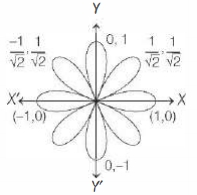
View full question & answer→MCQ 1121 Mark
The integer part of the number $\sum_{k=0}^{44} \frac{1}{\cos k^{\circ} \cos (k+1)^{\circ}}$ is
Answerc
(c)
Let $S=\sum \limits_{k=0}^{44} \frac{1}{\cos k^{\circ} \cos (k+1)^{\circ}}$
$\Rightarrow \quad S=\frac{1}{\sin 1^{\circ}} \sum \limits_{k=0}^{44} \frac{\sin (k+1-k)^{\circ}}{\cos k^{\bullet} \cos (k+1)^{\circ}}$
$S=\frac{1}{\sin 1^{\circ}}$
$S=\frac{1}{\sin 1^{\circ}} \sum \limits_{k=0}^{44}\left(\tan (k+1)^{\circ}-\tan k^{\circ}\right)$
$S=\frac{1}{\sin 1^{\circ}}\left[\tan 1^{\circ}-\tan 0^{\circ}+\tan 2^{\circ}\right.$
$S=\frac{1}{\sin 1^{\circ}} \tan 45^{\circ}$
$S=\frac{1}{\sin 1^{\circ}}=\frac{1}{0.0174}=57.29$
$\left[\because \sin 1^{\circ}=0.017\right]$
$[S]=[57.29]=57$
View full question & answer→MCQ 1131 Mark
Let $C(\theta)=\sum \limits_{n=0}^{\infty} \frac{\cos (n \theta)}{n !}$ Which of the following statements is FALSE?
AnswerCorrect option: D. $C^{\prime}(\theta) \neq 0$ for all $\theta \in R$
d
(d)
Given, $C(\theta)=\sum_{n=0}^{\infty} \frac{\cos (n \theta)}{n !}$
$C(0)=\sum_{n=0}^{\infty} \frac{1}{n !}=1+\frac{1}{1 !}+\frac{1}{2 !}+\frac{1}{3 !}+\ldots=e$
$C(\pi)=\sum_{n=0}^{\infty}(-1)^n \frac{1}{n !} \quad\left[\because \cos n \pi=(-1)^n\right]$
$C(\pi)=1-\frac{1}{1 !}+\frac{1}{2 !}-\frac{1}{3 !}+\ldots=e^{-1}$
(A) $C(0), C(\pi)=e \cdot e^{-1}=1$ T'rue
(B) $C(0)+C(\pi)=e+\frac{1}{e}>2$ True
(C) $C(\theta)>0 \forall \theta \in R$ True
(D) $C^{\prime}(\theta)=\sum_{n=0}^{\infty}-\frac{n \sin (n \theta)}{n !}$
$\therefore \quad C^{\prime}(\theta)=0 \Rightarrow \theta=0$ False
Hence, option $(d)$ is false.
View full question & answer→MCQ 1141 Mark
Observe that, at any instant, the minute and hour hands of a clock make two angles between them whose sum is $360^{\circ}$. At $6: 15$ the difference between these two angles is $....^{\circ}$
Answera
(a)
At 6: 15,
the minutes hand makes an angle is $\alpha$.
$\therefore \quad \alpha =90^{\circ}+15 \times\left(\frac{1}{2}\right)^{\circ}$
$\alpha =\left(\frac{195}{2}\right)^{\circ}$
and hour hand is $\beta$.
Given, $\alpha+\beta=360^{\circ}$
$\therefore \quad \beta =360^{\circ}-\alpha$
$=360^{\circ}-\left(\frac{195}{2}\right)^{\circ}=\left(\frac{525}{2}\right)^{\circ}$
Difference between their angles
$=\frac{525}{2}-\frac{195}{2}=\frac{390}{2}=165^{\circ}$
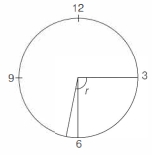
View full question & answer→MCQ 1151 Mark
The value of $\tan 81^{\circ}-\tan 63^{\circ}-\tan 27^{\circ}+\tan 9^{\circ}$ is
Answerd
(d)
We have,
$\tan 81^{\circ}-\tan 63^{\circ}-\tan 27^{\circ}+\tan 9^{\circ}$
$=\left(\tan 81^{\circ}+\tan 9^{\circ}\right)-\left(\tan 63^{\circ}+\tan 27^{\circ}\right)$
$=\left(\cot 9^{\circ}+\tan 9^{\circ}\right)-\left(\cot 27^{\circ}+\tan 27^{\circ}\right)$
$=\left(\frac{\cos 9^{\circ}}{\sin 9^{\circ}}+\frac{\sin 9^{\circ}}{\cos 9^{\circ}}\right)-\left(\frac{\cos 27^{\circ}}{\sin 27^{\circ}}+\frac{\sin 27^{\circ}}{\cos 27^{\circ}}\right)$
$=\left(\frac{\cos ^2 9^{\circ}+\sin ^2 9^{\circ}}{\sin 9^{\circ} \cos 9^{\circ}}\right)-\left(\frac{\cos ^2 27^{\circ}+\sin ^2 27^{\circ}}{\sin 27^{\circ} \cos 27^{\circ}}\right)$
$=\left(\frac{2}{2 \sin 9^{\circ} \cos 9^{\circ}}\right)-\left(\frac{2}{2 \sin 27^{\circ} \cos 27^{\circ}}\right)$
$=\left[\frac{2}{\sin 18^{\circ}}-\frac{2}{\sin 54^{\circ}}\right]$
$=2\left[\frac{1}{\sin 18^{\circ}}-\frac{1}{\cos 36^{\circ}}\right]=2\left[\frac{4}{\sqrt{5}-1}-\frac{4}{\sqrt{5}+1}\right]$
$\left[\because \sin 18^{\circ}=\frac{\sqrt{5}-1}{4}, \cos 36^{\circ}=\frac{\sqrt{5}+1}{4}\right]$
$=8\left[\frac{\sqrt{5}+1-\sqrt{5}+1]}{5-1}\right]=4$
View full question & answer→MCQ 1161 Mark
The product $\left(1+\tan 1^{\circ}\right)\left(1+\tan 2^{\circ}\right)\left(1+\tan 3^{\circ}\right)$ $. .\left(1+\tan 45^{\circ}\right)$ equals
- A
$2^{21}$
- B
$2^{22}$
- ✓
$2^{23}$
- D
$2^{25}$
AnswerCorrect option: C. $2^{23}$
c
(c)
We have,
$\begin{array}{l}\left(1+\tan 1^{\circ}\right)\left(1+\tan 2^{\circ}\right)\left(1+\tan 3^{\circ}\right) \\ \text { We know that, } \\ (1+\tan \theta)\left(1+\tan \left(45^{\circ}-\theta\right)\right)=2 \\ \therefore\left(1+\tan 45^{\circ}\right) \\ \left(1+\tan 43^{\circ}\right)\left(1+\tan 44^{\circ}\right)\left(1+\tan 2^{\circ}\right) \\ \left(1+\tan 45^{\circ}\right) \\ \Rightarrow \quad 2^{22} \cdot 2=2^{23} \end{array}$
View full question & answer→MCQ 1171 Mark
At what time between $10\,\,O'clock$ and $11\,\,O 'clock$ are the two hands of a clock symmetric with respect to the vertical line (give the answer to the nearest second)?
- A
$10h\,9m \,13s$
- ✓
$10h \,9m \,14s$
- C
$10h \,9m \,22s$
- D
$10h \,9m \,50s$
AnswerCorrect option: B. $10h \,9m \,14s$
b
(b)
Exactly at $10\,O'clock$ the hour hand has travelled $300^{\circ}$ from $120^{\prime}$ 'clock.
One hour $=60$ minute.
One minute hand moves $1^{\circ}$ and hour clock hand move $\left(\frac{30}{360}\right)^{\circ}=\left(\frac{1}{12}\right)^{\circ}$
Assuming we have made it to 10 O'clock and now the hour and the minute hand start moving spontaneously.
If the hands of the watch are symmetric with vertical line.
Supposing this happens when $x$ minutes have passed $x$ minutes $=(6 x)^{\circ}$ have been covered our hour hand would cover.
On subtracting this from $360^{\circ}$ to find the angle from 12 O'clock anti-clockwise, we get
$360^{\circ}-\left(300+\frac{x}{2}\right)^{\circ}=\left(60-\frac{x}{2}\right)^{\circ}$
So, they are symmetric.
$\therefore \quad 60-\frac{x}{2}=6 x$
$\Rightarrow \quad x=\left(\frac{120}{13}\right)^{\circ}=9min\,13.8s$
$\therefore \text { Time }=10 h\,9m\,14s$
View full question & answer→MCQ 1181 Mark
If $\sin x+\sin y=\frac{7}{5}$ and $\cos x+\cos y=\frac{1}{5}$, then $\sin (x+y)$ equals
- ✓
$\frac{7}{25}$
- B
$\frac{24}{25}$
- C
$\frac{-7}{25}$
- D
$\frac{-24}{25}$
AnswerCorrect option: A. $\frac{7}{25}$
a
(a)
We have,
$\sin x+\sin y=\frac{7}{5}$
and $\quad \cos x+\cos y=\frac{1}{5}$
$\Rightarrow \quad 2 \sin \left(\frac{x+y}{2}\right) \cos \left(\frac{x-y}{2}\right)=\frac{7}{5}$
and $2 \cos \left(\frac{x+y}{2}\right) \cos \left(\frac{x-y}{2}\right)=\frac{1}{5}$
On dividing Eq.$(ii)$ by E.$(i)$, we get
$\tan \left(\frac{x+y}{2}\right)=7$
$\Rightarrow \quad \sin (x+y) =\frac{2 \tan \left(\frac{x+y}{2}\right)}{1+\tan ^2\left(\frac{x+y}{2}\right)}$
$\Rightarrow \quad \sin (x+y)=\frac{14}{1+49}=\frac{14}{50}$
$\Rightarrow \quad \sin (x+y)=\frac{7}{25}$
View full question & answer→MCQ 1191 Mark
If $\sin x=-\frac{3}{5}$, where $\pi < x < \frac{3 \pi}{2}$ then $80\left(\tan ^2 x-\cos x\right)$ is equal to :
Answera
$ \sin x=\frac{-3}{5}, \pi$
$ \tan x=\frac{3}{4} \cos x=-\frac{4}{5} $
$ 80\left(\tan ^2 x-\cos x\right) $
$ =80\left(\frac{9}{16}+\frac{4}{5}\right)=45+64=109$
View full question & answer→MCQ 1201 Mark
Let $f(x)=3 \sqrt{x-2}+\sqrt{4-x}$ be a real valued function. If $\alpha$ and $\beta$ are respectively the minimum and the maximum values of $\mathrm{f}$, then $\alpha^2+2 \beta^2$ is equal to
Answerb
$ \mathrm{f}(\mathrm{x})=3 \sqrt{\mathrm{x}-2}+\sqrt{4-\mathrm{x}} $
$ \mathrm{x}-2 \geq 0 \& 4-\mathrm{x} \geq 0 $
$ \therefore \mathrm{x} \in[2,4] $
$ \text { Let } \mathrm{x}=2 \sin ^2 \theta+4 \cos ^2 \theta $
$ \therefore \mathrm{f}(\mathrm{x})=3 \sqrt{2}|\cos \theta|+\sqrt{2}|\sin \theta| $
$ \therefore \sqrt{2} \leq 3 \sqrt{2}|\cos \theta|+\sqrt{2}|\sin \theta| \leq \sqrt{9 \times 2+2} $
$ \sqrt{2} \leq 3 \sqrt{2}|\cos \theta|+\sqrt{2}|\sin \theta| \leq \sqrt{20} $
$ \therefore \alpha=\sqrt{2} \quad \beta=\sqrt{20} $
$ \alpha^2+2 \beta^2=2+40=42$
View full question & answer→MCQ 1211 Mark
Let $|\cos \theta \cos (60-\theta) \cos (60-\theta)| \leq \frac{1}{8}, \theta \in[0,2 \pi]$
Then, the sum of all $\theta \in[0,2 \pi]$, where $\cos 3 \theta$ attains its maximum value, is :
- A
$9 \pi$
- B
$18 \pi$
- ✓
$6 \pi$
- D
$15 \pi$
AnswerCorrect option: C. $6 \pi$
c
We know that
$\cos \theta \cos ( 6 0^{ \circ } - \theta ) \cos (60^{\circ}+ \theta)=\frac{1}{4} \cos 3 \theta.$
So equation reduces to $\left|\frac{1}{4} \cos 3 \theta\right| \leq \frac{1}{8}$
$ \Rightarrow|\cos 3 \theta| \leq \frac{1}{2} $
$ \Rightarrow-\frac{1}{2} \leq \cos 3 \theta \leq \frac{1}{2}$
$\Rightarrow$ maximum value of $\cos 3 \theta=\frac{1}{2}$, here
$ \Rightarrow 3 \theta=2 \mathrm{n} \pi \pm \frac{\pi}{3} $
$ \theta=\frac{2 \mathrm{n} \pi}{3} \pm \frac{\pi}{9}$
As $\theta \in[0,2 \pi]$ possible values are
$\theta=\left\{\frac{\pi}{9}, \frac{5 \pi}{9}, \frac{7 \pi}{9}, \frac{11 \pi}{9}, \frac{13 \pi}{9}, \frac{17 \pi}{9}\right\}$
Whose sum is
$\frac{\pi}{9}+\frac{5 \pi}{9}+\frac{7 \pi}{9}+\frac{11 \pi}{9}+\frac{13 \pi}{9}+\frac{17 \pi}{9}=\frac{54 \pi}{9}=6 \pi$
View full question & answer→MCQ 1221 Mark
Let the set of all $a \in R$ such that the equation $\cos 2 x+a \sin x=2 a-7$ has a solution be $[p, q]$ and $\mathrm{r}=\tan 9^{\circ}-\tan 27^{\circ}-\frac{1}{\cot 63^{\circ}}+\tan 81^{\circ}$, then $pqr$ is equal to ....................
Answerc
$\cos 2 x+a \cdot \sin x=2 a-7 $
$ a(\sin x-2)=2(\sin x-2)(\sin x+2) $
$ \sin x=2, \quad a=2(\sin x+2) $
$ \Rightarrow a \in[2,6] $
$ p=2 \quad q=6$
$ r=\tan 9^{\circ}+\cot 9^{\circ}-\tan 27-\cot 27 $
$ r=\frac{1}{\sin 9 \cdot \cos 9}-\frac{1}{\sin 27 \cdot \cos 27} $
$=2\left[\frac{4}{\sqrt{5}-1}-\frac{4}{\sqrt{5}+1}\right] $
$ r=4 $
$ \text { p.q. } r=2 \times 6 \times 4=48$
View full question & answer→MCQ 1231 Mark
The sum of the solutions $x \in \mathbb{R}$ of the equation $\frac{3 \cos 2 x+\cos ^3 2 x}{\cos ^6 x-\sin ^6 x}=x^3-x^2+6$ is
Answerc
$ \frac{3 \cos 2 x+\cos ^3 2 x}{\cos ^6 x-\sin ^6 x}=x^3-x^2+6 $
$ \Rightarrow \frac{\cos 2 x\left(3+\cos ^2 2 x\right)}{\cos 2 x\left(1-\sin ^2 x \cos ^2 x\right)}=x^3-x^2+6 $
$ \Rightarrow \frac{4\left(3+\cos ^2 2 x\right)}{\left(4-\sin ^2 2 x\right)}=x^3-x^2+6 $
$ \Rightarrow \frac{4\left(3+\cos ^2 2 x\right)}{\left(3+\cos ^2 2 x\right)}=x^3-x^2+6 $
$ x^3-x^2+2=0 \Rightarrow(x+1)\left(x^2-2 x+2\right)=0$
so, sum of real solutions $=-1$
View full question & answer→MCQ 1241 Mark
If $2 \sin ^3 x+\sin 2 x \cos x+4 \sin x-4=0$ has exactly $3$ solutions in the interval $\left[0, \frac{\mathrm{n} \pi}{2}\right], \mathrm{n} \in \mathrm{N}$, then the roots of the equation $x^2+n x+(n-3)=0$ belong to :
AnswerCorrect option: B. $(-\infty, 0)$
b
$ 2 \sin ^3 x+2 \sin x \cdot \cos ^2 x+4 \sin x-4=0$
$ 2 \sin ^3 x+2 \sin x \cdot\left(1-\sin ^2 x\right)+4 \sin x-4=0 $
$ 6 \sin x-4=0 $
$ \sin x=\frac{2}{3} $
${n}=5 \text { (in the given interval) } $
$ x^2+5 x+2=0$
$ x=\frac{-5 \pm \sqrt{17}}{2}$
$ \text { Required interval }(-\infty, 0)$
Required interval $(-\infty, 0)$
View full question & answer→MCQ 1251 Mark
For $\alpha, \beta \in\left(0, \frac{\pi}{2}\right)$, let $3 \sin (\alpha+\beta)=2 \sin (\alpha-\beta)$ and a real number $k$ be such that $\tan \alpha=k \tan \beta$. Then the value of $\mathrm{k}$ is equal to :
- A
$-\frac{2}{3}$
- ✓
$-5$
- C
$\frac{2}{3}$
- D
$ 5$
Answerb
$3\sin \alpha \cos \beta+3 \sin \beta \cos \alpha$
$=2 \sin \alpha \cos \beta-2 \sin \beta \cos \alpha$
$5 \sin \beta \cos \alpha=-\sin \alpha \cos \beta$
$\tan \beta=-\frac{1}{5} \tan \alpha $
$\tan \alpha=-5 \tan \beta$
Not possible as $\tan \alpha, \tan \beta$ are positive
$\Rightarrow$ Data inconsistent
View full question & answer→MCQ 1261 Mark
Suppose $\theta \in\left[0, \frac{\pi}{4}\right]$ is a solution of $4 \cos \theta-3 \sin \theta=1$ Then $\cos \theta$ is equal to :
- ✓
$\frac{4}{(3 \sqrt{6}-2)}$
- B
$\frac{6-\sqrt{6}}{(3 \sqrt{6}-2)}$
- C
$\frac{6+\sqrt{6}}{(3 \sqrt{6}+2)}$
- D
$\frac{4}{(3 \sqrt{6}+2)}$
AnswerCorrect option: A. $\frac{4}{(3 \sqrt{6}-2)}$
a
$4\left(\frac{1-\tan ^2 \theta / 2}{1+\tan ^2 \theta / 2}\right)-3\left(\frac{2 \tan \frac{\theta}{2}}{1+\tan ^2 \frac{\theta}{2}}\right)=1$
let $\tan \frac{\theta}{2}=\mathrm{t}$
$ \frac{4-4 t^2-6 t}{1+t^2}=1 $
$ 4-4 t^2-6 t=1+t^2$
$ \Rightarrow 5 t^2+6 t-3=0 $
$ \Rightarrow t=\frac{-6 \pm \sqrt{36-4(5)(-3)}}{2(5)} $
$ =\frac{-6 \pm \sqrt{96}}{10} $
$ =\frac{-6 \pm 4 \sqrt{6}}{10} $
$ t=\frac{-3+2 \sqrt{6}}{5} $
$ \cos \theta=\frac{1-t^2}{1+t^2}=\frac{1-\left(\frac{2 \sqrt{6}-3}{5}\right)^2}{1+\left(\frac{2 \sqrt{6}-3}{5}\right)^2}=\frac{1-\left(\frac{24+9-12 \sqrt{6}}{25}\right)}{1+\left(\frac{24+9-12 \sqrt{6}}{25}\right)} $
$ =\frac{25-33+12 \sqrt{6}}{25+33-12 \sqrt{6}}=\frac{12 \sqrt{6}-8}{58-12 \sqrt{6}}=\frac{6 \sqrt{6}-4}{29-6 \sqrt{6}} \times \frac{29+6 \sqrt{6}}{29+6 \sqrt{6}} $
$ =\frac{100+150 \sqrt{6}}{625}=\frac{4+6 \sqrt{6}}{25} \times \frac{4-6 \sqrt{6}}{4-6 \sqrt{6}} $
$ =\frac{-200}{25(4-6 \sqrt{6})}=\frac{-8}{4-6 \sqrt{6}}=\frac{4}{3 \sqrt{6}-2}$
View full question & answer→MCQ 1271 Mark
If the value of $\frac{3 \cos 36^{\circ}+5 \sin 18^{\circ}}{5 \cos 36^{\circ}-3 \sin 18^{\circ}}$ is $\frac{a \sqrt{5}-b}{c}$ where $\mathrm{a}, \mathrm{b}, \mathrm{c}$ are natural numbers and $\operatorname{gcd}(\mathrm{a}, \mathrm{c})=1$, then $\mathrm{a}+\mathrm{b}+\mathrm{c}$ is equal to :
Answerc
$ \frac{\frac{3(\sqrt{5}+1)}{4}+5\left(\frac{\sqrt{5}-1}{4}\right)}{5\left(\frac{\sqrt{5}+1}{4}\right)-3\left(\frac{\sqrt{5}-1}{4}\right)}=\frac{8 \sqrt{5}-2}{2 \sqrt{5}+8} $
$ =\frac{4 \sqrt{5}-1}{\sqrt{5}+4} \times \frac{\sqrt{5}-4}{\sqrt{5}-4}$
$ =\frac{20-16 \sqrt{5}-\sqrt{5}+4}{-11} $
$ =\frac{17 \sqrt{5}-24}{11} \Rightarrow a=17, b=27, c=11 $
$ a+b+c=52$
View full question & answer→MCQ 1281 Mark
The value of $\tan 9^{\circ}-\tan 27^{\circ}-\tan 63^{\circ}+\tan 81^{\circ}$ is $............$.
Answerc
The value of $\tan 9^{\circ}-\tan 27^{\circ}-\tan 63^{\circ}+\tan 81^{\circ}$
$\Rightarrow \tan 9^{\circ}+\cot 9^{\circ}-\tan 27^{\circ}-\cot 27^{\circ}$
$\Rightarrow \frac{2}{\sin 18^{\circ}}-\frac{2}{\sin 54^{\circ}}$
$\Rightarrow \frac{2 \times 4}{\sqrt{5}-1}-\frac{2 \times 4}{\sqrt{5+1}}$
$\Rightarrow 4$
View full question & answer→MCQ 1291 Mark
$96 \cos \frac{\pi}{33} \cos \frac{2 \pi}{33} \cos \frac{4 \pi}{33} \cos \frac{8 \pi}{33} \cos \frac{16 \pi}{33}$ is equal to$......$.
Answera
$P=96 \cos \frac{\pi}{33} \cos \frac{2 \pi}{33} \cos \frac{4 \pi}{33} \cos \frac{8 \pi}{33} \cos \frac{16 \pi}{33}$
$2 P \times \sin \frac{\pi}{33}=96 \times 2 \sin \frac{\pi}{33} \cos \frac{\pi}{33} \cos \frac{2 \pi}{33} \cos \frac{4 \pi}{33} \cos \frac{8 \pi}{33} \cos \frac{16 \pi}{33}$
$2 P \times \sin \frac{\pi}{33}=6 \times \sin \frac{32 \pi}{33}=6 \sin \frac{\pi}{33}$
$P=3$
View full question & answer→MCQ 1301 Mark
If $\tan 15^{\circ}+\frac{1}{\tan 75^{\circ}}+\frac{1}{\tan 105^{\circ}}+\tan 195^{\circ}=2 a$, then the value of $\left(a+\frac{1}{a}\right)$ is :
- ✓
$4$
- B
$4-2 \sqrt{3}$
- C
$2$
- D
$5-\frac{3}{2} \sqrt{3}$
Answera
$\tan 15^{\circ}=2-\sqrt{3}$
$\frac{1}{\tan 75^{\circ}}=\cot 75^{\circ}=2-\sqrt{3}$
$\frac{1}{\tan 105^{\circ}}=\cot \left(105^{\circ}\right)=-\cot 75^{\circ}=\sqrt{3}-2$
$\tan 195^{\circ}=\tan 15^{\circ}=2-\sqrt{3}$
$2(2-\sqrt{3})=2 a \Rightarrow a =2-\sqrt{3}$
$a +\frac{1}{ a }=4$
View full question & answer→MCQ 1311 Mark
The value of $36(4 \cos ^2 9^{\circ}-1)(4 \cos ^2 27^{\circ}-1) (4\cos ^2 81^{\circ}-1) (4 \cos ^2 243^{\circ}-1)$ is
Answerd
$4 \cos ^2 \theta-1=4\left(1-\sin ^2 \theta\right)-1=3-4 \sin ^2 \theta=\frac{\sin 3 \theta}{\sin \theta}$
so given expression can be written as
$36 \times \frac{\sin 27^{\circ}}{\sin 9^{\circ}} \times \frac{\sin 81^{\circ}}{\sin 27^{\circ}} \times \frac{\sin 243^{\circ}}{\sin 81^{\circ}} \times \frac{\sin 729^{\circ}}{\sin 243^{\circ}}$
$36 \times \frac{\sin 729^{\circ}}{\sin 9^{\circ}}=36$
View full question & answer→MCQ 1321 Mark
In the figure, $\theta_1+\theta_2=\frac{\pi}{2}$ and $\sqrt{3}(B E)=4(A B)$. If the area of $\triangle CAB$ is $2 \sqrt{3}-3$ unit $^2$, when $\frac{\theta_2}{\theta_1}$ is the largest, then the perimeter (in unit) of $\triangle CED$ is equal to $...........$.
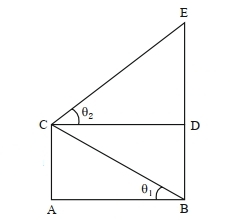
Answerc
$\sqrt{3} BE =4 AB$
$Ar (\triangle CAB )=2 \sqrt{3}-3$
$\frac{1}{2} x ^2 \tan \theta_1=2 \sqrt{3}-3$
$BE = BD + DE$
$= x \left(\tan \theta_1+\tan \theta_2\right)$
$BE = AB \left(\tan \theta_1+\cot \theta_1\right)$
$\frac{4}{\sqrt{3}} \tan \theta_1+\cot \theta_1 \Rightarrow \tan \theta_1=\sqrt{3}, \frac{1}{\sqrt{3}}$
$\theta_1=\frac{\pi}{6}$
$\theta_1=\frac{\pi}{3} \quad \theta_2=\frac{\pi}{3}$
$as \frac{\theta_2}{\theta_1} \text { is } \operatorname{largest} \therefore \theta_1=\frac{\pi}{6} \theta_2=\frac{\pi}{3}$
$\therefore x ^2=\frac{(2 \sqrt{3}-3) \times 2}{\tan \theta_1}=\frac{\sqrt{3}(2-\sqrt{3}) \times 2}{\tan \frac{\pi}{6}}$
$x ^2=12-6 \sqrt{3}=(3-\sqrt{3})^2$
$x =3-\sqrt{3}$
Perimeter of $\triangle C E D$
$= CD + DE + CE$
$=3 \sqrt{3}+(3-\sqrt{3}) \sqrt{3}+(3-\sqrt{3}) \times 2=6$
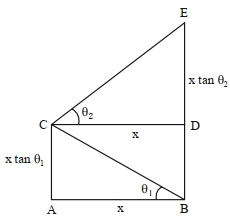
View full question & answer→MCQ 1331 Mark
The value of $2 \sin \left(12^{\circ}\right)-\sin \left(72^{\circ}\right)$ is
- A
$\frac{\sqrt{5}(1-\sqrt{3})}{4}$
- B
$\frac{1-\sqrt{5}}{8}$
- C
$\frac{\sqrt{3}(1-\sqrt{5})}{2}$
- ✓
$\frac{\sqrt{3}(1-\sqrt{5})}{4}$
AnswerCorrect option: D. $\frac{\sqrt{3}(1-\sqrt{5})}{4}$
d
$\sin 12^{\circ}+\sin 12^{\circ}-\sin 72^{\circ}$
$=\sin 12^{\circ}-2 \cos 42^{\circ} \sin 30^{\circ}$
$=\sin 12^{\circ}-\sin 48^{\circ}$
$=-2 \cos 30^{\circ} \sin 18^{\circ}$
$=-2 \times \frac{\sqrt{3}}{2} \times \frac{\sqrt{5}-1}{4}$
$=\frac{\sqrt{3}}{4}(1-\sqrt{5})$
View full question & answer→MCQ 1341 Mark
$16 \sin \left(20^{\circ}\right) \sin \left(40^{\circ}\right) \sin \left(80^{\circ}\right)$ is equal to
- A
$\sqrt{3}$
- ✓
$2 \sqrt{3}$
- C
$3$
- D
$4 \sqrt{3}$
AnswerCorrect option: B. $2 \sqrt{3}$
b
$16 \sin 20^{\circ} \sin 40^{\circ} \sin 80^{\circ}$
$=16 \sin 40^{\circ} \sin 20^{\circ} \sin 80^{\circ}$
$=4(4 \sin (60-20) \sin (20) \sin (60+20))$
$=4 \times \sin \left(3 \times 20^{\circ}\right)$
${[\because \sin 3 \theta=4 \sin (60-\theta) \times \sin \theta \times \sin (60+\theta)]}$
$=4 \times \sin 60^{\circ}$
$=4 \times \frac{\sqrt{3}}{2}=2 \sqrt{3}$
View full question & answer→MCQ 1351 Mark
The value of $\cos \left(\frac{2 \pi}{7}\right)+\cos \left(\frac{4 \pi}{7}\right)+\cos \left(\frac{6 \pi}{7}\right)$ is equal to
- ✓
$-\frac{1}{2}$
- B
$-1$
- C
$-\frac{1}{3}$
- D
$-\frac{1}{4}$
AnswerCorrect option: A. $-\frac{1}{2}$
a
$\cos \frac{2 \pi}{7}+\cos \frac{4 \pi}{7}+\cos \frac{6 \pi}{7}$
$=\frac{\sin \left(3 \times \frac{\pi}{7}\right)}{\sin \frac{\pi}{7}} \times \cos \left(\frac{\frac{2 \pi}{7}+\frac{6 \pi}{7}}{2}\right)$
$=\frac{2 \sin \left(\frac{3 \pi}{7}\right)}{2 \sin \frac{\pi}{7}} \times \cos \left(\frac{4 \pi}{7}\right)$
$=\frac{\sin \left(\frac{7 \pi}{7}\right)+\sin \left(\frac{-\pi}{7}\right)}{2 \sin \frac{\pi}{7}}$
$=\frac{-\sin \frac{\pi}{7}}{2 \sin \frac{\pi}{7}}$
$=-\frac{1}{2}$
View full question & answer→MCQ 1361 Mark
$2 \sin \left(\frac{\pi}{22}\right) \sin \left(\frac{3 \pi}{22}\right) \sin \left(\frac{5 \pi}{22}\right) \sin \left(\frac{7 \pi}{22}\right) \sin \left(\frac{9 \pi}{22}\right)$ is
- A
$\frac{3}{16}$
- ✓
$\frac{1}{16}$
- C
$\frac{1}{32}$
- D
$\frac{9}{32}$
AnswerCorrect option: B. $\frac{1}{16}$
b
$2 \sin \frac{\pi}{22} \sin \frac{3 \pi}{22} \sin \frac{5 \pi}{22} \sin \frac{7 \pi}{22} \sin \frac{9 \pi}{22}$
$=2 \sin \left(\frac{11 \pi-10 \pi}{22}\right) \sin \left(\frac{11 \pi-8 \pi}{22}\right) \sin \left(\frac{11 \pi-6 \pi}{22}\right)$ $\sin \left(\frac{11 \pi-4 \pi}{22}\right) \sin \left(\frac{11 \pi-2 \pi}{22}\right)$
$=2 \cos \frac{\pi}{11} \cos \frac{2 \pi}{11} \cos \frac{3 \pi}{11} \cos \frac{4 \pi}{11} \cos \frac{5 \pi}{11}$
$=\frac{2 \sin \frac{32 \pi}{11}}{2^{5} \sin \frac{\pi}{11}}$
$=\frac{1}{16}$
View full question & answer→MCQ 1371 Mark
If $\cot \alpha=1$ and $\sec \beta=-\frac{5}{3}$, where $\pi<\alpha<\frac{3 \pi}{2}$ and $\frac{\pi}{2}<\beta<\pi$, then the value of $\tan (\alpha+\beta)$ and the quadrant in which $\alpha+\beta$ lies, respectively are
- ✓
$-\frac{1}{7}$ and $IV$ $^{\text {th }}$ quadrant
- B
$7$ and $I ^{ st }$ quadrant
- C
$-7$ and $IV$ $^{\text {th }}$ quadrant
- D
$\frac{1}{7}$ and $I ^{ st }$ quadrant
AnswerCorrect option: A. $-\frac{1}{7}$ and $IV$ $^{\text {th }}$ quadrant
a
$\cot \alpha=1, \sec \beta=\frac{-5}{3}, \cos \beta=\frac{-3}{5}, \tan \beta=\frac{-4}{3}$
$\tan (\alpha+\beta)=\frac{1-\frac{4}{3}}{1+\frac{4}{3} \times 1}=\frac{-1}{7}$
View full question & answer→MCQ 1381 Mark
If $\sin ^{2}\left(10^{\circ}\right) \sin \left(20^{\circ}\right) \sin \left(40^{\circ}\right) \sin \left(50^{\circ}\right) \sin \left(70^{\circ}\right)=\alpha-$ $\frac{1}{16} \sin \left(10^{\circ}\right)$, then $16+\alpha^{-1}$ is equal to
Answerc
$\sin 10^{\circ}\left(\frac{1}{2} \cdot 2 \sin 20^{\circ} \sin 40^{\circ}\right) \cdot \sin 10^{\circ} \sin \left(60^{\circ}-10^{\circ}\right) \sin \left(60^{\circ}+10^{\circ}\right)$
$\sin 10^{\circ} \frac{1}{2}\left(\cos 20^{\circ}-\cos 60^{\circ}\right) \cdot \frac{1}{4} \sin 30^{\circ}$
$\frac{1}{2} \cdot \frac{1}{4} \cdot \frac{1}{2} \cdot \sin 10^{\circ}\left(\cos 20^{\circ}-\frac{1}{2}\right)$
$=\frac{1}{32}\left(2 \sin 10^{\circ} \cos 20^{\circ}-\sin 10^{\circ}\right)$
$=\frac{1}{32}\left(\sin 30^{\circ}-\sin 10^{\circ}-\sin 10^{\circ}\right)$
$=\frac{1}{32}\left(\frac{1}{2}-2 \sin 10^{\circ}\right)$
$=\frac{1}{64}\left(1-4 \sin 10^{\circ}\right)$
$=\frac{1}{64}-\frac{1}{16} \sin 10^{\circ}$
Hence $\alpha=\frac{1}{64}$
$16+\alpha^{-1}=80$
View full question & answer→MCQ 1391 Mark
The value of $2 \sin(\frac{\pi}{8}) \sin (\frac{2 \pi}{8}) \sin (\frac{3 \pi}{8}) \sin (\frac{5 \pi}{8}) \sin (\frac{6 \pi}{8}) \sin (\frac{7 \pi}{8})$ is:
- A
$\frac{1}{4 \sqrt{2}}$
- B
$\frac{1}{4}$
- ✓
$\frac{1}{8}$
- D
$\frac{1}{8 \sqrt{2}}$
AnswerCorrect option: C. $\frac{1}{8}$
c
$2 \sin \left(\frac{\pi}{8}\right) \sin \left(\frac{2 \pi}{8}\right) \sin \left(\frac{3 \pi}{8}\right) \sin \left(\frac{5 \pi}{8}\right) \sin \left(\frac{6 \pi}{8}\right) \sin \left(\frac{7 \pi}{8}\right)$
$2 \sin ^{2} \frac{\pi}{8} \sin ^{2} \frac{2 \pi}{8} \sin ^{2} \frac{3 \pi}{8}$
$\sin ^{2} \frac{\pi}{8} \sin ^{2} \frac{3 \pi}{8}$
$\sin ^{2} \frac{\pi}{8} \cos ^{2} \frac{\pi}{8}$
$\frac{1}{4} \sin ^{2}\left(\frac{\pi}{4}\right)=\frac{1}{8}$
View full question & answer→MCQ 1401 Mark
If $\sin \theta+\cos \theta=\frac{1}{2}$, then $16(\sin (2 \theta)+\cos (4 \theta)+\sin (6 \theta))$ is equal to:
Answerc
$16[2 \sin 4 \theta \cos 2 \theta+\cos 4 \theta]$
$16\left[4 \sin 2 \theta \cos ^{2} 2 \theta+2 \cos ^{2} 2 \theta-1\right]$
Now:
$\sin \theta+\cos \theta=\frac{1}{2}$
$1+\sin 2 \theta=\frac{1}{4}$
$\sin 2 \theta=-\frac{3}{4}$
$\cos ^{2} 2 \theta=1-\frac{9}{16}=\frac{7}{16}$
$16\left[-4(-3 / 4) \times \frac{7}{16}+2 \times \frac{7}{16}-1\right]$
$16\left[\frac{-7}{16}-1\right] \Rightarrow-23$
View full question & answer→MCQ 1411 Mark
If $15 \sin ^{4} \alpha+10 \cos ^{4} \alpha=6,$ for some $\alpha \in R ,$ then the value of $27 \sec ^{6} \alpha+8 \operatorname{cosec}^{6} \alpha$ is equal to ....... .
Answerd
$15 \sin 4 \alpha+10 \cos ^{4} \alpha=6$
$15 \sin ^{4} \alpha+10 \cos ^{4} \alpha=6\left(\sin ^{2} \alpha+\cos ^{2} \alpha\right)^{2}$
$\left(3 \sin ^{2} \alpha-2 \cos ^{2} \alpha\right)^{2}=0$
$\tan ^{2} \alpha=\frac{2}{3} \cdot \cot ^{2} \alpha=\frac{3}{2}$
$\Rightarrow 27 \sec ^{6} \alpha+8 \operatorname{cosec}^{6} \alpha$
$=27\left(\sec ^{6} \alpha\right)^{3}+8\left(\operatorname{cosec}^{6} \alpha\right)^{3}$
$=27\left(1+\tan ^{2} \alpha\right) 3+8\left(1+\cot ^{2} \alpha\right)^{3}$
$=250$
View full question & answer→MCQ 1421 Mark
The number of integral values of $'k'$ for which the equation $3 \sin x+4 \cos x=k+1$ has a solution, $k$ $\in R$ is
Answera
$3 \sin x+4 \cos x=k+1$
$\Rightarrow k +1 \in\left[-\sqrt{3^{2}+4^{2}}, \sqrt{3^{2}+4^{2}}\right]$
$\Rightarrow k +1 \in[-5,5]$
$\Rightarrow k \in[-6,4]$
No. of integral values of $k =11$
View full question & answer→MCQ 1431 Mark
The value of $\cot \frac{\pi}{24}$ is :
- A
$\sqrt{2}-\sqrt{3}-2+\sqrt{6}$
- B
$3 \sqrt{2}-\sqrt{3}-\sqrt{6}$
- C
$\sqrt{2}-\sqrt{3}+2-\sqrt{6}$
- ✓
$\sqrt{2}+\sqrt{3}+2+\sqrt{6}$
AnswerCorrect option: D. $\sqrt{2}+\sqrt{3}+2+\sqrt{6}$
d
$\cot \theta=\frac{1+\cos 2 \theta}{\sin 2 \theta}=\{ \therefore 1+\cos 2 \theta=2 \cos ^{2} \theta \,\& \, \sin 2 \theta=2 \sin \theta \cos \theta\}$
put, $\theta=\frac{\pi}{24}$
$\left\{\therefore \cos \frac{\pi}{12}=\frac{\sqrt{3}+1}{2 \sqrt{2}} \, \& \, \sin \frac{\pi}{12}=\frac{\sqrt{3}-1}{2 \sqrt{2}}\right\}$
$\Rightarrow \cot \left(\frac{\pi}{24}\right)=\frac{1+\left(\frac{\sqrt{3}+1}{2 \sqrt{2}}\right)}{\left(\frac{\sqrt{3}-1}{2 \sqrt{2}}\right)}$
$=\frac{(2 \sqrt{2}+\sqrt{3}+1)}{(\sqrt{3}-1)} \times \frac{(\sqrt{3}+1)}{(\sqrt{3}+1)}$
$=\frac{2 \sqrt{6}+2 \sqrt{2}+3+\sqrt{3}+\sqrt{3}+1}{2}$
$=\sqrt{6}+\sqrt{2}+\sqrt{3}+2$
View full question & answer→MCQ 1441 Mark
If $0 < x , y < \pi$ and $\cos x +\cos y-\cos ( x + y )=\frac{3}{2},$ then $\sin x+\cos y$ is equal to ...... .
- A
$\frac{1}{2}$
- ✓
$\frac{1+\sqrt{3}}{2}$
- C
$\frac{\sqrt{3}}{2}$
- D
$\frac{1-\sqrt{3}}{2}$
AnswerCorrect option: B. $\frac{1+\sqrt{3}}{2}$
b
$\cos x+\cos y-\cos (x+y)=\frac{3}{2}$
$\cos ^{2}\left(\frac{x+y}{2}\right)-\cos \left(\frac{x+y}{2}\right) \cdot \cos \left(\frac{x-y}{2}\right)$
$+\frac{1}{4} \cdot \cos ^{2}\left(\frac{x-y}{2}\right)+\frac{1}{4} \sin ^{2}\left(\frac{x-y}{2}\right)=0$
$\Rightarrow\left(\cos \left(\frac{x+y}{2}\right)-\frac{1}{2} \cos \left(\frac{x-y}{2}\right)\right)^{2}+\frac{1}{4} \sin ^{2}\left(\frac{x-y}{2}\right)=0$
$\Rightarrow \sin \left(\frac{x-y}{2}\right)=0$ and $\cos \left(\frac{x+y}{2}\right)=\frac{1}{2} \cos \left(\frac{x-y}{2}\right)$
$\Rightarrow x=y$ and $\cos x=\frac{1}{2}=\cos y$
$\therefore \sin x=\frac{\sqrt{3}}{2}$
$\Rightarrow \sin x+\cos y=\frac{1+\sqrt{3}}{2}$
View full question & answer→MCQ 1451 Mark
If for $x \in\left(0, \frac{\pi}{2}\right), \log _{10} \sin x+\log _{10} \cos x=-1$ and $\log _{10}(\sin x+\cos x)=\frac{1}{2}\left(\log _{10} n-1\right), n>0$ then the value of $n$ is equal to
Answerb
$x \in\left(0, \frac{\pi}{2}\right)$
$\log _{10} \sin x+\log _{10} \cos x=-1$
$\Rightarrow \quad \log _{10} \sin x \cdot \cos x=-1$
$\Rightarrow \quad \sin x \cdot \cos x=\frac{1}{10}$ $....(1)$
$\log _{10}(\sin x+\cos x)=\frac{1}{2}\left(\log _{10} n-1\right)$
$\Rightarrow \quad \sin x+\cos x=10^{\left(\log _{10} \sqrt{n}-\frac{1}{2}\right)}=\sqrt{\frac{n}{10}}$
by squaring
$1+2 \sin x \cdot \cos x=\frac{n}{10}$
$\Rightarrow \quad 1+\frac{1}{5}=\frac{ n }{10} \quad \Rightarrow \quad n =12$
View full question & answer→MCQ 1461 Mark
Let $\tan \alpha, \tan \beta$ and $\tan \gamma ; \alpha, \beta, \gamma \neq \frac{(2 n -1) \pi}{2}$ $n \in N$ be the slopes of three line segments $OA,OB$ and $OC$, respectively, where $O$ is origin.If circumcentre of $\Delta ABC$ coincides with origin and its orthocentre lies on $y-$axis, then the value of $\left(\frac{\cos 3 \alpha+\cos 3 \beta+\cos 3 \gamma}{\cos \alpha \cos \beta \cos \gamma}\right)^{2}$ is equal to :
Answera
Since orthocentre and circumcentre both lies on $y$ -axis
$\Rightarrow$ Centroid also lies on $y-$axis
$\Rightarrow \Sigma \cos \alpha=0$
$\quad \cos \alpha+\cos \beta+\cos \gamma=0$
$\Rightarrow \cos ^{3} \alpha+\cos ^{3} \beta+\cos ^{3} \gamma=3 \cos \alpha \cos \beta \cos \gamma$
$\therefore \frac{\cos 3 \alpha+\cos 3 \beta+\cos 3 \gamma}{\cos \alpha \cos \beta \cos \gamma}$
$\frac{4\left(\cos ^{3} \alpha+\cos ^{3} \beta+\cos ^{3} \gamma\right)-3(\cos \alpha+\cos \beta+\cos \gamma)}{\cos \alpha \cos \beta \cos \gamma}$
$=12$
View full question & answer→MCQ 1471 Mark
If $0<\theta, \phi<\frac{\pi}{2}, x =\sum_{ n =0}^{\infty} \cos ^{2 n } \theta, y =\sum_{ n =0}^{\infty} \sin ^{2 n } \phi$ and $z =\sum_{ n =0}^{\infty} \cos ^{2 n } \theta \cdot \sin ^{2 n } \phi$ then
- A
$x y-z=(x+y) z$
- B
$x y+y z+z x=z$
- C
$xyz =4$
- ✓
$x y+z=(x+y) z$
AnswerCorrect option: D. $x y+z=(x+y) z$
d
$x =\frac{1}{1-\cos ^{2} \theta} \Rightarrow \sin ^{2} \theta=\frac{1}{ x }$
Also, $\cos ^{2} \theta=\frac{1}{y} \& 1-\sin ^{2} \theta \cos ^{2} \theta=\frac{1}{z}$
So, $1-\frac{1}{x} \times \frac{1}{y}=\frac{1}{z} \Rightarrow z(x y-1)=x y \quad \ldots(1)$
Also, $\frac{1}{x}+\frac{1}{y}=1 \quad \Rightarrow x+y=x y$ $....(2)$
From $(i)$ and $(ii)$
$x y+z=x y z=(x+y) z$
View full question & answer→MCQ 1481 Mark
$\operatorname{cosec} 18^{\circ}$ is a root of the equation :
- A
$x^{2}+2 x-4=0$
- B
$4 x^{2}+2 x-1=0$
- C
$x^{2}-2 x+4=0$
- ✓
$x^{2}-2 x-4=0$
AnswerCorrect option: D. $x^{2}-2 x-4=0$
d
$\operatorname{cosec} 18^{\circ}=\frac{1}{\sin 18^{\circ}}=\frac{4}{\sqrt{5}-1}=\sqrt{5}+1$
Let $\operatorname{cosec} 18^{\circ}=\mathrm{x}=\sqrt{5}+1$
$\Rightarrow \mathrm{x}-1=\sqrt{5}$
Squaring both sides, we get
$x^{2}-2 x+1=5$
$\Rightarrow x^{2}-2 x-4=0$
View full question & answer→MCQ 1491 Mark
If $\frac{\sqrt{2} \sin \alpha}{\sqrt{1+\cos 2 \alpha}}=\frac{1}{7}$ and $\sqrt{\frac{1-\cos 2 \beta}{2}}=\frac{1}{\sqrt{10}}$ $\alpha, \beta \in\left(0, \frac{\pi}{2}\right),$ then $\tan (\alpha+2 \beta)$ is equal to
Answera
$\frac{\sqrt{2} \sin \alpha}{\sqrt{2} \cos \alpha}=\frac{1}{7} \Rightarrow \tan \alpha=\frac{1}{7}$
$\sin \beta=\frac{1}{\sqrt{10}} \Rightarrow \tan \beta=\frac{1}{3} \Rightarrow \tan 2 \beta=\frac{3}{4}$
$\tan (\alpha+2 \beta)=\frac{\tan \alpha+\tan 2 \beta}{1-\tan \alpha \tan 2 \beta}=1$
View full question & answer→MCQ 1501 Mark
The value of $ \cos ^{3}\left(\frac{\pi}{8}\right) \cdot \cos \left(\frac{3 \pi}{8}\right)+\sin ^{3}\left(\frac{\pi}{8}\right) \cdot \sin \left(\frac{3 \pi}{8}\right)$ is
- A
$\frac{1}{4}$
- B
$\frac{1}{\sqrt{2}}$
- ✓
$\frac{1}{2\sqrt{2}}$
- D
$\frac{1}{2}$
AnswerCorrect option: C. $\frac{1}{2\sqrt{2}}$
c
$\cos ^{3} \frac{\pi}{8} \cdot \sin \frac{\pi}{8}+\sin ^{3} \frac{\pi}{8} \cdot \cos \frac{\pi}{8}$
$=\sin \frac{\pi}{8} \cdot \cos \frac{\pi}{8}=\frac{1}{2} \sin \frac{\pi}{4}=\frac{1}{2 \sqrt{2}}$
View full question & answer→MCQ 1511 Mark
Let $\alpha$ and $\beta$ be two real roots of the equation $(\mathrm{k}+1) \tan ^{2} \mathrm{x}-\sqrt{2} \cdot \lambda \tan \mathrm{x}=(1-\mathrm{k})$ where $\mathrm{k}(\neq-1)$ and $\lambda$ are real numbers. If $\tan ^{2}(\alpha+\beta)=50,$ then a value of $\lambda$ is :
- A
$5$
- ✓
$10$
- C
$5\sqrt 2$
- D
$10\sqrt 2$
Answerb
$\tan \alpha+\tan \beta=\frac{\lambda \sqrt{2}}{\mathrm{k}+1}$
$\tan \alpha . \tan \beta=\frac{\mathrm{k}-1}{\mathrm{k}+1}$
$\tan (\alpha+\beta)=\frac{\frac{\lambda \sqrt{2}}{\mathrm{k}+1}}{1-\frac{\mathrm{k}-1}{\mathrm{k}+1}}=\frac{\lambda \sqrt{2}}{2}=\frac{\lambda}{\sqrt{2}}$
$\Rightarrow \frac{\lambda^{2}}{2}=50 \Rightarrow \lambda=10 \;and\;-10$
View full question & answer→MCQ 1521 Mark
For any $\theta \, \in \,\left( {\frac{\pi }{4},\frac{\pi }{2}} \right)$, the expression $3\,{\left( {\sin \,\theta - \cos \,\theta } \right)^4} + 6{\left( {\sin \,\theta + \cos \,\theta } \right)^2} + 4\,{\sin ^6}\,\theta $ equals
- A
$13 - 4\,{\cos ^2}\,\theta \, + 6\,{\sin ^2}\,\theta \,{\cos ^2}\,\theta $
- ✓
$13 - 4\,{\cos ^6}\,\theta \,$
- C
$13 - 4\,{\cos ^2}\,\theta \, + 6\,\,{\cos ^4}\,\theta $
- D
$13 - 4\,{\cos ^4}\,\theta \, + 2\,{\sin ^2}\,\theta \,{\cos ^2}\,\theta $
AnswerCorrect option: B. $13 - 4\,{\cos ^6}\,\theta \,$
b
$3\,{(1 - \sin 2\theta )^2}\, + \,6(1 + \sin 2\theta )\, + \,4\,{\sin ^6}\theta $
$ = 3\,(1 - 2\sin \,2\theta + {\sin ^2}2\theta ) + \,6 + 6\sin 2\theta + \,4\,{\sin ^6}\theta $
$ = \,9 + 3{\sin ^2}2\theta + 4\,{\sin ^6}\theta $
$ = \,9 + 12{\sin ^2}\theta {\cos ^2}\theta + 4\,{(1 - {\cos ^2}\theta )^3}$
$ = \,9 + 12(1 - {\cos ^2}\theta ){\cos ^2}\theta + 4\,(1 - 3{\cos ^2}\theta + 3{\cos ^4}\theta - {\cos ^6}\theta )$
$ = \,13 + 12{\cos ^2}\theta - 12{\cos ^4}\theta - 12{\cos ^2}\theta + 12{\cos ^4}\theta - 4{\cos ^6}\theta $
$ = \,13 - 4{\cos ^6}\theta $
View full question & answer→MCQ 1531 Mark
The sum of all values of $\theta \, \in \,\left( {0,\frac{\pi }{2}} \right)$ satisfying ${\sin ^2}\,2\theta + {\cos ^4}\,2\theta = \frac{3}{4}$ is
- A
$\pi $
- B
$\frac{{5\pi }}{4}$
- ✓
$\frac{{\pi }}{2}$
- D
$\frac{{3\pi }}{8}$
AnswerCorrect option: C. $\frac{{\pi }}{2}$
c
${\sin ^2}2\theta \, + \,{\cos ^4}2\theta \, = \frac{3}{4}$
Let $\,{\cos ^2}2\theta \, =t $
$ \Rightarrow \,1\, - \,\,{\cos ^2}2\theta \, + \,{\cos ^4}2\theta \, = \frac{3}{4}$
$ \Rightarrow t = \frac{1}{2}\, \Rightarrow \,\,{\cos ^2}2\theta \, = \frac{1}{2}\,$
$ \Rightarrow 2\,{\cos ^2}2\theta - 1 = 0\, \Rightarrow \,\cos 4\theta \, = 0$
$ \Rightarrow \,4\theta \, = (2n + 1)\frac{\pi }{2}$
$ \Rightarrow \,\theta \, = (2n + 1)\frac{\pi }{8} \Rightarrow \theta = \frac{\pi }{8},\frac{{3\pi }}{8} \in \left[ {0,\frac{\pi }{2}} \right]$
Sum of values of $\theta $ is $\frac {\pi }{2}$
View full question & answer→MCQ 1541 Mark
The value of ${\cos ^2}\,{10^o}\,\, - \,\cos \,\,{10^o}\,\cos \,\,{50^o}\, + \,{\cos ^2}\,{50^o}$ is
- A
$\frac{3}{2}\,(1\, + \,\cos \,{20^o})$
- ✓
$\frac {3}{4}$
- C
$\frac {3}{2}$
- D
$\frac{3}{4}\,\, + \,\,\cos \,{20^o}$
AnswerCorrect option: B. $\frac {3}{4}$
b
$\frac{1}{2}\,(2\,{\cos ^2}{10^o}\, - \,2\cos \,{10^o}\,\cos \,{50^o} + \,2\,{\cos ^2}{50^o})$
$ \Rightarrow \frac{1}{2}\,(1 + \,\cos \,{20^o} - (\cos \,{60^o} + \cos \,{40^o})\, + 1 + \,\,\cos {100^o})$
$ \Rightarrow \frac{1}{2}\,\left( {\frac{3}{2} + \,\cos \,{{20}^o} + 2\sin \,{{70}^o}\sin \,( - {{30}^o})} \right)$
$ \Rightarrow \frac{1}{2}\,\left( {\frac{3}{2} + \,\cos \,{{20}^o} - \sin \,{{70}^o}} \right)$
$ \Rightarrow \frac{3}{4}$
View full question & answer→MCQ 1551 Mark
The value of $sin\,10^o$ $sin\,30^o$ $sin\,50^o$ $sin\,70^o$ is
- A
$\frac{1}{{36}}$
- B
$\frac{1}{{32}}$
- C
$\frac{1}{{18}}$
- ✓
$\frac{1}{{16}}$
AnswerCorrect option: D. $\frac{1}{{16}}$
d
$\sin \,{10^o}\,\sin \,{30^o}\,\sin \,{50^o}\,\sin \,{70^o}$
$ = \,\,\sin \,{10^o}\,\sin \,{30^o}\,\sin \,{50^o}\,\sin \,{70^o}$
$ = \,\,\sin \,{30^o}\,\{ \sin \,{10^o}\sin \,({60^o} - {10^o})\,\sin ({60^o} + {10^o})\,\} $
$ = \,\,\sin \,{30^o}\,\left\{ {\frac{1}{4}\sin \,3({{10}^o})} \right\}$
$ = \,\frac{1}{2}\left( {\frac{1}{4} \times \frac{1}{2}} \right)$
$ = \,\frac{1}{{16}}$
View full question & answer→MCQ 1561 Mark
The maximum value of $3\,\cos \,\theta + 5\,\sin \,\left( {\theta - \frac{\pi }{6}} \right)$ for any real value of $\theta $ is
AnswerCorrect option: A. $\sqrt {19}$
a
$5\,\sin \,\left( {\theta \, - \,\frac{\pi }{6}} \right)\, + \,3\,\cos \,\theta $
$ = \,5\left( {\sin \,\theta \,\cos \frac{\pi }{6}\, - \,\cos \,\theta \sin \frac{\pi }{6}} \right)\, + \,3\cos \,\theta $
$ = \frac{{5\sqrt 3 }}{2}\sin \,\theta \, + \,\frac{1}{2}\cos \,\theta $
Maximum value is $\sqrt {{{\left( {\frac{{5\sqrt 3 }}{2}} \right)}^2} + {{\left( {\frac{1}{2}} \right)}^2}} \, = \,\sqrt {\frac{{76}}{4}} \, = \,\sqrt {19} $
View full question & answer→MCQ 1571 Mark
Let ${f_k}\,(x)\, = \frac{1}{k}({\sin ^k}\,x\, + \,{\cos ^k}\,x)$ for $k=1,2,3,...$ Then for all $x \in R,$ the value of $f_4(x) - f_6 (x)$ is equal to
- ✓
$\frac {1}{12}$
- B
$\frac {1}{4}$
- C
$\frac {-1}{12}$
- D
$\frac {5}{12}$
AnswerCorrect option: A. $\frac {1}{12}$
a
${F_4}(x)\, = \,\frac{{{{\sin }^4}x + {{\cos }^4}x}}{4} = $ $\frac{{1 - 2{{\sin }^2}x.{{\cos }^2}x}}{4} = \frac{1}{4} - \frac{1}{2}{\sin ^2}x.{\cos ^2}x$
${F_6}(x)\, = \,\frac{{{{\sin }^6}x + {{\cos }^6}x}}{6} = $ $\frac{{1 - 3{{\sin }^2}x.{{\cos }^2}x\,({{\sin }^2}x\, + \,{{\cos }^2}x)}}{6}$
$ = \frac{1}{6} - \frac{1}{2}{\sin ^2}x.{\cos ^2}x$
${F_4}\left( x \right) - {F_6}(x) = \frac{1}{4} - \frac{1}{6} = \frac{{6 - 4}}{{24}} = \frac{2}{{24}} = \frac{1}{{12}}$
View full question & answer→MCQ 1581 Mark
If $\cos \,\left( {\alpha + \beta } \right) = \frac{3}{5},\,\sin \,\left( {\alpha - \beta } \right) = \frac{5}{{13}}$ and $0 < \alpha ,\beta < \frac{\pi }{4}$ then $\tan \,\left( {2\alpha } \right)$ is equal to
- A
$\frac{{63}}{{52}}$
- B
$\frac{{33}}{{52}}$
- ✓
$\frac{{63}}{{16}}$
- D
$\frac{{21}}{{16}}$
AnswerCorrect option: C. $\frac{{63}}{{16}}$
c
$0\, < \,\alpha \, + \,\beta \, = \,\frac{\pi }{2}$ and $\frac{{ - \pi }}{4} < \,\alpha \, - \,\beta \, < \,\frac{\pi }{4}$
If $\cos \,(\,\alpha + \,\beta )\, = \,\frac{3}{5}$ then $\tan \,(\,\alpha + \,\beta )\, = \,\frac{3}{4}$ and if $\sin \,(\,\alpha - \,\beta )\, = \,\frac{5}{{13}}$ then $\tan \,(\,\alpha - \,\beta )\, = \,\frac{5}{{12}}$
(since $\alpha - \,\beta $ here lies in the first quadrant)
Now $\tan \,(\,2\alpha ) = \tan \{ (\alpha \, + \,\beta ) + (\alpha \, - \,\beta )\} $
$ = \,\frac{{\tan \,(\alpha \, + \,\beta ) + \tan \,(\alpha \, - \,\beta )}}{{1 - \tan \,(\alpha \, + \,\beta ).\tan \,(\alpha \, - \,\beta )}}$
$ = \frac{{\frac{4}{3} + \frac{5}{{12}}}}{{1 - \frac{4}{3}.\frac{5}{{12}}}} = \frac{{63}}{{16}}$
View full question & answer→MCQ 1591 Mark
If $tan\, A$ and $tan\, B$ are the roots of the quadratic equation, $3x^2 - 10x - 25 = 0$ then the value of $3\, sin^2\, (A +B)- 10\, sin\,(A +B). cos\,(A+ B)- 25\, cos^2\, (A+B)$ is
Answerb
$\text { Given, } 3 x ^2-10 x -25=0$
$\tan A+\tan B=\frac{10}{3}$
$\tan A \times \tan B=\frac{-25}{3}$
$\tan (A+B)=\frac{\tan A+\tan B}{1-\tan A \tan B}$
$\frac{\frac{10}{3}}{1+\frac{25}{3}}$
$\frac{\frac{10}{3}}{\frac{28}{3}}=\frac{10}{28}=\frac{5}{14}$
$\therefore \tan (A+B)=\frac{5}{14}$
$\therefore \sin (A+B)=\frac{5}{\sqrt{221}}$
$\cos (A+B)=\frac{14}{\sqrt{221}}$
$\therefore 3 \sin ^2(A+B)-10 \sin (A+B) \cos (A+B)-25 \cos ^2(A+B)$
$=3 \times \frac{25}{221}-10 \times \frac{70}{221}-25 \times \frac{196}{221}$
$=\frac{75-700-4900}{221}$
$=-25$
View full question & answer→MCQ 1601 Mark
Consider the following two statement.
Statement $p$ : The value of $sin\,120^o$ can be divided by taking $\theta\, = 240^o$ in the equation $2\,\sin \frac{\theta }{2} = \sqrt {1 + \sin \theta } - \sqrt {1 - \sin \theta } $
Statement $q$ : The angles $A, B, C$ and $D$ of any quadrilateral $ABCD$ satisfy the equation $\cos \left( {\frac{1}{2}\left( {A + C} \right)} \right) + \cos \left( {\frac{1}{2}\left( {B + D} \right)} \right) = 0$
Then the truth values of $p$ and $q$ are respectively.
- ✓
$F, T$
- B
$T, T$
- C
$F, F$
- D
$T, F$
AnswerCorrect option: A. $F, T$
a
For statement $p$: $\sin {120^ \circ } = \frac{{\sqrt 3 }}{2}$ $ \Rightarrow 2\sin {120^ \circ } = \sqrt 3 $
$ = \sqrt {1 + \sin {{240}^o}} - \sqrt {1 - \sin {{240}^o}} $ $ = \sqrt {\frac{{1 - \sqrt 3 }}{2}} - \sqrt {\frac{{1 + \sqrt 3 }}{2}} \ne \sqrt 3 $
For statement $q$: $\frac{{A + C}}{2} + \frac{{B + D}}{2} = \pi $$ \Rightarrow \cos (\frac{{A + C}}{2}) + \cos (\frac{{B + D}}{2}) = 0$
So statement $p$ is False and statement $q$ is True
View full question & answer→MCQ 1611 Mark
If $5\left( {{{\tan }^2}x - {{\cos }^2}x} \right) = 2\cos 2x + 9,$ then $\cos 4x$ is equal to
- ✓
$ - \frac{7}{9}$
- B
$ - \frac{3}{5}$
- C
$\frac{1}{3}$
- D
$\frac{2}{9}$
AnswerCorrect option: A. $ - \frac{7}{9}$
a
We have
$5\,{\tan ^2}x\, - 5{\cos ^2}x = 2(2{\cos ^2}x - 1) + 9$
$ \Rightarrow \,5\,{\tan ^2}x\, - 5{\cos ^2}x = 4{\cos ^2}x - 2 + 9$
$ \Rightarrow \,5\,{\tan ^2}x = 9{\cos ^2}x + 7$
$ \Rightarrow \,5\,({\sec ^2}x - 1) = 9{\cos ^2}x + 7$
Let ${\cos ^2}x = t$
$ \Rightarrow \frac{5}{t} - 9t - 12 = 0$
$ \Rightarrow 9{t^2} + 12t - 5 = 0$
$ \Rightarrow 9{t^2} + 15t - 3t - 5 = 0$
$ \Rightarrow (3t - 1)(3t + 5) = 0$
$ \Rightarrow t\, = \frac{1}{3}$ as $t\, \ne - \frac{5}{3}$
$\cos \,2x = 2{\cos ^2}x - 1 = 2\left( {\frac{1}{3}} \right) - 1 = - \frac{1}{3}$
$\cos \,4x = 2{\cos ^2}2x - 1 = 2{\left( { - \frac{1}{3}} \right)^2} - 1 = - \frac{7}{9}$
View full question & answer→MCQ 1621 Mark
If $m$ and $M$ are the minimum and the maximum values of $4 + \frac{1}{2}\,{\sin ^2}\,2x - 2\,{\cos ^4}\,x\,,x\, \in R,$ then $M - m$ is equal to
- A
$\frac {9}{4}$
- ✓
$\frac {15}{4}$
- C
$\frac {7}{4}$
- D
$\frac {1}{4}$
AnswerCorrect option: B. $\frac {15}{4}$
b
$4\, + \,\frac{1}{2}\,{\sin ^2}2x\, - \,2\,{\cos ^4}x$
$4\, + \,2(1 - {\cos ^2}x){\cos ^2}x - 2{\cos ^4}x$
$ - 4\left\{ {{{\cos }^4}x - \frac{{{{\cos }^2}x}}{2} - 1 + \frac{1}{{16}} - \frac{1}{{16}}} \right\}\, - \,4\left\{ {{{\left( {{{\cos }^2}x - \frac{1}{4}} \right)}^2} - \frac{{17}}{{16}}} \right\}$
$0\, \leqslant \,{\cos ^2}x\, \leqslant 1$
$ - \frac{1}{4}\, \leqslant \,\,{\cos ^2}x\, - \,\frac{1}{4}\, \leqslant \,\frac{3}{4}$
$0\, \leqslant \,{\left( {\,{{\cos }^2}x - \frac{1}{4}} \right)^2}\, \leqslant \,\frac{9}{{16}}$
$ - \frac{{17}}{{16}}\, \leqslant \,{\left( {\,{{\cos }^2}x - \frac{1}{4}} \right)^2}\, - \frac{{17}}{{16}}\, \leqslant \,\frac{9}{{16}}\, \leqslant \, - \frac{{17}}{{16}}\,$
$\frac{{17}}{4} \geqslant - \,4\left\{ {\,{{\left( {\,{{\cos }^2}x - \frac{1}{4}} \right)}^2} - \frac{{17}}{{16}}\,\,} \right\}\, \geqslant \,\frac{1}{2}$
$M = \frac{{17}}{4}$
$m = \frac{1}{2}$
$M - m\, = \,\frac{{17}}{4} - \frac{2}{4}\, = \frac{{15}}{4}$
View full question & answer→MCQ 1631 Mark
If $A> 0, B > 0$ and $A + B = \frac{\pi }{6}$, then the minimum value of $tan\,A + tan\,B$ is
- A
$\sqrt 3 - \sqrt 2 $
- ✓
$ 4 - 2\sqrt 3 $
- C
$\frac{2}{{\sqrt 3 }}$
- D
$2 - \sqrt 3 $
AnswerCorrect option: B. $ 4 - 2\sqrt 3 $
b
$\tan \,(A + B)\, = \,\frac{{\tan \,A\, + \tan \,B}}{{1 - \tan \,A\,\tan \,B}}$
$ \Rightarrow \,\frac{1}{{\sqrt 3 }}\, = \,\frac{y}{{1 - \tan \,A\,\tan \,B}}$ where $y\, = \tan \,A\, + \tan \,B$
$ \Rightarrow \tan \,A\,\tan \,B\, = \,1 - \sqrt 3 y$ Also $AM \geqslant GM$
$ \Rightarrow \,\frac{{\tan \,A\, + \,\tan \,B}}{2}\, \geqslant \,\sqrt {\tan \,A\,\tan \,B} $
$ \Rightarrow \,y\, \geqslant \,2\sqrt {1 - \sqrt 3 y} $
$ \Rightarrow \,{y^2}\, \geqslant \,4 - 4\sqrt 3 y$
$ \Rightarrow \,{y^2}\, + \,4\sqrt 3 y - 4 \geqslant 0$
$ \Rightarrow \,y\, \leqslant \, - \,2\sqrt 3 - 4$ or $ \Rightarrow \,y\, \geqslant \, - \,2\sqrt 3 + 4$
( $y\, \leqslant \, - \,2\sqrt 3 - 4$ is not possible as $\tan A\,\tan B\, > 0$
View full question & answer→MCQ 1641 Mark
Let ${f_k}\left( x \right) = \frac{1}{k}\left( {{{\sin }^k}x + {{\cos }^k}x} \right)$ where $x \in R\;$ and $k \ge 1$. Then ${f_4}\left( x \right) - {f_6}\left( x \right) $ is equals
- A
$\frac{1}{4}$
- ✓
$\frac{1}{{12}}$
- C
$\frac{1}{6}$
- D
$\frac{1}{3}$
AnswerCorrect option: B. $\frac{1}{{12}}$
b
${f_4}(x)\, - \,{f_6}(x)\, = \frac{1}{4}({\sin ^4} + {\cos ^4}x) - \frac{1}{6}({\sin ^6} + {\cos ^6}x)$
$ = \frac{1}{4}(1 - 2{\sin ^2}{\cos ^2}x) - \frac{1}{6}(1 - 3{\sin ^2}{\cos ^2}x)$
$ = \frac{1}{4} - \frac{1}{6} = \frac{{3 - 2}}{{12}} = \frac{1}{{12}}$
View full question & answer→MCQ 1651 Mark
Let $f$ be an odd function defined on the set of real numbers such that for $x \geq 0$ , $f(x)\, =3\, sin\, x + 4\, cos\, x$. Then $f(x)$ at $x = - \frac{{11\pi }}{6}$ is equal to
- A
$\frac{3}{2} + 2\sqrt 3 $
- B
$-\frac{3}{2} + 2\sqrt 3 $
- ✓
$\frac{3}{2} - 2\sqrt 3 $
- D
$-\frac{3}{2} - 2\sqrt 3 $
AnswerCorrect option: C. $\frac{3}{2} - 2\sqrt 3 $
c
Given $f$ be an odd function
$f(x)\, = \,3\,\sin x + 4\,\cos x$
Now,
$f\left( {\frac{{ - 11\pi }}{6}} \right)\, = \,3\,\sin \left( {\frac{{ - 11\pi }}{6}} \right)\, + 4\,\cos \left( {\frac{{ - 11\pi }}{6}} \right)\,$
$f\left( {\frac{{ - 11\pi }}{6}} \right)\, = \,3\,\sin \left( { - 2\pi + \frac{\pi }{6}} \right)\, + 4\,\cos \left( { - 2\pi + \frac{\pi }{6}} \right)\,$
$f\left( {\frac{{ - 11\pi }}{6}} \right)\, = \,3\,\sin \left\{ { - \left( {2\pi - \frac{\pi }{6}} \right)} \right\}\, + 4\,\cos \left\{ { - \left( {2\pi - \frac{\pi }{6}} \right)} \right\}$
$\left\{ {For\,\,odd\,\,functions\,\begin{array}{*{20}{c}}
{\sin \theta \, = \, - \,\sin \theta } \\
{and\,\,\cos \,( - \theta ) = - \cos \,\,\theta }
\end{array}} \right\}$
$f\left( {\frac{{ - 11\pi }}{6}} \right)\, = \, - 3\,\sin \left( {2\pi - \frac{\pi }{6}} \right)\, - 4\,\cos \left( {2\pi - \frac{\pi }{6}} \right)$
$ \Rightarrow \,f\left( {\frac{{ - 11\,\pi }}{6}} \right)\, = \,\, + 3\sin \left( {\frac{\pi }{6}} \right) - 4\,\cos \left( {\frac{\pi }{6}} \right)$
$ \Rightarrow \,f\left( {\frac{{ - 11\,\pi }}{6}} \right)\, = \,\,3 \times \frac{1}{2} - 4\, \times \frac{{\sqrt 3 }}{2}$
or $\,f\left( {\frac{{ - 11\,\pi }}{6}} \right)\, = \,\,\frac{3}{2} - 2\sqrt 3 $
View full question & answer→MCQ 1661 Mark
The expression$\frac{{\tan A}}{{1 - \cot A}} + \frac{{\cot A}}{{1 - tanA}}$ can be written as:
- A
$\sin A\cos A + 1$
- ✓
$\sec A cosecA + 1$
- C
$\tan A + \cot A$
- D
$\sec A + cosec\;A$
AnswerCorrect option: B. $\sec A cosecA + 1$
b
$ = \frac{{\sin A}}{{\cos A}} \times \frac{{\sin A}}{{\sin A - \cos A}} + \frac{{\cos A}}{{\sin A}} \times \frac{{\cos A}}{{\cos A - \sin A}}$
$ = \frac{1}{{\sin A - \cos A}}\left\{ {\frac{{{{\sin }^3}A - {{\cos }^3}A}}{{\cos A\sin A}}} \right\}$
$ = \frac{{{{\sin }^2}A + \sin A\cos A + {{\cos }^2}A}}{{\sin A\cos A}}$ $ = 1 + \sec A\cos ecA$
View full question & answer→MCQ 1671 Mark
Let $\frac{\pi}{2} < x < \pi$ be such that $\cot x=\frac{-5}{\sqrt{11}}$. Then $\left(\sin \frac{11 x}{2}\right)(\sin 6 x-\cos 6 x)+\left(\cos \frac{11 x}{2}\right)(\sin 6 x+\cos 6 x)$ is equal to
- A
$\frac{\sqrt{11}-1}{2 \sqrt{3}}$
- ✓
$\frac{\sqrt{11}+1}{2 \sqrt{3}}$
- C
$\frac{\sqrt{11}+1}{3 \sqrt{2}}$
- D
$\frac{\sqrt{11}-1}{3 \sqrt{2}}$
AnswerCorrect option: B. $\frac{\sqrt{11}+1}{2 \sqrt{3}}$
b
$x \in\left(\frac{\pi}{2}, \pi\right)$
$\left(\sin \frac{11 x}{2}\right)(\sin 6 x-\cos 6 x)+\left(\cos \frac{11 x}{2}\right)(\sin 6 x+\cos 6 x)$
$=\left\{\sin 6 x \sin \frac{11 x}{2}+\cos \frac{11 x}{2} \cos 6 x\right\}$
$=\cos \left(6 x-\frac{11 x}{2}\right)+\sin \left(6 x-\frac{11 x}{2}\right)$
$=\cos \frac{x}{2}+\sin \frac{x}{2}$
$=\frac{1}{2 \sqrt{3}}+\frac{\sqrt{11}}{2 \sqrt{3}}$
$=\frac{\sqrt{11}+1}{2 \sqrt{3}} \Rightarrow \text { Option (B) is correct. }$
$\cot x=-\frac{5}{\sqrt{11}}$
$\frac{1-\tan ^2 \frac{x}{2}}{2 \tan \frac{x}{2}}=-\frac{5}{\sqrt{11}}$
$\tan \frac{x}{2}=\sqrt{11},-\frac{1}{\sqrt{11}}$
$\tan \frac{x}{2}=\sqrt{11}$, As $\frac{\pi}{4}<\frac{x}{2}<\frac{\pi}{2}$
View full question & answer→MCQ 1681 Mark
Consider the following lists:
| $List-I$ |
$List-II$ |
| ($I$) $\left\{x \in\left[-\frac{2 \pi}{3}, \frac{2 \pi}{3}\right]: \cos x+\sin x=1\right\}$ |
($P$) has two elements |
| ($II$) $\left\{x \in\left[-\frac{5 \pi}{18}, \frac{5 \pi}{18}\right]: \sqrt{3} \tan 3 x=1\right\}$ |
($Q$) has three elements |
| ($III$) $\left\{x \in\left[-\frac{6 \pi}{5}, \frac{6 \pi}{5}\right]: 2 \cos (2 x)=\sqrt{3}\right\}$ |
($R$) has four elements |
| ($I$) $\left\{x \in\left[-\frac{6 \pi}{5}, \frac{6 \pi}{5}\right]: 2 \cos (2 x)=\sqrt{3}\right\}$ |
($S$) has five elements |
| ($VI$) $\left\{x \in\left[-\frac{7 \pi}{4}, \frac{7 \pi}{4}\right]: \sin x-\cos x=1\right\}$ |
($T$) has six elements |
The correct option is:
- A
$(I) \rightarrow (P); (II) \rightarrow (S); (III) \rightarrow (P); (IV) \rightarrow (S)$
- ✓
$(I) \rightarrow (P); (II) \rightarrow (P); (III) \rightarrow (T); (IV) \rightarrow (R)$
- C
$(I) \rightarrow (Q); (II) \rightarrow (P); (III) \rightarrow (T); (IV) \rightarrow (S)$
- D
$(I) \rightarrow (Q); (II) \rightarrow (S); (III) \rightarrow (P); (IV) \rightarrow (R)$
AnswerCorrect option: B. $(I) \rightarrow (P); (II) \rightarrow (P); (III) \rightarrow (T); (IV) \rightarrow (R)$
b
$\begin{array}{l}\text { (I) }\left\{x \in\left[\frac{-2 \pi}{3}, \frac{2 \pi}{3}\right]: \cos x+\sin x=1\right\} \\ \cos x+\sin x=1 \\\end{array}$
$\Rightarrow \frac{1}{\sqrt{2}} \cos x+\frac{1}{\sqrt{2}} \sin x=\frac{1}{\sqrt{2}}$
$\Rightarrow \cos \left(x-\frac{\pi}{4}\right)=\cos \frac{\pi}{4}$
$\Rightarrow x-\frac{\pi}{4}=2 n \pi \pm \frac{\pi}{4} ; n \in Z$
$\Rightarrow x=2 n \pi ; x=2 n \pi+\frac{\pi}{2} ; n \in Z$
$\Rightarrow x \in\left\{0, \frac{\pi}{2}\right\}$ in given range has two solutions
$(II)$
$\left\{x \in\left[\frac{-5 \pi}{18}, \frac{5 \pi}{18}\right]: \sqrt{3} \tan 3 x=1\right\}$
$\sqrt{3} \tan 3 x=1 \Rightarrow \tan 3 x=\frac{1}{\sqrt{3}} \Rightarrow 3 x=n \pi+\frac{\pi}{6}$
$\Rightarrow x=(6 n+1) \frac{\pi}{18} ; n \in Z$
$\Rightarrow x \in\left\{\frac{\pi}{18}, \frac{-5 \pi}{18}\right\}$in given range has two solutions
$\Rightarrow x \in\left\{\frac{\pi}{18}, \frac{-5 \pi}{18}\right\}$ in given range has two solutions
$(III)\left\{x \in\left[-\frac{6 \pi}{5}, \frac{6 \pi}{5}\right]: 2 \cos (2 x)=\sqrt{3}\right\}$
$2 \cos 2 x=\sqrt{3}$
$\Rightarrow \cos 2 x=\frac{\sqrt{3}}{2}=\cos \frac{\pi}{6}$
$\Rightarrow 2 x=2 n \pi \pm \frac{\pi}{6} ; n \in Z$
$\Rightarrow x=n \pi \pm \frac{\pi}{12} ; n \in Z$
$x\left.x \pm \frac{\pi}{12}, \pi \pm \frac{\pi}{12},-\pi \pm \frac{\pi}{12}\right\}$
Six solutions in given range
$(IV) $ $\left\{x \in\left[-\frac{7 \pi}{4}, \frac{7 \pi}{4}\right]: \sin x-\cos x=1\right\}$
$\cos x-\sin x=-1$
$\Rightarrow \cos \left(x+\frac{\pi}{4}\right)=\frac{-1}{\sqrt{2}}=\cos \frac{3 \pi}{4}$
$\Rightarrow x+\frac{\pi}{4}=2 n \pi \pm \frac{3 \pi}{4} ; n \in Z$
$\Rightarrow x=2 n \pi+\frac{\pi}{2} \text { or } x=2 n \pi-\pi ; n \in Z$
$\Rightarrow x \in\left\{\frac{\pi}{2}, \frac{-3 \pi}{2}, \pi,-\pi\right\}$ four solutions in given range
View full question & answer→MCQ 1691 Mark
Let $\alpha$ and $\beta$ be real numbers such that $-\frac{\pi}{4}<\beta<0<\alpha<\frac{\pi}{4}$. If $\sin (\alpha+\beta)=\frac{1}{3}$ and $\cos (\alpha-\beta)=\frac{2}{3}$, then the greatest integer less than or equal to
$\left(\frac{\sin \alpha}{\cos \beta}+\frac{\cos \beta}{\sin \alpha}+\frac{\cos \alpha}{\sin \beta}+\frac{\sin \beta}{\cos \alpha}\right)^2$ is. . . . . .
Answera
$\begin{array}{l}\alpha \in\left(0, \frac{\pi}{4}\right), \beta \in\left(-\frac{\pi}{4}, 0\right) \Rightarrow \alpha+\beta \in\left(-\frac{\pi}{4}, \frac{\pi}{4}\right) \\ \sin (\alpha+\beta)=\frac{1}{3}, \cos (\alpha-\beta)=\frac{2}{3} \\ \left(\frac{\sin \alpha}{\cos \beta}+\frac{\cos \alpha}{\sin \beta}+\frac{\cos \beta}{\sin \alpha}+\frac{\sin \beta}{\cos \alpha}\right)^2 \\ \left(\frac{\cos (\alpha-\beta)}{\cos \beta \sin \beta}+\frac{\cos (\beta-\alpha)}{\sin \alpha \cos \alpha}\right)^2 \\ =4 \cos ^2(\alpha-\beta)\left(\frac{1}{\sin 2 \beta}+\frac{1}{\sin 2 \alpha}\right)^2 \\ =4 \cos ^2(\alpha-\beta)\left(\frac{2 \sin (\alpha+\beta) \cos (\alpha-\beta)}{\sin 2 \alpha \sin 2 \beta}\right)\end{array}$
$=\frac{16 \cos ^4(\alpha-\beta) \sin ^2(\alpha+\beta) \times 4}{(\cos 2(\alpha-\beta)-\cos 2(\alpha+\beta))^2}$
$=\frac{64 \cos ^4(\alpha-\beta) \sin ^2(\alpha+\beta)}{\left(2 \cos ^2(\alpha-\beta)-1-1+2 \sin ^2(\alpha+\beta)\right)^2}$
$=64 \times \frac{16}{81} \times \frac{1}{9} \frac{1}{\left(2 \times \frac{4}{9}-1-1+\frac{2}{9}\right)^2}$
$=\frac{64 \times 16}{81 \times 9} \cdot \frac{81}{64}=\frac{16}{9}$
${\left[\frac{16}{9}\right]=1 \text { Ans. }}$
View full question & answer→MCQ 1701 Mark
Let the function $:(0, \pi) \rightarrow R$ be defined by
$f (\theta)=(\sin \theta+\cos \theta)^2+(\sin \theta-\cos \theta)^4$
Suppose the function $f$ has a local minimum at $\theta$ precisely when $\theta \in\left\{\lambda_1 \pi, \ldots, \lambda_{ T } \pi\right\}$, where $0<\lambda_1<\cdots<\lambda_r<1$. Then the value of $\lambda_1+\cdots+\lambda_r$ is. . . . .
- A
$0.40$
- ✓
$0.50$
- C
$0.60$
- D
$0.70$
AnswerCorrect option: B. $0.50$
b
$f(\theta) =(\sin \theta+\cos \theta)^2+(\sin \theta-\cos \theta)^4$
$f(\theta) =\sin ^2 2 \theta-\sin 2 \theta+2$
$f^{\prime}(\theta) =2(\sin 2 \theta) \cdot(2 \cos 2 \theta)-2 \cos 2 \theta$
$ =2 \cos 2 \theta(2 \sin 2 \theta-1)$
critical points
so, minimum at $\theta=\frac{\pi}{12}, \frac{5 \pi}{12}$
$\lambda_1+\lambda_2=\frac{1}{12}+\frac{5}{12}=\frac{6}{12}=\frac{1}{2}$
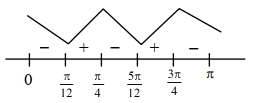
View full question & answer→MCQ 1711 Mark
Let $x , y$ and $z$ be positive real numbers. Suppose $x , y$ and $z$ are lengths of the sides of a triangle opposite to its angles $X , Y$ and $Z$, respectively. If
$\tan \frac{X}{2}+\tan \frac{Z}{2}=\frac{2 y}{x+y+z},$
then which of the following statements is/are $TRUE$?
$(A)$ $2 Y = X + Z$ $(B)$ $Y=X+Z$ $(C)$ $\tan \frac{x}{2}=\frac{x}{y+z}$ $(D)$ $x^2+z^2-y^2=x z$
Answerb
(IMAGE)
$\tan \frac{x}{2}+\tan \frac{z}{2}=\frac{2 y}{x+y+z}$
$\frac{\Delta}{S(S-x)}+\frac{\Delta}{S(S-z)}=\frac{2 y}{2 S}$
$\frac{\Delta}{ S }\left(\frac{2 S -( x + z )}{( S - x )( S - z )}\right)=\frac{ y }{ S }$
$\Rightarrow \frac{\Delta y}{S(S-x)(S-z)}=\frac{y}{S}$
$\Rightarrow \quad \Delta^2=(S-x)^2(S-z)^2$
$\Rightarrow \quad S ( S - y )=( S - x )( S - z )$
$\Rightarrow \quad(x+y+z)(x+z-y)=(y+z-x)(x+y-z)$
$\Rightarrow \quad(x+z)^2-y^2=y^2-(z-x)^2$
$\Rightarrow \quad(x+z)^2+(x-z)^2=2 y^2$
$\Rightarrow \quad x ^2+ z ^2= y ^2 \Rightarrow \angle Y =\frac{\pi}{2}$
$\Rightarrow \quad \angle Y =\angle X +\angle Z$
$\tan \frac{x}{2}=\frac{\Delta}{S(S-x)}$
$\tan \frac{x}{2}=\frac{\frac{1}{2} x z}{\frac{(y+z)^2-x^2}{4}}$
(IMAGE)
$\tan \frac{x}{2}=\frac{2 x z}{y^2+z^2+2 y z-x^2}$
$\tan \frac{x}{2}=\frac{2 x z}{2 z^2+2 y z} \quad \text { (using } y^2=x^2+z^2 \text { ) }$
$\tan \frac{x}{2}=\frac{x}{y+z}$
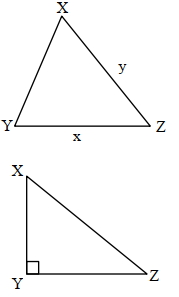
View full question & answer→MCQ 1721 Mark
Answer the following by appropriately matching the lists based on the information given in the paragraph
Let $f( x )=\sin (\pi \cos x )$ and $g ( x )=\cos (2 \pi \sin x )$ be two functions defined for $x >0$. Define the following sets whose elements are written in the increasing order :
$X =\{ x : f( x )=0\}, Y =\left\{ x : f^{\prime}( x )=0\right\}$
$Z =\{ x : g ( x )=0\}, W =\left\{ x : g ^{\prime}( x )=0\right\}.$
$List-I$ contains the sets $X , Y , Z$ and $W$. $List -II$ contains some information regarding these sets.
| $List-I$ |
$List-II$ |
| $(I)$ $X$ |
$(P)$ $\supseteq\left\{\frac{\pi}{2}, \frac{3 \pi}{2}, 4 \pi, 7 \pi\right\}$ |
| $(II)$ $Y$ |
$(Q)$ an arithmetic progression |
| $(III)$ $Z$ |
$(R)$ $NOT$ an arithmetic progression |
| $(IV)$ $W$ |
$(S)$ $\supseteq\left\{\frac{\pi}{6}, \frac{7 \pi}{6}, \frac{13 \pi}{6}\right\}$ |
| |
$(T)$ $\supseteq\left\{\frac{\pi}{3}, \frac{2 \pi}{3}, \pi\right\}$ |
| |
$( U )$ $\supseteq\left\{\frac{\pi}{6}, \frac{3 \pi}{4}\right\}$ |
($1$) Which of the following is the only $CORRECT$ combination?
$(1) (II), (R), (S)$ $(2) (I), (P), (R)$ $(3) (II), (Q), (T)$ $(4) (I), (Q), (U)$
($2$) Which of the following is the only $CORRECT$ combinations?
$(1) (IV), (Q), (T)$ $(2) (IV), (P), (R), (S)$ $(3) (III), (R), (U)$ $(4) (III), (P), (Q), (U)$
Give the answer the quetion ($1$) and ($2$)
Answerb
($2$) $f(x)=\sin (\pi \cos x)$
$X :\{ x : f ( x )=0\}$
$f(x)=0 \Rightarrow \sin (x \cos x)=0 \Rightarrow \cos x=n \Rightarrow \cos x=1,-1,0 \Rightarrow x=\frac{n \pi}{2}$
$x =\left\{\frac{ n \pi }{2}: \pi \in N \right\}-\left\{\frac{\pi}{2}, \pi \cdot \frac{3 \pi}{2}, 2 \pi,\right\}$
$g(x)=\cos (2 \pi \sin x)$
$Z=\{x: g(x)=0\}$
$\cos (2 \pi \sin x)=0 \Rightarrow 2 \pi \sin x=(2 n+1) \frac{\pi}{2} \Rightarrow \sin x-\frac{(2 n+1)}{4}$
$\sin x=-\frac{1}{4} \cdot \frac{1}{4} \cdot \frac{-3}{4} \cdot \frac{3}{4}$
$Z=\left\{n \pi \pm \sin ^{-1}\left(\frac{1}{4}\right), m \pi \pm \sin ^{-1}\left(\frac{3}{4}\right), n \in I\right\}$
$Y =\{ x : f ( x )=0\}$
$f(x)=\sin (\pi \cos x) \Rightarrow f^{\prime}(x)=\cos (\pi \cos x) \cdot(-\pi \sin x)=0$
$\sin x=0 \Rightarrow x=m \pi \text {. }$
$\cos (\pi \cos x)=0 \Rightarrow \pi \cos x=(2 n+1) \frac{\pi}{2} \Rightarrow \cos x-\frac{(2 n+1)}{2} \Rightarrow \cos x=-\frac{1}{2} \cdot \frac{1}{2}$
$Y=\left\{2 \pi, n \pi \pm \frac{\pi}{3}\right\}-\left\{\frac{\pi}{3}, \frac{2 \pi}{3}, \pi, \frac{4 \pi}{3}, \frac{5 \pi}{3}, 2 \pi, \ldots . .\right\}$
$W=\left\{x: g^{\prime}(x)=0\right\}$
$g(x)=\cos (2 \pi \sin x) \Rightarrow g^{\prime}(x)=-\sin (2 \pi \sin x) \cdot(2 \pi \cos x)=0$
$\cos x =0 \Rightarrow x =(2 n +1) \frac{\pi}{2}$
$\sin (2 \pi \sin x)=0 \Rightarrow 2 \pi \sin x=n \pi \Rightarrow \sin x=\frac{\pi}{2}=-1-\frac{1}{2} \cdot 0 \cdot \frac{1}{2} \cdot 1$
$W=\left\{\frac{n \pi}{2}, n \pi \pm \frac{\pi}{6}, \pi \in I\right\}-\left\{\frac{\pi}{6}, \frac{\pi}{2}, \frac{5 \pi}{6}, \pi, \frac{7 \pi}{6}, \frac{3 \pi}{2}, \ldots\right\}$
Now check the options
View full question & answer→MCQ 1731 Mark
Let $a , b , c$ be three non-zero real numbers such that the equation $\sqrt{3} a \cos x +2 b \sin$ $x=c, x \in\left[-\frac{\pi}{2}, \frac{\pi}{2}\right]$, has two distinct real roots a and $\beta$ with $a+\beta=\frac{\pi}{3}$. Then, the value of $\frac{ b }{ a }$ is. . . . . . .
Answerc
$\sqrt{3} a \cos x+2 b \sin x=c$
$\sqrt{3} \cos x+\frac{2 b}{a} \sin x=\frac{c}{a}$
As $\alpha, \beta$ are roots $\Rightarrow \sqrt{3} \cos \alpha+\frac{2 b }{ a } \sin \alpha=\frac{ c }{ a }$ $. . . . . .(1)$
$(1)$ $-(2)$
$\sqrt{3} \cos \beta+\frac{2 b}{a} \sin \beta=\frac{c}{a}$ $. . . . . .(2)$
$\sqrt{3}(\cos \alpha-\cos \beta)+\frac{2 b}{a}(\sin \alpha-\sin \beta)=0$
$\sqrt{3}\left(2 \sin \frac{\alpha+\beta}{2} \sin \frac{\beta-\alpha}{2}\right)+\frac{2 b}{a}\left(2 \cos \frac{\alpha+\beta}{2} \sin \frac{\alpha-\beta}{2}\right)=0$
Given $\alpha+\beta=\frac{\pi}{3}$
$\sqrt{3}\left(2 \cdot \frac{1}{2} \sin \frac{\beta-\alpha}{2}\right)+2 \frac{2 b}{a}\left(\frac{\sqrt{3}}{2} \sin \frac{\alpha-\beta}{2}\right)=0$
$\Rightarrow 1=\frac{2 b}{a} \quad \Rightarrow \frac{b}{a}=\frac{1}{2}$
View full question & answer→MCQ 1741 Mark
Let $\alpha$ and $\beta$ be nonzero real numbers such that $2(\cos \beta-\cos \alpha)+\cos \alpha \cos \beta=1$. Then which of the following is/are true?
$[A]$ $\tan \left(\frac{\alpha}{2}\right)+\sqrt{3} \tan \left(\frac{\beta}{2}\right)=0$
$[B]$ $\sqrt{3} \tan \left(\frac{\alpha}{2}\right)+\tan \left(\frac{\beta}{2}\right)=0$
$[C]$ $\tan \left(\frac{\alpha}{2}\right)-\sqrt{3} \tan \left(\frac{\beta}{2}\right)=0$
$[D]$ $\sqrt{3} \tan \left(\frac{\alpha}{2}\right)-\tan \left(\frac{\beta}{2}\right)=0$
- ✓
$A,C$
- B
$A,B$
- C
$A,D$
- D
$A,C,D$
Answera
$\frac{\cos \beta(2+\cos \alpha)=1+2 \cos \alpha}{1}=\frac{1+2 \cos \alpha}{2+\cos \alpha}$
$\frac{\cos \beta+1}{\cos \beta-1}=\frac{3(\cos \alpha+1)}{\cos \alpha-1}$
$\frac{2 \cos ^2 \frac{\beta}{2}}{-2 \sin ^2 \frac{\beta}{2}}=\frac{3 \times 2 \cos ^2 \frac{\alpha}{2}}{-2 \sin ^2 \frac{\alpha}{2}}$
$\tan ^2 \frac{\alpha}{2}=3 \tan ^2 \frac{\beta}{2}$
$\Rightarrow \quad \tan \frac{\alpha}{2}= \pm \sqrt{3} \tan \frac{\beta}{2}$
View full question & answer→MCQ 1751 Mark
Let $S=\left\{x \in(-\pi, \pi): x \neq 0, \pm \frac{\pi}{2}\right\}$. The sum of all distinct solutions of the equation $\sqrt{3} \sec x+\operatorname{cosec} x+2(\tan x-\cot x)=0$ in the set $S$ is equal to
- A
$-\frac{7 \pi}{9}$
- B
$-\frac{2 \pi}{9}$
- ✓
$0$
- D
$\frac{5 z:}{9}$
Answerc
$\sqrt{3} \sec x+\csc x+2(\tan x-\cot x)=0$
$\Rightarrow \sqrt{3} \sec x+\csc x=2(\cot x-\tan x)$
$\Rightarrow \frac{(\sqrt{3} \sec x+\csc x)}{2}=\cot x-\tan x$
$\Rightarrow \frac{\sqrt{3}}{2} \sec x +\frac{1}{2} \csc x =\cot x -\tan x$ by dividing both sides by $2$
We know that $\sec x=\frac{1}{\cos x}, \csc x=\frac{1}{\sin x}, \tan x=\frac{\sin x}{\cos x}$ and $\cot x=\frac{\cos x}{\sin x}$ $\Rightarrow \frac{\sqrt{3} 1}{2 \cos x}+\frac{11}{2 \sin x}=\frac{\cos x}{\sin x}-\frac{\sin x}{\cos x}$
$\Rightarrow \frac{\sqrt{3} \sin x}{2 \sin x \cos x}+\frac{1 \cos x}{2 \sin x \cos x}=\frac{\cos ^2 x}{\sin x \cos x}-\frac{\sin ^2 x}{\cos x \sin x}$
$\Rightarrow \frac{\sqrt{3}}{2} \sin x +\frac{1}{2} \cos x =\cos ^2 x -\sin ^2 x$
$\Rightarrow \sin \frac{\pi}{3} \sin x+\cos \frac{\pi}{3} \cos x=\cos 2 x$ where $\frac{\sqrt{3}}{2}=\sin \frac{\pi}{3}$ and $\frac{1}{2}=\cos \frac{\pi}{3}$
$\Rightarrow \cos \left(\frac{\pi}{3}-x\right)=\cos 2 x$
$\Rightarrow 2 x=2 n \pi \pm\left(x-\frac{\pi}{3}\right)$ since if $\cos \theta=\cos \alpha \Rightarrow \theta=2 n \pi \pm \alpha$
$\Rightarrow 2 x =2 n \pi+ x -\frac{\pi}{3}$ or $2 x =2 n \pi- x +\frac{\pi}{3}$
$\Rightarrow x=2 n \pi-\frac{\pi}{3}$ or $3 x=2 n \pi+\frac{\pi}{3}$ or $x=\frac{2 n \pi}{3}+\frac{\pi}{9}$
For $n =0, x =\frac{-\pi}{3}, \frac{\pi}{9}$
For $n =-1, x =\frac{-7 \pi}{3}$ which does not lie between $(-\pi, \pi)$
and $x=\frac{-2 \pi}{3}+\frac{\pi}{9}=\frac{-5 \pi}{9} \in(-\pi, \pi)$
For $n =2, x =\frac{5 \pi}{3}$ does not lie between $(-\pi, \pi)$
and $x=\frac{2 \pi}{3}+\frac{\pi}{9}=\frac{7 \pi}{9} \in(-\pi, \pi)$
$\therefore x =\frac{-\pi}{3}, \frac{\pi}{9}, \frac{-5 \pi}{9}, \frac{7 \pi}{9}$
Sum of all the solutions $=\frac{-\pi}{3}+\frac{\pi}{9}-\frac{5 \pi}{9}+\frac{7 \pi}{9}=\frac{-3 \pi}{9}+\frac{\pi}{9}-\frac{5 \pi}{9}+\frac{7 \pi}{9}=0$
View full question & answer→MCQ 1761 Mark
If $\frac{\sin ^4 x}{2}+\frac{\cos ^4 x}{3}=\frac{1}{5},$ then
$(A)$ $\tan ^2 x=\frac{2}{3}$ $(B)$ $\frac{\sin ^8 x}{8}+\frac{\cos ^8 x}{27}=\frac{1}{125}$
$(C)$ $\tan ^2 x=\frac{1}{3}$ $(D)$ $\frac{\sin ^8 x}{8}+\frac{\cos ^8 x}{27}=\frac{2}{125}$
- A
$(A,C)$
- ✓
$(A,B)$
- C
$(B,C)$
- D
$(D,B)$
AnswerCorrect option: B. $(A,B)$
b
$\frac{\sin ^4 x}{2}+\frac{\cos ^4 x}{3}=\frac{1}{5}$
$\frac{\left(\sin ^2 x\right)^2}{2}+\frac{\left(1-\sin ^2 x\right)^2}{3}=\frac{1}{5}$
$\text { Let } \sin ^2 x \text { bet, } t \geq 0$
$t \in[0,1]$
$\frac{ t ^2}{2}+\frac{(1-t)^2}{3}=\frac{1}{5}$
$\frac{ t ^2}{2}+\frac{1-2 t + t ^2}{3}=\frac{1}{5}$
$\frac{3 t ^2+2-4 t +2 t ^2}{6}=\frac{1}{5}$
$25 t ^2-20 t +10=6$
$25 t ^2-20 t +4=0$
$25 t ^2-10 t -10 t +4=0$
$(5 t -2)(5 t -2)=0$
$t =\frac{2}{5}$
$\therefore \sin ^2 x =\frac{2}{5}$
$\cos ^2 x =1-\sin ^2 x =1-\frac{2}{5}=\frac{3}{5}$
$\tan ^2 x =\frac{\sin ^2 x }{\cos ^2 x }=\frac{2}{3}$
View full question & answer→MCQ 1771 Mark
If $\cos (\alpha - \beta ) = 1$ and $\cos (\alpha + \beta ) = \frac{1}{e}$, $ - \pi < \alpha ,\beta < \pi $, then total number of ordered pair of $(\alpha ,\beta )$ is
Answerd
(d) $ - 2\pi < \alpha - \beta < 2\pi $
$\cos (\alpha - \beta ) = 1$
==> $\alpha - \beta = 0$
==> $\alpha = \beta $$\cos 2\alpha = \frac{1}{e}$
and $ - 2\pi < 2\alpha < 2\pi $
Hence, there will be four solutions.
View full question & answer→MCQ 1781 Mark
If $\alpha + \beta = \frac{\pi }{2}$ and $\beta + \gamma = \alpha ,$ then $\tan \,\alpha $ equals
- A
$2\,(\tan \beta + \tan \gamma )$
- B
$\tan \beta + \tan \gamma $
- ✓
$\tan \beta + 2\,\tan \gamma $
- D
$2\,\tan \beta + \tan \gamma $
AnswerCorrect option: C. $\tan \beta + 2\,\tan \gamma $
c
(c)$\alpha + \beta = \frac{\pi }{2} \Rightarrow \tan \beta = \cot \alpha $
$\tan (\beta + \gamma ) = \tan \alpha $ ==> $\tan \alpha = \frac{{\tan \beta + \tan \gamma }}{{1 - \tan \beta \tan \gamma }}$
==> $\tan \alpha = \frac{{\cot \alpha + \tan \gamma }}{{1 - \cot \alpha \tan \gamma }}$
==> $\tan \alpha - \tan \gamma = \cot \alpha + \tan \gamma $
==> $\tan \alpha = \tan \beta + 2\tan \gamma $.
View full question & answer→MCQ 1791 Mark
The maximum value of ${\rm{cos}}{\alpha _1}.{\rm{cos}}{\alpha _2}........{\rm{cos}}{\alpha _n},$ under the restrictions $0 \le {\alpha _1},\,{\alpha _2},.......,\,{\alpha _n} \le \frac{\pi }{2}$ and ${\rm{cot}}{\alpha _1}.{\rm{cot}}{\alpha _2}....{\rm{cot}}{\alpha _n} = 1$ is
- ✓
$\frac{1}{{{2^{n/2}}}}$
- B
$\frac{1}{{{2^n}}}$
- C
$\frac{1}{{2n}}$
- D
AnswerCorrect option: A. $\frac{1}{{{2^{n/2}}}}$
a
(a)Here $(\cot {\alpha _1})\,.\,(\cot {\alpha _2})....(\cot {\alpha _n}) = 1$
$\therefore \cos {\alpha _1}\,.\,\cos {\alpha _2}...\cos {\alpha _n} = \sin {\alpha _1}\,.\,\sin {\alpha _2}...\sin {\alpha _n}$
Now, ${(\cos {\alpha _1}\,.\,\cos {\alpha _2}...\cos {\alpha _n})^2}$
$ = (\cos {\alpha _1}\,.\,\cos {\alpha _2}...\cos {\alpha _n})$$(\cos {\alpha _1}\,.\,\cos {\alpha _2}...\cos {\alpha _n})$
$ = (\cos {\alpha _1}\,.\,\cos {\alpha _2}...\cos {\alpha _n})$$(\sin {\alpha _1}\,.\,\sin {\alpha _2}...\sin {\alpha _n})$
$ = \frac{1}{{{2^n}}}\sin 2{\alpha _1}\,.\,\sin 2{\alpha _2}...\sin 2{\alpha _n}.$
But each of $\sin 2{\alpha _i} \le 1$
$\therefore \,{(\cos {\alpha _1}\,.\,\cos {\alpha _2}...\cos {\alpha _n})^2} \le \frac{1}{{{2^n}}}.$
But each of $\cos {\alpha _i}$ is positive.
$\therefore \,\,\cos {\alpha _1}\,.\,\cos {\alpha _2}....\cos {\alpha _n}\, \le \,\,\sqrt {\frac{1}{{{2^n}}}} = \frac{1}{{{2^{n/2}}}}.$
View full question & answer→MCQ 1801 Mark
For a positive integer $n$, let ${f_n}(\theta ) = \left( {\tan \frac{\theta }{2}} \right)\,(1 + \sec \theta )\,(1 + \sec 2\theta )\,(1 + \sec 4\theta )$ ..... $(1 + \sec \,{2^n}\theta ).$ Then
- A
${f_2}\,\left( {\frac{\pi }{{16}}} \right) = 1$
- B
${f_3}\,\left( {\frac{\pi }{{32}}} \right) = 1$
- C
${f_4}\,\left( {\frac{\pi }{{64}}} \right) = 1$
- ✓
Answerd
(d) ${f_n}(\theta ) = \frac{{\sin (\theta /2)}}{{\cos (\theta /2)}}\left[ {\frac{{2{{\cos }^2}\theta /2}}{{\cos \theta }}.\frac{{2{{\cos }^2}\theta }}{{\cos 2\theta }}.\frac{{2{{\cos }^2}2\theta }}{{\cos 4\theta }}..} \right]$
Combine first two factors, ${f_n}(\theta ) = \frac{{\sin \theta }}{{\cos \theta }}\left[ {\frac{{2{{\cos }^2}\theta }}{{\cos 2\theta }}.\frac{{2{{\cos }^2}2\theta }}{{\cos 4\theta }}.....} \right]$
Again combine first two factors,
${f_n}(\theta ) = \tan 2\theta \left[ {\frac{{2{{\cos }^2}2\theta }}{{\cos 4\theta }}.....} \right] = \tan ({2^n}\theta )$
$\therefore {f_2}\left( {\frac{\pi }{{16}}} \right) = \tan \frac{{4\pi }}{{16}} = \tan \left( {\frac{\pi }{4}} \right) = 1$
${f_3}\left( {\frac{\pi }{{32}}} \right) = \tan \frac{{8\pi }}{{32}} = \tan \left( {\frac{\pi }{4}} \right) = 1$
${f_4}\left( {\frac{\pi }{{64}}} \right) = \tan \frac{{16\pi }}{{64}} = \tan \,\left( {\frac{\pi }{4}} \right) = 1$
${f_5}\left( {\frac{\pi }{{128}}} \right) = \tan 32\frac{\pi }{{128}} = \tan \,\left( {\frac{\pi }{4}} \right) = 1$.
View full question & answer→MCQ 1811 Mark
Which of the following number(s) is/are rational
AnswerCorrect option: C. $\sin 15^\circ \cos 15^\circ $
c
(c) $\sin {15^o} = \sin ({45^o} - {30^o}) = \frac{{\sqrt 3 - 1}}{{2\sqrt 2 }} = $ irrational
$\cos {15^o} = \cos ({45^o} - {30^o}) = \frac{{\sqrt 3 + 1}}{{2\sqrt 2 }}=$ irrational
$\therefore \,\,\,\sin {15^o}\cos {15^o} = \frac{1}{2}(2\sin {15^o}\cos {15^o})$
$ = \frac{1}{2}\sin {30^o} = \frac{1}{2}.\frac{1}{2} = \frac{1}{4} =$ rational
$\therefore \, \sin {15^o}\cos {75^o} = \sin {15^o}\sin {15^o} = {\sin ^2}{15^o}$
$ = {\left( {\frac{{\sqrt 3 - 1}}{{2\sqrt 2 }}} \right)^2} = \frac{{4 - 2\sqrt 3 }}{8}=$ irrational
View full question & answer→MCQ 1821 Mark
Let ${A_0}{A_1}{A_2}{A_3}{A_4}{A_5}$ be a regular hexagon inscribed in a circle of unit radius. Then the product of the lengths of the line segments ${A_0}{A_1},\,\,{A_0}{A_2}$ and ${A_0}{A_4}$ is
- A
$\frac{3}{4}$
- B
$3\sqrt 3 $
- ✓
$3$
- D
$\frac{{3\sqrt 3 }}{2}$
Answerc
(c) Each triangle is an equilateral triangle
Hence ${A_o}{A_1} = 1$
${A_0}A_2^2 = {A_0}A_1^2 + {A_1}A_2^2 - 2{A_0}{A_1}{A_1}{A_2}$$\cos {120^o}$
$ = 1 + 1 - 2.1.1\left( { - \frac{1}{2}} \right) = 3$
==> ${A_0}{A_2} = \sqrt 3 = {A_0}{A_4}$
$\therefore $ ${A_0}{A_1} \times {A_0}{A_2} \times {A_0}{A_4} = 1$.$\sqrt 3 .\sqrt 3 = 3$.
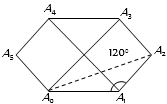
View full question & answer→MCQ 1831 Mark
If $\cos (\theta - \alpha ),\;\cos \theta $ and $\cos (\theta + \alpha )$ are in $H.P.$, then $\cos \theta \sec \frac{\alpha }{2}$ is equal to
AnswerCorrect option: A. $ \pm \sqrt 2 $
a
(a) Given $\cos (\theta - \alpha ),\cos \theta $ and $\cos (\theta + \alpha )$ are in $H.P. $
==> $\frac{1}{{\cos (\theta - \alpha )}},\frac{1}{{\cos \theta }},\frac{1}{{\cos (\theta + \alpha )}}$ will be in $A.P. $
Hence, $\frac{2}{{\cos \theta }} = \frac{1}{{\cos (\theta - \alpha )}} + \frac{1}{{\cos (\theta + \alpha )}}$
$ = \frac{{\cos (\alpha + \theta ) + \cos (\theta - \alpha )}}{{{{\cos }^2}\theta - {{\sin }^2}\alpha }}$
==> $\frac{2}{{\cos \theta }} = \frac{{2\cos \theta \cos \alpha }}{{{{\cos }^2}\theta - {{\sin }^2}\alpha }}$
==> ${\cos ^2}\theta - {\sin ^2}\alpha = {\cos ^2}\theta \cos \alpha $
==> ${\cos ^2}\theta \,(1 - \cos \alpha ) = {\sin ^2}\alpha $
==> ${\cos ^2}\theta \left( {2{{\sin }^2}\frac{\alpha }{2}} \right) $
$= 4{\sin ^2}\frac{\alpha }{2}{\cos ^2}\frac{\alpha }{2}$
${\cos ^2}\theta {\sec ^2}\frac{\alpha }{2} = 2$
$\Rightarrow \cos \theta \sec \frac{\alpha }{2} = \pm \sqrt 2 $.
View full question & answer→MCQ 1841 Mark
$\alpha ,\,\,\beta ,\,\,\gamma $ are real numbers satisfying $\alpha + \beta + \gamma = \pi $. The minimum value of the given expression $\sin \alpha + \sin \beta + \sin \gamma $ is
Answerc
(c) Since $\sin \alpha + \sin \beta + \sin \gamma > \sin (\alpha + \beta + \gamma )$
when $\alpha + \beta + \gamma = \pi $.
$\therefore $ $\sin \alpha + \sin \beta + \sin \gamma > 0$
$\therefore $ The minimum value of $\sin \alpha + \sin \beta + \sin \gamma $ is always positive.
View full question & answer→MCQ 1851 Mark
Let $0 < x < \frac{\pi }{4}.$ Then $\sec 2x - \tan 2x = $
- A
$\tan \left( {x - \frac{\pi }{4}} \right)$
- ✓
$\tan \left( {\frac{\pi }{4} - x} \right)$
- C
$\tan \left( {x + \frac{\pi }{4}} \right)$
- D
${\tan ^2}\left( {x + \frac{\pi }{4}} \right)$
AnswerCorrect option: B. $\tan \left( {\frac{\pi }{4} - x} \right)$
b
(b) $\sec 2x - \tan 2x = \frac{{1 - \sin 2x}}{{\cos 2x}}$
$ = \frac{{{{(\cos x - \sin x)}^2}}}{{({{\cos }^2}x - {{\sin }^2}x)}} $
$= \frac{{\cos x - \sin x}}{{\cos x + \sin x}} = \frac{{1 - \tan x}}{{1 + \tan x}}$
$ = \frac{{\tan \frac{\pi }{4} - \tan x}}{{1 + \tan \left( {\frac{\pi }{4}} \right)\sin x}} = \tan \left( {\frac{\pi }{4} - x} \right)$.
View full question & answer→MCQ 1861 Mark
Let $n$ be a positive integer such that $\sin \frac{\pi }{{{2^n}}} + \cos \frac{\pi }{{{2^n}}} = \frac{{\sqrt n }}{2}.$ Then
- A
$6 \le n \le 8$
- ✓
$4 < n \le 8$
- C
$4 \le n < 8$
- D
$4 < n < 8$
AnswerCorrect option: B. $4 < n \le 8$
b
(b) $\sin \frac{\pi }{{{2^n}}} + \cos \frac{\pi }{{{2^n}}} = \frac{{\sqrt n }}{2}$
==> $\sqrt 2 \left( {\sin \frac{\pi }{{{2^n}}}.\cos \frac{\pi }{4} + \cos \frac{\pi }{{{2^n}}}.\sin \frac{\pi }{4}} \right) = \frac{{\sqrt n }}{2}$
==> $\sqrt 2 \sin \left( {\frac{\pi }{4} + \frac{\pi }{{{2^n}}}} \right) = \frac{{\sqrt n }}{2}$
Since $\sin \,\left( {\frac{\pi }{4} + \frac{\pi }{{{2^n}}}} \right) \le 1$
$\therefore \;\frac{{\sqrt n }}{2} \le \sqrt 2 \Rightarrow \sqrt n \le 2\sqrt 2 \Rightarrow n \le 8$.
Again
$\therefore \;n > 4$, Hence, $4 < n \le 8$.
View full question & answer→MCQ 1871 Mark
If $k = \sin \frac{\pi }{{18}}\,.\,\sin \frac{{5\pi }}{{18}}\,.\,\sin \frac{{7\pi }}{{18}},$ then the numerical value of $k$ is
- A
$\frac{1}{4}$
- ✓
$\frac{1}{8}$
- C
$\frac{1}{{16}}$
- D
AnswerCorrect option: B. $\frac{1}{8}$
b
(b) We have $k = \sin \frac{\pi }{{18}}\sin \frac{{5\pi }}{{18}}\sin \frac{{7\pi }}{{18}}$
$ = \cos \left( {\frac{\pi }{2} - \frac{\pi }{{18}}} \right)\cos \left( {\frac{\pi }{2} - \frac{{5\pi }}{{18}}} \right)\cos \left( {\frac{\pi }{2} - \frac{{7\pi }}{{18}}} \right)$
$ = \cos \frac{\pi }{9}\cos \frac{{2\pi }}{9}\cos \frac{{4\pi }}{9} = \frac{{\sin {2^3}\frac{\pi }{9}}}{{{2^3}\sin \frac{\pi }{9}}} = \frac{{\sin \frac{{8\pi }}{9}}}{{8\sin \frac{\pi }{9}}}$
$ = \frac{{\sin \left( {\pi - \frac{\pi }{9}} \right)}}{{8\sin \frac{\pi }{9}}} = \frac{1}{8}$.
View full question & answer→MCQ 1881 Mark
For $0 < \phi < \frac{\pi }{2},$ if $x = \sum\limits_{n = 0}^\infty {{{\cos }^{2n}}\phi ,} $ $y = \sum\limits_{n = 0}^\infty {{{\sin }^{2n}}\phi ,} $ $z = \sum\limits_{n = 0}^\infty {{{\cos }^{2n}}\phi \,{{\sin }^{2n}}\phi ,} $ then
- A
$xyz = xz + y$
- B
$xyz = xy + z$
- C
$xyz = x + y + z$
- ✓
$b$ or $c$ both
AnswerCorrect option: D. $b$ or $c$ both
d
(b) $x = 1 + {\cos ^2}\phi + {\cos ^4}\phi + .... = \frac{1}{{(1 - {{\cos }^2}\phi )}} = \frac{1}{{{{\sin }^2}\phi }}$
$y = 1 + {\sin ^2}\phi + {\sin ^4}\phi + .... = \frac{1}{{(1 - {{\sin }^2}\phi )}} = \frac{1}{{{{\cos }^2}\phi }}$
$z = 1 + {\cos ^2}\phi {\sin ^2}\phi + {\cos ^4}\phi {\sin ^4}\phi + .. = \frac{1}{{(1 - {{\cos }^2}\phi {{\sin }^2}\phi )}}$
Now $xyz = \frac{1}{{{{\sin }^2}\phi {{\cos }^2}\phi (1 - {{\cos }^2}\phi {{\sin }^2}\phi )}}$
$xy + z = \frac{1}{{{{\sin }^2}\phi {{\cos }^2}\phi }} + \frac{1}{{1 - {{\cos }^2}\phi {{\sin }^2}\phi }}$
$ = \frac{1}{{{{\sin }^2}\phi {{\cos }^2}\phi (1 - {{\cos }^2}\phi {{\sin }^2}\phi )}} = xyz$
which is given in $(b)$
Also $x + y + z = xyz$, which is given in $(c)$.
View full question & answer→MCQ 1891 Mark
The maximum value of $\sin \left( {x + \frac{\pi }{6}} \right) + \cos \left( {x + \frac{\pi }{6}} \right)$ in the interval $\left( {0,\frac{\pi }{2}} \right)$ is attained at
- ✓
$x = \frac{\pi }{{12}}$
- B
$x = \frac{\pi }{6}$
- C
$x = \frac{\pi }{3}$
- D
$x = \frac{\pi }{2}$
AnswerCorrect option: A. $x = \frac{\pi }{{12}}$
a
(a) $\sqrt 2 \cos \left( {x + \frac{\pi }{6} - \frac{\pi }{4}} \right) = \sqrt 2 \cos \,\left( {x - \frac{\pi }{{12}}} \right)$.
Hence maximum value will be at $x = \frac{\pi }{{12}}$.
View full question & answer→MCQ 1901 Mark
The value of $\frac{{\tan x}}{{\tan \,3x}}$ whenever defined never lie between
- ✓
$1/3$ and $3$
- B
$1/4 $ and $4$
- C
$1/5$ and $5$
- D
$5$ and $6$
AnswerCorrect option: A. $1/3$ and $3$
a
(a) Let $y = \frac{{\tan x}}{{\tan 3x}} = \frac{{\tan x}}{{\frac{{3\tan x - {{\tan }^3}x}}{{1 - 3{{\tan }^2}x}}}}$
$y = \frac{{1 - 3{{\tan }^2}x}}{{3 - {{\tan }^2}x}} = \frac{{\frac{1}{3} - {{\tan }^2}x}}{{1 - \frac{1}{3}.{{\tan }^2}x}}$
Hence, $y$ should never lie between $\frac{1}{3}$ and $3$ whenever defined.
View full question & answer→MCQ 1911 Mark
The value of $\sin \frac{\pi }{{14}}\sin \frac{{3\pi }}{{14}}\sin \frac{{5\pi }}{{14}}\sin \frac{{7\pi }}{{14}}\sin \frac{{9\pi }}{{14}}\sin \frac{{11\pi }}{{14}}\sin \frac{{13\pi }}{{14}}$ is equal to
- A
$\frac{1}{8}$
- B
$\frac{1}{{16}}$
- C
$\frac{1}{{32}}$
- ✓
$\frac{1}{{64}}$
AnswerCorrect option: D. $\frac{1}{{64}}$
d
(d) $\sin \frac{\pi }{{14}}\sin \frac{{3\pi }}{{14}}\sin \frac{{5\pi }}{{14}}\sin \frac{{7\pi }}{{14}}\sin \frac{{9\pi }}{{14}}\sin \frac{{11\pi }}{{14}}\sin \frac{{13\pi }}{{14}}$
$ = \sin \frac{\pi }{{14}}\sin \frac{{3\pi }}{{14}}\sin \frac{{5\pi }}{{14}} \times 1$
$ \times \sin \left( {\pi - \frac{{5\pi }}{{14}}} \right)\sin \left( {\pi - \frac{{3\pi }}{{14}}} \right)\sin \left( {\pi - \frac{\pi }{{14}}} \right)$
$ = {\left[ {\sin \frac{\pi }{{14}}\sin \frac{{3\pi }}{{14}}\sin \frac{{5\pi }}{{14}}\sin \frac{{7\pi }}{{14}}} \right]^2} = \frac{1}{{64}}$.
View full question & answer→MCQ 1921 Mark
$\sqrt 3 \,{\rm{cosec}}\,{20^o} - \sec \,{20^o} = $
- A
$2$
- B
$\frac{{2\,\sin {{20}^o}}}{{\sin {{40}^o}}}$
- ✓
$4$
- D
$\frac{{4\,\sin {{20}^o}}}{{\sin {{40}^o}}}$
Answerc
(c) $\sqrt 3 {\rm{cosec}}\,20^\circ - \sec 20^\circ = \frac{{\sqrt 3 }}{{\sin 20^\circ }} - \frac{1}{{\cos \,20^\circ }}$
$ = \frac{{\sqrt 3 \cos 20^\circ - \sin 20^\circ }}{{\sin 20^\circ \cos 20^\circ }} $
$= \frac{{2\left[ {\frac{{\sqrt 3 }}{2}\cos 20^\circ - \frac{1}{2}\sin \,20^\circ } \right]}}{{\frac{2}{2}\sin 20^\circ \cos 20^\circ }}$
$ = \frac{{4\cos (20^\circ + 30^\circ )}}{{\sin 40^\circ }} $
$= \frac{{4\cos 50^\circ }}{{\sin 40^\circ }} = \frac{{4\sin 40^\circ }}{{\sin 40^\circ }} = 4$.
View full question & answer→MCQ 1931 Mark
$\tan \alpha + 2\tan 2\alpha + 4\tan 4\alpha + 8\cot \,8\alpha = $
- A
$\tan \alpha $
- B
$\tan 2\alpha $
- ✓
$\cot \,\alpha $
- D
$\cot \,2\alpha $
AnswerCorrect option: C. $\cot \,\alpha $
c
(c) $\tan \alpha + 2\tan \,\,2\alpha + 4\tan \,\,4\alpha + 8\cot \,8\alpha $
$ = \tan \alpha + 2\tan \,2\alpha + 4\left[ {\frac{{\sin 4\alpha }}{{\cos 4\alpha }} + 2\frac{{\cos \,8\alpha }}{{\sin \,8\alpha }}} \right]$
$ = \tan \alpha + 2\tan 2\alpha + $
$4\left[ {\frac{{\cos \,4\alpha \,\cos \,8\alpha + \sin \,4\alpha \,\sin \,8\alpha + \cos \,4\alpha \cos \,8\alpha }}{{\sin \,8\alpha \,\cos \,4\alpha }}} \right]$
$ = \tan \,\alpha + 2\tan \,2\alpha + 4\left[ {\frac{{\cos \,4\alpha + \cos \,4\alpha \,\cos \,8\alpha }}{{\sin \,8\alpha \cos \,4\alpha }}} \right]$
$ = \tan \,\alpha + 2\,\tan \,2\alpha + 4\,\left[ {\frac{{\cos \,\,4a(1 + \cos \,8\alpha )}}{{\cos \,4\alpha \sin \,8\alpha }}} \right]$
$ = \tan \alpha + 2\tan \,2\alpha + 4\left[ {\frac{{2{{\cos }^2}4\alpha }}{{2\sin \,4\alpha \,\,\cos \,\,4\alpha }}} \right]$
$ = \tan \,\alpha + 2\tan \,2\alpha + 4\cot \,4\alpha $$ = \tan \alpha + 2(\tan 2\alpha + 2\cot 4\alpha )$
$ = \tan \,\alpha + 2\left[ {\frac{{\sin \,\,2\alpha }}{{\cos 2\alpha }} + 2\frac{{\cos \,4\alpha }}{{\sin \,4\alpha }}} \right]$
$ = \tan \,\alpha + 2\left[ {\frac{{\cos \,2\alpha (1 + \cos \,4\alpha )}}{{\sin \,4\alpha \cos \,2\alpha }}} \right]$
$ = \tan \alpha + 2\cot 2\alpha = \frac{{\sin \,\alpha }}{{\cos \,\alpha }} + \frac{{2\cos \,2\alpha }}{{\sin \,2\alpha }}$
$ = \frac{{\cos \,\alpha + \cos \alpha \cos \,2\alpha }}{{\sin \,2\alpha \cos \alpha }}$
$ = \frac{{1 + \cos \,2\alpha }}{{\sin \,2\alpha }} = \frac{{2{{\cos }^2}\alpha }}{{2\sin \alpha \cos \alpha }} = \cot \,\alpha $.
View full question & answer→MCQ 1941 Mark
$3\,\left[ {{{\sin }^4}\,\left( {\frac{{3\pi }}{2} - \alpha } \right) + {{\sin }^4}\,(3\pi + \alpha )} \right]$ $ - 2\,\left[ {{{\sin }^6}\,\left( {\frac{\pi }{2} + \alpha } \right) + {{\sin }^6}(5\pi - \alpha )} \right] = $
Answerb
(b) $3\left\{ {{{\sin }^4}\left( {\frac{{3\pi }}{2} - \alpha } \right) + {{\sin }^4}(3\pi + \alpha )} \right\}$
$ - 2\left\{ {{{\sin }^6}\left( {\frac{\pi }{2} + \alpha } \right) + {{\sin }^6}(5\pi - \alpha )} \right\}$
$ = 3\left\{ {\,{{( - \cos \alpha )}^4} + {{( - \sin \alpha )}^4}} \right\} - 2\,\left\{ {{{\cos }^6}\alpha + {{\sin }^6}\alpha } \right\}$
$ = 3\left\{ {{{\cos }^2}\alpha + {{\sin }^2}\alpha {)^2} - 2{{\sin }^2}\alpha {{\cos }^2}\alpha } \right\}$
$ - 2\left\{ {{{({{\cos }^2}\alpha + {{\sin }^2}\alpha )}^3} - 3{{\cos }^2}\alpha {{\sin }^2}\alpha ({{\cos }^2}\alpha + {{\sin }^2}\alpha )} \right\}$
$ = 3 - 6{\sin ^2}\alpha {\cos ^2}\alpha - 2 + 6{\sin ^2}\alpha {\cos ^2}\alpha = 3 - 2 = 1$
Trick : Put $\alpha = 0,\frac{\pi }{2},$ the value of expression remains $1$ i.e., it is independent of $\alpha $.
View full question & answer→MCQ 1951 Mark
$\cos \frac{{2\pi }}{{15}}\cos \frac{{4\pi }}{{15}}\cos \frac{{8\pi }}{{15}}\cos \frac{{16\pi }}{{15}} =$
- A
$1/2$
- B
$1/4$
- C
$1/8$
- ✓
$1/16$
AnswerCorrect option: D. $1/16$
d
(d) $\cos \frac{{2\pi }}{{15}}\cos \frac{{4\pi }}{{15}}\cos \frac{{8\pi }}{{15}}\cos \frac{{16\pi }}{{15}}$
$ = \frac{{\sin \,{2^4}\frac{{2\pi }}{{15}}}}{{{2^4}\sin \frac{{2\pi }}{{15}}}} $
$= \frac{{\sin \,\frac{{32\pi }}{{15}}}}{{16\,\sin \frac{{2\pi }}{{15}}}} $
$= \frac{1}{{16}}\frac{{\sin \frac{{2\pi }}{{15}}}}{{\sin \frac{{2\pi }}{{15}}}} $
$= \frac{1}{{16}}$.
View full question & answer→MCQ 1961 Mark
$\left( {1 + \cos \frac{\pi }{8}} \right)\,\left( {1 + \cos \frac{{3\pi }}{8}} \right)\,\left( {1 + \cos \frac{{5\pi }}{8}} \right)\,\left( {1 + \cos \frac{{7\pi }}{8}} \right) = $
- A
$\frac{1}{2}$
- B
$\frac{1}{4}$
- ✓
$\frac{1}{8}$
- D
$\frac{1}{{16}}$
AnswerCorrect option: C. $\frac{1}{8}$
c
(c) $\left( {1 + \cos \frac{\pi }{8}} \right)\,\left( {1 + \cos \frac{{3\pi }}{8}} \right)\,\left( {1 + \cos \frac{{5\pi }}{8}} \right)\,\left( {1 + \cos \frac{{7\pi }}{8}} \right)$
$ = \left( {1 + \cos \frac{\pi }{8} + \cos \frac{{7\pi }}{8} + \cos \frac{\pi }{8}\cos \frac{{7\pi }}{8}} \right)$
$\left( {1 + \cos \frac{{5\pi }}{8} + \cos \frac{{3\pi }}{8} + \cos \frac{{3\pi }}{8}\cos \frac{{5\pi }}{8}} \right)$
$ = \left( {1 + \cos \frac{\pi }{8} - \cos \frac{\pi }{8} + \cos \frac{\pi }{8}\cos \frac{{7\pi }}{8}} \right)$
$\left( {1 + \cos \frac{{5\pi }}{8} - \cos \frac{{5\pi }}{8} + \cos \frac{{3\pi }}{8}\cos \frac{{5\pi }}{8}} \right)$
$ = \left( {1 + \cos \frac{\pi }{8}\cos \frac{{7\pi }}{8}} \right)\,\left( {1 + \cos \frac{{3\pi }}{8}\cos \frac{{5\pi }}{8}} \right)$
$ = \frac{1}{4}\,\,\left( {2 + 2\cos \frac{\pi }{8}\cos \frac{{7\pi }}{8}} \right)\,\,\left( {2 + 2\cos \frac{{3\pi }}{8}\cos \frac{{5\pi }}{8}} \right)$
$ = \frac{1}{4}\left( {2 + \cos \frac{{3\pi }}{4} + \cos \pi } \right)\left( {2 + \cos \frac{\pi }{4} + \cos \pi } \right)$
$ = \frac{1}{4}\,\left( {1 + \cos \frac{{3\pi }}{4}} \right)\,\left( {1 + \cos \frac{\pi }{4}} \right) = \frac{1}{4}\left( {1 - \cos \frac{\pi }{4}} \right)\,\left( {1 + \cos \frac{\pi }{4}} \right)$
$ = \frac{1}{4}\left( {1 - {{\cos }^2}\frac{\pi }{4}} \right) = \frac{1}{4}\left( {1 - \frac{1}{2}} \right) = \frac{1}{8}$.
Aliter : $\left( {1 + \cos \frac{\pi }{8}} \right)\,\left( {1 + \cos \frac{{7\pi }}{8}} \right)\,\left( {1 + \cos \frac{{3\pi }}{8}} \right)\,\left( {1 + \cos \frac{{5\pi }}{8}} \right)$
$ = \left( {1 + \cos \frac{\pi }{8}} \right)\,\left( {1 - \cos \frac{\pi }{8}} \right)\,\left( {1 + \cos \frac{{3\pi }}{8}} \right)\,\left( {1 - \cos \frac{{3\pi }}{8}} \right)$
$ = \left( {1 - {{\cos }^2}\frac{\pi }{8}} \right){\rm{ }}\left( {1 - {{\cos }^2}\frac{{3\pi }}{8}} \right) = {\sin ^2}\frac{\pi }{8}{\sin ^2}\frac{{3\pi }}{8}$
$ = \frac{1}{4}{\left( {2\sin \frac{\pi }{8}.\sin \frac{{3\pi }}{8}} \right)^2}$$ = \frac{1}{4}{\left( {\cos \frac{\pi }{4} - \cos \frac{\pi }{2}} \right)^2} = \frac{1}{8}$.
View full question & answer→MCQ 1971 Mark
If $x\cos \theta = y\cos \,\left( {\theta + \frac{{2\pi }}{3}} \right) = z\cos \,\left( {\theta + \frac{{4\pi }}{3}} \right),$ then the value of $\frac{1}{x} + \frac{1}{y} + \frac{1}{z}$ is equal to
- A
$1$
- B
$2$
- ✓
$0$
- D
$3\,\,\cos \theta $
Answerc
(c) We have
$x\cos \theta = y\cos \left( {\theta + \frac{{2\pi }}{3}} \right) = z\cos \left( {\theta + \frac{{4\pi }}{3}} \right) = k$
==> $\cos \theta = \frac{k}{x},\cos \left( {\theta + \frac{{2\pi }}{3}} \right) = \frac{k}{y}$
and $\cos \left( {\theta + \frac{{4\pi }}{3}} \right) = \frac{k}{z}$
Hence $\frac{k}{x} + \frac{k}{y} + \frac{k}{z} = \cos \theta + \cos \left( {\theta + \frac{{2\pi }}{3}} \right) + \cos \left( {\theta + \frac{{4\pi }}{3}} \right)$
$ = \cos \theta + \cos \left( {\frac{\pi }{3} - \theta } \right) - \cos \left( {\frac{\pi }{3} + \theta } \right)$
$ = \cos \theta - 2\cos \frac{\pi }{3}\cos \theta = 0$.
View full question & answer→MCQ 1981 Mark
If $\tan A = \frac{{1 - \cos B}}{{\sin B}},$ find $\tan 2A$ in terms of $\tan B$ and show that
AnswerCorrect option: A. $\tan 2A = \tan B$
a
(a) $\tan A = \frac{{1 - \cos B}}{{\sin B}}$
$ = \frac{{2{{\sin }^2}(B/2)}}{{2\sin (B/2)\cos (B/2)}} = \tan \frac{B}{2}$
==> $\tan 2A = \tan B$.
View full question & answer→MCQ 1991 Mark
$\sin 12^\circ \sin 48^\circ \sin 54^\circ = $
- A
$1/16$
- B
$1/32$
- ✓
$1/8$
- D
$1/4$
Answerc
(c) $\sin \,{12^o}\,\sin \,{48^o}\,\sin \,{54^o} = \frac{1}{2}\,\left\{ {\cos {{36}^o} - \cos {{60}^o}} \right\}\,\cos \,{36^o}$
$ = \frac{1}{2}\,\left[ {\frac{{\sqrt 5 + 1}}{4} - \frac{1}{2}} \right]\,\left[ {\frac{{\sqrt 5 + 1}}{4}} \right] $
$= \frac{1}{2}\,\left[ {\frac{{\sqrt 5 - 1}}{4}} \right]\,\left[ {\frac{{\sqrt 5 + 1}}{4}} \right]$
$ = \frac{{5 - 1}}{{32}} = \frac{4}{{32}} = \frac{1}{8}$.
View full question & answer→MCQ 2001 Mark
If $\alpha + \beta - \gamma = \pi ,$ then ${\sin ^2}\alpha + {\sin ^2}\beta - {\sin ^2}\gamma = $
- ✓
$2\,\sin \alpha \,\sin \beta \,\cos \gamma $
- B
$ 2\,\cos \alpha \,\cos \beta \,\cos \gamma$
- C
$2\,\sin \alpha \,\sin \beta \sin \gamma $
- D
AnswerCorrect option: A. $2\,\sin \alpha \,\sin \beta \,\cos \gamma $
a
(a) We have $\alpha + \beta - \gamma = \pi .$
Now ${\sin ^2}\alpha + {\sin ^2}\beta - {\sin ^2}\gamma $
$ = {\sin ^2}\alpha + \sin (\beta - \gamma )\sin (\beta + \gamma )$
$ = {\sin ^2}\alpha + \sin (\pi - \alpha )\sin (\beta + \gamma )$
$(\because \alpha + \beta - \gamma = \pi )$
$ = {\sin ^2}\alpha + \sin \alpha \sin (\beta + \gamma ) = \sin \alpha \{ \sin \alpha + \sin (\beta + \gamma )\} $
$ = \sin \alpha \{ \sin (\pi - \overline {\beta + \gamma )} + \sin (\beta + \gamma )\} $
$ = \sin \alpha \{ - \sin (\gamma - \beta ) + \sin (\gamma + \beta )\} $
$ = \sin \alpha \{ 2\sin \beta \cos \gamma \} = 2\sin \alpha \sin \beta \cos \gamma $.
View full question & answer→MCQ 2011 Mark
If $A = {\sin ^2}\theta + {\cos ^4}\theta ,$ then for all real values of $\theta$
- A
$1 \le A \le 2$
- ✓
$\frac{3}{4} \le A \le 1.$
- C
$\frac{{13}}{{16}} \le A \le 1$
- D
$\frac{3}{4} \le A \le \frac{{13}}{{16}}$
AnswerCorrect option: B. $\frac{3}{4} \le A \le 1.$
b
(b) We have $A = {\sin ^2}\theta + {\cos ^4}\theta $
$ = {\sin ^2}\theta + {\cos ^2}\theta {\cos ^2}\theta \le {\sin ^2}\theta + {\cos ^2}\theta $
(since ${\cos ^2}\theta \le 1)$
$ \Rightarrow {\sin ^2}\theta + {\cos ^4}\theta \le 1 \Rightarrow A \le 1$
Again, ${\sin ^2}\theta + {\cos ^4}\theta = 1 - {\cos ^2}\theta + {\cos ^4}\theta $
$ = {\cos ^4}\theta - {\cos ^2}\theta + 1 = {\left( {{{\cos }^2}\theta - \frac{1}{2}} \right)^2} + \frac{3}{4} \ge \frac{3}{4}$
Hence, $\frac{3}{4} \le A \le 1.$
View full question & answer→MCQ 2021 Mark
If $\tan \theta = \frac{{ - 4}}{3},$ then $\sin \theta = $
- A
$-4/5$ but not $4/5$
- ✓
$-4/5 $ or $4/5$
- C
$4/5$ but not $-4/5$
- D
AnswerCorrect option: B. $-4/5 $ or $4/5$
b
(b) Since ${\rm{cose}}{{\rm{c}}^2}\theta = 1 + {\cot ^2}\theta = 1 + \frac{9}{{16}} = \frac{{25}}{{16}}$
$\left( \because {\tan \theta = - \frac{4}{3}} \right)$
${\sin ^2}\theta = \frac{1}{{{\rm{cose}}{{\rm{c}}^2}\theta }} = \frac{{16}}{{25}} $
$\Rightarrow \sin \theta = \pm \frac{4}{5},$
Both the values are acceptable, since $\tan \theta = - \frac{4}{3}\,\,$
$\,i.e.,\theta $ lies in ${2^{nd}}$ or ${4^{th}}$ quadrant.
View full question & answer→MCQ 2031 Mark
If $\cos (\alpha + \beta ) = \frac{4}{5},\sin (\alpha - \beta ) = \frac{5}{{13}}$ and $\alpha ,\beta $ lie between $0$ and $\frac{\pi }{4},$ then $\tan 2\alpha = $
- A
$\frac{{16}}{{63}}$
- ✓
$\frac{{56}}{{33}}$
- C
$\frac{{28}}{{33}}$
- D
AnswerCorrect option: B. $\frac{{56}}{{33}}$
b
(b) We have $\cos \,(\alpha + \beta ) = \frac{4}{5}$
and $\sin \,(\alpha - \beta ) = \frac{5}{{13}}$
$ \Rightarrow \,\,\sin \,(\alpha + \beta ) = \frac{3}{5}$
and $\cos \,(\alpha - \beta ) = \frac{{12}}{{13}}$
$ \Rightarrow \,\,2\alpha = {\sin ^{ - 1}}\frac{3}{5} + {\sin ^{ - 1}}\frac{5}{{13}}$
$ = {\sin ^{ - 1}}\left[ {\frac{3}{5}\sqrt {1 - \frac{{25}}{{169}}} + \frac{5}{{13}}\sqrt {1 - \frac{9}{{25}}} } \right]$
$ \Rightarrow \,\,2\alpha = {\sin ^{ - 1}}\,\left( {\frac{{56}}{{65}}} \right)\,$
$\Rightarrow \,\sin \,2\alpha = \frac{{56}}{{65}}$
Now, $\tan \,2\alpha = \frac{{\sin \,2\alpha }}{{\cos \,2\alpha }} $
$= \frac{{56/65}}{{33/65}} = \frac{{56}}{{33}}$.
View full question & answer→MCQ 2041 Mark
If $\alpha + \beta + \gamma = 2\pi ,$ then
- ✓
$\tan \frac{\alpha }{2} + \tan \frac{\beta }{2} + \tan \frac{\gamma }{2} = \tan \frac{\alpha }{2}\tan \frac{\beta }{2}\tan \frac{\gamma }{2}$
- B
$\tan \frac{\alpha }{2}\tan \frac{\beta }{2} + \tan \frac{\beta }{2}\tan \frac{\gamma }{2} + \tan \frac{\gamma }{2}\tan \frac{\alpha }{2} = 1$
- C
$\tan \frac{\alpha }{2} + \tan \frac{\beta }{2} + \tan \frac{\gamma }{2} = - \tan \frac{\alpha }{2}\tan \frac{\beta }{2}\tan \frac{\gamma }{2}$
- D
AnswerCorrect option: A. $\tan \frac{\alpha }{2} + \tan \frac{\beta }{2} + \tan \frac{\gamma }{2} = \tan \frac{\alpha }{2}\tan \frac{\beta }{2}\tan \frac{\gamma }{2}$
a
(a) We have $\alpha + \beta + \gamma = 2\pi $
$\Rightarrow \frac{\alpha }{2} + \frac{\beta }{2} + \frac{\gamma }{2} = \pi $
$ \Rightarrow \tan \left( {\frac{\alpha }{2} + \frac{\beta }{2} + \frac{\gamma }{2}} \right) = \tan \pi = 0$
$ \Rightarrow \tan \frac{\alpha }{2} + \tan \frac{\beta }{2} + \tan \frac{\gamma }{2} - \tan \frac{\alpha }{2}\tan \frac{\beta }{2}\tan \frac{\gamma }{2} = 0$
$ \Rightarrow \tan \frac{\alpha }{2} + \tan \frac{\beta }{2} + \tan \frac{\gamma }{2}$
$= \tan \frac{\alpha }{2}\tan \frac{\beta }{2}\tan \frac{\gamma }{2}$.
View full question & answer→MCQ 2051 Mark
If $\tan \alpha = \frac{m}{{m + 1}}$ and $\tan \beta = \frac{1}{{2m + 1}}$, then $\alpha + \beta = $
- A
$\frac{\pi }{3}$
- ✓
$\frac{\pi }{4}$
- C
$\frac{\pi }{6}$
- D
AnswerCorrect option: B. $\frac{\pi }{4}$
b
(b) We have, $\tan \,\alpha = \frac{m}{{m + 1}}$
and $\tan \,\beta = \frac{1}{{2m + 1}}$
We know $\tan \,(\alpha + \beta ) = \frac{{\tan \,\alpha + \tan \,\beta }}{{1 - \tan \,\alpha \,\tan \,\beta }}$
$ = \frac{{\frac{m}{{m + 1}} + \frac{1}{{2m + 1}}}}{{1 - \frac{m}{{(m + 1)}}\,\frac{1}{{(2m + 1)}}}} = \frac{{2{m^2} + m + m + 1}}{{2{m^2} + m + 2m + 1 - m}}$
$ = \frac{{2{m^2} + 2m + 1}}{{2{m^2} + 2m + 1}} = 1\,\,$
$\Rightarrow \,\,\tan \,(\alpha + \beta ) = \tan \frac{\pi }{4}$
Hence, $\alpha + \beta = \frac{\pi }{4}$.
Trick : As $\alpha + \beta $ is independent of $m$,
therefore put $m = 1,$ તો $\tan \,\alpha = \frac{1}{2}$ and $\tan \,\beta = \frac{1}{3}$.
Therefore, $\tan \,(\alpha + \beta ) = \frac{{(1/2) + (1/3)}}{{1 - (1/6)}} = 1.$
Hence $\alpha + \beta = \frac{\pi }{4}.$
(Also check for other values of $m$).
View full question & answer→MCQ 2061 Mark
$2\,{\sin ^2}\beta + 4\,\,\cos \,(\alpha + \beta )\,\,\sin \,\alpha \,\sin \,\beta + \cos \,2\,(\alpha + \beta ) = $
- A
$\sin \,\,2\alpha $
- B
$\cos \,\,2\beta $
- ✓
$\cos \,\,2\alpha $
- D
$\sin \,\,2\beta $
AnswerCorrect option: C. $\cos \,\,2\alpha $
c
(c) $\cos 2(\alpha + \beta ) = 2{\cos ^2}(\alpha + \beta ) - 1,$
$2{\sin ^2}\beta = 1 - \cos 2\beta $
$L.H.S.$ $ = - \cos 2\beta + 2\cos (\alpha + \beta )\,[2\sin \alpha \sin \beta + \cos (\alpha + \beta )]$
$ = - \cos 2\beta + 2\cos (\alpha + \beta )\cos (\alpha - \beta )$
$ = - \cos 2\beta + (\cos 2\alpha + \cos 2\beta ) = \cos 2\alpha $.
View full question & answer→MCQ 2071 Mark
$\frac{1}{{\sin 10^\circ }} - \frac{{\sqrt 3 }}{{\cos 10^\circ }} =$
Answerd
(d) $\frac{1}{{\sin 10^\circ }} - \frac{{\sqrt 3 }}{{\cos 10^\circ }}$
$ = \frac{{2\left( {\frac{{\cos 10^\circ }}{2} - \frac{{\sqrt 3 }}{2}\sin 10^\circ } \right)}}{{(2\sin 10^\circ \cos 10^\circ ) \times \frac{1}{2}}}$
$ = \frac{{4\,\sin \,({{30}^o} - {{10}^o})}}{{\sin \,{{20}^o}}} $
$= \frac{{4\,\sin \,{{20}^o}}}{{\sin \,{{20}^o}}} = 4$.
View full question & answer→MCQ 2081 Mark
$\tan 20^\circ \tan 40^\circ \tan 60^\circ \tan 80^\circ = $
- A
$1$
- B
$2$
- ✓
$3$
- D
$\sqrt 3 /2$
Answerc
(c) $\tan \,\,{20^o}\tan \,\,{40^o}\tan \,\,{60^o}\tan \,\,{80^o}$
$ = \frac{{\sin \,\,{{20}^o}\sin \,\,{{40}^o}\sin \,\,{{80}^o}\tan {{60}^o}}}{{\cos \,\,{{20}^o}\cos \,\,{{40}^o}\cos \,\,{{80}^o}}}$
Here ${N^r} = (\sin \,\,{20^o}\sin \,\,{40^o}\sin \,\,{80^o})$
$ = \frac{{\sin \,\,{{20}^o}}}{2}\,(2\,\,\sin \,\,{40^o}\sin \,\,{80^o})$
$ = \frac{{\sin \,\,{{20}^o}}}{2}\,(\cos \,\,{40^o} - \cos \,\,{120^o})$
$ = \frac{1}{2}\sin \,\,{20^o}\,\left( {1 - 2\,\,{{\sin }^2}{{20}^o} + \frac{1}{2}} \right)$
$ = \frac{1}{2}\sin \,\,{20^o}\,\left( {\frac{3}{2} - 2\,\,{{\sin }^2}{{20}^o}} \right) = \frac{{\sin \,{{60}^o}}}{4} = \frac{{\sqrt 3 }}{8}$
Now, we take ${D^r} = \cos {20^o}\cos {40^o}\cos {80^o}$
$ = \frac{{\sin \,\,{2^3}\,{{20}^o}}}{{{2^3}\,\sin \,\,{{20}^o}}} = \frac{{\sin \,\,{{160}^o}}}{{8\,\,\sin \,\,{{20}^o}}} = \frac{{\sin \,\,{{20}^o}}}{{8\,\,\sin \,\,{{20}^o}}} = \frac{1}{8}$
$\therefore $ Hence $\tan \,\,{20^o}\tan \,\,{40^o}\tan \,\,{80^o} = \frac{{\sqrt 3 /8}}{{1/8}}$
Therefore $\tan {20^o}\tan {40^o}\tan {60^o}\tan {80^o} = \sqrt 3 .\sqrt 3 = 3$.
View full question & answer→MCQ 2091 Mark
If $\tan \theta + \sin \theta = m$ and $\tan \theta - \sin \theta = n,$ then
AnswerCorrect option: D. ${m^2} - {n^2} = 4\sqrt {mn} $
d
(d) $(m + n) = 2\,\tan \theta ,\,\,m - n = 2\,\sin \theta $
$\therefore \,\,\,{m^2} - {n^2} = 4\,\tan \theta \,.\,\sin \theta $…..$(i)$
$4\sqrt {mn} = 4\sqrt {{{\tan }^2}\theta - {{\sin }^2}\theta } $
$= 4\,\sin \theta \,.\,\tan \theta $…..$(ii)$
From $(i)$ and $(ii)$, ${m^2} - {n^2} = 4\sqrt {mn} $.
View full question & answer→MCQ 2101 Mark
If $A, B, C, D$ are the angles of a cyclic quadrilateral, then $\cos \,A + \cos B + \cos \,\,C + \cos D = $
Answerd
(d) Given that $ABCD$ is a cyclic quadrilateral.
So $A + C = 180^\circ \Rightarrow A = 180^\circ - C$
$ \Rightarrow \cos A = \cos (180^\circ - C) = - \cos C$
$ \Rightarrow \cos A + \cos C = 0$.....$(i) $
Similarly, $\cos B + \cos D = 0$ .....$(ii)$
Adding, $\cos A + \cos B + \cos C + \cos D = 0.$
View full question & answer→MCQ 2111 Mark
If $\tan A = - \frac{1}{2}$ and $\tan B = - \frac{1}{3},$ then $A + B = $
- A
$\frac{\pi }{4}$
- ✓
$\frac{{3\pi }}{4}$
- C
$\frac{{5\pi }}{4}$
- D
AnswerCorrect option: B. $\frac{{3\pi }}{4}$
b
(b) We have $\tan A = - \frac{1}{2}$ and $\tan B = - \frac{1}{3}$
Now, $\tan \,(A + B) = \frac{{\tan A + \tan B}}{{1 - \tan A\,\tan B}}$
$= \frac{{ - \frac{1}{2} - \frac{1}{3}}}{{1 - \frac{1}{2}.\frac{1}{3}}} = - 1$
$ \Rightarrow \,\,\tan \,(A + B) = \tan \frac{{3\pi }}{4}.$
Hence, $A + B = \frac{{3\pi }}{4}.$
View full question & answer→MCQ 2121 Mark
The equation ${\sec ^2}\theta = \frac{{4xy}}{{{{(x + y)}^2}}}$ is only possible when
- ✓
$x = y$
- B
$x < y$
- C
$x > y$
- D
AnswerCorrect option: A. $x = y$
a
(a) Since ${\cos ^2}\theta \le 1$
${\sec ^2}\theta = \frac{{4xy}}{{{{(x + y)}^2}}} \ge 1 $
$\Rightarrow 4xy \ge {(x + y)^2} $
$\Rightarrow {(x - y)^2} \le 0$
It is possible only when $x = y$, .$(x,\,y \in R)$
View full question & answer→MCQ 2131 Mark
$\sqrt 2 + \sqrt 3 + \sqrt 4 + \sqrt 6 $ is equal to
AnswerCorrect option: A. $\cot 7\frac{{{1^o}}}{2}$
a
(a) We have $\cot A = \frac{{\cos A}}{{\sin A}} $
$= \frac{{2{{\cos }^2}A}}{{2\sin A\cos A}} = \frac{{1 + \cos 2A}}{{\sin 2A}}$
Putting $A = 7\frac{{{1^o}}}{2} $
$\Rightarrow \cot 7\frac{{{1^o}}}{2} = \frac{{1 + \cos {{15}^o}}}{{\sin {{15}^o}}}$
On simplification, we get
$\cot 7\frac{{{1^o}}}{2} = \sqrt 6 + \sqrt 2 + \sqrt 3 + \sqrt 4 $.
View full question & answer→MCQ 2141 Mark
$\frac{{\sin (B + A) + \cos (B - A)}}{{\sin (B - A) + \cos (B + A)}} = $
- A
$\frac{{\cos B + \sin B}}{{\cos B - \sin B}}$
- ✓
$\frac{{\cos A + \sin A}}{{\cos A - \sin A}}$
- C
$\frac{{\cos A - \sin A}}{{\cos A + \sin A}}$
- D
AnswerCorrect option: B. $\frac{{\cos A + \sin A}}{{\cos A - \sin A}}$
b
(b) $\frac{{\sin \,(B + A) + \cos \,(B - A)}}{{\sin \,(B - A) + \cos \,(B + A)}}$
$ = \frac{{\sin \,(B + A) + \sin \,({{90}^o} - \overline {B - A} )}}{{\sin \,(B - A) + \sin \,({{90}^o} - \overline {A + B} )}}$
$ = \,\frac{{2\,\sin \,(A + {{45}^o})\,\cos \,({{45}^o} - B)}}{{2\,\sin \,({{45}^o} - A)\,\cos \,({{45}^o} - B)}}$
$ = \frac{{\sin \,(A + {{45}^o})}}{{\sin \,({{45}^o} - A)}} $
$= \frac{{\cos A + \sin A}}{{\cos A - \sin A}}$.
View full question & answer→MCQ 2151 Mark
If $m\tan (\theta - 30^\circ ) = n\tan (\theta + 120^\circ ),$ then $\frac{{m + n}}{{m - n}} = $
- ✓
$2\,\cos \,2\theta $
- B
$\cos \,\,2\theta $
- C
$2\,\sin \,2\theta $
- D
$\sin \,\,2\theta $
AnswerCorrect option: A. $2\,\cos \,2\theta $
a
(a) $\frac{m}{n} = \frac{{\tan \,({{120}^o} + \theta )}}{{\tan \,(\theta - {{30}^o})}}$
$ \Rightarrow \,\,\frac{{m + n}}{{m - n}} $
$= \frac{{\tan \,(\theta + {{120}^o}) + \tan \,(\theta - {{30}^o})}}{{\tan \,(\theta + {{120}^o}) - \tan \,(\theta - {{30}^o})}}$
(By componendo and dividendo)
$ = \frac{{\sin (\theta + {{120}^o})\cos (\theta - {{30}^o}) + \cos (\theta + {{120}^o})\sin (\theta - {{30}^o})}}{{\sin (\theta + {{120}^o})\cos (\theta - {{30}^o}) - \cos (\theta + {{120}^o})\sin (\theta - {{30}^o})}}$
$ = \frac{{\sin \,(2\theta + {{90}^o})}}{{\sin \,({{150}^o})}} $
$= \frac{{\cos \,2\theta }}{{1/2}} = 2\,\cos \,2\theta $.
View full question & answer→MCQ 2161 Mark
$\sin 36^\circ \sin 72^\circ \sin 108^\circ \sin 144^\circ = $
- A
$1/4$
- B
$1/16$
- C
$3/4$
- ✓
$5/16$
AnswerCorrect option: D. $5/16$
d
(d) $\sin \,\,{36^o}\,\,\sin \,\,{72^o}\,\sin \,\,{108^o}\,\,\sin \,\,{144^o}$
$ = {\sin ^2}{36^o}\,\,{\sin ^2}\,{72^o} = \frac{1}{4}\,\left\{ {(2\,\,{{\sin }^2}{{36}^o})\,\,(2\,\,{{\sin }^2}\,\,{{72}^o})} \right\}$
$ = \frac{1}{4}\left\{ {(1 - \cos \,\,{{72}^o})\,\,(1 - \cos \,\,{{144}^o})} \right\}$
$ = \frac{1}{4}\left\{ {(1 - \sin \,\,{{18}^o})\,\,(1 + \cos \,\,{{36}^o})} \right\}$
$ = \frac{1}{4}\left[ {\left( {1 - \frac{{\sqrt 5 - 1}}{4}} \right)\,\,\left( {1 + \frac{{\sqrt 5 + 1}}{4}} \right)} \right]$
$= \frac{{20}}{{16}} \times \frac{1}{4} = \frac{5}{{16}}$.
View full question & answer→MCQ 2171 Mark
$1 + \cos \,{56^o} + \cos \,{58^o} - \cos {66^o} = $
- A
$2\,\cos {28^o}\,\cos \,{29^o}\,\cos \,{33^o}$
- B
$4\,\cos {28^o}\,\cos \,{29^o}\,\cos \,{33^o}$
- ✓
$4\,\cos {28^o}\,\cos \,{29^o}\,\sin {33^o}$
- D
$2\,\cos {28^o}\,\cos \,{29^o}\,\sin \,{33^o}$
AnswerCorrect option: C. $4\,\cos {28^o}\,\cos \,{29^o}\,\sin {33^o}$
c
(c) $1 + \cos 56^\circ + \cos 58^\circ - \cos 66^\circ $
$ = 2{\cos ^2}28^\circ + 2\sin 62^\circ .\sin 4^\circ $
$ = 2{\cos ^2}28^\circ + 2\cos 28^\circ .\sin 4^\circ $
$ = 2\cos 28^\circ (\cos 28^\circ + \cos 86^\circ )$
$ = 2\cos 28^\circ .2\cos 57^\circ \cos 29^\circ $
$ = 4\cos 28^\circ \cos 29^\circ \sin 33^\circ $.
Aliter : Apply the conditional identity
$\cos A + \cos B - \cos C = - 1 + 4\cos \frac{A}{2}\cos \frac{B}{2}\sin \frac{C}{2}$ $[\, \because 56^\circ + 58^\circ + 66^\circ = 180^\circ ]$
We get the value of required expression equal to $4\cos 28^\circ \cos 29^\circ \sin 33^\circ $.
View full question & answer→MCQ 2181 Mark
The angle subtended at the centre of a circle of radius $3$ metres by an arc of length $1$ metre is equal to
- A
$20°$
- B
$60°$
- ✓
$\frac{1}{3}$ radian
- D
$3$ radians
AnswerCorrect option: C. $\frac{1}{3}$ radian
c
(c) Given that radius $(r) = 3m$ and arc $(d) = 1m$
We know that ${\rm{Angle}} = \frac{{{\rm{arc}}}}{{{\rm{radius}}}} = \frac{1}{3}radian.$
View full question & answer→MCQ 2191 Mark
A circular wire of radius $7\,cm$ is cut and bend again into an arc of a circle of radius $12\,cm$. The angle subtended by the arc at the centre is ......$^o$
Answerb
(b) Given that diameter of circular wire $= 14\,cm$
Therefore length of circular wire $= 14 \pi\, cm.$
$\therefore $ Required angle $ = \frac{{{\rm{arc}}}}{{{\rm{radius}}}} = \frac{{14\pi }}{{12}} = \frac{{7\pi }}{6}$
$ = \frac{7}{6}\pi .\frac{{{{180}^o}}}{\pi } = {210^o}$.
View full question & answer→MCQ 2201 Mark
The radius of the circle whose arc of length $15\,cm$ makes an angle of $3/4$ radian at the centre is .....$cm$
- A
$10$
- ✓
$20$
- C
$11\frac{1}{4}$
- D
$22\frac{1}{2}$
Answerb
(b) Angle $ = \frac{{{\rm{arc}}}}{{{\rm{radius}}}} = \frac{{15}}{{(3/4)}}\,cm$
==> Radius $= 20\, cm.$
View full question & answer→MCQ 2211 Mark
The incorrect statement is
AnswerCorrect option: C. $\sec \theta = \frac{1}{2}$
c
(c) Incorrect statement is $\sec \theta = \frac{1}{2}$, because value of $\sec \theta $ is always $ \ge 1$.
View full question & answer→MCQ 2221 Mark
Which of the following relations is possible
- A
$\sin \theta = \frac{5}{3}$
- ✓
$\tan \theta = 1002$
- C
$\cos \theta = \frac{{1 + {p^2}}}{{1 - {p^2}}},(p \ne \pm 1)$
- D
$\sec \theta = \frac{1}{2}$
AnswerCorrect option: B. $\tan \theta = 1002$
b
(b) Options $(a), (c), (d)$ are false but $(b)$ is correct. i.e., $\tan \theta = 1002$ possible.
View full question & answer→MCQ 2231 Mark
Which of the following is correct
- ✓
$\tan 1 > \tan 2$
- B
$\tan 1 = \tan 2$
- C
$\tan 1 < \tan 2$
- D
$\tan 1 = 1$
AnswerCorrect option: A. $\tan 1 > \tan 2$
a
As, $\tan 1=1.557$
and $\tan 2=-2.185$
Clearly, $\tan 1 > \tan 2$
View full question & answer→MCQ 2241 Mark
Which of the following relations is correct
- A
$\sin 1 < \sin 1^\circ $
- ✓
$\sin 1 > \sin 1^\circ $
- C
$\sin 1 = \sin 1^\circ $
- D
$\frac{\pi }{{180}}\sin \,\,\,1\, = \sin \,\,\,{1^o}$
AnswerCorrect option: B. $\sin 1 > \sin 1^\circ $
b
(b)The true relation is $\sin 1 > \sin 1^\circ $
Since value of $\sin \theta $ is increasing $\left[ {0 \to \frac{\pi }{2}} \right]$.
View full question & answer→MCQ 2251 Mark
$\tan 1^\circ \tan 2^\circ \tan 3^\circ \tan 4^\circ ........\tan 89^\circ = $
Answera
(a) $\tan 1^\circ \tan 2^\circ ....\tan 89^\circ $
$ = (\tan 1^\circ \tan 89^\circ )(\tan 2^\circ \tan 88^\circ )......$$ = 1 \times 1 \times 1.... = 1.$
View full question & answer→MCQ 2261 Mark
If $\sin \theta + {\rm{cosec}}\theta = 2,$ the value of ${\sin ^{10}}\theta + {\rm{cose}}{{\rm{c}}^{10}}\theta $ is
- A
$10$
- B
${2^{10}}$
- C
${2^9}$
- ✓
$2$
Answerd
(d) We have, $\sin \theta + {\rm{cosec}}\theta = 2$
$ \Rightarrow $${\sin ^2}\theta + 1 = 2\sin \theta $
$ \Rightarrow $${\sin ^2}\theta - 2\sin \theta + 1 = 0$
$ \Rightarrow $${(\sin \theta - 1)^2} = 0$
$\Rightarrow \sin \theta = 1$ Required value of
${\sin ^{10}}\theta + {\rm{cose}}{{\rm{c}}^{10}}\theta = {(1)^{10}} + \frac{1}{{{{(1)}^{10}}}} = 2$.
View full question & answer→MCQ 2271 Mark
If $\sin \theta + {\rm{cosec}}\theta = {\rm{2}}$, then ${\sin ^2}\theta + {\rm{cose}}{{\rm{c}}^{\rm{2}}}\theta = $
Answerc
(c) ${\sin ^2}\theta + {\rm{cose}}{{\rm{c}}^2}\theta $
$= {(\sin \theta + {\rm{cosec}}\theta )^2} - 2\sin \theta {\rm{ cosec}}\theta $
$ = {(2)^2} - 2 = 4 - 2 = 2,$
since $(\sin \theta + {\rm{cosec}}\theta ) = 2.$
View full question & answer→MCQ 2281 Mark
If $\sin \theta + \cos \theta = m$ and $\sec \theta + {\rm{cosec}}\theta = n$, then $n(m + 1)(m - 1) = $
Answerc
(c) $n({m^2} - 1) = (\sec \theta + {\rm{cosec}}\theta ).2\sin \theta \cos \theta $ ($\because$ ${m^2} = 1 + 2\sin \theta \cos \theta $)
$ = \frac{{\sin \theta + \cos \theta }}{{\sin \theta .\cos \theta }}.2\sin \theta \cos \theta = 2m$.
View full question & answer→MCQ 2291 Mark
If $\sin \theta + \cos \theta = 1$, then $\sin \theta \cos \theta = $
Answera
(a) $\sin \theta + \cos \theta = 1$
Squaring on both sides, we get
$ \Rightarrow {\sin ^2}\theta + {\cos ^2}\theta + 2\sin \theta \cos \theta = 1$
$\therefore \sin \theta \cos \theta = 0$.
View full question & answer→MCQ 2301 Mark
If $\sin \theta = \frac{{24}}{{25}}$ and $\theta $ lies in the second quadrant, then $\sec \theta + \tan \theta = $
Answerc
(c) $\sin \theta = \frac{{24}}{{25}} $
$\Rightarrow \cos \theta = \frac{{ - 7}}{{25}},\,\tan \theta = \frac{{ - 24}}{7}$
$\therefore$ $\sec \theta + \tan \theta = \frac{{ - 25}}{7} + \frac{{ - 24}}{7} = - 7$
View full question & answer→MCQ 2311 Mark
If ${\rm{cosec }}A + \cot A = \frac{{11}}{2},$ then $\tan A = $
- A
$\frac{{21}}{{22}}$
- B
$\frac{{15}}{{16}}$
- ✓
$\frac{{44}}{{117}}$
- D
$\frac{{117}}{{43}}$
AnswerCorrect option: C. $\frac{{44}}{{117}}$
c
(c) ${\rm{cosec}}\,A + \cot A = \frac{{11}}{2} $
$\Rightarrow {\rm{cosec}}\,A - \cot A = \frac{2}{{11}}$
Therefore $2\cot\, A = \frac{{117}}{{22}} $
$\Rightarrow \tan A = \frac{{44}}{{117}}$.
View full question & answer→MCQ 2321 Mark
If $5\tan \theta = 4,$ then $\frac{{5\sin \theta - 3\cos \theta }}{{5\sin \theta + 2\cos \theta }} = $
Answerc
(c) $5\tan \theta = 4 \Rightarrow \tan \theta = \frac{4}{5}$
$\therefore \sin \theta = \frac{4}{{\sqrt {41} }}$ and
$\cos \theta = \frac{5}{{\sqrt {41} }}$
$\frac{{5\sin \theta - 3\cos \theta }}{{5\sin \theta + 2\cos \theta }}$
$= \frac{{5 \times \frac{4}{{\sqrt {41} }} - 3 \times \frac{5}{{\sqrt {41} }}}}{{5 \times \frac{4}{{\sqrt {41} }} + 2 \times \frac{5}{{\sqrt {41} }}}}$
$\frac{{20 - 15}}{{20 + 10}} = \frac{5}{{30}} = \frac{1}{6}$.
View full question & answer→MCQ 2331 Mark
If $\tan \theta = \frac{{20}}{{21}},$ cos$\theta$ will be
- A
$ \pm \frac{{20}}{{41}}$
- B
$ \pm \frac{1}{{21}}$
- ✓
$ \pm \frac{{21}}{{29}}$
- D
$ \pm \frac{{20}}{{21}}$
AnswerCorrect option: C. $ \pm \frac{{21}}{{29}}$
c
(c)$\tan \theta = \frac{{20}}{{21}} \Rightarrow \cos \theta = \pm \frac{{21}}{{29}}$.
View full question & answer→MCQ 2341 Mark
If $\sin x = \frac{{ - 24}}{{25}},$ then the value of $\tan \, x$ is
- A
$\frac{{24}}{{25}}$
- ✓
$\frac{{ - 24}}{7}$
- C
$\frac{{25}}{{24}}$
- D
AnswerCorrect option: B. $\frac{{ - 24}}{7}$
b
(b) $\cos x = \sqrt {1 - {{\sin }^2}x} $
$= \sqrt {1 - {{\left( {\frac{{ - 24}}{{25}}} \right)}^2}} = \frac{7}{{25}}$
$ \Rightarrow \tan x = \frac{{\sin x}}{{\cos x}} = \frac{{ - 24}}{7}$.
View full question & answer→MCQ 2351 Mark
If $\sin \theta = - \frac{1}{{\sqrt 2 }}$ and $\tan \theta = 1,$ then $\theta $ lies in which quadrant
Answerc
(c) $\sin \theta = - \frac{1}{{\sqrt 2 }}$ and $\tan \theta = 1$
$ \Rightarrow $$\sin \theta = \sin 225^\circ \Rightarrow \theta = 225^\circ $
Since $\sin \theta $ is $ - ve$ and $\tan \theta $is $ + ve$ in third quadrant.
View full question & answer→MCQ 2361 Mark
If $\sin \theta = \frac{{ - 4}}{5}$ and $\theta $ lies in the third quadrant, then $\cos \frac{\theta }{2} = $
AnswerCorrect option: B. $ - \frac{1}{{\sqrt 5 }}$
b
(b) Given that $\sin \theta = - \frac{4}{5}$ and $\theta $ lies in the $III$ quadrant.
$ \Rightarrow \cos \theta = \sqrt {1 - \frac{{16}}{{25}}} = \pm \frac{3}{5}$
$\cos \frac{\theta }{2} = \pm \sqrt {\frac{{1 + \cos \theta }}{2}} $
$= \sqrt {\frac{{1 - 3/5}}{2}} = \pm \sqrt {\frac{1}{5}} $
But $\cos \frac{\theta }{2} = - \frac{1}{{\sqrt 5 }}.$
since $\frac{\theta }{2}$ will be in $II$ quadrant.
Hence $\cos \frac{\theta }{2} = - \frac{1}{{\sqrt 5 }}$.
View full question & answer→MCQ 2371 Mark
If $\sin (\alpha - \beta ) = \frac{1}{2}$ and $\cos (\alpha + \beta ) = \frac{1}{2},$ where $\alpha $ and $\beta $ are positive acute angles, then
- ✓
$\alpha = 45^\circ ,\beta = 15^\circ $
- B
$\alpha = 15^\circ ,\beta = 45^\circ $
- C
$\alpha = 60^\circ ,\beta = 15^\circ $
- D
AnswerCorrect option: A. $\alpha = 45^\circ ,\beta = 15^\circ $
a
(a) $\sin (\alpha - \beta ) = \frac{1}{2} = \sin 30^\circ \Rightarrow \alpha - \beta = 30^\circ $…..$(i)$
and $\cos (\alpha + \beta ) = \frac{1}{2} \Rightarrow \alpha + \beta = 60^\circ $…..$(ii)$
Solving $(i)$ and $(ii)$, we get $\alpha = 45^\circ $ and $\beta = 15^\circ $.
Trick : In such type of problems, students should satisfy the given conditions with the values given in the options.
Here $\alpha = 45^\circ $ and $\beta = 15^\circ $ satisfy both the conditions.
View full question & answer→MCQ 2381 Mark
If $\tan \theta = - \frac{1}{{\sqrt {10} }}$ and $\theta $ lies in the fourth quadrant, then $\cos \theta = $
AnswerCorrect option: C. $\sqrt {\frac{{10}}{{11}}} $
c
(c) We have $\tan \theta = - \frac{1}{{\sqrt {10} }},$
therefore $\theta $ is in $IV$ quadrant.
So $\cos \theta = + ve$.Now $1 + {\tan ^2}\theta = {\sec ^2}\theta $
$\Rightarrow 1 + \frac{1}{{10}} = {\sec ^2}\theta $
$ \Rightarrow {\sec ^2}\theta = \frac{{11}}{{10}}$
$\Rightarrow \cos \theta = \sqrt {\left( {\frac{{10}}{{11}}} \right)} $.
View full question & answer→MCQ 2391 Mark
If $A$ lies in the second quadrant and $3\tan A + 4 = 0,$ the value of $2\cot A - 5\cos A + \sin A$ is equal to
- A
$\frac{{ - 53}}{{10}}$
- B
$\frac{{ - 7}}{{10}}$
- C
$\frac{7}{{10}}$
- ✓
$\frac{{23}}{{10}}$
AnswerCorrect option: D. $\frac{{23}}{{10}}$
d
(d) $3\,\tan A + 4 = 0\, \Rightarrow \,\tan A = - \frac{4}{3}$
$ \Rightarrow \,\,\sin A\, = \pm \,\frac{{\tan A}}{{\sqrt {1 + {{\tan }^2}A} }} $
$= \pm \frac{{ - 4/3}}{{\sqrt {1 + 16/9} }} = \frac{4}{5}$ ($\because$ $A$ is in $2^{nd}$ quadrant)
and $\cos \,A = - \frac{3}{5}$.
Thus, $2\cot A - 5\cos A + \sin A$ $ = 2\,\left( { - \frac{3}{4}} \right) - 5\,\left( { - \frac{3}{5}} \right) + \frac{4}{5} = \frac{{23}}{{10}}$.
View full question & answer→MCQ 2401 Mark
If $\theta $ lies in the second quadrant, then the value of $\sqrt {\left( {\frac{{1 - \sin \theta }}{{1 + \sin \theta }}} \right)} + \sqrt {\left( {\frac{{1 + \sin \theta }}{{1 - \sin \theta }}} \right)} $
AnswerCorrect option: B. $ - 2\sec \theta $
b
(b) $\sqrt {\left( {\frac{{1 - \sin \theta }}{{1 + \sin \theta }}} \right)} + \sqrt {\left( {\frac{{1 + \sin \theta }}{{1 - \sin \theta }}} \right)} $
is the sum of two positive quantities and hence the result must be positive.
But for $\frac{\pi }{2} < \theta < \pi ,$
we have the sum equal to $\frac{{1 - \sin \theta + 1 + \sin \theta }}{{\sqrt {1 - {{\sin }^2}\theta } }} = \frac{2}{{\cos \theta }};$
which is negative.
( $\because$ $\cos \theta $ is negative for $\theta$ lying in $2^{nd}$ quadrant).
So the required positive value $ = \frac{{ - 2}}{{\cos \theta }} = - 2\,\sec \theta ,\,\left( {\frac{\pi }{2} < \theta < \pi } \right)$.
View full question & answer→MCQ 2411 Mark
$\frac{{\sin \theta }}{{1 - \cot \theta }} + \frac{{\cos \theta }}{{1 - \tan \theta }} = $
AnswerCorrect option: D. $\cos \theta + \sin \theta $
d
(d) $\frac{{\sin \theta }}{{1 - \cot \theta }} + \frac{{\cos \theta }}{{1 - \tan \theta }}$
$ = \frac{{\sin \theta \,.\,\sin \theta }}{{\,\sin \theta - \cos \theta }} + \frac{{\cos \theta \,.\cos \theta }}{{\cos \theta - \sin \theta }}$
$ = \frac{{({{\cos }^2}\theta - {{\sin }^2}\theta )}}{{(\cos \theta - \sin \theta )}} = \cos \theta + \sin \theta $.
View full question & answer→MCQ 2421 Mark
If $\sec \theta + \tan \theta = p,$ then $\tan \theta $ is equal to
- A
$\frac{{2p}}{{{p^2} - 1}}$
- ✓
$\frac{{{p^2} - 1}}{{2p}}$
- C
$\frac{{{p^2} + 1}}{{2p}}$
- D
$\frac{{2p}}{{{p^2} + 1}}$
AnswerCorrect option: B. $\frac{{{p^2} - 1}}{{2p}}$
b
(b) $\sec \theta + \tan \theta = p\,\, $........$(i)$
$\Rightarrow \,\sec \,\theta - \tan \theta = \frac{1}{p}$..........$(ii)$
Subtracting second from first, we get
$2\tan \theta = p - \frac{1}{p}$
$ \Rightarrow \,\tan \theta = \frac{{{p^2} - 1}}{{2p}}$.
View full question & answer→MCQ 2431 Mark
If $x = \sec \theta + \tan \theta ,$ then $x + \frac{1}{x} = $
- A
$1$
- ✓
$2\sec \theta $
- C
$2$
- D
$2\tan \theta $
AnswerCorrect option: B. $2\sec \theta $
b
(b) Given that $x = \sec \theta + \tan \theta $
$ \Rightarrow \,x + \frac{1}{x} = \sec \theta + \tan \theta + \frac{1}{{\sec \theta + \tan \theta }}$
$ = \sec \theta + \tan \theta + \sec \theta - \tan \theta = 2\sec \theta $
View full question & answer→MCQ 2441 Mark
If $x + \frac{1}{x} = 2\cos \alpha $, then ${x^n} + \frac{1}{{{x^n}}} = $
- A
${2^n}\cos \alpha $
- B
${2^n}\cos n\alpha $
- C
$2i\,\sin \,n\,\alpha $
- ✓
$2\cos \,n\alpha $
AnswerCorrect option: D. $2\cos \,n\alpha $
d
(d) We have, $x + \frac{1}{x} = 2\cos \alpha $
${x^2} + \frac{1}{{{x^2}}} + 2 = 4{\cos ^2}\alpha $.
${x^2} + \frac{1}{{{x^2}}} = 4{\cos ^2}\alpha - 2$
${x^2} + \frac{1}{{{x^2}}} = 2(2{\cos ^2}\alpha - 1) = 2\cos 2\alpha $
Similarly ${x^n} + \frac{1}{{{x^n}}} = 2\cos \,n\alpha $.
View full question & answer→MCQ 2451 Mark
If $\cos \theta = \frac{1}{2}\left( {x + \frac{1}{x}} \right)$, then $\frac{1}{2}\left( {{x^2} + \frac{1}{{{x^2}}}} \right) = $
- A
$\sin 2\theta $
- ✓
$\cos \,2\theta $
- C
$\tan \,2\theta $
- D
$\sec \,2\theta $
AnswerCorrect option: B. $\cos \,2\theta $
b
(b) Given that $\cos \theta = \frac{1}{2}\,\left( {x + \frac{1}{x}} \right)\,\, $
$\Rightarrow \,x + \frac{1}{x} = 2\,\cos \theta $
We know that ${x^2} + \frac{1}{{{x^2}}} = {\left( {x + \frac{1}{x}} \right)^2} - 2$
$ = {(2\cos \theta )^2} - 2 = 4\,{\cos ^2}\theta - 2 = 2\,\cos \,\,2\theta $
$\therefore \,\,\frac{1}{2}\,\left( {{x^2} + \frac{1}{{{x^2}}}} \right) = \frac{1}{2} \times 2\,\cos \,2\theta = \cos \,2\theta $
View full question & answer→MCQ 2461 Mark
$\cot x - \tan x = $
- A
$\cot \,2x$
- B
$2{\cot ^2}x$
- ✓
$2\,\,\cot \,2x$
- D
${\cot ^2}\,2x$
AnswerCorrect option: C. $2\,\,\cot \,2x$
c
(c) $\cot x - \tan x = \frac{{\cos x}}{{\sin x}} - \frac{{\sin x}}{{\cos x}} = \frac{{{{\cos }^2}x - {{\sin }^2}x}}{{\sin x\,\cos x}}$
$ = \frac{{2\,\cos \,2x}}{{\sin \,2x}} = 2\,\,\cot \,\,2x.$
View full question & answer→MCQ 2471 Mark
$\frac{{2\sin \theta \,\tan \theta (1 - \tan \theta ) + 2\sin \theta {{\sec }^2}\theta }}{{{{(1 + \tan \theta )}^2}}} = $
- A
$\frac{{\sin \,\theta }}{{1 + \tan \theta }}$
- ✓
$\frac{{2\,\sin \theta }}{{1 + \tan \theta }}$
- C
$\frac{{2\sin \theta }}{{{{(1 + \tan \theta )}^2}}}$
- D
AnswerCorrect option: B. $\frac{{2\,\sin \theta }}{{1 + \tan \theta }}$
b
(b) Given expression
$ = \frac{{2\,\sin \theta }}{{{{(1 + \tan \,\theta )}^2}}}\,\left\{ {\tan \,\theta \,(1 - \tan \,\theta ) + {{\sec }^2}\theta } \right\}$
$ = \frac{{2\,\sin \theta }}{{{{(1 + \tan \,\theta )}^2}}}\,\left\{ {\tan \,\theta \, - {{\tan }^2}\,\theta + 1 + {{\tan }^2}\theta } \right\}$
$ = \frac{{2\,\sin \theta }}{{1 + \tan \theta }}$.
View full question & answer→MCQ 2481 Mark
If $\tan A + \cot A = 4,$ then ${\tan ^4}A + {\cot ^4}A$ is equal to
Answerd
(d) $\tan A + \cot A = 4$
$ \Rightarrow \,{\tan ^2}A + {\cot ^2}A + 2\,\tan A\,\,\cot A = 16$
$ \Rightarrow \,{\tan ^2}A + {\cot ^2}A = 14\,\, $
$\Rightarrow \,{\tan ^4}A + {\cot ^4}A + 2 = 196$
$ \Rightarrow \,{\tan ^4}A + {\cot ^4}A = 194.$
View full question & answer→MCQ 2491 Mark
If $a\cos \theta + b\sin \theta = m$ and $a\sin \theta - b\cos \theta = n,$ then ${a^2} + {b^2} = $
- A
$m + n$
- B
${m^2} - {n^2}$
- ✓
${m^2} + {n^2}$
- D
AnswerCorrect option: C. ${m^2} + {n^2}$
c
(c) Given that $a\,\cos \theta + b\,\sin \theta = m$
and $a\,\sin \,\theta - b\,\cos \theta = n.$
Squaring and adding, we get
${(a\,\,\cos \theta + b\,\sin \theta )^2} + {(a\,\sin \theta - b\,\cos \theta )^2} = {m^2} + {n^2}$
$ \Rightarrow \,\,{a^2}({\cos ^2}\theta + {\sin ^2}\theta ) + {b^2}({\cos ^2}\theta + {\sin ^2}\theta )$
$ + 2ab\,(\cos \theta \,\sin \theta - \sin \theta \,\cos \theta ) = {m^2} + {n^2}$ Hence, ${a^2} + {b^2} = {m^2} + {n^2}.$
Trick : Here we can guess that the value of ${a^2} + {b^2}$ is independent of $\theta$, so put any suitable value of $\theta$
$i.e.$ $\frac{\pi }{2},$ so that $b = m$ and $a = n.$
Hence ${a^2} + {b^2} = {m^2} + {n^2}.$
(Also check for other value of $\theta$).
View full question & answer→MCQ 2501 Mark
If $x = a{\cos ^3}\theta ,y = b{\sin ^3}\theta ,$ then
- A
${\left( {\frac{a}{x}} \right)^{2/3}} + {\left( {\frac{b}{y}} \right)^{2/3}} = 1$
- B
${\left( {\frac{b}{x}} \right)^{2/3}} + {\left( {\frac{a}{y}} \right)^{2/3}} = 1$
- ✓
${\left( {\frac{x}{a}} \right)^{2/3}} + {\left( {\frac{y}{b}} \right)^{2/3}} = 1$
- D
${\left( {\frac{x}{b}} \right)^{2/3}} + {\left( {\frac{y}{a}} \right)^{2/3}} = 1$
AnswerCorrect option: C. ${\left( {\frac{x}{a}} \right)^{2/3}} + {\left( {\frac{y}{b}} \right)^{2/3}} = 1$
c
(c) ${\left( {\frac{x}{a}} \right)^{1/3}} = \cos \,\theta ,\,\,{\left( {\frac{y}{b}} \right)^{1/3}} = \sin \theta $
Now square and add.
View full question & answer→MCQ 2511 Mark
${\sin ^6}\theta + {\cos ^6}\theta + 3{\sin ^2}\theta {\cos ^2}\theta = $
Answerc
(c) ${\sin ^6}\theta + {\cos ^6}\theta + 3\,{\sin ^2}\theta \,{\cos ^2}\theta $
$ = {({\sin ^2}\theta + {\cos ^2}\theta )^3} - 3{\sin ^2}\theta {\cos ^2}\theta + 3{\sin ^2}\theta {\cos ^2}\theta = 1.$
Trick : Put $\theta = {0^o},$
we get the value of expression equal to $1. $
Again put $\theta = {45^o},$ the value remains $1,$ it means that the expression is independent of $\theta$ and is equal to $1.$
View full question & answer→MCQ 2521 Mark
The value of $2({\sin ^6}\theta + {\cos ^6}\theta ) - 3({\sin ^4}\theta + {\cos ^4}\theta ) + 1$ is
Answerb
(b) ${({\sin ^2}\theta + {\cos ^2}\theta )^3} = {(1)^3}$
$ \Rightarrow \,\,{\sin ^6}\theta + {\cos ^6}\theta + 3\,{\sin ^2}\theta \,{\cos ^2}\theta = 1$
and ${\sin ^4}\theta + {\cos ^4}\theta + 2\,{\sin ^2}\theta \,{\cos ^2}\theta = 1$
Both gives, $2\,\,({\sin ^6}\theta + {\cos ^6}\theta ) - 3\,({\sin ^4}\theta + {\cos ^4}\theta ) + 1 = 0$.
View full question & answer→MCQ 2531 Mark
If $(1 + \sin A)(1 + \sin B)(1 + \sin C)$$ = (1 - \sin A)(1 - \sin B)(1 - \sin C),$ then each side is equal to
- A
$ \pm \sin A\sin B\sin C$
- ✓
$ \pm \cos A\cos B\cos C$
- C
$ \pm \sin A\cos B\cos C$
- D
$ \pm \cos A\sin B\sin C$
AnswerCorrect option: B. $ \pm \cos A\cos B\cos C$
b
(b) Multiplying both sides by $(1 - \sin A)(1 - \sin B)(1 - \sin C)$,
we have, $(1 - {\sin ^2}A)(1 - {\sin ^2}B)(1 - {\sin ^2}C)$
$ = {(1 - \sin A)^2}{(1 - \sin B)^2}{(1 - \sin C)^2}$
==> $(1 - \sin A)(1 - \sin B)(1 - \sin C) = \pm \cos A\cos B\cos C$
Similarly, $(1 + \sin A)(1 + \sin B)(1 + \sin C) = \pm \cos A\cos B\cos C$.
View full question & answer→MCQ 2541 Mark
If $(\sec \alpha + \tan \alpha )(\sec \beta + \tan \beta )(\sec \gamma + \tan \gamma )$$ = \tan \alpha \tan \beta \tan \gamma $, then $(\sec \alpha - \tan \alpha )(\sec \beta - \tan \beta )$$(\sec \gamma - \tan \gamma ) = $
- ✓
$\cot \alpha \cot \beta \cot \gamma $
- B
$\tan \alpha \tan \beta \tan \gamma $
- C
$\cot \alpha + \cot \beta + \cot \gamma $
- D
$\tan \alpha + \tan \beta + \tan \gamma $
AnswerCorrect option: A. $\cot \alpha \cot \beta \cot \gamma $
a
(a)Given : $(\sec \alpha + \tan \alpha )(\sec \beta + \tan \beta )(\sec \gamma + \tan \gamma )$
$ = \tan \alpha \tan \beta \tan \gamma $ ...(i)
Let$x = (\sec \alpha - \tan \alpha )(\sec \beta - \tan \beta )(\sec \gamma - \tan \gamma )$ ...(ii)
Multiply both equations, (i) and (ii), we get
$({\sec ^2}\alpha - {\tan ^2}\alpha )({\sec ^2}\beta - {\tan ^2}\beta )({\sec ^2}\gamma - {\tan ^2}\gamma )$
$ = x.(\tan \alpha \tan \beta \tan \gamma )$
$ \Rightarrow x = \frac{1}{{\tan \alpha \tan \beta \tan \gamma }}$$\therefore x = \cot \alpha \cot \beta \cot \gamma $
View full question & answer→MCQ 2551 Mark
If $\sin {\theta _1} + \sin {\theta _2} + \sin {\theta _3} = 3,$ then $\cos {\theta _1} + \cos {\theta _2} + \cos {\theta _3} = $
Answerd
(d) $\sin {\theta _1} + \sin {\theta _2} + \sin {\theta _3} = 3$
$ \Rightarrow \sin {\theta _1} = \sin {\theta _2} = \sin {\theta _3} = 1$, $( \because - 1 \le \sin x \le 1)$
$ \Rightarrow {\theta _1} = {\theta _2} = {\theta _3} = \frac{\pi }{2} $
$\Rightarrow \cos {\theta _1} + \cos {\theta _2} + \cos {\theta _3} = 0$.
View full question & answer→MCQ 2561 Mark
If ${\sin ^2}\theta = \frac{{{x^2} + {y^2} + 1}}{{2x}}$, then $x$ must be
Answerd
(d) ${\sin ^2}\theta \le 1$
$\therefore$ $\frac{{{x^2} + {y^2} + 1}}{{2x}} \le 1$
$\Rightarrow$ ${x^2} + {y^2} - 2x + 1 \le 0$.
$\Rightarrow$ ${(x - 1)^2} + {y^2} \le 0$
It is possible, if $x = 1$ and $y = 0$,
$i.e.$, It also depends on value of $y$.
Hence, option $(d)$ is correct.
View full question & answer→MCQ 2571 Mark
$\cos 1^\circ .\cos 2^\circ .\cos 3^\circ .........\cos 179^\circ = $
- ✓
$0$
- B
$1$
- C
$2$
- D
$\frac{1}{2}$
Answera
(a) We know that one of the factor of the given expression is $\cos 90^\circ = 0$.
Therefore $\cos 1^\circ .\cos 2^\circ .\cos 3^\circ ...\cos 179^\circ = 0$.
View full question & answer→MCQ 2581 Mark
The value of $\frac{{\cot 54^\circ }}{{\tan 36^\circ }} + \frac{{\tan 20^\circ }}{{\cot 70^\circ }}$ is
Answera
(a) $\tan (90^\circ - \theta ) = \cot \theta ,\;\cot (90^\circ - \theta ) = \tan \theta .$
Therefore $\frac{{\cot 54^\circ }}{{\tan 36^\circ }} + \frac{{\tan 20^\circ }}{{\cot 70^\circ }}$
$ = \frac{{\cot 54^\circ }}{{\tan (90^\circ - 54^\circ )}} + \frac{{\tan 20^\circ }}{{(\cot 90^\circ - 20^\circ )}}$
$\frac{{\cot 54^\circ }}{{\cot 54^\circ }} + \frac{{\tan 20^\circ }}{{\tan 20^\circ }} = 1 + 1 = 2$.
View full question & answer→MCQ 2591 Mark
The value of $\sin 10^\circ + \sin 20^\circ + \sin 30^\circ + ... + $ $\sin 360^\circ $ is
Answerb
(b) Since $\sin 190^\circ = - \sin 10^\circ ,\;\sin 200^\circ = - \sin 20^\circ ,$
$\sin 210^\circ = - \sin 30^\circ ,\;\sin 360^\circ = \sin 180^\circ = 0$ $etc.$
View full question & answer→MCQ 2601 Mark
$\cos 1^\circ + \cos 2^\circ + \cos 3^\circ + ..... + \cos 180^\circ = $
Answerc
$(\cos 1^\circ + \cos 179^\circ ) + (\cos 2^\circ + \cos 178^\circ ) + ....$
$ + (\cos 89^\circ + \cos 91^\circ ) + \cos 90^\circ + \cos 180^\circ = - 1$.
View full question & answer→MCQ 2611 Mark
$\sin \left( {\frac{\pi }{{10}}} \right)\sin \left( {\frac{{3\pi }}{{10}}} \right) = $
Answerc
(c) $\sin \frac{\pi }{{10}}\sin \frac{{3\pi }}{{10}} = \sin 18^\circ .\sin 54^\circ $
$ = \sin 18^\circ .\cos 36^\circ = \frac{{\sqrt 5 - 1}}{4}.\frac{{\sqrt 5 + 1}}{4} = \frac{1}{4}$.
View full question & answer→MCQ 2621 Mark
If $x\sin 45^\circ {\cos ^2}60^\circ = \frac{{{{\tan }^2}60^\circ {\rm{cosec}}30^\circ }}{{\sec 45^\circ {{\cot }^2}30^\circ }},$ then $x = $
Answerc
(c) $x.\frac{1}{{\sqrt 2 }}.\frac{1}{4} = \frac{{3.2}}{{\sqrt 2 .3}} $
$\Rightarrow \frac{x}{{4\sqrt 2 }} = \sqrt 2 $
$\Rightarrow x = 8$.
View full question & answer→MCQ 2631 Mark
If $A = 130^\circ $ and $x = \sin A + \cos A,$ then
- ✓
$x > 0$
- B
$x < 0$
- C
$x = 0$
- D
$x \le 0$
AnswerCorrect option: A. $x > 0$
a
(a) $x = \cos 40^\circ + \cos 130^\circ $
$= 2\cos 85^\circ \cos 45^\circ > 0$.
View full question & answer→MCQ 2641 Mark
The value of $\tan ( - 945^\circ )$ is
Answera
(a) $\tan ( - 945^\circ ) = \tan [ - (945^\circ )]$
$ = - \tan [(2 \times 360^\circ + 225^\circ )]$
$ = - \tan [225^\circ ] = - \tan 45^\circ = - 1$.
View full question & answer→MCQ 2651 Mark
The value of $\cos A - \sin A$ when $A = \frac{{5\pi }}{4},$ is
- A
$\sqrt 2 $
- B
$\frac{1}{{\sqrt 2 }}$
- ✓
$0$
- D
$1$
Answerc
(c) $\cos A - \sin A = \cos \frac{{5\pi }}{4} - \sin \frac{{5\pi }}{4},\left( \because {A = \frac{{5\pi }}{4}} \right)$
$ = - \cos \frac{\pi }{4} + \sin \frac{\pi }{4} = - \frac{1}{{\sqrt 2 }} + \frac{1}{{\sqrt 2 }} = 0$.
View full question & answer→MCQ 2661 Mark
If $\cos A = \frac{{\sqrt 3 }}{2},$ then $\tan 3A = $
AnswerCorrect option: D. $\infty $
d
(d) We have $\cos A = \frac{{\sqrt 3 }}{2} $
$\Rightarrow A = {30^o}$
==> $\tan 3A = \tan {90^o} = \infty $.
View full question & answer→MCQ 2671 Mark
$\cos 15^\circ = $
- ✓
$\sqrt {\frac{{1 + \cos 30^\circ }}{2}} $
- B
$\sqrt {\frac{{1 - \cos 30^\circ }}{2}}$
- C
$ \pm \sqrt {\frac{{1 + \cos 30^\circ }}{2}} $
- D
$ \pm \sqrt {\frac{{1 - \cos 30^\circ }}{2}} $
AnswerCorrect option: A. $\sqrt {\frac{{1 + \cos 30^\circ }}{2}} $
a
(a) $\cos {15^o} = \sqrt {\frac{{1 + \cos (2 \times {{15}^o})}}{2}} $
$= \sqrt {\frac{{1 + \cos {{30}^o}}}{2}} $ .$\left( {\,\,\,\,\because \cos {{15}^o} > 0} \right)$
View full question & answer→MCQ 2681 Mark
The circular wire of diameter $10\,cm$ is cut and placed along the circumference of a circle of diameter $1\, metre.$ The angle subtended by the wire at the centre of the circle is equal to
- A
$\frac{\pi }{4} \,\,radian$
- B
$\frac{\pi }{3}radian$
- ✓
$\frac{\pi }{5}\,\,radian$
- D
$\frac{\pi }{{10}}\,\,radian$
AnswerCorrect option: C. $\frac{\pi }{5}\,\,radian$
c
(c) Given, diameter of circular wire $= 10\,cm$,
therefore length of wire = $10\pi $.
Hence required angle $ = \frac{{{\rm{arc}}}}{{{\rm{radius}}}} = \frac{{10\pi }}{{50}} = \frac{\pi }{5}\,\, radian.$
View full question & answer→MCQ 2691 Mark
If $\frac{{3\pi }}{4} < \alpha < \pi ,$ then $\sqrt {{\rm{cose}}{{\rm{c}}^2}\alpha + 2\cot \alpha } $ is equal to
- A
$1 + \cot \alpha $
- B
$1 - \cot \alpha $
- ✓
$ - 1 - \cot \alpha $
- D
$ - 1 + \cot \alpha $
AnswerCorrect option: C. $ - 1 - \cot \alpha $
c
(c) $\sqrt {{\rm{cose}}{{\rm{c}}^2}\alpha + 2\cot \alpha } $
$= \sqrt {1 + {{\cot }^2}\alpha + 2\cot \alpha } = \,\,|1 + \cot \alpha |$
But $\frac{{3\pi }}{4} < \alpha < \pi \Rightarrow \cot \alpha < - 1 $
$\Rightarrow 1 + \cot \alpha < 0$
Hence, $|1 + \cot \alpha | = - (1 + \cot \alpha )$.
View full question & answer→MCQ 2701 Mark
If $\sin x + {\rm{cosec}}\,x = 2,$ then $sin^n x + cosec^n x$ is equal to
- ✓
$2$
- B
${2^n}$
- C
${2^{n - 1}}$
- D
${2^{n - 2}}$
Answera
(a) $\sin x + \cos {\rm{ec}}x = 2$
$\Rightarrow {(\sin x - 1)^2} = 0 \Rightarrow \sin x = 1$
$\therefore {\sin ^n}x + {\rm{cose}}{{\rm{c}}^n}x = 1 + 1 = 2$ .
View full question & answer→MCQ 2711 Mark
If $A + B + C = \pi $ and $\cos A = \cos B\,\cos C,$ then $\tan B\,\,\tan C$ is equal to
- A
$\frac{1}{2}$
- ✓
$2$
- C
$1$
- D
$ - \frac{1}{2}$
Answerb
(b) $\cos [\pi - (B + C)] = \cos B\cos C$
$⇒$ $ - \cos (B + C) = \cos B\cos C$
$⇒$ $ - [\cos B\cos C - \sin B\sin C] = \cos B\cos C$
$⇒$ $\sin B\sin C = 2\cos B\cos C$
$⇒$ $\tan B\tan C = 2$.
View full question & answer→MCQ 2721 Mark
If $A + C = B,$ then $\tan A\,\tan B\,\tan C = $
- A
$\tan A\,\tan B + \tan \,C$
- ✓
$\tan \,B - \tan \,C - \tan \,A$
- C
$\tan A + \tan C - \tan B$
- D
$ - \,(\tan A\tan B + \tan C)$
AnswerCorrect option: B. $\tan \,B - \tan \,C - \tan \,A$
b
(b) $B = A + C \Rightarrow \tan B = \tan (A + C)$
==> $\tan B = \frac{{\tan A + \tan C}}{{1 - \tan A\tan C}}$
==> $\tan A\tan B\tan C = \tan B - \tan A - \tan C$.
View full question & answer→MCQ 2731 Mark
$\sin 15^\circ + \cos 105^\circ = $
Answera
(a) $\sin 15^\circ + \cos 105^\circ $
$\sin 15^\circ + \cos (90^\circ + 15^\circ ) = \sin 15^\circ - \sin 15^\circ = 0$.
View full question & answer→MCQ 2741 Mark
The value $\cos 105^\circ + \sin 105^\circ $ is
- A
$\frac{1}{2}$
- B
$1$
- C
$\sqrt 2 $
- ✓
$\frac{1}{{\sqrt 2 }}$
AnswerCorrect option: D. $\frac{1}{{\sqrt 2 }}$
d
(d) $\cos 105^\circ + \sin 105^\circ = \cos (90^\circ + 15^\circ ) + \sin (90^\circ + 15^\circ )$
$= \cos 15^\circ - \sin 15^\circ $
$= \frac{{\sqrt 3 + 1}}{{2\sqrt 2 }} - \frac{{\sqrt 3 - 1}}{{2\sqrt 2 }} $
$= \frac{2}{{2\sqrt 2 }} = \frac{1}{{\sqrt 2 }}$.
View full question & answer→MCQ 2751 Mark
$\cos A + \sin (270^\circ + A) - \sin (270^\circ - A) + \cos (180^\circ + A) = $
Answerb
(b) $\cos A + \sin (270^\circ + A) - \sin (270^\circ - A) + \cos (180^\circ + A)$
$=\cos A - \cos A + \cos A - \cos A = 0$.
View full question & answer→MCQ 2761 Mark
$\tan \left( {\frac{\pi }{4} + \theta } \right) - \tan \left( {\frac{\pi }{4} - \theta } \right) = $
- ✓
$2\tan 2\theta $
- B
$2\cot 2\theta $
- C
$\tan 2\theta $
- D
$\cot 2\theta $
AnswerCorrect option: A. $2\tan 2\theta $
a
(a) $\tan \left( {\frac{\pi }{4} + \theta } \right) - \tan \left( {\frac{\pi }{4} - \theta } \right) $
$= \frac{{1 + \tan \theta }}{{1 - \tan \theta }} - \frac{{1 - \tan \theta }}{{1 + \tan \theta }}$
$ = \frac{{4\tan \theta }}{{1 - {{\tan }^2}\theta }} $
$= 2\left( {\frac{{2\tan \theta }}{{1 - {{\tan }^2}\theta }}} \right) $
$= 2\tan 2\theta $.
View full question & answer→MCQ 2771 Mark
$\sin (\pi + \theta )\sin (\pi - \theta )\,{\rm{ cose}}{{\rm{c}}^2}\theta = $
- A
$1$
- ✓
$-1$
- C
$\sin \theta $
- D
$ - \sin \theta $
Answerb
(b) $\sin (\pi + \theta )\sin (\pi - \theta ){\rm{cose}}{{\rm{c}}^2}\theta $
$ = - \sin \theta \sin \theta \frac{1}{{{{\sin }^2}\theta }} = - 1$.
View full question & answer→MCQ 2781 Mark
$\cot (45^\circ + \theta )\cot (45^\circ - \theta ) = $
Answerc
(c) $\cot (45^\circ + \theta )\cot (45^\circ - \theta ) $
$= \tan (90^\circ - 45^\circ - \theta )\cot (45^\circ - \theta )$
$ = \tan (45^\circ - \theta )\cot (45^\circ - \theta ) = 1$.
View full question & answer→MCQ 2791 Mark
$\tan A + \cot (180^\circ + A) + \cot (90^\circ + A) + \cot (360^\circ - A)$
- ✓
$0$
- B
$2\tan A$
- C
$2\cot A$
- D
$2(\tan A - \cot A)$
Answera
(a) $\tan A + \cot (180^\circ + A) + \cot (90^\circ + A) + \cot (360^\circ - A)$
$ = \tan A + \cot A - \tan A - \cot A = 0$.
View full question & answer→MCQ 2801 Mark
$\tan \theta \sin \left( {\frac{\pi }{2} + \theta } \right)\cos \left( {\frac{\pi }{2} - \theta } \right) = $
- A
$1$
- B
$0$
- C
$\frac{1}{{\sqrt 2 }}$
- ✓
Answerd
(d) $\tan \theta \cos \theta \sin \theta = {\sin ^2}\theta $.
View full question & answer→MCQ 2811 Mark
If $x = y\cos \frac{{2\pi }}{3} = z\cos \frac{{4\pi }}{3}$, then $xy + yz + zx = $
Answerb
(b) We have $x = y\cos \frac{{2\pi }}{3} = z\cos \frac{{4\pi }}{3}$
$ \Rightarrow \frac{x}{1} = \frac{y}{{ - 2}} = \frac{z}{{ - 2}} = \lambda $ (say)
$ \Rightarrow x = \lambda ,\;y = - 2\lambda ,\,z = - 2\lambda $
$\therefore xy + yz + zx = - 2{\lambda ^2} + 4{\lambda ^2} - 2{\lambda ^2} = 0$.
View full question & answer→MCQ 2821 Mark
$(\sec A + \tan A - 1)(\sec A - \tan A + 1) - 2\tan A = $
- A
$\sec A$
- B
$2\sec A$
- ✓
$0$
- D
$1$
Answerc
(c) $(\sec A + \tan A - 1)(\sec A - \tan A + 1) - 2\tan A$
$ = ({\sec ^2}A - {\tan ^2}A) + \sec A + \tan A - \sec A$$ + \tan A - 1 - 2\tan A = 0$
$( \because {\sec ^2}A - {\tan ^2}A = 1)$
View full question & answer→MCQ 2831 Mark
The value of $\cos (270^\circ + \theta )\,\cos (90^\circ - \theta ) - \sin (270^\circ - \theta )\,\cos \theta $ is
Answerd
(d) $\cos (270 + \theta )\cos (90 - \theta ) - \sin (270 - \theta )\cos \theta $
$ = \sin \theta .\sin \theta + \cos \theta .\cos \theta = 1$.
View full question & answer→MCQ 2841 Mark
If $\sin A = \frac{1}{{\sqrt {10} }}$and $\sin B = \frac{1}{{\sqrt 5 }},$ where $A$ and $B$ are positive acute angles, then $A + B = $
- A
$\pi $
- B
$\pi /2$
- C
$\pi /3$
- ✓
$\pi /4$
AnswerCorrect option: D. $\pi /4$
d
(d) We know that $\sin \,(A + B) = \sin A\cos B + \cos A\sin B$
$ = \frac{1}{{\sqrt {10} }}\sqrt {1 - \frac{1}{5}} + \frac{1}{{\sqrt 5 }}\,\sqrt {1 - \frac{1}{{10}}} $
$ = \frac{1}{{\sqrt {10} }}\sqrt {\frac{4}{5}} + \frac{1}{{\sqrt 5 }}\sqrt {\frac{9}{{10}}} $
$= \frac{1}{{\sqrt {50} }}(2 + 3) = \frac{5}{{\sqrt {50} }} = \frac{1}{{\sqrt 2 }}$
$ \Rightarrow \,\,\sin \,(A + B) = \sin \frac{\pi }{4}$
Hence, $A + B = \frac{\pi }{4}$.
View full question & answer→MCQ 2851 Mark
If $\tan A = 2\tan B + \cot B,$ then $2\tan (A - B) = $
- A
$\tan B$
- B
$2\tan B$
- ✓
$\cot B$
- D
$2\cot B$
AnswerCorrect option: C. $\cot B$
c
(c) $2\,\,\tan \,(A - B) = 2\,\left( {\frac{{\tan A - \tan B}}{{1 + \tan A\tan B}}} \right)$
$ = 2\frac{{(2\tan B + \cot B - \tan B)}}{{1 + (2\,\tan B + \cot B)\,\tan B}} $
$= 2\,\frac{{\tan B + \cot B}}{{2\,(1 + {{\tan }^2}B)}}$
$ = \frac{{\cot B\,({{\tan }^2}B + 1)}}{{(1 + {{\tan }^2}B)}} $
$= \cot B$.
View full question & answer→MCQ 2861 Mark
$\sin 50^\circ - \sin 70^\circ + \sin 10^\circ = $
Answerb
(b) $\sin \,\,{50^o} - \sin \,\,{70^o} + \sin \,\,{10^o}$
$ = - 2\,\,\cos \,\,{60^o}\sin \,\,{10^o} + \sin \,\,{10^o}$
$ = \,\sin \,{10^o}\,(1 - 2\,\,\cos \,\,{60^o}) = 0.$
View full question & answer→MCQ 2871 Mark
${\cos ^2}48^\circ - {\sin ^2}12^\circ = $
- A
$\frac{{\sqrt 5 - 1}}{4}$
- ✓
$\frac{{\sqrt 5 + 1}}{8}$
- C
$\frac{{\sqrt 3 - 1}}{4}$
- D
$\frac{{\sqrt 3 + 1}}{{2\sqrt 2 }}$
AnswerCorrect option: B. $\frac{{\sqrt 5 + 1}}{8}$
b
(b) ${\cos ^2}A - {\sin ^2}B = \cos \,(A + B)\,.\,\cos \,(A - B)$
$\therefore \,\,{\cos ^2}{48^o} - {\sin ^2}{12^o} = \cos \,\,{60^o}\,.\,\cos \,\,{36^o}$
$ = \frac{1}{2}\,\left( {\frac{{\sqrt 5 + 1}}{4}} \right) = \frac{{\sqrt 5 + 1}}{8}.$
View full question & answer→MCQ 2881 Mark
$\sin 75^\circ = $
- A
$\frac{{2 - \sqrt 3 }}{2}$
- ✓
$\frac{{\sqrt 3 + 1}}{{2\sqrt 2 }}$
- C
$\frac{{\sqrt 3 - 1}}{{ - 2\sqrt 2 }}$
- D
$\frac{{\sqrt 3 - 1}}{{2\sqrt 2 }}$
AnswerCorrect option: B. $\frac{{\sqrt 3 + 1}}{{2\sqrt 2 }}$
b
(b) $\sin \,{75^o} = \sin \,\,({90^o} - {15^o}) $
$= \cos \,{15^o} = \cos \,\,({45^o} - {30^o})$
$ = \frac{{\sqrt 3 + 1}}{{2\sqrt 2 }}$.
View full question & answer→MCQ 2891 Mark
$\frac{1}{4}\left[ {\sqrt 3 \cos 23^\circ - \sin 23^\circ } \right] = $
- A
$\cos 43^\circ $
- B
$\cos 7^\circ $
- C
$\cos 53^\circ $
- ✓
Answerd
(d) $\frac{1}{4}\{ \sqrt 3 \cos {23^o} - \sin {23^o}\} $
$ = \frac{1}{2}\{ \cos {30^o}\cos {23^o} - \sin {30^o}\sin {23^o}\} $
$ = \frac{1}{2}\,\cos \,({30^o} + {23^o}) $
$= \frac{1}{2}\,\cos \,{53^o}.$
View full question & answer→MCQ 2901 Mark
If $\cos (A + B) = \alpha \cos A\cos B + \beta \sin A\sin B,$ then $(\alpha ,\beta ) =$
- A
$(-1, -1)$
- B
$(-1, 1)$
- ✓
$(1, -1)$
- D
$(1, 1)$
AnswerCorrect option: C. $(1, -1)$
c
(c) Given $\cos \,(A + B) = \alpha \,\cos A\,\cos B + \beta \,\sin A\,\sin B$
But $\cos \,(A + B) = \cos \,A\,\cos B - \sin A\,\sin \,B$
$ \Rightarrow \,\,\alpha = 1,\,\,\beta = - 1.$
View full question & answer→MCQ 2911 Mark
$\frac{{{{\sin }^2}A - {{\sin }^2}B}}{{\sin A\cos A - \sin B\cos B}} = $
- A
$\tan (A - B)$
- ✓
$\tan (A + B)$
- C
$\cot (A - B)$
- D
$\cot (A + B)$
AnswerCorrect option: B. $\tan (A + B)$
b
(b) $\frac{{{{\sin }^2}A - {{\sin }^2}B}}{{\sin A\cos A - \sin B\cos B}}$
$= \frac{{2\,\sin \,(A + B)\,\sin \,(A - B)}}{{\sin \,2A - \sin \,2B}}$
$ = \frac{{2\,\sin \,(A + B)\,\sin \,(A - B)}}{{2\,\cos \,(A + B)\,\sin \,(A - B)}} $
$= \tan \,(A + B)$.
View full question & answer→MCQ 2921 Mark
$\tan \frac{{2\pi }}{5} - \tan \frac{\pi }{{15}} - \sqrt 3 \tan \frac{{2\pi }}{5}\tan \frac{\pi }{{15}}$ is equal to
- A
$ - \sqrt 3 $
- B
$\frac{1}{{\sqrt 3 }}$
- C
$1$
- ✓
$\sqrt 3 $
AnswerCorrect option: D. $\sqrt 3 $
d
(d) We have $\frac{{\tan \frac{{6\pi }}{{15}} - \tan \frac{\pi }{{15}}}}{{1 + \tan \frac{{6\pi }}{{15}}\tan \frac{\pi }{{15}}}} = \tan \frac{\pi }{3}$
$ \Rightarrow \,\,\tan \frac{{6\pi }}{{15}} - \tan \frac{\pi }{{15}} = \sqrt 3 + \sqrt 3 \,\tan \frac{{6\pi }}{{15}}\tan \frac{\pi }{{15}}$
$ \Rightarrow \,\,\tan \frac{{6\pi }}{{15}} - \tan \frac{\pi }{{15}} - \sqrt 3 \,\tan \frac{{6\pi }}{{15}}\tan \frac{\pi }{{15}} = \sqrt 3 $
View full question & answer→MCQ 2931 Mark
The value of $\cos 12^\circ + \cos 84^\circ + \cos 156^\circ + \cos 132^\circ $ is
- A
$\frac{1}{2}$
- B
$1$
- ✓
$ - \frac{1}{2}$
- D
$\frac{1}{8}$
AnswerCorrect option: C. $ - \frac{1}{2}$
c
(c)$\cos \,\,{12^o} + \cos \,\,{84^o} + \cos \,\,{156^o} + \cos \,\,{132^o}$
$ = (\cos \,\,{12^o} + \cos \,\,{132^o}) + (\cos \,\,{84^o} + \cos \,\,{156^o})$
$ = 2\,\,\cos {72^o}\cos \,{\kern 1pt} {60^o} + 2\cos \,\,{120^o}\cos \,\,{36^o}$
$ = 2\,\left[ {\cos \,\,{{72}^o} \times \frac{1}{2} - \frac{1}{2} \times \cos \,\,{{36}^o}} \right]$
$ = [\cos \,\,{72^o} - \cos \,{36^o}]$
$ = \left[ {\frac{{\sqrt 5 - 1}}{4} - \frac{{\sqrt 5 + 1}}{4}} \right] = \frac{{ - 1}}{2}$.
View full question & answer→MCQ 2941 Mark
The value of $\cos 52^\circ + \cos 68^\circ + \cos 172^\circ $ is
- ✓
$0$
- B
$1$
- C
$2$
- D
$\frac{3}{2}$
Answera
(a) $\cos \,\,{52^o} + \cos \,\,{68^o} + \cos \,\,{172^o}$
$ = (\cos \,\,{52^o} + \cos \,\,{172^o}) + \cos \,\,{68^o}$
$ = 2\,\,\cos \,\,{112^o}\,\cos \,\,{60^o} + \cos \,\,{68^o}$
$ = \cos \,\,{112^o} + \cos \,\,{68^o} = 2\,\,\cos \,\,({90^o})\,\,\cos \,\,{22^o} = 0$.
View full question & answer→MCQ 2951 Mark
$\frac{{\cos 17^\circ + \sin 17^\circ }}{{\cos 17^\circ - \sin 17^\circ }} = $
- ✓
$\tan 62^\circ $
- B
$\tan 56^\circ $
- C
$\tan 54^\circ $
- D
$\tan 73^\circ $
AnswerCorrect option: A. $\tan 62^\circ $
a
(a) Divided by $\cos \,\,{17^o}$ in numerator and denominator,
we get, $\frac{{\cos \,\,{{17}^o} + \sin \,\,{{17}^o}}}{{\cos \,\,{{17}^o} - \sin \,\,{{17}^o}}}$
$ = \frac{{1 + \tan \,\,{{17}^o}}}{{1 - \tan \,\,{{17}^o}}} $
$= \frac{{\tan \,\,{{45}^o} + \tan \,\,{{17}^o}}}{{1 - \tan \,\,{{45}^o}\tan \,\,{{17}^o}}} = \tan \,\,{62^o}$.
View full question & answer→MCQ 2961 Mark
$\frac{{\cos 9^\circ + \sin 9^\circ }}{{\cos 9^\circ - \sin 9^\circ }} = $
- ✓
$\tan 54^\circ $
- B
$\tan 36^\circ $
- C
$\tan 18^\circ $
- D
AnswerCorrect option: A. $\tan 54^\circ $
a
(a) $1+ tan 9^\circ \over {1 - tan 9^\circ}$
$= \tan \,\left( {{{45}^o} + {9^o}} \right) = \tan {54^o}$.
View full question & answer→MCQ 2971 Mark
$\frac{{\sin 70^\circ + \cos 40^\circ }}{{\cos 70^\circ + \sin 40^\circ }} = $
- A
$1$
- B
$\frac{1}{{\sqrt 3 }}$
- ✓
$\sqrt 3 $
- D
$\frac{1}{2}$
AnswerCorrect option: C. $\sqrt 3 $
c
(c) $\frac{{\sin \,\,{{70}^o} + \cos \,\,{{40}^o}}}{{\cos \,\,{{70}^o} + \sin \,\,{{40}^o}}}$
$ = \frac{{\sin 70^\circ + \sin 50^\circ }}{{\sin 20^\circ + \sin 40^\circ }} $
$= \frac{{2\sin 60^\circ \cos 10^\circ }}{{2\sin 30^\circ \cos ( - 10^\circ )}}$
$ = \frac{{\sin \,\,{{60}^o}}}{{\sin \,\,{{30}^o}}} = \frac{{\sqrt 3 }}{2}.\frac{2}{1} = \sqrt 3 $.
View full question & answer→MCQ 2981 Mark
If $\cos (A - B) = \frac{3}{5}$ and $\tan A\tan B = 2,$ then
- ✓
$\cos A\cos B = \frac{1}{5}$
- B
$\sin A\sin B = - \frac{2}{5}$
- C
$\cos A\cos B = - \frac{1}{5}$
- D
$\sin A\sin B = - \frac{1}{5}$
AnswerCorrect option: A. $\cos A\cos B = \frac{1}{5}$
a
(a) $\cos \,(A - B) = \frac{3}{5}$
$\therefore$ $5\,\,\cos A\,\,\cos B + 5\,\,\sin A\,\,\sin B = 3$…..$(i) $
From $2^{nd}$ relation, $\sin A\sin B = 2\cos A\cos B$ .....$(ii)$
$\therefore $ $\cos A\cos B = \frac{1}{5}$
and $5\,\left( {\frac{1}{2} + 1} \right)\,\sin A\,\,\sin B = 3$.
View full question & answer→MCQ 2991 Mark
$\tan 100^\circ + \tan 125^\circ + \tan 100^\circ \tan 125^\circ = $
Answerd
(d) $\tan \,({100^o} + {125^o}) = \frac{{\tan \,{{100}^o} + \tan \,{{125}^o}}}{{1 - \tan \,{{100}^o}\,\tan \,{{125}^o}}}$
$\therefore $ $\tan \,{225^o} = \frac{{\tan \,\,{{100}^o} + \tan \,\,{{125}^o}}}{{1 - \tan \,{{100}^o}\,\tan \,{{125}^o}}}$
$i.e.$, $1 = \frac{{\tan \,{{100}^o} + \tan \,\,{{125}^o}}}{{1 - \tan \,\,{{100}^o}\,\tan \,\,{{125}^o}}}$
$i.e.$,$\tan {100^o} + \tan {125^o} + \tan {100^o}\tan {125^o} = 1.$
View full question & answer→MCQ 3001 Mark
$\frac{{\cos {{10}^o} + \sin {{10}^o}}}{{\cos {{10}^o} - \sin {{10}^o}}} = $
- ✓
$\tan \,{55^o}$
- B
$\cot {55^o}$
- C
$ - \tan {35^o}$
- D
$ - \cot {35^o}$
AnswerCorrect option: A. $\tan \,{55^o}$
a
(a) $\frac{{\cos {{10}^o} + \sin {{10}^o}}}{{\cos {{10}^o} - \sin {{10}^o}}}$
$ = \tan ({45^o} + {10^o}) = \tan {55^o}$.
View full question & answer→MCQ 3011 Mark
If $\cos P = \frac{1}{7}$ and $\cos Q = \frac{{13}}{{14}},$ where $P$ and $Q$ both are acute angles. Then the value of $P - Q$ is....$^o$
- A
${30}$
- ✓
${60}$
- C
${45}$
- D
${75}$
AnswerCorrect option: B. ${60}$
b
(b) Given, $\cos P = \frac{1}{7},\cos Q = \frac{{13}}{{14}}$
$\therefore$ $\cos (P - Q) = \cos P\cos Q + \sin P\sin Q$
$ = \frac{1}{7}.\frac{{13}}{{14}} + \frac{{\sqrt {48} }}{7}.\frac{{\sqrt {27} }}{{14}} $
$= \frac{{13 + 36}}{{98}} = \frac{1}{2} = \cos {60^o}$
==> $P - Q = {60^o}$.
View full question & answer→MCQ 3021 Mark
If $\sin \theta = \frac{{12}}{{13}},(0 < \theta < \frac{\pi }{2})$ and $\cos \phi = - \frac{3}{5},\left( {\pi < \phi < \frac{{3\pi }}{2}} \right)$. Then $\sin (\theta + \phi )$will be
- A
$\frac{{ - 56}}{{61}}$
- ✓
$\frac{{ - 56}}{{65}}$
- C
$\frac{1}{{65}}$
- D
$-56$
AnswerCorrect option: B. $\frac{{ - 56}}{{65}}$
b
(b) We have $\sin \theta = \frac{{12}}{{13}}$
$\cos \theta = \sqrt {1 - {{\sin }^2}\theta } = \sqrt {1 - {{\left( {\frac{{12}}{{13}}} \right)}^2}} = \frac{5}{{13}}$
and $\cos \phi = \frac{{ - 3}}{5},\sin \phi = \sqrt {1 - \frac{9}{{25}}} = \frac{{ - 4}}{5}$,
$\left[ \because {\pi < \phi < \frac{{3\pi }}{2}} \right]$
Now, $\sin (\theta + \phi ) = \sin \theta .\cos \phi + \cos \theta .\sin \phi $
$ = \left( {\frac{{12}}{{13}}} \right)\,\left( {\frac{{ - 3}}{5}} \right) + \left( {\frac{5}{{13}}} \right)\,\left( {\frac{{ - 4}}{5}} \right)$
$= \frac{{ - 36}}{{65}} - \frac{{20}}{{65}}$$ = \frac{{ - 56}}{{65}}$.
View full question & answer→MCQ 3031 Mark
If $\tan A - \tan B = x$ and $\cot B - \cot A = y,$ then $\cot (A - B) = $
AnswerCorrect option: D. $\frac{1}{x} + \frac{1}{y}$
d
(d) $\cot \,(A - B) = \frac{1}{{\tan \,(A - B)}} $
$= \frac{{1 + \tan A\,\,\tan B}}{{\tan A - \tan B}}$
$ = \frac{1}{{\tan A - \tan B}} + \frac{{\tan A\,\,\tan B}}{{\tan A - \tan B}} $
$= \frac{1}{x} + \frac{1}{y}$.
View full question & answer→MCQ 3041 Mark
${\cos ^2}\left( {\frac{\pi }{4} - \beta } \right) - {\sin ^2}\left( {\alpha - \frac{\pi }{4}} \right) = $
- A
$\sin (\alpha + \beta )\sin (\alpha - \beta )$
- B
$\cos (\alpha + \beta )\cos (\alpha - \beta )$
- C
$\sin (\alpha - \beta )\cos (\alpha + \beta )$
- ✓
$\sin (\alpha + \beta )\cos (\alpha - \beta )$
AnswerCorrect option: D. $\sin (\alpha + \beta )\cos (\alpha - \beta )$
d
(d) ${\cos ^2}\left( {\frac{\pi }{4} - \beta } \right) - {\sin ^2}\left( {\alpha - \frac{\pi }{4}} \right)$
$ = \cos \,\left( {\frac{\pi }{4} - \beta + \alpha - \frac{\pi }{4}} \right)\,\cos \,\left( {\frac{\pi }{4} - \beta - \alpha + \frac{\pi }{4}} \right)\,$
$ = \cos (\alpha - \beta )\cos \left( {\frac{\pi }{2} - \overline {\alpha + \beta } } \right) $
$= \cos (\alpha - \beta )\sin (\alpha + \beta )$.
View full question & answer→MCQ 3051 Mark
${\cos ^2}\left( {\frac{\pi }{6} + \theta } \right) - {\sin ^2}\left( {\frac{\pi }{6} - \theta } \right) = $
AnswerCorrect option: A. $\frac{1}{2}\cos 2\theta $
a
(a) ${\cos ^2}\left( {\frac{\pi }{6} + \theta } \right) - {\sin ^2}\left( {\frac{\pi }{6} - \theta } \right)$
$ = \cos \left( {\frac{\pi }{6} + \theta + \frac{\pi }{6} - \theta } \right)\cos \left( {\frac{\pi }{6} + \theta - \frac{\pi }{6} + \theta } \right)$
$[ \because {\cos ^2}A - {\sin ^2}B = \cos (A + B)\cos (A - B)]$
$ = \cos \frac{{2\pi }}{6}\cos 2\theta = \frac{1}{2}\cos 2\theta $.
View full question & answer→MCQ 3061 Mark
If $b\sin \alpha = a\sin (\alpha + 2\beta ),$ then $\frac{{a + b}}{{a - b}} = $
- A
$\frac{{\tan \beta }}{{\tan (\alpha + \beta )}}$
- B
$\frac{{\cot \beta }}{{\cot (\alpha - \beta )}}$
- ✓
$\frac{{ - \cot \beta }}{{\cot (\alpha + \beta )}}$
- D
$\frac{{\cot \beta }}{{\cot (\alpha + \beta )}}$
AnswerCorrect option: C. $\frac{{ - \cot \beta }}{{\cot (\alpha + \beta )}}$
c
(c) We have $b\,\sin \,\alpha = a\,\sin \,(\alpha + 2\beta )\, $
$\Rightarrow \,\frac{a}{b} = \frac{{\sin \,\alpha }}{{\sin \,(\alpha + 2\beta )}}$
$ \Rightarrow \,\,\frac{{a + b}}{{a - b}} = \frac{{\sin \,\alpha + \sin \,(\alpha + 2\beta )}}{{\sin \,\alpha - \sin \,(\alpha + 2\beta )}} $
$= \frac{{2\,\sin \,(\alpha + \beta )\,\cos \,\beta }}{{ - 2\,\cos \,(\alpha + \beta )\,\sin \,\beta }}$
$ = - \tan \,(\alpha + \beta )\,\cot \,\beta $
$= - \frac{{\cot \beta }}{{\cot \,(\alpha + \beta )}}$.
View full question & answer→MCQ 3071 Mark
If $\frac{{\sin (x + y)}}{{\sin (x - y)}} = \frac{{a + b}}{{a - b}},$ then $\frac{{\tan x}}{{\tan y}}$ is equal to
- A
$\frac{b}{a}$
- ✓
$\frac{a}{b}$
- C
$ab$
- D
AnswerCorrect option: B. $\frac{a}{b}$
b
(b) $\frac{{\sin \,(x + y)}}{{\sin \,(x - y)}} = \frac{{a + b}}{{a - b}}$
$ \Rightarrow \,\,\frac{{\sin \,(x + y) + \sin \,(x - y)}}{{\sin \,(x + y) - \sin \,(x - y)}} $
$= \frac{{(a + b) + (a - b)}}{{(a + b) - (a - b)}}$
$ \Rightarrow \,\,\frac{{2\,\sin x\,\cos y}}{{2\,\cos x\,\sin y}} = \frac{{2a}}{{2b}}\, $
$\Rightarrow \,\,\frac{{\tan x}}{{\tan y}} = \frac{a}{b}$.
View full question & answer→MCQ 3081 Mark
$\sin (\beta + \gamma - \alpha ) + \sin (\gamma + \alpha - \beta )$$ + \sin (\alpha + \beta - \gamma ) - \sin (\alpha + \beta + \gamma ) = $
- A
$2\sin \alpha \sin \beta \sin \gamma $
- ✓
$4\sin \alpha \sin \beta \sin \gamma $
- C
$\sin \alpha \sin \beta \sin \gamma $
- D
AnswerCorrect option: B. $4\sin \alpha \sin \beta \sin \gamma $
b
(b) Combine first two terms and last two terms
$L.H.S.$ $ = 2\,\sin \gamma \cos \,(\beta - \alpha ) + 2\,\sin \,( - \gamma )\,\cos \,(\alpha + \beta )$
$ = 2\,\sin \,\gamma \,[\cos \,(\beta - \alpha ) - \cos \,(\alpha + \beta )]$
$ = 2\,\sin \,\gamma \,.\,2\,\sin \alpha \,\sin \beta $
$ = 4\sin \alpha \sin \beta \sin \gamma $.
View full question & answer→MCQ 3091 Mark
$\frac{{{{\cot }^2}15^\circ - 1}}{{{{\cot }^2}15^\circ + 1}} = $
- A
$\frac{1}{2}$
- ✓
$\frac{{\sqrt 3 }}{2}$
- C
$\frac{{3\sqrt 3 }}{4}$
- D
$\sqrt 3 $
AnswerCorrect option: B. $\frac{{\sqrt 3 }}{2}$
b
(b) $\frac{{{{\cot }^2}{{15}^o} - 1}}{{{{\cot }^2}{{15}^o} + 1}} $
$= \frac{{\frac{{{{\cos }^2}{{15}^o}}}{{{{\sin }^2}{{15}^o}}} - 1}}{{\frac{{{{\cos }^2}{{15}^o}}}{{{{\sin }^2}{{15}^o}}} + 1}}$
$ = \frac{{{{\cos }^2}{{15}^o} - {{\sin }^2}{{15}^o}}}{{{{\cos }^2}{{15}^o} + {{\sin }^2}{{15}^o}}}$
$= \cos ({30^o}) = \frac{{\sqrt 3 }}{2}$.
View full question & answer→MCQ 3101 Mark
If $\sec \theta = 1\frac{1}{4}$, then $\tan \frac{\theta }{2} = $
- ✓
$\frac{1}{3}$
- B
$\frac{3}{4}$
- C
$\frac{1}{4}$
- D
$\frac{5}{4}$
AnswerCorrect option: A. $\frac{1}{3}$
a
(a) Given that $\sec \theta = \frac{5}{4}$
$\sec \theta = \frac{{1 + {{\tan }^2}(\theta /2)}}{{1 - {{\tan }^2}(\theta /2)}} $
$\Rightarrow \frac{5}{4} = \frac{{1 + {{\tan }^2}(\theta /2)}}{{1 - {{\tan }^2}(\theta /2)}}$
==> $5 - 5{\tan ^2}(\theta /2) = 4 + 4{\tan ^2}(\theta /2)$
==> $9{\tan ^2}(\theta /2) = 1\, $
$\Rightarrow \tan (\theta /2) = \frac{1}{3}$.
View full question & answer→MCQ 3111 Mark
If $\tan \frac{A}{2} = \frac{3}{2},$ then $\frac{{1 + \cos A}}{{1 - \cos A}} = $
Answerd
(d) Given that $\tan \frac{A}{2} = \frac{3}{2}$.
$\frac{{1 + \cos A}}{{1 - \cos A}} $
$= \frac{{2{{\cos }^2}\frac{A}{2}}}{{2{{\sin }^2}\frac{A}{2}}} $
$= {\cot ^2}\frac{A}{2} = {\left( {\frac{2}{3}} \right)^2} = \frac{4}{9}$.
View full question & answer→MCQ 3121 Mark
$\tan 15^\circ = $
- A
$\frac{1}{3}$
- B
$\sqrt 3 - 2$
- ✓
$2 - \sqrt 3 $
- D
AnswerCorrect option: C. $2 - \sqrt 3 $
c
(c) $\tan {15^o} = \tan ({45^o} - {30^o})$
$ = \frac{{1 - 1/\sqrt 3 }}{{1 + 1/\sqrt 3 }} = \frac{{\sqrt 3 - 1}}{{\sqrt 3 + 1}} \times \frac{{\sqrt 3 - 1}}{{\sqrt 3 - 1}} $
$= 2 - \sqrt 3 $.
View full question & answer→MCQ 3131 Mark
If $\tan A = \frac{1}{2},\tan B = \frac{1}{3},$ then $\cos 2A = $
- A
$\sin B$
- ✓
$\sin 2B$
- C
$\sin 3B$
- D
AnswerCorrect option: B. $\sin 2B$
b
(b) $A + B = 45^\circ ,$
therefore $2A = 90^\circ - 2B$
$\therefore \cos 2A = \sin 2B$.
View full question & answer→MCQ 3141 Mark
$\tan 75^\circ - \cot 75^\circ = $
- ✓
$2\sqrt 3 $
- B
$2 + \sqrt 3 $
- C
$2 - \sqrt 3 $
- D
AnswerCorrect option: A. $2\sqrt 3 $
a
(a) $\tan \,{75^o} - \cot \,{75^o} = \cot \,{15^o} - \cot \,{75^o}$
$ = (2 + \sqrt 3 ) - (2 - \sqrt 3 ) = 2\sqrt 3 $.
View full question & answer→MCQ 3151 Mark
The value of $\cos 15^\circ - \sin 15^\circ $ is equal to
AnswerCorrect option: A. $\frac{1}{{\sqrt 2 }}$
a
(a) $\cos {15^o} - \sin {15^o} = \sqrt 2 \,.\cos \,({45^o} + {15^o}) $
$= \sqrt 2 \,.\,\cos \,\,{60^o}$
$ = \sqrt 2 \,.\frac{1}{2} = \frac{1}{{\sqrt 2 }}$.
View full question & answer→MCQ 3161 Mark
$\tan 5x\tan 3x\tan 2x = $
AnswerCorrect option: A. $\tan 5x - \tan 3x - \tan 2x$
a
(a) We have $5x = 3x + 2x $
$\Rightarrow \tan 5x = \tan (3x + 2x)$
==> $\tan 5x = \frac{{\tan 3x + \tan 2x}}{{1 - \tan 3x\tan 2x}}$
==>$\tan 5x - \tan 5x\tan 3x\tan 2x = \tan 3x + \tan 2x$
==> $\tan 5x\tan 3x\tan 2x = \tan 5x - \tan 3x - \tan 2x$.
View full question & answer→MCQ 3171 Mark
$\cos \frac{\pi }{5}\cos \frac{{2\pi }}{5}\cos \frac{{4\pi }}{5}\cos \frac{{8\pi }}{5} = $
- A
$1/16$
- B
$0$
- C
$-1/8$
- ✓
$-1/16$
AnswerCorrect option: D. $-1/16$
d
(d) $\cos \frac{\pi }{5}\cos \frac{{2\pi }}{5}\cos \frac{{4\pi }}{5}\cos \frac{{8\pi }}{5}$
$ = \frac{{\sin \frac{{{2^4}\pi }}{5}}}{{{2^4}\sin \frac{\pi }{5}}} = \frac{{\sin \frac{{16\pi }}{5}}}{{16\,\sin \frac{\pi }{5}}} $
$= \frac{{\sin \,\left( {3\pi + \frac{\pi }{5}} \right)}}{{16\,\sin \frac{\pi }{5}}}$
$ = \frac{{ - \sin \frac{\pi }{5}}}{{16\,\sin \frac{\pi }{5}}} = - \frac{1}{{16}}$.
View full question & answer→MCQ 3181 Mark
$\frac{{\cos 12^\circ - \sin 12^\circ }}{{\cos 12^\circ + \sin 12^\circ }} + \frac{{\sin 147^\circ }}{{\cos 147^\circ }} = $
Answerc
(c) $\frac{{\cos \,{{12}^o} - \sin \,{{12}^o}}}{{\cos \,\,{{12}^o} + \sin \,\,{{12}^o}}} + \frac{{\sin \,\,{{147}^o}}}{{\cos \,\,{{147}^o}}}$
$ = \frac{{1 - \tan \,\,{{12}^o}}}{{1 + \tan \,\,{{12}^o}}} + \tan \,\,{147^o}$
$ = \tan \,\,{33^o} - \tan \,\,{33^o} = 0$.
View full question & answer→MCQ 3191 Mark
$\cos 20^\circ \cos 40^\circ \cos 80^\circ = $
Answerd
(d) $\cos {20^o}\cos {40^o}\cos {80^o} = \frac{{\sin {2^3}{{20}^o}}}{{{2^3}\sin {{20}^o}}}$
$ = \frac{{\sin {{160}^o}}}{{8\sin {{20}^o}}} = \frac{1}{8}$.
View full question & answer→MCQ 3201 Mark
$\tan 3A - \tan 2A - \tan A = $
AnswerCorrect option: A. $\tan 3A\tan 2A\tan A$
a
(a) Since $\tan \,\,3A = \frac{{\tan A + \tan 2A}}{{1 - \tan A\,\,\tan 2A}}$
$ \Rightarrow \,\,\tan \,\,3A - \tan \,\,2A - \tan A = \tan \,\,3A\,\tan \,\,2A\,\,\tan A$.
View full question & answer→MCQ 3211 Mark
$\frac{{\sin 3\theta + \sin 5\theta + \sin 7\theta + \sin 9\theta }}{{\cos 3\theta + \cos 5\theta + \cos 7\theta + \cos 9\theta }} = $
- A
$\tan 3\theta $
- B
$\cot 3\theta $
- ✓
$\tan 6\theta $
- D
$\cot 6\theta $
AnswerCorrect option: C. $\tan 6\theta $
c
(c) $\frac{{\sin \,\,3\theta + \sin \,\,5\theta + \sin \,7\theta + \sin 9\theta }}{{\cos 3\theta + \cos 5\theta + \cos \,7\theta + \cos \,9\theta }}$
$ = \frac{{(\sin \,3\theta + \sin \,9\theta ) + (\sin \,5\theta + \sin \,7\theta )}}{{(\cos \,3\theta + \cos \,9\theta ) + (\cos \,5\theta + \cos \,7\theta )}}$
$ = \frac{{2\,\sin \,6\theta \,\cos \,3\theta + 2\,\sin \,6\theta \,\cos \,\theta }}{{2\,\cos \,6\theta \,\cos \,3\theta + 2\,\cos \,6\theta \,\cos \,\theta }}$
$ = \frac{{2\,\sin \,6\theta \,(\cos \,3\theta + \cos \theta )}}{{2\,\cos \,6\theta \,(\cos \,3\theta + \cos \theta )}}$
$= \tan \,6\theta $.
View full question & answer→MCQ 3221 Mark
$\sin {163^o}\cos {347^o} + \sin {73^o}\sin {167^o} = $
Answerb
(b) $\sin {163^o}\cos {347^o} + \sin {73^o}\sin {167^o}$
$ = \sin ({180^o} - {17^o})\cos ({360^o} - {13^o}) + \cos ({90^o} - {17^o}) \sin ({180^o} - {13^o})$
$ = \sin {17^o}\cos {13^o} + \cos {17^o}\sin {13^o}$
$ =\sin {30^o} = 1/2$.
View full question & answer→MCQ 3231 Mark
The value of $\sin 600^\circ \cos 330^\circ + \cos 120^\circ \sin 150^\circ $ is
- ✓
$-1$
- B
$1$
- C
$\frac{1}{{\sqrt 2 }}$
- D
$\frac{{\sqrt 3 }}{2}$
Answera
(a) $\sin \,{600^o}\,\cos \,{330^o} + \cos \,{120^o}\,\sin \,{150^o}$
$ = - \sin \,{60^o}\,\cos \,{30^o} - \sin \,{30^o}\,\cos \,{60^o}$
$ = - \left\{ {\sin \,({{60}^o} + {{30}^o})} \right\} = - 1$.
View full question & answer→MCQ 3241 Mark
$\cos A + \cos (240^\circ + A) + \cos (240^\circ - A) = $
- A
$\cos A$
- ✓
$0$
- C
$\sqrt 3 \sin A$
- D
$\sqrt 3 \cos A$
Answerb
(b) $\cos A + \cos \,({240^o} + A) + \cos \,({240^o} - A)$
$ = \cos A + 2\cos {240^o}\cos A$
$ = \cos A\{ 1 + 2\cos ({180^o} + {60^o})\} $
$= \cos A\,\left\{ {1 + 2\,\left( { - \frac{1}{2}} \right)} \right\}$
$ = 0$.
View full question & answer→MCQ 3251 Mark
$\cos \alpha .\sin (\beta - \gamma ) + \cos \beta .\sin (\gamma - \alpha ) + \cos \gamma .\sin (\alpha - \beta ) = $
Answera
(a) $\cos \alpha \sin (\beta - \gamma ) + \cos \alpha \sin (\gamma - \alpha ) + \cos \gamma \sin (\alpha - \beta )$
Put $\alpha = \beta = \gamma = {60^o} $
$\Rightarrow \frac{1}{2}(0) + \frac{1}{2}(0) + \frac{1}{2}(0) = 0$.
View full question & answer→MCQ 3261 Mark
$2\cos x - \cos 3x - \cos 5x = $
- ✓
$16{\cos ^3}x{\sin ^2}x$
- B
$16{\sin ^3}x{\cos ^2}x$
- C
$4{\cos ^3}x{\sin ^2}x$
- D
$4{\sin ^3}x{\cos ^2}x$
AnswerCorrect option: A. $16{\cos ^3}x{\sin ^2}x$
a
(a) $2\,\cos x - \cos \,3x - \cos \,5x = 2\cos x(1 - \cos 4x)$
$ = 2\cos x\,2{\sin ^2}2x$$ = 4\,\cos x\,{\sin ^2}\,2x $
$= 16\,{\sin ^2}x\,{\cos ^3}x$.
View full question & answer→MCQ 3271 Mark
$1 + \cos 2x + \cos 4x + \cos 6x = $
AnswerCorrect option: C. $4\cos x\cos 2x\cos 3x$
c
(c) $1 + \cos \,\,2x + \cos \,4x + \cos \,6x$
$ = (1 + \cos \,6x) + (\cos \,2x + \cos \,4x)$
$ = 2\,{\cos ^2}3x + 2\,\cos \,3x\,\cos x $
$= 2\,\cos \,3x\,(\cos \,3x + \cos \,x)$
$ = 4\,\cos x\,\cos \,2x\,\cos \,3x$.
View full question & answer→MCQ 3281 Mark
$\cos \frac{\pi }{7}\cos \frac{{2\pi }}{7}\cos \frac{{4\pi }}{7} = $
- A
$0$
- B
$\frac{1}{2}$
- C
$\frac{1}{4}$
- ✓
$ - \frac{1}{8}$
AnswerCorrect option: D. $ - \frac{1}{8}$
d
(d) $\cos \frac{\pi }{7}.\cos \frac{{2\pi }}{7}.\cos \frac{{4\pi }}{7} $
$= \left[ {\frac{{\sin \left( {{2^3}.\frac{\pi }{7}} \right)}}{{{2^3}\sin \left( {\frac{\pi }{7}} \right)}}} \right] $
$= \frac{{\sin \frac{{8\pi }}{7}}}{{8\sin \frac{\pi }{7}}}$
$= - \frac{1}{8}$.
View full question & answer→MCQ 3291 Mark
$\sin 4\theta $ can be written as
- ✓
$4\sin \theta (1 - 2{\sin ^2}\theta )\sqrt {1 - {{\sin }^2}\theta } $
- B
$2\sin \theta \cos \theta {\sin ^2}\theta $
- C
$4\sin \theta - 6{\sin ^3}\theta $
- D
AnswerCorrect option: A. $4\sin \theta (1 - 2{\sin ^2}\theta )\sqrt {1 - {{\sin }^2}\theta } $
a
(a) $\sin 4\theta = 2\sin 2\theta \cos 2\theta $
$ = 2.2\sin \theta \cos \theta (1 - 2{\sin ^2}\theta )$
$ = 4\sin \theta (1 - 2{\sin ^2}\theta )\sqrt {1 - {{\sin }^2}\theta } $
View full question & answer→MCQ 3301 Mark
If $a\tan \theta = b$, then $a\cos 2\theta + b\sin 2\theta = $
Answera
(a) Given that $\tan \theta = \frac{b}{a}$.
Now, $a\cos 2\theta + b\sin 2\theta $
$= a\left( {\frac{{1 - {{\tan }^2}\theta }}{{1 + {{\tan }^2}\theta }}} \right) + b\left( {\frac{{2\tan \theta }}{{1 + {{\tan }^2}\theta }}} \right)$
Putting $\tan \theta = \frac{b}{a}$, we get
$ = a\left( {\frac{{1 - \frac{{{b^2}}}{{{a^2}}}}}{{1 + \frac{{{b^2}}}{{{a^2}}}}}} \right) + b\left( {\frac{{2\frac{b}{a}}}{{1 + \frac{{{b^2}}}{{{a^2}}}}}} \right) $
$= a\left( {\frac{{{a^2} - {b^2}}}{{{a^2} + {b^2}}}} \right) + b\left( {\frac{{2ba}}{{{a^2} + {b^2}}}} \right)$
$ = \frac{1}{{({a^2} + {b^2})}}\{ {a^3} - a{b^2} + 2a{b^2}\} $
$= \frac{{a({a^2} + {b^2})}}{{{a^2} + {b^2}}} = a$.
View full question & answer→MCQ 3311 Mark
$\left( {\frac{{\sin 2A}}{{1 + \cos 2A}}} \right)\,\left( {\frac{{\cos A}}{{1 + \cos A}}} \right)= $
AnswerCorrect option: A. $\tan \frac{A}{2}$
a
(a) $\left( {\frac{{\sin 2A}}{{1 + \cos 2A}}} \right)\,\left( {\frac{{\cos A}}{{1 + \cos A}}} \right)$
$ = \frac{{2\sin A\cos A}}{{2{{\cos }^2}A}}\frac{{\cos A}}{{1 + \cos A}}$
$= \frac{{\sin A}}{{1 + \cos A}} $
$= \tan \frac{A}{2}$.
View full question & answer→MCQ 3321 Mark
$\frac{1}{{\tan 3A - \tan A}} - \frac{1}{{\cot 3A - \cot A}} = $
- A
$\tan A$
- B
$\tan 2A$
- C
$\cot A$
- ✓
$\cot 2A$
AnswerCorrect option: D. $\cot 2A$
d
(d) $\frac{1}{{\tan 3A - \tan A}} - \frac{1}{{\cot 3A - \cot A}}$
$=\frac{1}{{\tan 3A - \tan A}} + \frac{{\tan A\tan 3A}}{{\tan 3A - \tan A}}$
$= \frac{1}{{\tan 2A}} = \cot 2A$.
View full question & answer→MCQ 3331 Mark
${\rm{cosec }}A - 2\cot 2A\cos A = $
- ✓
$2\sin A$
- B
$\sec A$
- C
$2\cos A\cot A$
- D
AnswerCorrect option: A. $2\sin A$
a
(a) ${\rm{cosec}}\,A - 2\cot 2A\cos A $
$= \frac{1}{{\sin A}} - \frac{{2\cos A\cos 2A}}{{\sin 2A}}$
$ = \frac{1}{{\sin A}} - \frac{{2\cos A\cos 2A}}{{2\sin A\cos A}} $
$= \frac{{1 - \cos 2A}}{{\sin A}} $
$= \frac{{2{{\sin }^2}A}}{{\sin A}}$
$ = 2\sin A$.
View full question & answer→MCQ 3341 Mark
$\sqrt {2 + \sqrt {2 + 2\cos 4\theta } } = $
- A
$\cos \theta $
- B
$\sin \theta $
- ✓
$2\cos \theta $
- D
$2\sin \theta $
AnswerCorrect option: C. $2\cos \theta $
c
(c) $\sqrt {2 + \sqrt {2 + 2\cos 4\theta } } $
$=\sqrt {2 + \sqrt {2.2{{\cos }^2}2\theta } } $
$ = \sqrt {2 + 2\cos 2\theta }$
$= \sqrt {4{{\cos }^2}\theta } $
$= 2\cos \theta $.
View full question & answer→MCQ 3351 Mark
If $\cos 3\theta = \alpha \cos \theta + \beta {\cos ^3}\theta ,$ then $(\alpha ,\beta ) = $
- A
$(3,\,4)$
- B
$(4,\,3)$
- ✓
$( - 3,\,4)$
- D
$(3,\, - 4)$
AnswerCorrect option: C. $( - 3,\,4)$
c
(c) Given that $\cos 3\theta $
$= \alpha \cos \theta + \beta {\cos ^3}\theta $
But $\cos 3\theta = 4{\cos ^3}\theta - 3\cos \theta $
==> $(\alpha ,\beta ) = ( - 3,\,4)$.
View full question & answer→MCQ 3361 Mark
${(\cos \alpha + \cos \beta )^2} + {(\sin \alpha + \sin \beta )^2} = $
- ✓
$4{\cos ^2}\frac{{\alpha - \beta }}{2}$
- B
$4{\sin ^2}\frac{{\alpha - \beta }}{2}$
- C
$4{\cos ^2}\frac{{\alpha + \beta }}{2}$
- D
$4{\sin ^2}\frac{{\alpha + \beta }}{2}$
AnswerCorrect option: A. $4{\cos ^2}\frac{{\alpha - \beta }}{2}$
a
(a) ${(\cos \alpha + \cos \beta )^2} + {(\sin \alpha + \sin \beta )^2}$
$ = {\cos ^2}\alpha + {\cos ^2}\beta + 2\cos \alpha \cos \beta + {\sin ^2}\alpha + $
${\sin ^2}\beta + 2\sin \alpha \sin \beta $
$ = 2\{ 1 + \cos (\alpha - \beta )\}$
$= 4{\cos ^2}\left( {\frac{{\alpha - \beta }}{2}} \right)$.
View full question & answer→MCQ 3371 Mark
If $\tan x = \frac{b}{a},$ then $\sqrt {\frac{{a + b}}{{a - b}}} + \sqrt {\frac{{a - b}}{{a + b}}} = $
- A
$\frac{{2\sin x}}{{\sqrt {\sin 2x} }}$
- ✓
$\frac{{2\cos x}}{{\sqrt {\cos 2x} }}$
- C
$\frac{{2\cos x}}{{\sqrt {\sin 2x} }}$
- D
$\frac{{2\sin x}}{{\sqrt {\cos 2x} }}$
AnswerCorrect option: B. $\frac{{2\cos x}}{{\sqrt {\cos 2x} }}$
b
(b) Given that, $\tan x = \frac{b}{a}$
Now $\sqrt {\frac{{a + b}}{{a - b}}} + \sqrt {\frac{{a - b}}{{a + b}}}$
$= \sqrt {\frac{{1 + b/a}}{{1 - b/a}}} + \sqrt {\frac{{1 - b/a}}{{1 + b/a}}} $
$ = \frac{2}{{\sqrt {1 - \frac{{{b^2}}}{{{a^2}}}} }} = \frac{2}{{\sqrt {1 - {{\tan }^2}x} }} $
$= \frac{2}{{\sqrt {1 - \frac{{{{\sin }^2}x}}{{{{\cos }^2}x}}} }} $
$= \frac{{2\cos x}}{{\sqrt {\cos 2x} }}$.
View full question & answer→MCQ 3381 Mark
$1 - 2{\sin ^2}\left( {\frac{\pi }{4} + \theta } \right) = $
- A
$\cos 2\theta $
- B
$ - \cos 2\theta $
- C
$\sin 2\theta $
- ✓
$ - \sin 2\theta $
AnswerCorrect option: D. $ - \sin 2\theta $
d
(d) $1 - 2{\sin ^2}\left( {\frac{\pi }{4} + \theta } \right) $
$= \cos \left( {\frac{\pi }{2} + 2\theta } \right) $
$= - \sin 2\theta $.
View full question & answer→MCQ 3391 Mark
$\frac{{\sin 3A - \cos \left( {\frac{\pi }{2} - A} \right)}}{{\cos A + \cos (\pi + 3A)}} = $
- A
$\tan A$
- B
$\cot A$
- C
$\tan 2A$
- ✓
$\cot 2A$
AnswerCorrect option: D. $\cot 2A$
d
(d) $\frac{{\sin 3A - \cos \left( {\frac{\pi }{2} - A} \right)}}{{\cos A + \cos (\pi + 3A)}}$
$ = \frac{{\sin 3A - \sin A}}{{\cos A - \cos 3A}}$
$=\frac{{2\cos 2A\sin A}}{{2\sin 2A\sin A}}$
$= \frac{{\cos 2A}}{{\sin 2A}} = \cot 2A$.
View full question & answer→MCQ 3401 Mark
If $\tan A = \frac{1}{2},$ then $\tan 3A = $
- A
$\frac{9}{2}$
- ✓
$\frac{{11}}{2}$
- C
$\frac{7}{2}$
- D
$ - \frac{1}{2}$
AnswerCorrect option: B. $\frac{{11}}{2}$
b
(b) We have $\tan A = \frac{1}{2}$
$ \Rightarrow \tan 3A = \frac{{3\tan A - {{\tan }^3}A}}{{1 - {{3+an }^2}A}} $
$= \frac{{3.\frac{1}{2} - \frac{1}{8}}}{{1 - 3.\frac{1}{4}}} $
$= \frac{{12 - 1}}{2} = \frac{{11}}{2}$.
View full question & answer→MCQ 3411 Mark
$\frac{{\sqrt {1 + \sin x} + \sqrt {1 - \sin x} }}{{\sqrt {1 + \sin x} - \sqrt {1 - \sin x} }} = $ (when $x$ lies in $II^{nd}$ quadrant)
AnswerCorrect option: B. $\tan \frac{x}{2}$
b
(b) $\frac{{\sqrt {1 + \sin x} + \sqrt {1 - \sin x} }}{{\sqrt {1 + \sin x} - \sqrt {1 - \sin x} }}$
$= \frac{{\cos \frac{x}{2} + \sin \frac{x}{2} + \sin \frac{x}{2} - \cos \frac{x}{2}}}{{\cos \frac{x}{2} + \sin \frac{x}{2} - \sin \frac{x}{2} + \cos \frac{x}{2}}}$
$ = \tan \frac{x}{2}$.
View full question & answer→MCQ 3421 Mark
$(\sec 2A + 1){\sec ^2}A = $
- A
$\sec A$
- B
$2\sec A$
- C
$\sec 2A$
- ✓
$2\sec 2A$
AnswerCorrect option: D. $2\sec 2A$
d
(d) $(\sec 2A + 1){\sec ^2}A $
$= \left( {\frac{{1 + {{\tan }^2}A}}{{1 - {{\tan }^2}A}} + 1} \right)\,(1 + {\tan ^2}A)$
$ = \frac{{2\,(1 + {{\tan }^2}A)}}{{1 - {{\tan }^2}A}}$
$= 2\sec 2A.$
View full question & answer→MCQ 3431 Mark
$2\sin A{\cos ^3}A - 2{\sin ^3}A\cos A = $
- A
$\sin 4A$
- ✓
$\frac{1}{2}\sin 4A$
- C
$\frac{1}{4}\sin 4A$
- D
AnswerCorrect option: B. $\frac{1}{2}\sin 4A$
b
(b) $2\sin A{\cos ^3}A - 2{\sin ^3}A\cos A$
$ = 2\sin A\cos A({\cos ^2}A - {\sin ^2}A)$
$ = 2\sin A\cos A\cos 2A $
$= \sin 2A\cos 2A $
$= \frac{1}{2}\sin 4A$.
View full question & answer→MCQ 3441 Mark
$\frac{{\sin \theta + \sin 2\theta }}{{1 + \cos \theta + \cos 2\theta }} = $
AnswerCorrect option: C. $\tan \theta $
c
(c) $\frac{{\sin \theta + \sin 2\theta }}{{1 + \cos \theta + \cos 2\theta }}$
$ = \frac{{\sin \theta + 2\sin \theta \cos \theta }}{{2{{\cos }^2}\theta + \cos \theta }} $
$= \frac{{\sin \theta (1 + 2\cos \theta )}}{{\cos \theta (1 + 2\cos \theta )}} $
$= \tan \theta $.
Trick : Put $\theta = 30^\circ $,
since for $\theta = 30^\circ $ no option will give the common value.
View full question & answer→MCQ 3451 Mark
$\frac{{\sec 8A - 1}}{{\sec 4A - 1}} = $
- A
$\frac{{\tan 2A}}{{\tan 8A}}$
- ✓
$\frac{{\tan 8A}}{{\tan 2A}}$
- C
$\frac{{\cot 8A}}{{\cot 2A}}$
- D
AnswerCorrect option: B. $\frac{{\tan 8A}}{{\tan 2A}}$
b
(b) $\frac{{\sec 8A - 1}}{{\sec 4A - 1}}$
$ = \frac{{1 - \cos 8A}}{{\cos 8A}}.\frac{{\cos 4A}}{{1 - \cos 4A}}$
$ = \frac{{2{{\sin }^2}4A}}{{\cos 8A}}\frac{{\cos 4A}}{{2{{\sin }^2}2A}}$
$ = \frac{{2\sin 4A\cos 4A}}{{\cos 8A}}\frac{{\sin 4A}}{{2{{\sin }^2}2A}}$
$ = \tan 8A\frac{{2\sin 2A\cos 2A}}{{2{{\sin }^2}2A}} $
$= \frac{{\tan 8A}}{{\tan 2A}}.$
View full question & answer→MCQ 3461 Mark
If $\tan \beta = \cos \theta \tan \alpha ,$ then ${\tan ^2}\frac{\theta }{2} = $
- A
$\frac{{\sin (\alpha + \beta )}}{{\sin (\alpha - \beta )}}$
- B
$\frac{{\cos (\alpha - \beta )}}{{\cos (\alpha + \beta )}}$
- ✓
$\frac{{\sin (\alpha - \beta )}}{{\sin (\alpha + \beta )}}$
- D
$\frac{{\cos (\alpha + \beta )}}{{\cos (\alpha - \beta )}}$
AnswerCorrect option: C. $\frac{{\sin (\alpha - \beta )}}{{\sin (\alpha + \beta )}}$
c
(c) ${\tan ^2}\frac{\theta }{2} = \frac{{1 - \cos \theta }}{{1 + \cos \theta }} $
$= \frac{{\tan \alpha - \tan \beta }}{{\tan \alpha + \tan \beta }} $
$= \frac{{\sin (\alpha - \beta )}}{{\sin (\alpha + \beta )}}$.
View full question & answer→MCQ 3471 Mark
If $\cos A = \frac{3}{4}$, then $32\sin \frac{A}{2}\cos \frac{5}{2}A = $
- A
$\sqrt 7 $
- ✓
$ - \sqrt 7 $
- C
$7$
- D
$-7$
AnswerCorrect option: B. $ - \sqrt 7 $
b
(b) $\cos A = \frac{3}{4} \Rightarrow \sin A = \frac{{\sqrt 7 }}{4}$
$L.H.S.$ $ = 16(\sin 3A - \sin 2A)$
$ = 16\sin A(3 - 4{\sin ^2}A - 2\cos A)$
$ = 16.\frac{{\sqrt 7 }}{4}\left( {3 - 4.\frac{7}{{16}} - 2.\frac{3}{4}} \right) = - \sqrt 7 $.
View full question & answer→MCQ 3481 Mark
$\frac{{\cos A}}{{1 - \sin A}} = $
- A
$\sec A - \tan A$
- B
${\rm{cosec}}\,A + \cot A$
- C
$\tan \left( {\frac{\pi }{4} - \frac{A}{2}} \right)$
- ✓
$\tan \left( {\frac{\pi }{4} + \frac{A}{2}} \right)$
AnswerCorrect option: D. $\tan \left( {\frac{\pi }{4} + \frac{A}{2}} \right)$
d
(d) $\frac{{\cos A}}{{1 - \sin A}} = \frac{{\cos A(1 + \sin A)}}{{{{\cos }^2}A}} = \frac{{(1 + \sin A)}}{{\cos A}}$
$ = \frac{{{{\left( {\cos \frac{A}{2} + \sin \frac{A}{2}} \right)}^2}}}{{\left( {\cos \frac{A}{2} + \sin \frac{A}{2}} \right)\,\left( {\cos \frac{A}{2} - \sin \frac{A}{2}} \right)}} $
$= \frac{{\cos \frac{A}{2} + \sin \frac{A}{2}}}{{\cos \frac{A}{2} - \sin \frac{A}{2}}}$
$ = \frac{{1 + \tan \frac{A}{2}}}{{1 - \tan \frac{A}{2}}}$, $\left( {{\rm{Dividing}}\,{N^r}\,{\rm{and}}\,{D^r}\,{\rm{by}}\,\cos \frac{A}{2}} \right)$
$ = \tan \left( {\frac{\pi }{4} + \frac{A}{2}} \right)$.
View full question & answer→MCQ 3491 Mark
$\tan \frac{A}{2}$ is equal to
- A
$ \pm \sqrt {\frac{{1 - \sin A}}{{1 + \sin A}}} $
- B
$ \pm \sqrt {\frac{{1 + \sin A}}{{1 - \sin A}}} $
- ✓
$ \pm \sqrt {\frac{{1 - \cos A}}{{1 + \cos A}}} $
- D
$ \pm \sqrt {\frac{{1 + \cos A}}{{1 - \cos A}}} $
AnswerCorrect option: C. $ \pm \sqrt {\frac{{1 - \cos A}}{{1 + \cos A}}} $
c
(c) $\tan \left( {\frac{A}{2}} \right) $
$= \frac{{\sin (A/2)}}{{\cos (A/2)}} $
$= \pm \sqrt {\frac{{(1 - \cos A)/2}}{{(1 + \cos A)/2}}} $
$= \pm \sqrt {\frac{{1 - \cos A}}{{1 + \cos A}}} $.
View full question & answer→MCQ 3501 Mark
If $\sin \alpha = \frac{{ - 3}}{5},$ where $\pi < \alpha < \frac{{3\pi }}{2},$ then $\cos \frac{1}{2}\alpha = $
- ✓
$\frac{{ - 1}}{{\sqrt {10} }}$
- B
$\frac{1}{{\sqrt {10} }}$
- C
$\frac{3}{{\sqrt {10} }}$
- D
$\frac{{ - 3}}{{\sqrt {10} }}$
AnswerCorrect option: A. $\frac{{ - 1}}{{\sqrt {10} }}$
a
(a) $\cos (\alpha /2) = - \sqrt {\frac{{1 + \cos \alpha }}{2}} $
$\cos \alpha = - \sqrt {1 - {{\sin }^2}\alpha } $ [$\because \alpha$ lies in $III^{rd}$ Quadrant]
$ = - \sqrt {1 - \frac{9}{{25}}} = - \frac{4}{5}$
$\therefore \,\,\,\cos (\alpha /2) = - \sqrt {\frac{{1 - \frac{4}{5}}}{2}} = - \frac{1}{{\sqrt {10} }}$.
View full question & answer→MCQ 3511 Mark
If $\tan \theta = t,$ then $\tan 2\theta + \sec 2\theta = $
AnswerCorrect option: A. $\frac{{1 + t}}{{1 - t}}$
a
(a) $\tan 2\theta = \frac{{2\tan \theta }}{{1 - {{\tan }^2}\theta }},\cos 2\theta = \frac{{1 - {{\tan }^2}\theta }}{{1 + {{\tan }^2}\theta }}$
$\tan 2\theta + \sec 2\theta = \frac{{2t}}{{1 - {t^2}}} + \frac{{1 + {t^2}}}{{1 - {t^2}}} $
$= \frac{{{{(1 + t)}^2}}}{{(1 - t)(1 + t)}} = \frac{{1 + t}}{{1 - t}}$.
View full question & answer→MCQ 3521 Mark
If $\cos \theta = \frac{1}{2}\left( {a + \frac{1}{a}} \right),$then the value of $\cos 3\theta $is
- A
$\frac{1}{8}\left( {{a^3} + \frac{1}{{{a^3}}}} \right)$
- B
$\frac{3}{2}\left( {a + \frac{1}{a}} \right)$
- ✓
$\frac{1}{2}\left( {{a^3} + \frac{1}{{{a^3}}}} \right)$
- D
$\frac{1}{3}\left( {{a^3} + \frac{1}{{{a^3}}}} \right)$
AnswerCorrect option: C. $\frac{1}{2}\left( {{a^3} + \frac{1}{{{a^3}}}} \right)$
c
(c) $\because$ $\;\cos 3\theta = 4{\cos ^3}\theta - 3\cos \theta $
$\therefore \cos 3\theta = 4\frac{1}{{{2^3}}}{\left( {a + \frac{1}{a}} \right)^3} - 3\frac{1}{2}\left( {a + \frac{1}{a}} \right)$
$ \Rightarrow \cos 3\,\theta = \frac{1}{2}\left( {a + \frac{1}{a}} \right)\,\left[ {{{\left( {a + \frac{1}{a}} \right)}^2} - 3} \right]$
==> $\cos 3\theta = \frac{1}{2}\left( {{a^3} + \frac{1}{{{a^3}}}} \right)$.
View full question & answer→MCQ 3531 Mark
If $90^\circ < A < 180^\circ $ and $\sin A = \frac{4}{5},$ then $\tan \frac{A}{2}$ is equal to
Answerd
(d) $\sin \,A = \frac{4}{5}$
==>$\tan A = - \frac{4}{3}$, $({90^o} < A < {180^o})$
$\tan A = \frac{{2\tan \frac{A}{2}}}{{1 - {{\tan }^2}\frac{A}{2}}}$, (Let $\tan \frac{A}{2} = P$)
==> $ - \frac{4}{3} = \frac{{2P}}{{1 - {P^2}}}$
==> $4{P^2} - 6P - 4 = 0$
==> $P = \frac{{ - 1}}{2}{\rm{ (impossible),}}\,$
hence $\tan \frac{A}{2} = 2$.
View full question & answer→MCQ 3541 Mark
If $\tan \frac{\theta }{2} = t,$then $\frac{{1 - {t^2}}}{{1 + {t^2}}}$is equal to
- ✓
$\cos \theta $
- B
$\sin \theta$
- C
$\sec \theta $
- D
$\cos 2\theta $
AnswerCorrect option: A. $\cos \theta $
a
(a) $\tan \frac{\theta }{2} = t$
$ \Rightarrow \frac{{1 - {{\tan }^2}\frac{\theta }{2}}}{{1 + {{\tan }^2}\frac{\theta }{2}}} = \cos \theta $.
View full question & answer→MCQ 3551 Mark
If $\sin A + \cos A = \sqrt 2 ,$ then ${\cos ^2}A = $
- A
$\frac{1}{4}$
- ✓
$\frac{1}{2}$
- C
$\frac{1}{{\sqrt 2 }}$
- D
$\frac{3}{2}$
AnswerCorrect option: B. $\frac{1}{2}$
b
(b) $\sin A + \cos A = \sqrt 2 $.
On squaring both the sides
==> $1 + \sin 2A = 2\, \Rightarrow \sin 2A = 1 = \sin {90^o}$
==> $2A = {90^o}$ or $A = {45^o}$
Now, ${\cos ^2}A = {(\cos {45^o})^2} $
$= {\left( {\frac{1}{{\sqrt 2 }}} \right)^2} = \frac{1}{2}$.
View full question & answer→MCQ 3561 Mark
$2{\cos ^2}\theta - 2{\sin ^2}\theta = 1$, then $\theta =$ .......$^o$
Answerb
(b) $2{\cos ^2}\theta - 2{\sin ^2}\theta = 1$
==> $2\cos 2\theta = 1$
==> $\cos 2\theta = \frac{1}{2} = \cos {60^o}$
==> $2\theta = {60^o}$
$\Rightarrow \theta = {30^o}$.
View full question & answer→MCQ 3571 Mark
If ${\tan ^2}\theta = 2{\tan ^2}\phi + 1,$ then $\cos 2\theta + {\sin ^2}\phi $ equals
Answerb
(b) ${\tan ^2}\theta = 2{\tan ^2}\phi + 1 $
$\Rightarrow 1 + {\tan ^2}\theta = 2\,(1 + {\tan ^2}\phi )$
==> ${\sec ^2}\theta = 2{\sec ^2}\phi $
$\Rightarrow {\cos ^2}\phi = 2{\cos ^2}\theta $
==> ${\cos ^2}\phi = 1 + \cos 2\theta $
$\Rightarrow {\sin ^2}\phi + \cos 2\theta = 0$.
Trick : Let $\theta = {45^o}$, then $\phi = 0$
$\therefore \;\cos (2 \times {45^o}) + {\sin ^2}0 = 0 + 0 = 0$.
View full question & answer→MCQ 3581 Mark
If $\sin x + \cos x = \frac{1}{5},$ then $\tan 2x$ is
- A
$\frac{{25}}{{17}}$
- B
$\frac{{7}}{{25}}$
- C
$\frac{{25}}{7}$
- ✓
$\frac{{24}}{7}$
AnswerCorrect option: D. $\frac{{24}}{7}$
d
(d) $\sin x + \cos x = \frac{1}{5}$
==> ${\sin ^2}x + {\cos ^2}x + 2\sin x\cos x = \frac{1}{{25}}$
$\sin 2x = \frac{{ - 24}}{{25}}$
==> $\cos 2x = \frac{{ - 7}}{{25}}$
==> $\tan 2x = \frac{{24}}{7}$.
View full question & answer→MCQ 3591 Mark
${\cos ^2}A{(3 - 4{\cos ^2}A)^2} + {\sin ^2}A{(3 - 4{\sin ^2}A)^2} = $
- A
$\cos 4A$
- B
$sin 4 A$
- ✓
$1$
- D
Answerc
(c) ${\cos ^2}A{(3 - 4{\cos ^2}A)^2} + {\sin ^2}A{(3 - 4{\sin ^2}A)^2}$
$ = {(3\cos A - 4{\cos ^3}A)^2} + {(3\sin A - 4{\sin ^3}A)^2}$
$ = {(\cos 3A)^2} + {(\sin 3A)^2} = 1$.
Trick : Put $A = \frac{\pi }{2},{0^o}$, the value of expression remains $1$,
therefore it is independent of $A$ and is equal to $1.$
View full question & answer→MCQ 3601 Mark
$\sqrt {\frac{{1 - \sin A}}{{1 + \sin A}}} = $
- A
$\sec A + \tan A$
- B
$\tan \left( {\frac{\pi }{4} - A} \right)$
- C
$\tan \left( {\frac{\pi }{4} + \frac{A}{2}} \right)$
- ✓
$\tan \left( {\frac{\pi }{4} - \frac{A}{2}} \right)$
AnswerCorrect option: D. $\tan \left( {\frac{\pi }{4} - \frac{A}{2}} \right)$
d
(d) $\sqrt {\frac{{1 - \sin A}}{{1 + \sin A}}} = \sqrt {\frac{{1 - \cos \left( {\frac{\pi }{2} - A} \right)}}{{1 + \cos \left( {\frac{\pi }{2} - A} \right)}}} $
$ = \sqrt {\frac{{2{{\sin }^2}\left( {\frac{\pi }{4} - \frac{A}{2}} \right)}}{{2{{\cos }^2}\left( {\frac{\pi }{4} - \frac{A}{2}} \right)}}} = \tan \left( {\frac{\pi }{4} - \frac{A}{2}} \right)$.
View full question & answer→MCQ 3611 Mark
In a triangle $ABC,$ the value of $\sin A + \sin B + \sin C$ is
- A
$4\sin \frac{A}{2}\sin \frac{B}{2}\sin \frac{C}{2}$
- ✓
$4\cos \frac{A}{2}\cos \frac{B}{2}\cos \frac{C}{2}$
- C
$4\cos \frac{A}{2}\sin \frac{B}{2}\sin \frac{C}{2}$
- D
$4\cos \frac{A}{2}\sin \frac{B}{2}\cos \frac{C}{2}$
AnswerCorrect option: B. $4\cos \frac{A}{2}\cos \frac{B}{2}\cos \frac{C}{2}$
b
(b) In $\Delta ABC,A + B + C = 180^\circ $
$ \Rightarrow \sin A + \sin B + \sin C $
$= 2\sin \frac{{A + B}}{2}\cos \frac{{A - B}}{2} + 2\sin \frac{C}{2}\cos \frac{C}{2}$
$ = 2\sin \left( {\frac{\pi }{2} - \frac{C}{2}} \right)\cos \frac{{A - B}}{2} + 2\cos \frac{C}{2}\sin \left( {\frac{\pi }{2} - \frac{{\overline {A + B} }}{2}} \right)$
$ = 2\cos \frac{C}{2}\cos \frac{{A - B}}{2} + 2\cos \frac{C}{2}\cos \frac{{A + B}}{2}$
$ = 2\cos \frac{C}{2}\left[ {\cos \frac{{A - B}}{2} + \cos \frac{{A + B}}{2}} \right]$
$ = 2\cos \frac{C}{2}\left( {2\cos \frac{A}{2}\cos \frac{B}{2}} \right) $
$= 4\cos \frac{A}{2}\cos \frac{B}{2}\cos \frac{C}{2}$ .
View full question & answer→MCQ 3621 Mark
In triangle $ABC$, the value of $\sin 2A + \sin 2B + \sin 2C$ is equal to
- ✓
$4\sin A.\,\sin B.\,\sin C$
- B
$4\cos A.\,\cos B.\,\cos C$
- C
$2\cos A.\,\cos B.\,\cos C$
- D
$2\sin A.\,\sin B.\,\,\sin C$
AnswerCorrect option: A. $4\sin A.\,\sin B.\,\sin C$
a
(a) We know that $A + B + C = 180^\circ $ (in $\Delta ABC$)
Now, $\sin 2A + \sin 2B + \sin 2C$
$ = 2\sin (A + B)\cos (A - B) + 2\sin C\cos C$
$ = 2\sin (\pi - C)\cos (A - B) + 2\sin C\cos (\pi - \overline {A + B} )$
$ = 2\sin C\cos (A - B) - 2\sin C\cos (A + B)$
$ = 2\sin C\{ \cos (A - B) - \cos (A + B)\} $
$ = 2\sin C\{ 2\sin A\sin B\} = 4\sin A\sin B\sin C$.
View full question & answer→MCQ 3631 Mark
If $x + y + z = {180^o},$ then $\cos 2x + \cos 2y - \cos 2z$ is equal to
- A
$4\sin x.\,\sin y.\,\sin z$
- ✓
$1 - 4\sin x.\,\sin y.\,\cos z$
- C
$4 sin x. sin y. sin z -1$
- D
$\cos A.\cos B.\cos C$
AnswerCorrect option: B. $1 - 4\sin x.\,\sin y.\,\cos z$
b
(b) $\cos 2x + \cos 2y - \cos 2z$
$ = 2\cos (x + y)\cos (x - y) - 2{\cos ^2}z + 1$
$ = 2\cos (\pi - z)\cos (x - y) - 2{\cos ^2}z + 1$
$ = 1 - 2\cos z\{ \cos (x - y) - \cos (x + y)\} $
$ = 1 - 2\cos z2\sin x\sin y = 1 - 4\sin x\sin y\cos z$.
View full question & answer→MCQ 3641 Mark
If $A + B + C = {180^o},$ then $\frac{{\tan A + \tan B + \tan C}}{{\tan A\,.\,\tan B\,.\,\tan C}} = $
Answerc
(c) Since ${S_1} = {S_3} \Rightarrow \frac{{{S_1}}}{{{S_3}}} = 1$.
View full question & answer→MCQ 3651 Mark
If $A, B, C$ are angles of a triangle, then $\sin 2A + \sin 2B - \sin 2C$ is equal to
- A
$4\sin A\,\,\cos B\,\,\cos C$
- B
$4\cos A$
- C
$4\sin A\,\cos A$
- ✓
$4\cos A\,\cos B\,\sin C$
AnswerCorrect option: D. $4\cos A\,\cos B\,\sin C$
d
(d) $\sin 2A + \sin 2B\, - \sin 2C$
$= 2\sin A\cos A + 2\cos (B + C)\sin (B - C)$
$\{ \because A + B + C = \pi ,\,\therefore \,B + C = \pi - A,\cos (B + C) = \cos (\pi - A),$ $\cos (B + C) = - \cos A,\,\sin (B + C) = \sin A\} $
$ = 2\cos A\,\,[\sin A - \sin (B - C)]$
$ = 2\cos A\,[\sin (B + C) - \sin (B - C)]$
$ = 2\cos A.2\cos B.\sin C$
$ = 4\cos A.\,\cos B.\,\sin C$.
Trick : First put $A = B = C = {60^o}$ for, these values.
Options $(a)$ and $ (d)$ satisfies the condition, Now put $A = B = 45^\circ $ and $c = {90^o}$.
Then only $(d)$ satisfies. Hence $(d)$ is the answer.
View full question & answer→MCQ 3661 Mark
In any triangle $ABC ,$ ${\sin ^2}\frac{A}{2} + {\sin ^2}\frac{B}{2} + {\sin ^2}\frac{C}{2}$ is equal to
- A
$1 - 2\,\cos \frac{A}{2}\cos \frac{B}{2}\cos \frac{C}{2}$
- B
$1 - 2\,\sin \frac{A}{2}\cos \frac{B}{2}\cos \frac{C}{2}$
- ✓
$1 - 2\,\sin \frac{A}{2}\sin \frac{B}{2}\sin \frac{C}{2}$
- D
$1 - 2\,\cos \frac{A}{2}\cos \frac{B}{2}\sin \frac{C}{2}$
AnswerCorrect option: C. $1 - 2\,\sin \frac{A}{2}\sin \frac{B}{2}\sin \frac{C}{2}$
c
(c) Trick: For $A = B = C = {60^o}$ only option $(c)$ satisfies the condition.
View full question & answer→MCQ 3671 Mark
If $A + B + C = {270^o},$ then $\cos \,2A + \cos 2B + \cos 2C + 4\sin A\,\sin B\,\sin C = $
Answerb
(b) $A + B + C = {270^o}\,\,\, \Rightarrow A = B = C = {90^o},$ then
$\cos 2A + \cos 2B + \cos 2C + 4\sin A\,\sin B\,\sin C$
$ = \cos {180^o} + \cos {180^o} + \cos {180^o} + 4\sin {90^o}\sin {90^o}\sin {90^o}$
$ = - 1 - 1 - 1 + 4 \cdot 1\cdot 1\cdot 1 = - 3 + 4 = 1$.
View full question & answer→MCQ 3681 Mark
If $x + \frac{1}{x} = 2\,\cos \theta ,$ then ${x^3} + \frac{1}{{{x^3}}} = $
- A
$\cos \,\,3\theta $
- ✓
$2\,\cos \,3\theta $
- C
$\frac{1}{2}\cos \,3\theta $
- D
$\frac{1}{3}\cos \,3\theta $
AnswerCorrect option: B. $2\,\cos \,3\theta $
b
(b) We have $x + \frac{1}{x} = 2\cos \theta $,
Now ${x^3} + \frac{1}{{{x^3}}} = {\left( {x + \frac{1}{x}} \right)^3} - 3x\frac{1}{x}\left( {x + \frac{1}{x}} \right)$
$= {(2\cos \theta )^3} - 3(2\cos \theta ) = 8{\cos ^3}\theta - 6\cos \theta $
$= 2(4{\cos ^3}\theta - 3\cos \theta ) = 2\cos 3\theta $.
Trick : Put $x = 1$ $ \Rightarrow $ $\theta = {0^\circ }$.
Then ${x^3} + \frac{1}{{{x^3}}} = 2 = 2\cos 3\theta $.
View full question & answer→MCQ 3691 Mark
If $x = \sin {130^o}\,\cos {80^o},\,\,y = \sin \,{80^o}\,\cos \,{130^o},\,\,z = 1 + xy,$which one of the following is true
- A
$x > 0,\,\,y > 0,\,\,z > 0$
- ✓
$x > 0,\,\,y < 0,\,\,0 < z < 1$
- C
$x > 0,\,\,y < 0,\,\,z > 1$
- D
$x < 0,\,\,y < 0,\,0 < z < 1$
AnswerCorrect option: B. $x > 0,\,\,y < 0,\,\,0 < z < 1$
b
(b) $x = \sin {130^o}\cos {80^o},$
$y = \sin {80^o}\cos {130^o}$
==> $x = \cos {40^o}\cos {80^o},\,\,\,y = - \sin {80^o}\sin {40^o}$
So, $x > 0$ and $y < 0$ and $xy < 0$
Now, $z = 1 + xy$ ==> $0 < z < 1$.
View full question & answer→MCQ 3701 Mark
If $\alpha ,\,\beta ,\,\gamma \in \,\left( {0,\,\frac{\pi }{2}} \right)$, then $\frac{{\sin \,(\alpha + \beta + \gamma )}}{{\sin \alpha + \sin \beta + \sin \gamma }}$ is
Answera
(a) We have $\sin \alpha + \sin \beta + \sin \gamma - \sin (\alpha + \beta + \gamma )$
$ = \sin \alpha + \sin \beta + \sin \gamma - \sin \alpha \cos \beta \cos \gamma $
$ - \cos \alpha \sin \beta \cos \gamma - \cos \alpha \cos \beta \sin \gamma + \sin \alpha \sin \beta \sin \gamma $
$ = \sin \alpha (1 - \cos \beta \cos \gamma ) + \sin \beta (1 - \cos \alpha \cos \gamma )$
$ + \sin \gamma (1 - \cos \alpha \cos \beta ) + \sin \alpha \sin \beta \sin \gamma > 0$
$\therefore \sin \alpha + \sin \beta + \sin \gamma > \sin (\alpha + \beta + \gamma )$
$ \Rightarrow \frac{{\sin (\alpha + \beta + \gamma )}}{{\sin \alpha + \sin \beta + \sin \gamma }} < 1$ .
View full question & answer→MCQ 3711 Mark
If $\tan \,(A + B) = p,\,\,\tan \,(A - B) = q,$ then the value of $\tan \,2A$ in terms of $p$ and $q$ is
- A
$\frac{{p + q}}{{p - q}}$
- B
$\frac{{p - q}}{{1 + pq}}$
- ✓
$\frac{{p + q}}{{1 - pq}}$
- D
$\frac{{1 + pq}}{{1 - p}}$
AnswerCorrect option: C. $\frac{{p + q}}{{1 - pq}}$
c
(c) $2A = (A + B) + (A - B)$
$ \Rightarrow $$\tan 2A = \frac{{\tan (A + B) + \tan (A - B)}}{{1 - \tan (A + B)\tan (A - B)}}$
$= \frac{{p + q}}{{1 - pq}}$.
View full question & answer→MCQ 3721 Mark
The maximum value of $3\cos \theta - 4\sin \theta $ is
Answerc
(c) Let $3 = r\cos \alpha ,4 = r\sin \alpha ,$so $r = 5$
$f(\theta ) = r.(\cos \alpha \cos \theta + \sin \alpha \sin \theta ) = 5.\cos (\theta - \alpha )$
$\therefore $ The maximum value of $f(\theta ) = 5.1 = 5.$
{Since the maximum value of $\cos (\theta - \alpha ) = 1$}.
Aliter : As we know that, the maximum value of $a\sin \theta + b\cos \theta $ is $ + \sqrt {{a^2} + {b^2}} $
and the minimum value is $ - \sqrt {{a^2} + {b^2}} $.
Therefore, the maximum value is $(3\cos \theta + 4\sin \theta ) = + \sqrt {{3^2} + {{( - 4)}^2}} = 5$
and the minimum value is $-5.$
View full question & answer→MCQ 3731 Mark
Minimum value of $5{\sin ^2}\theta + 4{\cos ^2}\theta $ is
Answerd
(d) Let $f(\theta ) = 5{\sin ^2}\theta + 4{\cos ^2}\theta = 4 + {\sin ^2}\theta $
$\therefore f(\theta ) \ge 4 + 0$ $( \because {\sin ^2}\theta \ge 0)$
$\therefore $ The minimum value of $f(\theta )$ is $4.$
View full question & answer→MCQ 3741 Mark
The maximum value of ${\cos ^2}\left( {\frac{\pi }{3} - x} \right) - {\cos ^2}\left( {\frac{\pi }{3} + x} \right)$ is
AnswerCorrect option: C. $\frac{{\sqrt 3 }}{2}$
c
(c) ${\cos ^2}\left( {\frac{\pi }{3} - x} \right) - {\cos ^2}\left( {\frac{\pi }{3} + x} \right)$
$ = \left\{ {\cos \left( {\frac{\pi }{3} - x} \right) + \cos \left( {\frac{\pi }{3} + x} \right)} \right\}\left\{ {\cos \left( {\frac{\pi }{3} - x} \right) - \cos \left( {\frac{\pi }{3} + x} \right)} \right\}$
$ = \left\{ {2\cos \frac{\pi }{3}\cos x} \right\}\left\{ {2\sin \frac{\pi }{3}\sin x} \right\}$
$ = \sin \frac{{2\pi }}{3}\sin 2x = \frac{{\sqrt 3 }}{2}\sin 2x$
Its maximum value is $\frac{{\sqrt 3 }}{2},\,\{ - 1 \le \sin 2x \le 1\} $.
View full question & answer→MCQ 3751 Mark
${\tan ^2}\theta + {\cot ^2}\theta $ is
- ✓
$ \ge 2$
- B
$ \le 2$
- C
$ \ge - 2$
- D
AnswerCorrect option: A. $ \ge 2$
a
(a) We know that ${\left( {x - \frac{1}{x}} \right)^2} \ge 0 $
$\Rightarrow {x^2} + \frac{1}{{{x^2}}} - 2 \ge 0$
Put $x = \tan \theta \Rightarrow {\tan ^2}\theta + {\cot ^2}\theta \ge 2$.
View full question & answer→MCQ 3761 Mark
The value of $x$ for the maximum value of $\sqrt 3 \cos x + \sin x $ is .....$^o$
Answera
(a) Let $f(x) = \sqrt 3 \cos x + \sin x$
$ \Rightarrow f(x) = 2\left( {\frac{{\sqrt 3 }}{2}\cos x + \frac{1}{2}\sin x} \right) = 2\sin \left( {x + \frac{\pi }{3}} \right)$
But $ - 1 \le \sin \left( {x + \frac{\pi }{3}} \right) \le 1$
Hence, $f(x)$ is maximum, if $x + \frac{\pi }{3} = 90^\circ \Rightarrow x = 30^\circ $.
View full question & answer→MCQ 3771 Mark
The minimum value of $3\cos x + 4\sin x + 5$ is
Answerd
(d) The minimum value of $3\cos x + 4\sin x$ is $ - \sqrt {{3^2} + {4^2}} = - 5$
Hence the minimum value of $3\cos x + 4\sin x + 5$
$ = - 5 + 5 = 0$.
View full question & answer→MCQ 3781 Mark
The greatest and least value of $\sin x\cos x$ are
- A
$1,\, - 1$
- ✓
$\frac{1}{2}, - \frac{1}{2}$
- C
$\frac{1}{4}, - \frac{1}{4}$
- D
$2, - 2$
AnswerCorrect option: B. $\frac{1}{2}, - \frac{1}{2}$
b
(b) Let $f(x) = \sin x\cos x = \frac{1}{2}\sin 2x$
We know $ - 1 \le \sin 2x \le 1 \Rightarrow - \frac{1}{2} \le \frac{1}{2}\sin 2x \le \frac{1}{2}$
Thus the greatest and least value of $f(x)$are $\frac{1}{2}$ and $ - \frac{1}{2}$ respectively.
View full question & answer→MCQ 3791 Mark
The minimum value of $\cos \theta + \sin \theta $ is
- A
$0$
- ✓
$ - \sqrt 2 $
- C
$1/2$
- D
$\sqrt 2 $
AnswerCorrect option: B. $ - \sqrt 2 $
b
(b) Let $f(x) = \cos \theta + \sin \theta = \sqrt 2 \cos \left( {\theta - \frac{\pi }{4}} \right)$
Since $ - 1 \le \cos \left( {\theta - \frac{\pi }{4}} \right) \le 1$
==> $ - \sqrt 2 \le \sqrt 2 \cos \left( {\theta - \frac{\pi }{4}} \right) \le \sqrt 2 $
Thus, the minimum value of $f(x)$ is $ - \sqrt 2 $.
View full question & answer→MCQ 3801 Mark
The maximum value of $4{\sin ^2}x + 3{\cos ^2}x$ is
Answerb
(b) $f\,(x) = 4{\sin ^2}x + 3{\cos ^2}x={\sin ^2}x + 3$ and $0 \le \,|\sin x|\, \le 1$
$\therefore $ Maximum value of ${\sin ^2}x + 3$ is $4.$
View full question & answer→MCQ 3811 Mark
The minimum value of $9{\tan ^2}\theta + 4{\cot ^2}\theta $ is
Answerd
(d) $A.M.\,\, \ge \,\, G.M. $
$ \Rightarrow \frac{{9{{\tan }^2}\theta + 4{{\cot }^2}\theta }}{2} \ge \sqrt {4{{\cot }^2}\theta .9{{\tan }^2}\theta } $
$ \Rightarrow 9{\tan ^2}\theta + 4{\cot ^2}\theta \ge 12$
Therefore, the minimum value is $12.$
View full question & answer→MCQ 3821 Mark
The minimum value of $3\sin \theta + 4\cos \theta $ is
Answerd
(d) Minimum value of $(3\sin \theta + 4\cos \theta )$ is $ - \sqrt {{3^2} + {4^2}} $
$i.e., \,-5.$
View full question & answer→MCQ 3831 Mark
Maximum value of $\sin x - \cos x$ is equal to
AnswerCorrect option: A. $\sqrt 2 $
a
(a) Maximum value of $(\sin x - \cos x)$ is $ - \sqrt {{1^2} + {1^2}} $
$i.e.,\,\,$$ \sqrt 2 $.
View full question & answer→MCQ 3841 Mark
The value of $x$ for maximum value of $(\sqrt 3 \,\sin x + \cos x)$ is .....$^o$
Answerc
(c) The greatest value of $\sqrt 3 \sin x + \cos x$ is $\sqrt {3 + 1} = 2$ and obviously it will be at $x = 60^\circ $.
Aliter : $2\,\left( {\frac{{\sqrt 3 }}{2}\sin x + \frac{1}{2}\cos x} \right) = 2\sin \,\left( {x + \frac{\pi }{6}} \right)$
As $\sin x$ is maximum at $x = \frac{\pi }{2},$
so $x + \frac{\pi }{6} = \frac{\pi }{2}$ or $x = \frac{\pi }{3}$.
View full question & answer→MCQ 3851 Mark
If $ABCD$ is a cyclic quadrilateral, then the value of $\cos A - \cos B + \cos C - \cos D = $
- ✓
$0$
- B
$1$
- C
$2\,(\cos \,B - \cos D)$
- D
$2\,(\cos \,A - \cos C)$
Answera
(a) We know that $A + C = 180^\circ ,$
since $ABCD$ is a cyclic quadrilateral.
$ \Rightarrow A = 180^\circ - C$
$ \Rightarrow \cos A = \cos (180^\circ - C) = - \cos C$
$ \Rightarrow \cos A + \cos C = 0$.....$(i)$
Now $B + D = 180^\circ ,$ then $\cos B + \cos D = 0$.....$(ii) $
Subtracting $(ii)$ from $(i),$ we get
$\cos A - \cos B + \cos C - \cos D = 0$.
View full question & answer→MCQ 3861 Mark
Maximum value of $f(x) = \sin x + \cos x$ is
- A
$1$
- B
$2$
- C
$\frac{1}{{\sqrt 2 }}$
- ✓
$\sqrt 2 $
AnswerCorrect option: D. $\sqrt 2 $
d
(d) Maximum value of $f(x) = \sqrt {{1^2} + {1^2}} = \sqrt 2 $.
View full question & answer→MCQ 3871 Mark
In the graph of the function$\sqrt 3 \sin x + \cos x$ the maximum distance of a point from $x-$ axis is
Answerb
(b) Maximum distance $ = \sqrt {{{\left( {\sqrt 3 } \right)}^2} + {{(1)}^2}} = 2$.
Hence, in the graph of function $\sqrt 3 \sin x + \cos x$,
maximum distance of a point from $x-$ axis is $2.$
View full question & answer→MCQ 3881 Mark
The maximum value of the function $f(x) = 3\sin x + 4\cos x$ is
Answerc
(c) Maximum value of $f(x) = \sqrt {{3^2} + {4^2}} = 5$.
View full question & answer→MCQ 3891 Mark
The value of $\sin \theta + \cos \theta $ will be greatest when
- A
$\theta = {30^o}$
- ✓
$\theta = {45^o}$
- C
$\theta = {60^o}$
- D
$\theta = {90^o}$
AnswerCorrect option: B. $\theta = {45^o}$
b
(b) Let $f(x) = \sin \theta + \cos \theta = \sqrt 2 \sin \left( {\theta + \frac{\pi }{4}} \right)$
But $ - 1 \le \sin \left( {\theta + \frac{\pi }{2}} \right) \le 1$
$\Rightarrow - \sqrt 2 \le \sqrt 2 \sin \left( {\theta + \frac{\pi }{4}} \right) \le \sqrt 2 $.
Hence the maximum value of $(\sin \theta + \cos \theta )$
$i.e.$, of $\sqrt 2 \sin \left( {\theta + \frac{\pi }{4}} \right) = \sqrt 2 $.
$\therefore $$\sin \left( {\theta + \frac{\pi }{4}} \right) = 1 $
$\Rightarrow \sin \left( {\theta + \frac{\pi }{4}} \right) = \sin \frac{\pi }{2}$
==> $\theta + \frac{\pi }{4} = \frac{\pi }{2} $
$\Rightarrow \theta = \frac{\pi }{4} = {45^o}$.
View full question & answer→MCQ 3901 Mark
If $f(x) = {\cos ^2}x + {\sec ^2}x,$ then
- A
$f(x) < 1$
- B
$f(x) = 1$
- C
$1 < f(x) < 2$
- ✓
$f(x) \ge 2$
AnswerCorrect option: D. $f(x) \ge 2$
d
(d) Since ${\left( {x - \frac{1}{x}} \right)^2} \ge 0,\,\,{\rm{\rlap{--} V}}\,\,x \in R,$
we have ${x^2} + \frac{1}{{{x^2}}} \ge 2$ and
Hence, $f(x) = {\cos ^2}x + \frac{1}{{{{\cos }^2}x}} \ge 2$.
View full question & answer→MCQ 3911 Mark
If $y = 3\,sin\,x + 4\,cos\,x$ then find the maximum value of $y$
Answerb
$y =\sqrt {3^2+4^2}= 5$
View full question & answer→MCQ 3921 Mark
The value of ${e^{{{\log }_{10}}\tan 1^\circ + {{\log }_{10}}\tan 2^\circ + {{\log }_{10}}\tan 3^\circ + ........... + {{\log }_{10}}\tan 89^\circ }}$ is
Answerd
(d) We have ${e^{{{\log }_{10}}\tan \,\,{1^o} + {{\log }_{10}}\tan \,\,{2^o} + {{\log }_{10}}\,\tan \,\,{3^o} + .......... + {{\log }_{10}}\,\tan \,\,{{89}^o}}}$
$ = {e^{{{\log }_{10}}\,(\tan \,\,{1^o}\,\tan \,\,{2^o}\,\,\tan \,\,{3^o}.....\tan \,\,{{89}^o})}} = {e^{{{\log }_{10}}\,\,1}} = {e^o} $
$= 1$
View full question & answer→MCQ 3931 Mark
If $\tan \theta = \frac{{x\,\sin \,\phi }}{{1 - x\,\cos \,\phi }}$ and $\tan \,\phi = \frac{{y\sin \,\theta }}{{1 - y\,\cos \,\theta }}$, then $\frac{x}{y} = $
- A
$\frac{{\sin \phi }}{{\sin \theta }}$
- ✓
$\frac{{\sin \theta }}{{\sin \phi }}$
- C
$\frac{{\sin \phi }}{{1 - \cos \theta }}$
- D
$\frac{{\sin \theta }}{{1 - \cos \phi }}$
AnswerCorrect option: B. $\frac{{\sin \theta }}{{\sin \phi }}$
b
(b) We have $\tan \theta = \frac{{x\,\sin \,\phi }}{{1 - x\,\cos \,\,\phi }}$
$ \Rightarrow \,\,\frac{1}{x}\tan \theta - \tan \theta \,\,\cos \phi = \sin \,\phi $
$ \Rightarrow \,\,\frac{1}{x} = \frac{{\sin \,\phi + \cos \,\,\phi \,\tan \,\theta }}{{\tan \,\theta }}$
and $\tan \,\phi = \frac{{y\,\sin \,\theta }}{{1 - y\,\cos \,\theta }}$
$ \Rightarrow \tan \,\phi \, = \frac{{\sin \,\theta }}{{\frac{1}{y} - \cos \,\theta }}$
$ \Rightarrow \,\,\frac{1}{y}\tan \,\phi - \tan \,\phi \cos \theta = \sin \theta $
$ \Rightarrow \,\,\frac{1}{y}\tan \,\phi \, = \sin \,\theta + \tan \,\phi \,\cos \theta $
$\therefore \,\,\,\,\frac{1}{y} = \frac{{\sin \,\theta + \tan \,\phi \,\cos \theta }}{{\tan \,\phi }}$
Now $\frac{x}{y} = \left[ {\frac{{\tan \,\theta }}{{\sin \,\phi + \cos \,\phi \,\tan \,\theta }}} \right] \times \left[ {\frac{{\sin \,\theta + \tan \,\phi \,\cos \,\theta }}{{\tan \,\phi }}} \right]$
$ = \frac{{\tan \,\theta }}{{\tan \,\phi }}\,\left[ {\frac{{\sin \,\theta + \cos \,\theta \frac{{\sin \varphi }}{{\cos \phi }}}}{{\sin \phi + \cos \phi \frac{{\sin \theta }}{{\cos \theta }}}}} \right] $
$= \frac{{\tan \theta \,\,\cos \theta }}{{\tan \,\phi \,\cos \phi }} = \frac{{\sin \theta }}{{\sin \phi }}$
Aliter : $x\,\sin \,\phi = \tan \,\theta - x\,\cos \,\phi \,\tan \,\theta $
$ \Rightarrow \,x = \frac{{\tan \,\theta }}{{\sin \,\phi + \cos \,\phi \,\tan \,\theta }}$
$ = \frac{{\sin \,\theta }}{{\cos \,\theta \sin \,\phi + \cos \,\phi \,\sin \,\theta }} = \frac{{\sin \,\theta }}{{\sin \,(\theta + \phi )}}$
Similarly, $y = \frac{{\sin \,\phi }}{{\sin \,(\theta + \phi )}}$;
$\therefore \,\,\frac{x}{y} = \frac{{\sin \theta }}{{\sin \phi }}.$
View full question & answer→MCQ 3941 Mark
If $\cot \,\theta + \tan \theta = m$ and $\sec \theta - \cos \theta = n,$ then which of the following is correct
- ✓
$m{(m{n^2})^{1/3}} - n{(n{m^2})^{1/3}} = 1$
- B
$m{({m^2}n)^{1/3}} - n{(m{n^2})^{1/3}} = 1$
- C
$n{(m{n^2})^{1/3}} - m{(n{m^2})^{1/3}} = 1$
- D
$n{({m^2}n)^{1/3}} - m{(m{n^2})^{1/3}} = 1$
AnswerCorrect option: A. $m{(m{n^2})^{1/3}} - n{(n{m^2})^{1/3}} = 1$
a
(a) As given
$\frac{1}{{\tan \theta }} + \tan \theta = m\, $
$\Rightarrow \,1 + {\tan ^2}\theta = m\,\tan \theta $
$ \Rightarrow \,\,{\sec ^2}\theta = m\,\tan \theta $…..$(i) $
and $\sec \theta - \cos \theta = n\,\, \Rightarrow \,\,{\sec ^2}\theta - 1 = n\,\sec \theta $
$ \Rightarrow \,\,{\tan ^2}\theta = n\,\,\sec \theta $
$ \Rightarrow \,\,{\tan ^4}\theta = {n^2}\,{\sec ^2}\theta = {n^2}.\,m\,\,\tan \theta $ {by $(i)$}
$ \Rightarrow \,\,{\tan ^3}\theta = {n^2}m\,,\,\,\,(\,\,\,\tan \theta \ne 0)$
$\Rightarrow \,\,\tan \theta = {({n^2}m)^{1/3}}$…..$(ii)$
Also, ${\sec ^2}\theta = m\,\,\tan \theta = m\,{({n^2}m)^{1/3}}$ {by $(i)$ and $(ii)$}
$\therefore$ Using the identity ${\sec ^2}\theta - {\tan ^2}\theta = 1$
$ \Rightarrow \,\,m\,{(m{n^2})^{1/3}} - {({n^2}m)^{2/3}} = 1$
$ \Rightarrow \,\,m\,{(m{n^2})^{1/3}} - n\,{(n{m^2})^{1/3}} = 1.$
View full question & answer→MCQ 3951 Mark
If $\sin x + {\sin ^2}x = 1$, then the value of ${\cos ^{12}}x + 3{\cos ^{10}}x + 3{\cos ^8}x + {\cos ^6}x - 2$ is equal to
Answerc
(c) We have, $\sin x + {\sin ^2}x = 1$
or $\sin x = 1 - {\sin ^2}x$ or $\sin x = {\cos ^2}x$
$\therefore$ ${\cos ^{12}}x + 3{\cos ^{10}}x + 3{\cos ^8}x + {\cos ^6}x - 2$
$ = {\sin ^6}x + 3{\sin ^5}x + 3{\sin ^4}x + {\sin ^3}x - 2$
$ = {({\sin ^2}x)^3} + 3{({\sin ^2}x)^2}\sin x + 3({\sin ^2}x){(\sin x)^2} + {(\sin x)^3} - 2$
$ = {({\sin ^2}x + \sin x)^3} - 2$
$ = {(1)^3} - 2$ $[ \because \sin x + {\sin ^2}x = 1({\rm{given}})]$
$= -1.$
View full question & answer→MCQ 3961 Mark
If ${\tan ^2}\alpha {\tan ^2}\beta + {\tan ^2}\beta {\tan ^2}\gamma + {\tan ^2}\gamma {\tan ^2}\alpha $$ + 2{\tan ^2}\alpha {\tan ^2}\beta {\tan ^2}\gamma = 1,$ then the value of ${\sin ^2}\alpha + {\sin ^2}\beta + {\sin ^2}\gamma $ is
Answerc
(c) ${\sin ^2}\alpha + {\sin ^2}\beta + {\sin ^2}\gamma $
$ = \frac{{{{\tan }^2}\alpha }}{{1 + {{\tan }^2}\alpha }} + \frac{{{{\tan }^2}\beta }}{{1 + {{\tan }^2}\beta }} + \frac{{{{\tan }^2}\gamma }}{{1 + {{\tan }^2}\gamma }}$
$ = \frac{x}{{1 + x}} + \frac{y}{{1 + y}} + \frac{z}{{1 + z}}$ $(x = {\tan ^2}\alpha ,\,y = {\tan ^2}\beta ,\,z = {\tan ^2}\gamma )$
$ = \frac{{(x + y + z) + (xy + yz + zx + 2xyz) + xy + yz + zx + xyz}}{{(1 + x)(1 + y)(1 + z)}}$
$ = \frac{{1 + x + y + z + xy + yz + zx + xyz}}{{(1 + x)(1 + y)(1 + z)}} = 1$ $( \because xy + yz + zx + 2xyz = 1)$
View full question & answer→MCQ 3971 Mark
If $a\,{\cos ^3}\alpha + 3a\,\cos \alpha \,{\sin ^2}\alpha = m$ and $a\,{\sin ^3}\alpha + 3a\,{\cos ^2}\alpha \sin \alpha = n,$ then ${(m + n)^{2/3}} + {(m - n)^{2/3}}$ is equal to
- A
$2{a^2}$
- B
$2{a^{1/3}}$
- ✓
$2{a^{2/3}}$
- D
$2{a^3}$
AnswerCorrect option: C. $2{a^{2/3}}$
c
(c) Adding and subtracting the given relation, we get
$(m + n) = a{\cos ^3}\alpha + 3a\cos \alpha \,{\sin ^2}\alpha $ $ + 3a{\cos ^2}\alpha .\sin \alpha + a{\sin ^3}\alpha $
$ = a{(\cos \alpha + \sin \alpha )^3}$
and similarly $(m - n) = a\,\,{(\cos \alpha - \sin \alpha )^3}$
Thus, ${(m + n)^{2/3}} + {(m - n)^{2/3}}$
$ = {a^{2/3}}{\{ \cos \alpha + \sin \alpha )^2} + {(\cos \alpha - \sin \alpha )^2}\} $
$ = {a^{2/3}}\{ 2({\cos ^2}\alpha + {\sin ^2}\alpha )\} = 2{a^{2/3}}$.
View full question & answer→MCQ 3981 Mark
If $\left| {\cos \,\theta \,\left\{ {\sin \theta + \sqrt {{{\sin }^2}\theta + {{\sin }^2}\alpha } } \right\}\,} \right|\, \le k,$ then the value of $k$ is
- A
$\sqrt {1 + {{\cos }^2}\alpha } $
- ✓
$\sqrt {1 + {{\sin }^2}\alpha } $
- C
$\sqrt {2 + {{\sin }^2}\alpha } $
- D
$\sqrt {2 + {{\cos }^2}\alpha } $
AnswerCorrect option: B. $\sqrt {1 + {{\sin }^2}\alpha } $
b
(b) Let $u = \cos \theta \left\{ {\sin \theta + \sqrt {{{\sin }^2}\theta + {{\sin }^2}\alpha } } \right\}$
==> ${(u - \sin \theta \cos \theta )^2} = {\cos ^2}\theta ({\sin ^2}\theta + {\sin ^2}\alpha )$
==> ${u^2}{\tan ^2}\theta - 2u\tan \theta + {u^2} - {\sin ^2}\alpha = 0$
Since tan $\theta $ is real, therefore
==> $4{u^2} - 4{u^2}({u^2} - {\sin ^2}\alpha ) \ge 0$
$ \Rightarrow {u^2} - (1 + {\sin ^2}\alpha ) \le 0$
==> $|u|\, \le \sqrt {1 + {{\sin }^2}\alpha } $.
View full question & answer→MCQ 3991 Mark
If $\left| {\,a\,{{\sin }^2}\theta + b\sin \theta \cos \theta + c\,{{\cos }^2}\theta - \frac{1}{2}(a + c)\,} \right|\, \le \frac{1}{2}k,$ then ${k^2}$ is equal to
- ✓
${b^2} + {(a - c)^2}$
- B
${a^2} + {(b - c)^2}$
- C
${c^2} + {(a - b)^2}$
- D
AnswerCorrect option: A. ${b^2} + {(a - c)^2}$
a
(a) $a{\sin ^2}\theta + b\sin \theta \cos \theta + c{\cos ^2}\theta - \frac{1}{2}(a + c)$
$ = \frac{1}{2}[ - a\cos 2\theta + b\sin 2\theta + c\cos 2\theta ]$
$ = \frac{1}{2}[b\sin 2\theta - (a - c)\cos 2\theta ]$
$|b\sin 2\theta - (a - c)\cos 2\theta |\, \le \sqrt {{b^2} + {{(a - c)}^2}} $
$\therefore $$\left| {\frac{1}{2}\{ b\sin 2\theta - (a - c)\cos 2\theta \} } \right| \le \frac{1}{2}\sqrt {{b^2} + {{(a - c)}^2}} $
==> $\left| {a{{\sin }^2}\theta + b\sin \theta \cos \theta + c{{\cos }^2}\theta - \frac{1}{2}(a + c)} \right|$
$ \le \frac{1}{2}\sqrt {{b^2} + {{(a - c)}^2}} $
View full question & answer→MCQ 4001 Mark
The equation ${\sin ^2}\theta = \frac{{{x^2} + {y^2}}}{{2xy}},x,y, \ne 0$ is possible if
- ✓
$x = y$
- B
$x = \, -y$
- C
$2x = y$
- D
AnswerCorrect option: A. $x = y$
a
Now, $\sin ^{2} \theta=\frac{x^{2}+y^{2}}{2 x y}$
$\therefore \mathrm{x},$ $y$ have same sign
$\frac{x^{2}+y^{2}}{2 x y}=\frac{1}{2}\left[(\sqrt{\frac{x}{y}}-\sqrt{\frac{y}{x}})^{2}+2\right] \geq 1$
Now, $\sin ^{2} \theta \leq 1 .$
Therefore, $\frac{x^{2}+y^{2}}{2 x y}=1$
$ \Rightarrow x=y$
View full question & answer→MCQ 4011 Mark
If angle $\theta $ be divided into two parts such that the tangent of one part is $k$ times the tangent of the other and $\phi $ is their difference, then $\sin \theta = $
- ✓
$\frac{{k + 1}}{{k - 1}}\sin \phi $
- B
$\frac{{k - 1}}{{k + 1}}\sin \phi $
- C
$\frac{{2k - 1}}{{2k + 1}}\sin \phi $
- D
AnswerCorrect option: A. $\frac{{k + 1}}{{k - 1}}\sin \phi $
a
(a) Let $A + B = \theta $ and $A - B = \phi$.
તો $\tan A = k\tan B $
or $\frac{k}{1} = \frac{{\tan A}}{{\tan B}} = \frac{{\sin A\cos B}}{{\cos A\sin B}}$
Applying componendo and dividendo
$ \Rightarrow \frac{{k + 1}}{{k - 1}} = \frac{{\sin A\cos B + \cos A\sin B}}{{\sin A\cos B - \cos A\sin B}}$
$ = \frac{{\sin (A + B)}}{{\sin (A - B)}} = \frac{{\sin \theta }}{{\sin \phi}}$
$\Rightarrow \sin \theta = \frac{{k + 1}}{{k - 1}}\sin \phi$.
View full question & answer→MCQ 4021 Mark
Given that $\pi < \alpha < \frac{{3\pi }}{2},$ then the expression $\sqrt {(4{{\sin }^4}\alpha + {{\sin }^2}2\alpha )} + 4{\cos ^2}\left( {\frac{\pi }{4} - \frac{\alpha }{2}} \right)$ is equal to
- A
$2$
- B
$2 - 4\sin \alpha $
- ✓
$(a)$ and $(b)$
- D
AnswerCorrect option: C. $(a)$ and $(b)$
c
(c) Given that $\pi < \alpha < \frac{{3\pi }}{2}i.e.,\alpha $ is in third quadrant.
Now, $\sqrt {(4{{\sin }^4}\alpha + {{\sin }^2}2\alpha )} + 4{\cos ^2}\left( {\frac{\pi }{4} - \frac{\alpha }{2}} \right)$
$ = \sqrt {(4{{\sin }^4}\alpha + 4{{\sin }^2}\alpha {{\cos }^2}\alpha )} + 2.2{\cos ^2}\left( {\frac{\pi }{4} - \frac{\alpha }{2}} \right)$
$ = \sqrt {4{{\sin }^2}\alpha ({{\sin }^2}\alpha + {{\cos }^2}\alpha )} + 2\left[ {1 + \cos \left( {\frac{\pi }{2} - \alpha } \right)} \right]$
$ = \pm 2\sin \alpha + 2 + 2\sin \alpha $
On taking $-ve$, answer is $2$ and on taking $+ve$, answer is $2 + 4\sin \alpha $
But $\pi < \alpha < \frac{{3\pi }}{4},$
Hence answer is $2 - 4\sin \alpha $ because $\sin \alpha $ is $ - ve$ in third quadrant.
View full question & answer→MCQ 4031 Mark
If $y = (1 + \tan A)(1 - \tan B)$ where $A - B = \frac{\pi }{4}$, then ${(y + 1)^{y + 1}}$ is equal to
Answerc
(c) $A - B = \frac{\pi }{4}\,$
$\Rightarrow \,\tan \,(A - B) = \tan \frac{\pi }{4}$
$ \Rightarrow \,\,\frac{{\tan A - \tan B}}{{1 + \tan A\,\tan B}} = 1$
$ \Rightarrow \,\,\tan A - \tan B - \tan A\,\tan B = 1$
$ \Rightarrow \,\,\tan A - \tan B - \tan A\,\tan B + 1 = 2$
$ \Rightarrow \,\,(1 + \,\tan A)\,\,(1 - \tan B) = 2$
==> $y = 2$
Hence, ${(y + 1)^{y + 1}} = {(2 + 1)^{2 + 1}} = {(3)^3} = 27$.
Trick : Put suitable $A$ અને $B$ as $A - B = \frac{\pi }{4}$
$i.e.$,$A = \frac{\pi }{4},B = 0$
$\therefore \,\,\,\left( {1 + \tan \frac{\pi }{4}} \right)\,(1 - \tan {0^o}) = 2(1) = 2$.
View full question & answer→MCQ 4041 Mark
If $\sin (\theta + \alpha ) = a$ and $\sin (\theta + \beta ) = b,$ then $\cos 2\,(\alpha - \beta ) - 4ab\,\cos (\alpha - \beta )$ is equal to
- A
$1 - {a^2} - {b^2}$
- ✓
$1 - 2{a^2} - 2{b^2}$
- C
$2 + {a^2} + {b^2}$
- D
$2 - {a^2} - {b^2}$
AnswerCorrect option: B. $1 - 2{a^2} - 2{b^2}$
b
(b) Given that $\sin \,(\theta + \alpha ) = a$…..$(i)$
and $\sin \,(\theta + \beta ) = b$…..$(ii)$
Now, $\cos \,(\theta + \alpha ) = \sqrt {1 - {a^2}} \, \Rightarrow \,\,\theta + \alpha = {\cos ^{ - 1}}\sqrt {1 - {a^2}} $
and $\alpha \, - \beta = (\theta + \alpha ) - (\theta + \beta )$
$ = \,\,{\cos ^{ - 1}}\sqrt {1 - {a^2}} - {\cos ^{ - 1}}\sqrt {1 - {b^2}} $
$ \Rightarrow \,\,\alpha - \beta = {\cos ^{ - 1}}(\sqrt {1 - {a^2}} \,\sqrt {1 - {b^2}} + ab)$
$ \Rightarrow \,\,\cos \,(\alpha - \beta ) = \sqrt {1 - {a^2}} \,\sqrt {1 - {b^2}} + ab$
Now, $\cos \,\,2\,(\alpha - \beta ) - 4ab\,\,\cos \,(\alpha - \beta )$
$ = 2\,\,{\cos ^2}\,(\alpha - \beta ) - 1 - 4ab\,\,\cos \,(\alpha - \beta )$
$ = 2\,{\left( {\sqrt {1 - {a^2}} \sqrt {1 - {b^2}} + ab} \right)^2}$
$ - 4ab\,\left( {\sqrt {1 - {a^2}} \sqrt {1 - {b^2}} + ab} \right) - 1$
$ = 2\,\{ (1 - {a^2})(1 - {b^2}) + {a^2}{b^2} + 2ab\sqrt {1 - {a^2}} \sqrt {1 - {b^2}} \} $
$ - 4ab\,(\sqrt {1 - {a^2}} \sqrt {1 - {b^2}} + ab)$
$ = \,\,2\,(1 - {b^2} - {a^2} + {a^2}{b^2}) + 2{a^2}{b^2} - 4{a^2}{b^2} - 1$
$ = \,\,2\,(1 - {a^2} - {b^2}) - 1 = 1 - 2{a^2} - 2{b^2}.$
View full question & answer→MCQ 4051 Mark
The expression ${\cos ^2}(A - B) + {\cos ^2}B - 2\cos (A - B)\cos A\cos B$ is
AnswerCorrect option: C. Dependent on $A$
c
(c) ${\cos ^2}(A - B) + {\cos ^2}B - 2\,\cos \,(A - B)\,\cos A\,\,\cos B$
$ = {\cos ^2}(A - B) + {\cos ^2}B$
$ - \cos \,(A - B)\,\left\{ {\cos (A - B) + \cos (A + B)} \right\}$
$ = {\cos ^2}B - \cos \,(A - B)\,\,\cos \,\,(A + B)$
$ = {\cos ^2}B - ({\cos ^2}A - {\sin ^2}B) = 1 - {\cos ^2}A$
Hence it depends on $A.$
Trick : Put two different values of $A$.
Let $A = {90^o},$ then the value of expression will be ${\sin ^2}B + {\cos ^2}B = 1$
Now put $A = {0^o}$, then the value of expression will be ${\cos ^2}B + {\cos ^2}B - 2\,\,{\cos ^2}B = 0$
It means that the expression has different values for different $A$
$i.e.$ it depends on $A.$
Now similarly for $B = {90^o},$
the value of expression will be ${\sin ^2}A + 0 - 0$
$ = {\sin ^2}A$ and at $B\,\, = {0^o}$
the value of expression will be ${\cos ^2}A + 1 - 2{\cos ^2}A = {\sin ^2}A$.
Hence, the expression has the same value for different values of $B$,
so it does not depend on $B.$
View full question & answer→MCQ 4061 Mark
$cos^4 {\pi \over{8}} + cos^4 {3\pi \over{8}} + cos^4 {5\pi \over{8}} + cos^4 {7\pi \over{8}} = $
- A
$\frac{1}{2}$
- B
$\frac{1}{4}$
- ✓
$\frac{3}{2}$
- D
$\frac{3}{4}$
AnswerCorrect option: C. $\frac{3}{2}$
c
(c) ${\cos ^4}\frac{\pi }{8} + {\cos ^4}\frac{{3\pi }}{8} + {\cos ^4}\frac{{5\pi }}{8} + {\cos ^4}\frac{{7\pi }}{8}$
$ = {\cos ^4}\frac{\pi }{8} + {\cos ^4}\frac{{3\pi }}{8} + {\cos ^4}\frac{{3\pi }}{8} + {\cos ^4}\frac{\pi }{8}$
$ = 2\left( {{{\cos }^4}\frac{\pi }{8} + {{\cos }^4}\frac{{3\pi }}{8}} \right)$
$ = 2\left[ {{{\left( {{{\cos }^2}\frac{\pi }{8} + {{\cos }^2}\frac{{3\pi }}{8}} \right)}^2} - 2{{\cos }^2}\frac{\pi }{8}{{\cos }^2}\frac{{3\pi }}{8}} \right]$
$ = 2\left[ {1 - \frac{1}{2}\left( {2{{\cos }^2}\frac{\pi }{8}} \right)\,\left( {2{{\cos }^2}\frac{{3\pi }}{8}} \right)} \right]$
$ = 2 - \left( {1 + \cos \frac{\pi }{4}} \right)\,\left( {1 + \cos \frac{{3\pi }}{4}} \right)$
$ = 2 - \left( {1 + \cos \frac{\pi }{4}} \right)\,\left( {1 - \cos \frac{\pi }{4}} \right)$
$ = 2 - \left( {1 - {{\cos }^2}\frac{\pi }{4}} \right) = 2 - \left( {1 - \frac{1}{2}} \right) $
$= 2 - \frac{1}{2} = \frac{3}{2}$.
View full question & answer→MCQ 4071 Mark
If $\sin \alpha = \frac{{336}}{{625}}$ and $450^\circ < \alpha < 540^\circ ,$ then $\sin \left( {\frac{\alpha }{4}} \right) = $
- A
$\frac{1}{{5\sqrt 2 }}$
- B
$\frac{7}{25}$
- ✓
$\frac{4}{5}$
- D
$\frac{3}{5}$
AnswerCorrect option: C. $\frac{4}{5}$
c
(c) $\sin \alpha = \frac{{336}}{{625}}$
==> $\cos \alpha = - \sqrt {1 - {{\sin }^2}\alpha } = - \sqrt {1 - {{\left( {\frac{{336}}{{625}}} \right)}^2}} $,
[$\because \alpha $ is in $II$ Quadrant]
Now, $\cos \left( {\frac{\alpha }{2}} \right) = - \sqrt {\frac{{1 + \cos \alpha }}{2}} = - \frac{7}{{25}}$,
[ $\because \frac{\alpha }{2}$ is in $III$ Quadrant]
$\therefore \,\,\,\sin \left( {\frac{\alpha }{4}} \right) = + \sqrt {\frac{{1 - \cos (\alpha /2)}}{2}} = \sqrt {\frac{{1 + \frac{7}{{25}}}}{2}} = \frac{4}{5}$,
[ $\because \,\frac{\alpha }{4}$ is in $II$ Quadrant]
View full question & answer→MCQ 4081 Mark
The value of $\tan 7\frac{1}{2}^\circ $ is equal to
- A
$\sqrt 6 + \sqrt 3 + \sqrt 2 - 2$
- ✓
$\sqrt 6 - \sqrt 3 + \sqrt 2 - 2$
- C
$\sqrt 6 - \sqrt 3 + \sqrt 2 + 2$
- D
$\sqrt 6 - \sqrt 3 - \sqrt 2 - 2$
AnswerCorrect option: B. $\sqrt 6 - \sqrt 3 + \sqrt 2 - 2$
b
(b) We have $\tan A = \frac{{\sin A}}{{\cos A}} $
$= \frac{{2\sin A\cos A}}{{2{{\cos }^2}A}} = \frac{{\sin 2A}}{{1 + {{\cos }^2}A}}$
Putting $A = 7{\frac{1}{2}^o} $
$\Rightarrow \tan 7{\frac{1}{2}^o} = \frac{{\sin {{15}^o}}}{{1 + \cos {{15}^o}}}$
On simplification, we get $\tan 7{\frac{1}{2}^o} = \sqrt 6 - \sqrt 3 + \sqrt 2 - 2$.
View full question & answer→MCQ 4091 Mark
If $\theta $ is an acute angle and $\sin \frac{\theta }{2} = \sqrt {\frac{{x - 1}}{{2x}}} $, then $\tan \theta $ is equal to
- A
${x^2} - 1$
- ✓
$\sqrt {{x^2} - 1} $
- C
$\sqrt {{x^2} + 1} $
- D
${x^2} + 1$
AnswerCorrect option: B. $\sqrt {{x^2} - 1} $
b
(b) $\tan \theta = \frac{{\sin \theta }}{{\cos \theta }}$
$\tan \theta = \frac{{2\sin \frac{\theta }{2}\cos \frac{\theta }{2}}}{{1 - 2{{\sin }^2}\frac{\theta }{2}}} = \frac{{2\tan \frac{\theta }{2}}}{{1 - {{\tan }^2}\frac{\theta }{2}}}$
$\left[ \begin{array}{l}{\rm{Using\,}}\,\,{\rm{sin}}\frac{\theta }{{\rm{2}}} = \sqrt {\frac{{x - 1}}{{2x}}} \\\therefore \,\,\cos \frac{\theta }{2} = \sqrt {1 - {{\sin }^2}\frac{\theta }{2}} = \sqrt {\frac{{x + 1}}{{2x}}} {\rm{\, \,and\,\,}}\,{\rm{tan}}\frac{\theta }{{\rm{2}}} = \frac{{\sqrt {x - 1} }}{{\sqrt {x + 1} }}\end{array} \right]$
$\therefore \,\,\,\tan \theta = \sqrt {{x^2} - 1} $.
View full question & answer→MCQ 4101 Mark
If $A, B, C$ are acute positive angles such that $A + B + C = \pi $ and $\cot A\,\cot \,B\,\cot \,C = K,$ then
AnswerCorrect option: A. $K \le \frac{1}{{3\sqrt 3 }}$
a
(a) $A + B + C = \pi $
$ \Rightarrow \tan A + \tan B + \tan C = \tan A\tan B\tan C$
Now $A.M.$ $\geq$ $G.M. $
$ \Rightarrow \frac{{\tan A + \tan B + \tan C}}{3} \ge {(\tan A\tan B\tan C)^{1/3}}$
$ \Rightarrow \left( {\frac{{\tan A\tan B\tan C}}{3}} \right) \ge {(\tan A\tan B\tan C)^{1/3}}$
$ \Rightarrow {(\tan A\tan B\tan C)^{2/3}} \ge 3$
$ \Rightarrow {\left( {\frac{1}{K}} \right)^{2/3}} \ge 3$
$\Rightarrow \frac{1}{K} \ge {3^{3/2}} $
$\Rightarrow K \le \frac{1}{{3\sqrt 3 }}$.
View full question & answer→MCQ 4111 Mark
If $\cos \,(\theta - \alpha ) = a,\,\,\sin \,(\theta - \beta ) = b,\,\,$then ${\cos ^2}(\alpha - \beta ) + 2ab\,\sin \,(\alpha - \beta )$ is equal to
- A
$4{a^2}{b^2}$
- B
${a^2} - {b^2}$
- ✓
${a^2} + {b^2}$
- D
$ - {a^2}{b^2}$
AnswerCorrect option: C. ${a^2} + {b^2}$
c
(c) We have $\sin (\alpha - \beta ) = \sin (\theta - \beta - \overline {\theta - \alpha } )$
$ = \sin (\theta - \beta )\cos (\theta - \alpha ) - \cos (\theta - \beta )\sin (\theta - \alpha )$
$ = ba - \sqrt {1 - {b^2}} \sqrt {1 - {a^2}} $
and $\cos (\alpha - \beta ) = \cos (\theta - \beta - \overline {\theta - \alpha } )$
$ = \cos (\theta - \beta )\cos (\theta - \alpha ) + \sin (\theta - \beta )\sin (\theta - \alpha )$
$ = a\sqrt {1 - {b^2}} + b\sqrt {1 - {a^2}} $
$\therefore $ Given expression is ${\cos ^2}(\alpha - \beta ) + 2ab\sin (\alpha - \beta )$
$ = (a\sqrt {1 - {b^2}} + b\sqrt {1 - {a^2}{)^2}} + 2ab\{ ab - \sqrt {1 - {a^2}} \sqrt {1 - {b^2}} \} $
$ = {a^2} + {b^2}$.
Trick : Put $\alpha = 30^\circ ,\beta = 60^\circ $ and $\theta = 90^\circ ,$
then $a = \frac{1}{2},b = \frac{1}{2}$
$\therefore {\cos ^2}(\alpha - \beta ) + 2ab\sin (\alpha - \beta ) = \frac{3}{4} + \frac{1}{2} \times \left( { - \frac{1}{2}} \right) = \frac{1}{2}$
which is given by option $(c).$
View full question & answer→MCQ 4121 Mark
If $\tan x = \frac{{2b}}{{a - c}}(a \ne c),$
$y = a\,{\cos ^2}x + 2b\,\sin x\cos x + c\,{\sin ^2}x$
and $z = a{\sin ^2}x - 2b\sin x\cos x + c{\cos ^2}x,$ then
AnswerCorrect option: B. $y + z = a + c$
b
(b) We have,
$y + z = a({\cos ^2}x + {\sin ^2}x) + c({\sin ^2}x + {\cos ^2}x) = a + c$
$(\therefore {\rm{solution\,\, is\,\, (b)}} )$
$y - z = a({\cos ^2}x - {\sin ^2}x) + 4b\sin x\cos x$
$ - c({\cos ^2}x - {\sin ^2}x)$
$ = (a - c)\cos 2x + 2b\sin 2x$
$ = (a - c).\,\left( {\frac{{1 - {{\tan }^2}x}}{{1 + {{\tan }^2}x}}} \right) + 2b.\left( {\frac{{2\tan x}}{{1 + {{\tan }^2}x}}} \right)$
$ = (a - c).\left\{ {\frac{{1 - 4{b^2}/{{(a - c)}^2}}}{{1 + 4{b^2}/{{(a - c)}^2}}}} \right\} + 2b.\left\{ {\frac{{2.2b/(a - c)}}{{1 + 4{b^2}/{{(a - c)}^2}}}} \right\}$
Since $\tan x = \frac{{2b}}{{(a - c)}}$,
$\therefore y - z = \frac{{(a - c).\{ {{(a - c)}^2} - 4{b^2}\} + 8{b^2}(a - c)}}{{{{(a - c)}^2} + 4{b^2}}}$
$ = \frac{{(a - c){{(a - c)}^2} + 4{b^2}}}{{\{ {{(a - c)}^2} + 4{b^2}\} }} = (a - c)$
$ \Rightarrow y \ne z\,,\,(a \ne c)$
View full question & answer→MCQ 4131 Mark
If $a{\sin ^2}x + b{\cos ^2}x = c,\,\,$$b\,{\sin ^2}y + a\,{\cos ^2}y = d$ and $a\,\tan x = b\,\tan y,$ then $\frac{{{a^2}}}{{{b^2}}}$ is equal to
- A
$\frac{{(b - c)\,\,(d - b)}}{{(a - d)\,\,(c - a)}}$
- ✓
$\frac{{(a - d)\,\,(c - a)}}{{(b - c)\,\,(d - b)}}$
- C
$\frac{{(d - a)\,\,(c - a)}}{{(b - c)\,\,(d - b)}}$
- D
$\frac{{(b - c)\,\,(b - d)}}{{(a - c)\,\,(a - d)}}$
AnswerCorrect option: B. $\frac{{(a - d)\,\,(c - a)}}{{(b - c)\,\,(d - b)}}$
b
(b) $a{\sin ^2}x + b{\cos ^2}x = c \Rightarrow (b - a){\cos ^2}x = c - a$
$\Rightarrow (b - a) = (c - a)(1 + {\tan ^2}x)$
$b{\sin ^2}y + a{\cos ^2}y = d \Rightarrow (a - b){\cos ^2}y = d - b$
$ \Rightarrow (a - b) = (d - b)(1 + {\tan ^2}y)$
$\therefore {\tan ^2}x = \frac{{b - c}}{{c - a}},\,\,{\tan ^2}y = \frac{{a - d}}{{d - b}}$
$\therefore \frac{{{{\tan }^2}x}}{{{{\tan }^2}y}} = \frac{{(b - c)(d - b)}}{{(c - a)(a - d)}}$…..$(i)$
But $a\tan x = b\tan y,$
$i.e.,$ $\frac{{\tan x}}{{\tan y}} = \frac{b}{a}$…..$(ii)$
From $(i)$ and $(ii), $
$\frac{{{b^2}}}{{{a^2}}} = \frac{{(b - c)(d - b)}}{{(c - a)(a - d)}}$
$ \Rightarrow \frac{{{a^2}}}{{{b^2}}} = \frac{{(c - a)(a - d)}}{{(b - c)(d - b)}}$.
View full question & answer→MCQ 4141 Mark
${\sin ^4}\frac{\pi }{4} + {\sin ^4}\frac{{3\pi }}{8} + {\sin ^4}\frac{{5\pi }}{8} + {\sin ^4}\frac{{7\pi }}{8} = $
- A
$\frac{1}{2}$
- B
$\frac{1}{4}$
- ✓
$\frac{3}{2}$
- D
$\frac{3}{4}$
AnswerCorrect option: C. $\frac{3}{2}$
c
(c) ${\sin ^4}\frac{\pi }{8} + {\sin ^4}\frac{{3\pi }}{8} + {\sin ^4}\frac{{5\pi }}{8} + {\sin ^4}\frac{{7\pi }}{8}$
$= \frac{1}{4}\,\left[ {{{\left( {2{{\sin }^2}\frac{\pi }{8}} \right)}^2} + {{\left( {2{{\sin }^2}\frac{{3\pi }}{8}} \right)}^2}} \right]$
$ + \frac{1}{4}\,\left[ {{{\left( {2{{\sin }^2}\frac{\pi }{8}} \right)}^2} + {{\left( {2{{\sin }^2}\frac{{3\pi }}{8}} \right)}^2}} \right]$
= $\frac{1}{4}\,\left[ {{{\left( {1 - \cos \frac{\pi }{4}} \right)}^2} + {{\left( {1 - \cos \frac{{3\pi }}{4}} \right)}^2}} \right]$
$ + \frac{1}{4}\,\left[ {{{\left( {1 - \cos \frac{\pi }{4}} \right)}^2} + {{\left( {1 - \cos \frac{{3\pi }}{4}} \right)}^2}} \right]$
$= \frac{1}{4}\,\left[ {{{\left( {1 - \frac{1}{{\sqrt 2 }}} \right)}^2} + {{\left( {1 + \frac{1}{{\sqrt 2 }}} \right)}^2}} \right] + \frac{1}{4}\,\left[ {{{\left( {1 - \frac{1}{{\sqrt 2 }}} \right)}^2} + {{\left( {1 + \frac{1}{{\sqrt 2 }}} \right)}^2}} \right]$
$= \frac{1}{4}(3)\, + \frac{1}{4}(3) = \frac{3}{2}$.
View full question & answer→MCQ 4151 Mark
If $\alpha ,\,\,\beta ,\gamma ,\,\,\delta $ are the smallest positive angles in ascending order of magnitude which have their sines equal to the positive quantity $k$, then the value of $4\,\sin \frac{\alpha }{2} + 3\,\sin \frac{\beta }{2} + 2\,\sin \frac{\gamma }{2} + \sin \frac{\delta }{2}$ is equal to
AnswerCorrect option: C. $2\,\sqrt {1 + k} $
c
(c) Given $\alpha < \beta < \gamma < \delta $ and $\sin \alpha = \sin \beta = \sin \gamma = \sin \delta = k$. Also $\alpha ,\beta ,\gamma ,\delta $ are smallest positive angles satisfying above two conditions.
$\therefore$ We can take $\beta = \pi - \alpha ,\gamma = 2\pi + \alpha ,\delta = 3\pi - \alpha $.
Given expression
$ = 4\sin \frac{\alpha }{2} + 3\sin \left( {\frac{\pi }{2} - \frac{\alpha }{2}} \right) + 2\sin \left( {\pi + \frac{\alpha }{2}} \right) + \sin \left( {\frac{{3\pi }}{2} - \frac{\alpha }{2}} \right)$
$ = 4\sin \frac{\alpha }{2} + 3\cos \frac{\alpha }{2} - 2\sin \frac{\alpha }{2} - \cos \frac{\alpha }{2} = 2\left( {\sin \frac{\alpha }{2} + \cos \frac{\alpha }{2}} \right)$
$ = 2\sqrt {{{\left( {\sin \frac{1}{2}\alpha + \cos \frac{1}{2}\alpha } \right)}^2}} = 2\sqrt {1 + \sin \alpha } = 2\sqrt {1 + k} $.
View full question & answer→MCQ 4161 Mark
If a $cos^3 \alpha + 3a \,cos\, \alpha \, sin^2\, \alpha = m$ and $asin^3\, \alpha + 3a \, cos^2\, \alpha \,sin\, \alpha = n$ . Then $(m + n)^{2/3} + (m - n)^{2/3}$ is equal to :
- A
$2\, a^2$
- B
$2\, a^{1/3}$
- ✓
$2 \,a^{2/3}$
- D
$2\, a^3$
AnswerCorrect option: C. $2 \,a^{2/3}$
c
Add $-$ raise to the power $2/3$ ; subtract $-$ raise to the power $2/3$ & add the two results ]
$m+n = a\{(cos^3\alpha + sin^3\alpha ) + 3\, cos\alpha \,sin\alpha \,(cos\alpha + sin\alpha ) \}$
$m+n = a \{cos\alpha + sin\alpha \}^3$
$|||^{1y}$ $m-n = a\{cos\alpha - sin\alpha \}^3$
$(m+n)^{2/3} = a^{2/3} (cos\alpha + sin\alpha )^2$
add. $(m-n)^{2/3} = a^{2/3}(cos\alpha -sin\alpha)^2$
________________________
$= a^{2/3}$ $(2)$ $\Rightarrow$ $2a^{2/3}$
View full question & answer→MCQ 4171 Mark
The expression,$\frac{{\tan \,\left( {{\textstyle{{3\,\pi } \over 2}}\,\, - \,\,\alpha } \right)\,\,\,\cos \,\left( {{\textstyle{{3\,\pi } \over 2}}\,\, - \,\,\alpha } \right)}}{{\cos \,(2\,\pi \,\, - \,\alpha )}}$ $+ cos \left( {\alpha \,\, - \,\,\frac{\pi }{2}} \right) \,sin (\pi -\alpha ) + cos (\pi +\alpha ) sin \,\left( {\alpha \,\, - \,\,\frac{\pi }{2}} \right)$ when simplified reduces to :
Answera
$\frac{{ - \,\cot \alpha \,\,\sin \alpha }}{{\cos \alpha }} + sin\alpha . sin\alpha + cos\alpha . cos\alpha = -1+1 = 0$
View full question & answer→MCQ 4181 Mark
If $\sin \alpha = 1/\sqrt 5 $ and $\sin \beta = 3/5$, then $\beta - \alpha $ lies in the interval
- A
$[0,\,\pi /4]$
- B
$[\pi /2,\,3\pi /4]$
- C
$[3\pi /4,\,\pi ]$
- ✓
$(a)$ and $(c)$ both
AnswerCorrect option: D. $(a)$ and $(c)$ both
d
(a) We have $\sin \alpha = 1/\sqrt 5 \Rightarrow \cos \alpha = 2/\sqrt 5 $
and $\sin \beta = 3/5 \Rightarrow \cos \beta = 4/5$
$\sin (\beta - \alpha ) = \sin \beta \cos \alpha - \sin \alpha \cos \beta $
$ = \frac{3}{5}.\frac{2}{{\sqrt 5 }} - \frac{1}{{\sqrt 5 }}.\frac{4}{5} = \frac{2}{{5\sqrt 5 }} = 0.1789$
Now $\sin \frac{\pi }{4} = \frac{1}{{\sqrt 2 }} = 0.7071 = \sin \frac{{3\pi }}{4}$
Since $0 < 0.1789 < 0.7071$
$\therefore $$\sin 0 < \sin (\beta - \alpha ) < \sin \frac{\pi }{4}$
$\Rightarrow 0 < (\beta - \alpha ) < \frac{\pi }{4}$
Also, $\sin \pi < \sin (\beta - \alpha ) < \sin \frac{{3\pi }}{4}$
$\therefore $$(\beta - \alpha ) \in [0,\,\pi /4]$ and $[3\pi /4,\,\pi ]$.
View full question & answer→MCQ 4191 Mark
If $A = {\rm{si}}{{\rm{n}}^8}\theta + {\rm{co}}{{\rm{s}}^{14}}\theta ,$then for all real values of ?
- A
$A \ge 1$
- ✓
$0 < A \le 1$
- C
$1 < 2A \le 3$
- D
AnswerCorrect option: B. $0 < A \le 1$
b
(b) Given that $A = {\sin ^8}\theta + {\cos ^{14}}\theta $
we know that ${({\sin ^2}\theta )^4} \le {\sin ^2}\theta $ and ${({\cos ^2}\theta )^7} \le {\cos ^2}\theta $
Adding, we that ${\sin ^8}\theta + {\cos ^{14}}\theta \le 1$
or $0 < {\sin ^8}\theta + {\cos ^{14}}\theta \le 1$.Hence $0 < A \le 1$.
View full question & answer→MCQ 4201 Mark
If $\theta$ is an acute angle and ${\rm{sin}}\theta = \frac{{p - 6}}{{8 - p}},$ then $p$ must satisfy
- A
$6 \le p < 8$
- ✓
$6 \le p < 7$
- C
$3 \le p \le 4$
- D
$4 \le p < 7$
AnswerCorrect option: B. $6 \le p < 7$
b
(b) $\theta$ is an acute angle so ${0^o} \le \theta < {90^o}$
$\therefore$ $0 \le \frac{{p - 6}}{{8 - p}} < 1$==> $0 \le (p - 6) < (8 - p)$ ==> $6 \le p < 7$.
View full question & answer→MCQ 4211 Mark
If $\tan \alpha ,\tan \beta $are the roots of the equation ${x^2} + px + q = 0{\rm{ }}(p \ne 0),$ then
- A
${\sin ^2}(\alpha + \beta ) + p\sin (\alpha + \beta )\cos (\alpha + \beta ) + q{\cos ^2}(\alpha + \beta ) = q$
- B
$\tan (\alpha + \beta ) = \frac{p}{{q - 1}}$
- C
$\sin (\alpha + \beta ) = - p$
- ✓
$(a)$ and $(b)$ both
AnswerCorrect option: D. $(a)$ and $(b)$ both
d
(a) Since $\tan \,\alpha ,\,\tan \beta $ are the roots of the equation
${x^2} + px + q = 0.$
$\therefore$ $\tan \alpha + \tan \beta = - p,$ $\tan \alpha \tan \beta = q$
$\therefore$ $\tan \,(\alpha + \beta ) = \frac{{\tan \alpha + \tan \beta }}{{1 - \tan \alpha \tan \beta }} = \frac{p}{{q - 1}}$,
which is given in $(b)$
Also when $\tan \,(\alpha + \beta ) = \frac{p}{{q - 1}}$.
$L.H.S.$ of the expression given in $(a)$
$ = {\cos ^2}(\alpha + \beta )\,\,[{\tan ^2}(\alpha + \beta ) + p\tan \,(\alpha + \beta ) + q]$
$ = \frac{1}{{1 + {{\tan }^2}(\alpha + \beta )}}\,\left[ {\frac{{{p^2}}}{{{{(q - 1)}^2}}} + \frac{{{p^2}}}{{q - 1}} + q} \right]$
$ = \frac{{{{(q - 1)}^2}}}{{{{(q - 1)}^2} + {p^2}}}\left[ {\frac{{{p^2} + {p^2}(q - 1) + q\,{{(q - 1)}^2}}}{{{{(q - 1)}^2}}}} \right]$
$ = \frac{{q\,\left\{ {{p^2} + {{(q - 1)}^2}} \right\}}}{{{p^2} + {{(q - 1)}^2}}} $
$= q = R.H.S.$ of $(a)$
$i.e.$, relation given in $(a)$ is also satisfied.
View full question & answer→MCQ 4221 Mark
If $\tan \alpha $ equals the integral solution of the inequality $4{x^2} - 16x + 15 < 0$ and $\cos \beta $ equals to the slope of the bisector of first quadrant, then $\sin (\alpha + \beta )\sin (\alpha - \beta )$ is equal to
- A
$\frac{3}{5}$
- B
$ - \frac{3}{5}$
- C
$\frac{2}{{\sqrt 5 }}$
- ✓
$\frac{4}{5}$
AnswerCorrect option: D. $\frac{4}{5}$
d
(d) We have $4{x^2} - 16x + 15 < 0\,\, $
$\Rightarrow \,\frac{3}{2} < x < \frac{5}{2}$
$\therefore $ Integral solution of $4{x^2} - 16x + 15 < 0$ is $x = 2.$
Thus $\tan \alpha = 2.$ It is given that $\cos \beta = \tan {45^o} = 1$
$\therefore \,\,\sin \,(\alpha + \beta )\,\sin \,(\alpha - \beta ) = {\sin ^2}\alpha - {\sin ^2}\beta $
$ = \frac{1}{{1 + {{\cot }^2}\alpha }} - (1 - {\cos ^2}\beta ) = \frac{1}{{1 + \frac{1}{4}}} - 0 = \frac{4}{5}$.
View full question & answer→MCQ 4231 Mark
If $\frac{{{{\sin }^4}A}}{a} + \frac{{{{\cos }^4}A}}{b} = \frac{1}{{a + b}},$ then the value of $\frac{{{{\sin }^8}A}}{{{a^3}}} + \frac{{{{\cos }^8}A}}{{{b^3}}}$ is equal to
- ✓
$\frac{1}{{{{(a + b)}^3}}}$
- B
$\frac{{{a^3}{b^3}}}{{{{(a + b)}^3}}}$
- C
$\frac{{{a^2}{b^2}}}{{{{(a + b)}^2}}}$
- D
AnswerCorrect option: A. $\frac{1}{{{{(a + b)}^3}}}$
a
(a) It is given that $\frac{{{{\sin }^4}A}}{a} + \frac{{{{\cos }^4}A}}{b} = \frac{1}{{a + b}}$
==> $\frac{{{{(1 - \cos 2A)}^2}}}{{4a}} + \frac{{{{(1 + \cos 2A)}^2}}}{{4b}} = \frac{1}{{a + b}}$
==> $b(a + b)(1 - 2\cos 2A + {\cos ^2}2A)$
$ + a(a + b)(1 + 2\cos 2A + {\cos ^2}2A) = 4ab$
==>$\{ b(a + b) + a(a + b)\} {\cos ^2}2A + 2(a + b)(a - b)\cos 2A$
$ + a(a + b) + b(a + b) - 4ab = 0$
==> ${(a + b)^2}{\cos ^2}2A + 2(a + b)(a - b)\cos 2A + {(a - b)^2} = 0$
==> ${\{ (a + b)\cos 2A + (a - b)\} ^2} = 0$or $\cos 2A = \frac{{b - a}}{{b + a}}$
Hence, $\frac{{{{\sin }^8}A}}{{{a^3}}} + \frac{{{{\cos }^8}A}}{{{b^3}}} = \frac{{{{(1 - \cos 2A)}^4}}}{{16{a^3}}} + \frac{{{{(1 + \cos 2A)}^4}}}{{16{b^3}}}$
$ = \frac{1}{{16{a^3}}}{\left[ {1 - \frac{{b - a}}{{b + a}}} \right]^4} + \frac{1}{{16{b^3}}}{\left[ {1 + \frac{{b - a}}{{b + a}}} \right]^4}$
$ = \frac{{16{a^4}}}{{16{a^3}{{(b + a)}^4}}} + \frac{{16{b^4}}}{{16{b^3}{{(b + a)}^4}}}$
$ = \frac{1}{{{{(b + a)}^4}}}(a + b) = \frac{1}{{{{(a + b)}^3}}}$
Trick : Put $A = {90^o}$, then
$\frac{{{{\sin }^4}A}}{a} + \frac{{{{\cos }^4}A}}{b} = \frac{1}{{a + b}}$==>$\frac{1}{a} = \frac{1}{{a + b}} \Rightarrow b = 0$
$\therefore \,\,\,\,\frac{{{{\sin }^8}A}}{{{a^3}}} + \frac{{{{\cos }^8}A}}{{{b^3}}} = \frac{1}{{{a^3}}}$
which is given by option $(a)$
Note : Students can check this question for other values of $A$ also.
View full question & answer→MCQ 4241 Mark
If ${\sin ^3}x\sin 3x = \sum\limits_{m = 0}^n {{c_m}\cos mx} $ where ${c_0},\,{c_1},\,{c_2},.....,{c_n}$ are constants and ${c_n} \ne 0,$ then the value of $n$ is
Answerb
(b) ${\sin ^3}x\sin 3x = \frac{1}{4}(3\sin x - \sin 3x)\,\sin 3x$
$ = \frac{3}{8}\,.\,2\sin x\sin 3x - \frac{1}{8}\,.\,2\,{\sin ^2}3x$
$ = \frac{3}{8}(\cos 2x - \cos 4x) - \frac{1}{8}(1 - \cos 6x)$
$ = - \frac{1}{8} + \frac{3}{8}\cos 2x - \frac{3}{8}\cos 4x + \frac{1}{8}\cos 6x$.....$(i)$
and $\sum\limits_{m = 0}^n {{c_m}\cos mx} = {c_0} + {c_1}\cos x + {c_2}\cos 2x$
$ + {c_3}\cos 3x + ...... + {c_n}\cos nx$..…$(ii)$
Comparing both sides of $(i)$ and $(ii),$ we get $n = 6$.
View full question & answer→MCQ 4251 Mark
If $\tan \theta = \sqrt {\frac{3}{2},} $ the sum of the infinite series $1 + 2\,(1 - \cos \theta ) + 3\,{(1 - \cos \theta )^2} + 4\,{(1 - \cos \theta )^3} + ....\infty $ is
- A
$\frac{2}{3}$
- B
$\frac{{\sqrt 3 }}{4}$
- C
$\frac{5}{{2\sqrt 2 }}$
- ✓
$\frac{5}{2}$
AnswerCorrect option: D. $\frac{5}{2}$
d
(d) $1 + 2x + 3{x^2} + 4{x^3} + ...... + (r + 1){x^r} + ......{\rm{to}}\,\,\infty $
$ = {(1 - x)^{ - 2}}$, $[{\rm{let (1}} - \cos \theta ) = x]$
$\therefore$ series $ = {(1 - 1 + \cos \theta )^{ - 2}} = {\sec ^2}\theta $
$ = (1 + {\tan ^2}\theta ) = 1 + \frac{3}{2} = \frac{5}{2}$.
View full question & answer→MCQ 4261 Mark
If $A, B, C$ be the angles of a triangle, then $\sum {\frac{{\cot A + \cot B}}{{\tan A + \tan B}} = } $
Answera
(a) $ = \sum\limits_{}^{} {\frac{{\sin B\cos A + \sin A\cos B}}{{\sin A.\sin B}}} \frac{{\cos A.\cos B}}{{(\sin A\cos B + \cos A.\sin B)}}$
$ = \sum\limits_{}^{} {\cot A\cot B} $
As we know if $A + B + C = \pi $, then
$\cot A\cot B + \cot B\cot C + \cot C\cot A = 1$.
View full question & answer→MCQ 4271 Mark
If $0 < \theta < \pi $, then minimum value of $3\, sin\, \theta + cosec^3\, \theta $ is
Answera
Using $A.M. \ge G.M.$
$\frac{{\sin \theta + \sin \theta + \sin \theta + \cos {{\sec }^3}\theta }}{4} \ge {\left( {{{\sin }^3}\theta \cdot \cos e{c^3}\theta } \right)^{1/4}}$
Hence, minimum value of $3\sin \theta + \cos e{c^3}\theta $ is $4$
View full question & answer→MCQ 4281 Mark
The value of $cos\, 255^o + sin\, 195^o$ is
- A
$\frac{{\sqrt 3 - 1}}{{2\sqrt 2 }}\,$
- B
$\frac{{\sqrt 3 - 1}}{{\sqrt 2 }}\,$
- ✓
$-\frac{{\sqrt 3 - 1}}{{\sqrt 2 }}\,$
- D
$\frac{{\sqrt 3 + 1}}{{\sqrt 2 }}\,$
AnswerCorrect option: C. $-\frac{{\sqrt 3 - 1}}{{\sqrt 2 }}\,$
c
Consider $\cos \,{255^o}\, + \,\sin \,{195^o}$
$ = \,\cos \,({270^o}\, - \,{15^o})\, + \,\sin \,({180^o} + {15^o})$
$ = \, - \,\sin \,{15^o}\, - \,\sin \,{15^o}$
$ = \, - \,2\,\sin \,{15^o}\, = \, - \,2\left( {\frac{{\sqrt 3 - 1}}{{2\sqrt 2 }}} \right)\, = \, - \,\left( {\frac{{\sqrt 3 - 1}}{{\sqrt 2 }}} \right)$
View full question & answer→MCQ 4291 Mark
Suppose $\theta $ and $\phi (\ne 0)$ are such that $sec\,(\theta + \phi ),$ $sec\,\theta $ and $sec\,(\theta - \phi )$ are in $A.P.$ If $cos\,\theta = k\,cos\,( \frac {\phi }{2})$ for some $k,$ then $k$ is equal to
AnswerCorrect option: A. $ \pm \sqrt 2 $
a
Since, $\sec \,(\theta - \phi ),\,\,\sec \,\theta $ and $\sec \,(\theta + \phi )$ are in $A.P.,$
$\therefore \,2\,\sec \,\theta \, = \,\sec \,(\theta - \phi ) + \sec \,(\theta + \phi )$
$ \Rightarrow \frac{2}{{\cos \theta \,}} = \frac{{\cos \,(\theta + \phi ) + \,\cos \,(\theta - \phi )}}{{\cos \,(\theta - \phi )\,\cos \,(\theta + \phi )}}$
$ \Rightarrow \,2({\cos ^2}\theta - {\sin ^2} \phi )\, = \,\cos \,\theta \,[2\,\cos \theta \,\cos \phi ]$
$ \Rightarrow \,{\cos ^2}\theta \,(1 - \cos \phi )\, = \,{\sin ^2}\phi \, = \,1 - {\cos ^2}\phi $
$ \Rightarrow \,{\cos ^2}\theta \, = 1 + \cos \phi \, = 2{\cos ^2}\frac{\phi }{2}$
$\therefore \,\,\cos \,\theta \, = \, \pm \,\sqrt 2 \cos \frac{\phi }{2}$
But given $\cos \,\theta \, = k\cos \frac{\phi }{2}$
$\therefore \,\,k = \,\, \pm \,\sqrt 2 $
View full question & answer→MCQ 4301 Mark
If $A = {\sin ^2}x + {\cos ^4}x$,then for all real $x :$
- A
$1 \le A \le 2$
- B
$\frac{{13}}{{16}} \le A \le 1$
- ✓
$\frac{3}{4} \le A \le 1$
- D
$\frac{3}{4} \le A \le \frac{{13}}{{16}}$
AnswerCorrect option: C. $\frac{3}{4} \le A \le 1$
c
$A=\sin ^{2} x+\cos ^{2} x$
We have $\cos ^{4} x \leq \cos ^{2} x$
$\sin ^{2} x=\sin ^{2} x$
Adding $\sin ^{2} x+\cos ^{4} x \leq \sin ^{2} x+\cos ^{2} x$
$\therefore A \leq 1$
Again $A=t+(1-t)^{2}=t^{2}-t+1, t \geq 0$,
where minimum is $3 / 4$
Thus $3 / 4 \leq A \leq 1$.
View full question & answer→MCQ 4311 Mark
If $\cos \left( {\alpha + \beta } \right) = \frac{4}{5}$ and $\sin \left( {\alpha - \beta } \right) = \frac{5}{{13}}$,where $0 \le \alpha ,\beta \le \frac{\pi }{4}$ . Then $\tan 2\alpha =$
- A
$\frac{{16}}{{63}}$
- ✓
$\frac{{56}}{{33}}$
- C
$\frac{{28}}{{33}}$
- D
AnswerCorrect option: B. $\frac{{56}}{{33}}$
b
$\cos \,(\alpha \, + \beta ) = \frac{4}{5} \Rightarrow \tan (\alpha \, + \beta ) = \frac{3}{4}$
$\sin \,(\alpha \, - \beta )\, = \frac{5}{{13}} \Rightarrow \tan \,(\alpha \, - \beta ) = \frac{5}{{12}}$
$\tan 2\alpha \, = \tan [(\alpha \, + \beta ) + (\alpha \, - \beta )]$ $\, = \,\frac{{\frac{3}{4} + \frac{5}{{12}}}}{{1 - \frac{3}{4}.\frac{5}{{12}}}} = \frac{{56}}{{33}}$
View full question & answer→MCQ 4321 Mark
Let $A $ and $B$ donate the statements.
$A:$$\cos \alpha + \cos \beta + \cos \gamma = 0$
$B$:$\sin \alpha + \sin \beta + \sin \gamma = 0$
If $\cos \left( {\alpha - \beta } \right) + \cos \left( {\beta - \gamma } \right) + \cos \left( {\gamma - \alpha } \right) = - \frac{3}{2}$ then
Answerb
$\cos (\beta-\gamma)+\cos (\gamma-\alpha)+\cos (\alpha-\beta)=-\frac{3}{2}$
$\Rightarrow 2[\cos (\beta-\gamma)+\cos (\gamma-\alpha)+\cos (\alpha-\beta)]+3=0$
$\Rightarrow 2[\cos (\beta-\gamma)+\cos (\gamma-\alpha)+\cos (\alpha-\beta)]+\sin ^{2} \alpha+\cos ^{2} \alpha+\sin ^{2} \beta$
$+\cos ^{2} \beta+\sin ^{2} \gamma+\cos ^{2} \alpha=0$
$\Rightarrow\left[\sin ^{2} \alpha+\sin ^{2} \beta+\sin ^{2} \gamma+2 \sin \alpha \sin \beta+2 \sin \beta \sin \gamma+2 \sin \gamma \sin \alpha\right]$
$+\left[\cos ^{2} \alpha+\cos ^{2} \beta+\cos ^{2} \gamma+2 \cos \alpha \cos \beta+2 \cos \beta \cos \gamma+2 \cos \gamma \cos \alpha\right]$
$=0$
$\Rightarrow[\sin \alpha+\sin \beta+\sin \gamma]^{2}+[\cos \alpha+\cos \beta+\cos \gamma]^{2}=0$
$\sin \alpha+\sin \beta+\sin \gamma=0$
$\cos \alpha+\cos \beta+\cos \gamma=0$
$\therefore \mathrm{A}$ and $\mathrm{B}$ both are true.
View full question & answer→MCQ 4331 Mark
If $0 < x < \pi $ and $\cos x + \sin x = \frac{1}{2}$,then $tan \,x$ is
- A
$\frac{{1 - \sqrt 7 }}{4}$
- B
$\;\frac{{4 - \sqrt 7 }}{3}$
- ✓
$ - \frac{{4 + \sqrt 7 }}{3}$
- D
$\;\frac{{1 + \sqrt 7 }}{4}$
AnswerCorrect option: C. $ - \frac{{4 + \sqrt 7 }}{3}$
c
$\cos x+\sin x=\frac{1}{2}$
$\Rightarrow(\cos x+\sin x)^{2}=\frac{1}{4}$
$\Rightarrow \cos ^{2} x+\sin ^{2} x+2 \cos x \sin x=\frac{1}{4}$
$\left[\because \cos ^{2} x+\sin ^{2} x=1 \text { and } 2 \cos x \sin x=\sin 2 x\right]$
$\Rightarrow 1+\sin 2 x=\frac{1}{4}$
$\Rightarrow \sin 2 x=-\frac{3}{4},$ so $x$ is obtuse and
$\frac{2 \tan x}{1+\tan ^{2} x}=-\frac{3}{4}$
$\Rightarrow 3 \tan ^{2} x+8 \tan x+3=0$
$\tan x=\frac{-8+\sqrt{64-36}}{6}$
$=\frac{-4+\sqrt{7}}{3}$
as $\tan x<0$
$\tan x=\frac{-4-\sqrt{7}}{3}$
View full question & answer→MCQ 4341 Mark
If the roots of the quadratic equation ${x^2} + px + q = 0$ are $\tan 30^\circ $ and $\tan 15^\circ $ respectively, then the value of $2 + q - p $ is
Answerd
$-p=\tan 30^{\circ}+\tan 15^{\circ}$
$-q=\tan 30^{\circ} \cdot \tan 15^{\circ}$
$\tan 45^{\circ}=\tan (30+15)^{\circ}$$=\frac{\tan 30^{\circ}+\tan 15^{\circ}}{1-\tan 30^{\circ} \tan 15^{\circ}}$
$\Rightarrow 1=-\frac{p}{1+q} \Rightarrow-p-q=1$
$\Rightarrow 2-p-q=2+1=3$
View full question & answer→MCQ 4351 Mark
Let $\alpha ,\beta $ be such that $\pi < (\alpha - \beta ) < 3\pi $. If $\sin \alpha + \sin \beta = - \frac{{21}}{{65}}$ and $\cos \alpha + \cos \beta = - \frac{{27}}{{65}},$ then the value of $\cos \frac{{\alpha - \beta }}{2}$ is
AnswerCorrect option: D. $ - \frac{3}{{\sqrt {130} }}$
d
(d) $\sin \alpha + \sin \beta = - \frac{{21}}{{65}},\;\cos \alpha + \cos \beta = - \frac{{27}}{{65}}$
Now ${(\sin \alpha + \sin \beta )^2} + {(\cos \alpha + \cos \beta )^2}$
$ = {\left( {\frac{{ - 21}}{{65}}} \right)^2} + {\left( {\frac{{ - 27}}{{65}}} \right)^2}$
==> $2 + 2\sin \alpha \sin \beta + 2\cos \alpha \cos \beta = \frac{{441}}{{{{65}^2}}} + \frac{{729}}{{{{65}^2}}}$
==> $2 + 2\left[ {\cos (\alpha - \beta )} \right] = \frac{{1170}}{{{{(65)}^2}}} \Rightarrow 2.2{\cos ^2}\left( {\frac{{\alpha + \beta }}{2}} \right) = \frac{{1170}}{{{{(65)}^2}}}$
==> $\cos \left( {\frac{{\alpha - \beta }}{2}} \right) = \frac{{3\sqrt {130} }}{{130}} = \frac{3}{{\sqrt {130} }}$
Therefore $\cos \left( {\frac{{\alpha - \beta }}{2}} \right) = \frac{{ - 3}}{{\sqrt {130} }}$, .
View full question & answer→MCQ 4361 Mark
In a right angled triangle the hypotenuse is $2 \sqrt 2$ times the perpendicular drawn from the opposite vertex. Then the other acute angles of the triangle are
- A
$\frac{\pi }{3}$ & $\frac{\pi }{3}$
- ✓
$\frac{\pi }{8}$ & $\frac{3 \pi }{8}$
- C
$\frac{\pi }{4}$ & $\frac{\pi }{4}$
- D
$\frac{\pi }{5}$ & $\frac{3 \pi }{10}$
AnswerCorrect option: B. $\frac{\pi }{8}$ & $\frac{3 \pi }{8}$
b
$p^2sec^2\theta + p^2cosec^2\theta ={\left( {2\sqrt 2 } \right)^2} p^2$
$\Rightarrow$ $\frac{1}{{{{\sin }^2}\theta \,{{\cos }^2}\theta }}\,\, = \,8$
$sin^22\theta = 1/2 = {\left( {\frac{1}{{\sqrt 2 }}} \right)^2}$
$2\theta = n\pi + \pi /4$
$\theta = n\pi /2 + \pi /8$
for $n = 0$ $\Rightarrow$ $\theta = \pi /8$
for $n=1$ $\Rightarrow$ $\theta = 3\pi /8$
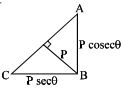
View full question & answer→MCQ 4371 Mark
If the arcs of the same length in two circles $S_1$ and $S_2$ subtend angles $75^o $ and $120^o $ respectively at the centre. The ratio $\frac{{{S_1}}}{{{S_2}}}$ is equal to
- A
$\frac{1}{5}$
- B
$\frac{{81}}{{16}}$
- ✓
$\frac{{64}}{{25}}$
- D
$\frac{{25}}{{64}}$
AnswerCorrect option: C. $\frac{{64}}{{25}}$
c
$\theta=\frac{l}{r}$
$\theta \rightarrow$ angle (in radians)
$l \rightarrow$ are length
$r \rightarrow$ radius
$l_{1}=l_{2}=l(\operatorname{say})$
$\theta_{1}=75^{\circ} \quad ; \quad \theta_{2}=120^{\circ}$
$1^{0}=\left(\frac{\pi}{180}\right)^{c}$
$\theta_{1}=75^{\circ}=\left(\frac{5 \pi}{12}\right)^{\text {radians }}$
$\theta_{1}=120^{\circ}=\left(\frac{2 \pi}{3}\right)^{\text {radians }}$
$\frac{r_{1}}{r_{2}}=\frac{\frac{l_{1}}{\theta_{1}}}{\frac{\lambda_{2}}{\theta_{2}}}$
$=\frac{l_{1}}{\theta_{1}} \times \frac{\theta_{2}}{l_{2}}$
$r_{1}: r_{2}=8: 5$
View full question & answer→MCQ 4381 Mark
Let $S_1,S_2$ and $S_3$ be three circles of unit radius which touch each other externally. The common tangent to each pair of circles are drawn and extended so that they can intersect and form a triangle $ABC$ with circumradius $R,$ then $R$ is equal to
- A
$4+2\sqrt 3$
- ✓
$2(1+\frac{1}{\sqrt 3})$
- C
$4(1+\sqrt 3)$
- D
$\frac{3(1+\sqrt 3)}{2}$
AnswerCorrect option: B. $2(1+\frac{1}{\sqrt 3})$
b
Ans. $( 2 )$
$\mathrm{BM}=\mathrm{NC}=\cot 30^{\circ}=\sqrt{3}$
and $\mathrm{MN}=2$
$\therefore \mathrm{BC}=2(1+\sqrt{3})$
$\therefore$ By sine Rule
$\mathrm{R}=\frac{2(1+\sqrt{3})}{2 \sin 60^{\circ}}=2\left(1+\frac{1}{\sqrt{3}}\right)$
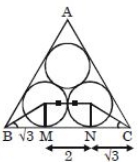
View full question & answer→MCQ 4391 Mark
If $\tan B = \frac{{n\sin A\cos A}}{{1 - n{{\cos }^2}A}}$ then $\tan(A + B)$ equals
- ✓
$\frac{{\sin A}}{{(1 - n)\cos A}}$
- B
$\frac{{(n - 1)\cos A}}{{\sin A}}$
- C
$\frac{{\sin A}}{{(n - 1)\cos A}}$
- D
$\frac{{\sin A}}{{(n + 1)\cos A}}$
AnswerCorrect option: A. $\frac{{\sin A}}{{(1 - n)\cos A}}$
a
$\tan(A + B)$ $=$$\frac{{\tan A + \tan B}}{{1 - \tan A\tan B}}$ $=$$\frac{{\tan A + \frac{{n\sin A\cos A}}{{1 - n{{\cos }^2}A}}}}{{1 - \tan A\,\cdot\,\frac{{n\sin A\cos A}}{{1 - n{{\cos }^2}A}}}}$ $=$$\frac{{\sin A(1 - n{{\cos }^2}A) + n\sin A{{\cos }^2}A}}{{\cos A(1 - n{{\cos }^2}A) - n{{\sin }^2}A\cos A}}$
$=$$\frac{{\sin A - 0}}{{\cos A(1 - n{{\cos }^2}A - n{{\sin }^2}A)}}$ $=$ $\frac{{\sin A}}{{(1 - n)\cos A}}$
View full question & answer→MCQ 4401 Mark
If $2\, cos\theta + sin\theta = 1$, then the value of $4\, cos\theta + 3sin\theta$ is equal to
- A
$3$
- B
$-5$
- C
$\frac{7}{5}$
- ✓
Both $(a)$ and $(c)$
AnswerCorrect option: D. Both $(a)$ and $(c)$
d
$(2cos\theta )^2 = (1 - sin\theta )^2$
$\Rightarrow 5sin^2\theta - 2sin\theta - 3 = 0$
$\Rightarrow sin\theta = 1$ or $- \frac{3}{5}$ , now proceed
If $sin\theta = 1 \Rightarrow cos\theta = 0$
$\Rightarrow E = 3;$ if $sin\theta = - \frac{3}{5}$ $\Rightarrow cos\theta = \frac{4}{5}$ or $- \frac{4}{5}$ but $cos\theta \ne - \frac{4}{5}$ (think!)
hence $E = \frac{7}{5}$
View full question & answer→MCQ 4411 Mark
In a $\Delta ABC$ , the value of $sinA\ cos B\ cos C\ +\ sinB\ cosC\ cosA\ +\ sinC\ cosA\ cosB$ is
- A
$0$
- B
$1$
- C
$\frac{{3\sqrt 3 }}{8}$
- ✓
$sinA\ sinB\ sinC$
AnswerCorrect option: D. $sinA\ sinB\ sinC$
d
$sinA\ cosB\ cosC\ +\ sinB\ cosC\ cosA\ +\ sinC\ cosA\ cosB$
$=\ cosA\ cosB\ cosC\ (tanA\ +\ tanB\ +\ tanC)$
$=\ cosA\ cosB\ cosC\ . tanA\ tanB\ tanC$
$=\ sinA\ sinB\ sinC$
View full question & answer→MCQ 4421 Mark
If $\tan \left( {\frac{\pi }{4} + \theta } \right) + \tan \left( {\frac{\pi }{4} - \theta } \right) = \lambda \sec 2\theta ,$ $\lambda$ =
Answerd
$\frac{{1 + \tan \theta }}{{1 - \tan \theta }} + \frac{{1 - \tan \theta }}{{1 + \tan \theta }} = \lambda \left[ {\frac{{1 + {{\tan }^2}\theta }}{{1 - {{\tan }^2}\theta }}} \right]$
View full question & answer→MCQ 4431 Mark
If $x + y = 3 - cos4\theta$ and $x - y = 4 \,sin2\theta$ then
- A
$x^4 + y^4 = 9$
- B
$\sqrt x \, + \,\sqrt y \, = \,16\,$
- C
$x^3 + y^3 = 2(x^2 + y^2)$
- ✓
$\sqrt x \, + \,\sqrt y \, = \,2$
AnswerCorrect option: D. $\sqrt x \, + \,\sqrt y \, = \,2$
d
On adding and subtracting
$x = \frac{{3 - \cos 4\theta \, + 4\sin 2\theta }}{2}\,$; $y = \frac{{3 - \cos 4\theta \, - 4\sin 2\theta }}{2}\,$
$x =\frac{{4(1 + \sin 2\theta )\, - \,(1 + \cos 4\theta )}}{2}\,$ ; $y =\frac{{4(1 - \sin 2\theta )\, - \,(1 + \cos 4\theta )}}{2}\,$
$x = 2 (1 + sin2\theta ) - cos^22\theta$ ; $y = 2 (1 - sin2\theta ) - cos^22\theta$
$x = 1 + 2\, sin2\theta + sin^22\theta$ ;$ y = 1 - 2 sin2\theta + sin^22\theta$
$x = (1 + sin2\theta )^2$ ;$y = (1 - sin2\theta )^2$ $\Rightarrow \sqrt x \, + \,\sqrt y \, = \,2$
Alternate : Or put $\theta$ = $\frac{\pi }{4}\,$ and verify
View full question & answer→MCQ 4441 Mark
The exact value of $\cos \frac{{2\pi }}{{28}}\,\cos ec\frac{{3\pi }}{{28}}\, + \,\cos \frac{{6\pi }}{{28}}\,\cos ec\frac{{9\pi }}{{28}} + \cos \frac{{18\pi }}{{28}}\cos ec\frac{{27\pi }}{{28}}$ is equal to
Answerd
$put \frac{\pi}{28} = x$
$T_1$ $= \frac{{\cos \,2\,x}}{{\sin \,3\,x}}$
$= \frac{{\cos \,2\,x\,\,\sin \,x}}{{\sin \,3\,x\,\,\sin \,x}} $
$= \frac{1}{2}\left[ {\frac{{\sin \,3x\, - \,\sin \,x}}{{\sin \,3x\,\,\sin \,x}}} \right] $
$= \frac{1}{2}\left[ {\cos \,ecx\, - \,\cos \,ec\,3x} \right]$ etc.
View full question & answer→MCQ 4451 Mark
$\frac{{\tan \,\,\left( {x\,\, - \,\,{\textstyle{\pi \over 2}}} \right)\,\,.\,\,\cos \,\,\left( {{\textstyle{{3\pi } \over 2}}\,\, + \,\,x} \right)\,\, - \,\,{{\sin }^3}\,\left( {{\textstyle{{7\pi } \over 2}}\,\, - \,\,x} \right)}}{{\cos \,\,\left( {x\,\, - \,\,{\textstyle{\pi \over 2}}} \right)\,\,.\,\,\tan \,\,\left( {{\textstyle{{3\pi } \over 2}}\,\, + \,\,x} \right)}}$ when simplified reduces to :
- A
$sin \,x\, cos\, x$
- B
$- sin^2\, x$
- C
$- sin\, x\, cos\, x$
- ✓
$sin^2x$
AnswerCorrect option: D. $sin^2x$
d
$\frac{{\tan \,\,\left( {x\,\, - \,\,{\textstyle{\pi \over 2}}} \right)\,\,.\,\,\cos \,\,\left( {{\textstyle{{3\pi } \over 2}}\,\, + \,\,x} \right)\,\, - \,\,{{\sin }^3}\,\left( {{\textstyle{{7\pi } \over 2}}\,\, - \,\,x} \right)}}{{\cos \,\,\left( {x\,\, - \,\,{\textstyle{\pi \over 2}}} \right)\,\,.\,\,\tan \,\,\left( {{\textstyle{{3\pi } \over 2}}\,\, + \,\,x} \right)}}$
$=$$\frac{{ - \cot x\,.\,\sin x\, + \,{{\cos }^3}x}}{{ - \sin x\,.\cot x}}$ $=$$\frac{{{{\cos }^3}x\, - \,\frac{{\sin x.\cos x}}{{\sin x}}}}{{ - \,\sin x\,.\,\frac{{\cos x}}{{\sin x}}}}$ $= sin^2x$
View full question & answer→MCQ 4461 Mark
If $\frac{{5\pi }}{2} < x < 3\pi $, then the value of the expression $\frac{{\sqrt {1 - \sin x} + \sqrt {1 + \sin x} }}{{\sqrt {1 - \sin x} - \sqrt {1 + \sin x} }}$ is
- A
$-cot \frac{x}{2}$
- B
$cot \frac{x}{2}$
- C
$ tan \frac{x}{2}$
- ✓
$-tan \frac{x}{2}$
AnswerCorrect option: D. $-tan \frac{x}{2}$
d
On rationalizing ; we get
$\frac{{1 - \sin x\, + 1 + \sin x\, + 2|\cos x|}}{{1 - \sin x - 1 + \sin x}}$ $=$ $\frac{{2\left( {1 + |\cos x|} \right)}}{{ - \,2\,(\sin x)}}$ $=$$\frac{{1 - \cos x}}{{ - (\sin x)}}$
View full question & answer→MCQ 4471 Mark
If $x\, sin \theta = y\, sin \, \left( {\theta \,\, + \,\,\frac{{2\,\pi }}{3}} \right) = z\, sin \, \left( {\theta \,\, + \,\,\frac{{4\,\pi }}{3}} \right)$ then :
- A
$x + y + z = 0$
- ✓
$xy + yz + zx = 0$
- C
$xyz + x + y + z = 1$
- D
AnswerCorrect option: B. $xy + yz + zx = 0$
b
$\frac{x}{y}\,\, = \,\frac{{\sin 2\pi /3\,.\,\,\cos \theta \,\, + \,\cos 2\pi /3\,.\sin \theta }}{{\sin \theta }}$
$=$ $\frac{1}{2}\,\left[ {\frac{{\sqrt 3 \,\cos \theta \, - \,\sin \theta }}{{\sin \theta }}} \right]$
$=$$\frac{{\sqrt 3 }}{2}\,\cot \theta \, - \,\frac{1}{2}$ ....$(1)$
$|||^{1y}$ $\frac{x}{z}\,\, = \,\,\frac{{\sin \theta \,.\,\cos 4\pi /3\,\, + \,\,\cos \theta \,.\,\sin 4\pi /3}}{{\sin \theta }}$
$=$ $ - \,\,\frac{1}{2}\,\, - \,\,\frac{{\sqrt 3 }}{2}\,\,\cot \theta $ ....$(2)$
$\frac{x}{y}\,\, + \,\,\frac{x}{z}\,\, = \,\, - 1$
$\Rightarrow xz + xy + yz = 0$
View full question & answer→MCQ 4481 Mark
The value of $cos\, \frac{\pi }{{10}} \,cos\, \frac{2\pi }{{10}} \,cos\,\frac{4\pi }{{10}}\, cos\,\frac{8\pi }{{10}}\, cos\,\frac{16\pi }{{10}}$ is
- A
$\frac{1 }{{32}}$
- B
$\frac{1}{{16}}$
- C
$\frac{{\cos \,\,\left( {\pi /10} \right)}}{{16}}$
- ✓
$-\frac{{\sqrt {10\,\, + \,\,2\sqrt 5 } }}{{64}}$
AnswerCorrect option: D. $-\frac{{\sqrt {10\,\, + \,\,2\sqrt 5 } }}{{64}}$
d
$\pi /10 = \theta$
$E =$$\frac{{2\,\sin \theta \,(\cos \theta \,.\,\cos 2\theta \,.\,\cos 4\theta \,.\cos 8\theta \,.\cos 16\theta \,)}}{{2\,\sin \theta }}$
$=$$\frac{{\sin 32\theta }}{{32\,\sin \theta }}$
$=$$\frac{{\sin (30\theta \, + \,2\theta )}}{{32.\,\sin \theta }}$ $=$ $ - \,\,\frac{1}{{16}}\,\cos \frac{\pi }{{10}}$
$=$ $ - \,\,\frac{1}{{16}}\,\,\sqrt {1 - {{\sin }^2}\pi /10} $
View full question & answer→MCQ 4491 Mark
The value of $cot\, x + cot\, (60^o + x) + cot\, (120^o + x)$ is equal to :
- A
$cot\, 3x$
- B
$tan\, 3x$
- C
$3\, tan \,3x$
- ✓
$\frac{{3\,\, - \,\,9\,{{\tan }^2}\,x}}{{3\,\tan \,x\,\, - \,\,{{\tan }^3}\,x}}$
AnswerCorrect option: D. $\frac{{3\,\, - \,\,9\,{{\tan }^2}\,x}}{{3\,\tan \,x\,\, - \,\,{{\tan }^3}\,x}}$
d
Note that the given expression simplifies to $3 \, cot3x$
$cotx +\frac{{\cos (60 + x)}}{{\sin (60 + x)}}\,\, + \,\,\frac{{\cos (x - 60)}}{{\sin (x - 60)}}$
$=$ $\frac{{\cos x}}{{\sin x}}\,\, + \,\,\frac{{\sin (2x)}}{{\sin (x + 60)\,\sin (x - 60)}}$
$=$$\frac{{\cos x}}{{\sin x}}\,\, + \,\,\frac{{8\,\sin x\,\,\cos x}}{{4{{\sin }^2}x\, - \,3}}$
$=$ $\frac{{4\,{{\sin }^2}x\,\,\cos x\,\, - \,3\cos x\,\, + \,8\,{{\sin }^2}x\,\cos x}}{{4{{\sin }^3}x\, - \,3\,\sin x}}$
$=$ $\frac{{3[3\cos x - 4{{\cos }^3}x]}}{{{{\sin }^3}x}}\,\,$
$= 3\, cot3x$
$\Rightarrow$ $\frac{{3[1 - 3{{\tan }^2}x]}}{{3\tan x\, - \,{{\tan }^3}x}}\,\,$
View full question & answer→MCQ 4501 Mark
The value of $\frac{{3 + \cot \,7\,{6^ \circ }\,\cot \,{{16}^ \circ }}}{{\cot \,{{76}^ \circ } + \cot \,{{16}^ \circ }}}$ is :
- ✓
$cot \,44^º$
- B
$tan \, 44^º$
- C
$tan \, 2^º$
- D
$cot \, 46^º$
AnswerCorrect option: A. $cot \,44^º$
a
Using $\frac{{3\,\sin {{76}^0}\,.\,\sin {{16}^0}\, + \,\cos {{76}^0}\,\cos {{16}^0}}}{{\cos {{76}^0}\,\sin {{16}^0}\, + \,\sin {{76}^0}\,\cos {{16}^0}}}$
$=$ $\frac{{2\,\sin {{76}^0}\,\sin {{16}^0}\, + \,[\sin {{76}^0}\,\sin {{16}^0}\, + \,\cos {{76}^0}\,\cos {{16}^0}]}}{{\sin {{92}^0}}}$
$=$ $\frac{{\cos 60^\circ - \cos 92^\circ + \cos 60^\circ }}{{\sin 92^\circ }}$
$=$$\frac{{1 - \cos {{92}^0}}}{{\sin {{92}^0}}}$ $=$$\frac{{2\,{{\sin }^2}{{46}^0}}}{{2\,\sin {{46}^0}\,\cos {{46}^0}}}\,$ $= tan 46^o = cot44^o$
View full question & answer→MCQ 4511 Mark
The value of $cosec \frac{\pi }{{18}} - \sqrt 3 \,sec\, \frac{\pi }{{18}}$ is a
- A
- B
rational which is not integral
- C
- ✓
Answerd
$\frac{1}{{\sin \pi /18}}\,\, - \,\,\frac{{\sqrt 3 }}{{\cos \pi /18}}$ $=$$\frac{{2\,\left[ {\frac{1}{2}\cos \frac{\pi }{{18}}\, - \,\frac{{\sqrt 3 }}{2}\,\,\sin \frac{\pi }{{18}}} \right]}}{{\frac{{\sin \frac{\pi }{9}}}{2}}}$
$=$$\frac{{4\left[ {\sin \frac{\pi }{6}\,\,\cos \frac{\pi }{{18}}\,\, - \,\,\cos \frac{\pi }{6}\,\,\sin \frac{\pi }{{18}}} \right]}}{{\sin \frac{\pi }{9}}}$ $= 4$
View full question & answer→MCQ 4521 Mark
$\frac{{\sec \,8\theta - 1}}{{\sec \,4\theta - 1}}$ is equal to
- A
$tan\, 2\theta \,cot \,8\theta$
- B
$tan \,8\theta\, tan \,2\theta$
- C
$cot\, 8\theta \,cot \,2\theta$
- ✓
$tan \,8\theta\, cot\, 2\theta$
AnswerCorrect option: D. $tan \,8\theta\, cot\, 2\theta$
d
$\frac{\sec 8 \theta-1}{\sec 4 \theta-1}=\frac{\frac{1}{\cos 8 \theta}-1}{\frac{1}{\cos 4 \theta}-1}=\frac{1-\cos 8 \theta}{\cos 8 \theta} \times \frac{\cos 4 \theta}{1-\cos 4 \theta}$
$=\frac{2 \sin ^{2} 4 \theta}{\cos 8 \theta} \times \frac{\cos 4 \theta}{2 \sin ^{2} 2 \theta} \quad\left[\because 1-\cos 8 \theta=2 \sin ^{2} \frac{8 \theta}{2}=2 \sin ^{2} 4 \theta\right]$ and
$\left[\because 1-\cos 4 \theta=2 \sin ^{2} \frac{4 \theta}{2}=2 \sin ^{2} 2 \theta\right]$
$=\frac{(2 \sin 4 \theta \cos 4 \theta)}{\cos 8 \theta} \times \frac{\sin 4 \theta}{2 \sin ^{2} 2 \theta}$
$=\left(\frac{2 \sin 4 \theta \cos 4 \theta}{\cos 8 \theta}\right) \times\left(\frac{2 \sin 2 \theta \cos 2 \theta}{2 \sin ^{2} 2 \theta}\right)$
$=\left(\frac{\sin 2(4 \theta)}{\cos 8 \theta}\right) \times\left(\frac{\cos 2 \theta}{\sin 2 \theta}\right)=\left(\frac{\sin 8 \theta}{\cos 8 \theta}\right) \times\left(\frac{\cos 2 \theta}{\sin 2 \theta}\right)$
$\tan 8 \theta \cot 2 \theta$
View full question & answer→MCQ 4531 Mark
Number of values of $ x \in \left[ {0,2\pi } \right]$ satisfying the equation $cotx - cosx = 1 - cotx. cosx$
Answerb
$\cot x-\cos x=1-\cot x \cos x$
$1-\cot x+\cos x-\cot x \cos x=0$
$(1-\cot x)(1+\cos x)=0$
$\therefore \cot x=1$ or $\cos x=-1$
$x=n \pi+\frac{\pi}{4}$ or $x=(2 n+1) \pi$
$\therefore$ Solution set $=x: x=2 n \pi+\pi, n \in I \cup x: x=2 n \pi+\frac{\pi}{4}, n \in I$
View full question & answer→MCQ 4541 Mark
The exact value of $cos^273^o + cos^247^o + (cos73^o . cos47^o )$ is
Answerc
$\frac{{1 + \cos {{146}^o }}}{2}$ $+$$\frac{{1 + \cos {{94}^o }}}{2}$ $+$ $\frac{{\cos {{120}^o } + \cos {{26}^o }}}{2}$
$= 1 +$ $\left[ {\frac{{\cos {{146}^o }\, + \cos {{94}^o }}}{2}} \right]\,\, - \,\,\frac{1}{4}\, + \,\frac{{\cos {{26}^o }}}{2}$
$= 3/4$
View full question & answer→MCQ 4551 Mark
If $A$ and $B$ are complimentary angles, then :
- ✓
$\left( {1\,\, + \,\,\tan \,\frac{A}{2}} \right)\,\,\left( {1\,\, + \,\,\tan \,\frac{B}{2}} \right) = 2$
- B
$\left( {1\,\, + \,\,\cot \,\frac{A}{2}} \right)\,\,\left( {1\,\, + \,\,\cot \,\frac{B}{2}} \right) = 2$
- C
$\left( {1\,\, + \,\,\sec \,\frac{A}{2}} \right)\,\,\left( {1\,\, + \,\,\cos ec\,\frac{B}{2}} \right) = 2$
- D
$\left( {1\,\, - \,\,\tan \,\frac{A}{2}} \right)\,\,\left( {1\,\, - \,\,\tan \,\frac{B}{2}} \right) = 2$
AnswerCorrect option: A. $\left( {1\,\, + \,\,\tan \,\frac{A}{2}} \right)\,\,\left( {1\,\, + \,\,\tan \,\frac{B}{2}} \right) = 2$
a
$A = \pi /2 - B \Rightarrow \frac{A}{2}$ $= \frac{\pi }{4} - \frac{B}{2}$
Hence $1 + tanA/2 = 1 + \frac{{1 - \tan \,B/2}}{{1 + \tan \,B/2}}$ $= \frac{2}{{1 + \tan \,\frac{B}{2}}}$
Hence $A$ is correct
View full question & answer→MCQ 4561 Mark
If $\theta = 3\, \alpha$ and $sin\, \theta =$ $\frac{a}{{\sqrt {{a^2}\,\, + \,\,{b^2}} }}$. The value of the expression , $a \,cosec\, \alpha - b \,sec\, \alpha$ is
- A
$\frac{1}{{\sqrt {{a^2}\,\, + \,\,{b^2}} }}$
- ✓
$2 \sqrt {{a^2}\,\, + \,\,{b^2}}$
- C
$a + b$
- D
AnswerCorrect option: B. $2 \sqrt {{a^2}\,\, + \,\,{b^2}}$
b
$a \,cosec\alpha - bsec\alpha $ $=$ $\frac{a}{{\sin \alpha }}\,\, - \,\,\frac{b}{{\cos \alpha }}$
$\frac{{\sqrt {{a^2} + {b^2}} }}{{\sin \alpha \,\,\cos \alpha }}\,\,\,\left[ {\frac{a}{{\sqrt {{a^2} + {b^2}} }}\,\,\cos \alpha \, - \,\frac{b}{{\sqrt {{a^2} + {b^2}} }}\,\sin \alpha } \right]$
Now $sin3\alpha =$ $\frac{a}{{\sqrt {{a^2} + {b^2}} }}$ gives
$ \Rightarrow \,\,\sqrt {{a^2} + {b^2}} \,\,\left[ {\frac{{\sin 3\alpha \,\cos \alpha \,\, - \,\,\cos 3\alpha \,\,\sin \alpha }}{{\sin \alpha \,\,\cos \alpha }}} \right] = 2\sqrt {{a^2}\, + \,{b^2}} $
View full question & answer→MCQ 4571 Mark
The value of $cot\, 7\frac{{{1^0}}}{2}$ $+ tan\, 67 \frac{{{1^0}}}{2} - cot 67 \frac{{{1^0}}}{2} - tan7 \frac{{{1^0}}}{2}$ is :
- A
- ✓
- C
$2(3 + 2 \sqrt 3)$
- D
$2 (3 -\sqrt 3)$
View full question & answer→MCQ 4581 Mark
The value of the expression $(sinx + cosecx)^2 + (cosx + secx)^2 - ( tanx + cotx)^2$ wherever defined is equal to
View full question & answer→MCQ 4591 Mark
If $A = 580^o$ then which one of the following is true
- A
$2\,\sin \left( {\frac{A}{2}} \right)\,\, = \,\,\sqrt {1 + \sin A} \, - \,\sqrt {1 - \sin A} $
- B
$2\sin \left( {\frac{A}{2}} \right)\, = \,\, - \,\,\sqrt {1 + \sin A} \,\, + \,\sqrt {1 - \sin A} $
- ✓
$2\sin \left( {\frac{A}{2}} \right)\, = \,\, - \,\,\sqrt {1 + \sin A} \,\, - \,\sqrt {1 - \sin A} $
- D
$2\sin \left( {\frac{A}{2}} \right)\, = \,\,\,\,\sqrt {1 + \sin A} \,\, + \,\sqrt {1 - \sin A} $
AnswerCorrect option: C. $2\sin \left( {\frac{A}{2}} \right)\, = \,\, - \,\,\sqrt {1 + \sin A} \,\, - \,\sqrt {1 - \sin A} $
View full question & answer→MCQ 4601 Mark
The expression $\frac{{{{\tan }^2}20^\circ - {{\sin }^2}20^\circ }}{{{{\tan }^2}20^\circ \,\cdot\,{{\sin }^2}20^\circ }}$ simplifies to
- A
a rational which is not integral
- B
- C
- ✓
a natural which is not composite
AnswerCorrect option: D. a natural which is not composite
d
$tan^220^° - sin^220^° = tan^220^° (1 - cos^220^°) = tan^220^°\, sin^220^°$
Hence $ N^r = D^r$
View full question & answer→MCQ 4611 Mark
The value of $x$ that satisfies the relation $x = 1 - x + x^2 - x^3 + x^4 - x^5 + ......... \infty$
- A
$2\, cos36^°$
- B
$2 \,cos144^°$
- ✓
$2\, sin18^°$
- D
AnswerCorrect option: C. $2\, sin18^°$
c
$x = \frac{1}{{1 + x}}$ $\Rightarrow$ $x^2 + x - 1 = 0$
$x = \frac{{ - 1 + \sqrt 5 }}{2}$ or $\frac{{ - 1 - \sqrt 5 }}{2}$ (rejected, think ! )
hence $x = \left( {\frac{{\sqrt 5 - 1}}{4}} \right)\,\cdot\,2 = 2 \, sin18^°$
View full question & answer→MCQ 4621 Mark
Which of the following functions have the maximum value unity ?
- A
$sin^2 x - cos^2 x$
- B
$\frac{{\sin \,2x\,\, - \,\,\cos \,2x}}{{\sqrt 2 }}$
- C
$-\frac{{\sin \,2x\,\, - \,\,\cos \,2x}}{{\sqrt 2 }}$
- ✓
View full question & answer→MCQ 4631 Mark
The value of $\frac{1}{4} \,\,tan \frac{\pi}{8} +\frac{1}{8} \,\,tan \frac{\pi}{16}+\frac{1}{16} \,\,tan \frac{\pi}{32}+.\,.\,.\,\infty $ terms is equal to-
- A
$\frac{5}{\pi}-\frac{1}{2}$
- B
$\frac{3}{\pi}+\frac{1}{2}$
- ✓
$\frac{2}{\pi}-\frac{1}{2}$
- D
$\frac{4}{\pi}-\frac{1}{4}$
AnswerCorrect option: C. $\frac{2}{\pi}-\frac{1}{2}$
c
$\cot x=\frac{1}{2}\left(\cot \frac{x}{2}-\tan \frac{x}{2}\right)$
$\cot x=\frac{1}{2}\left\{\frac{1}{2}\left(\cot \frac{x}{4}-\tan \frac{x}{4}\right)-\tan \frac{x}{2}\right\}$
$=\frac{1}{4} \cot \frac{x}{4}-\frac{1}{4} \tan \frac{x}{4}-\frac{1}{2} \tan \frac{x}{2}$
$=\frac{1}{8}\left(\cot \frac{x}{8}-\tan \frac{x}{8}\right)-\frac{1}{4} \tan \frac{x}{4}-\frac{1}{2} \tan \frac{x}{2}$
$\Rightarrow \cot x=\frac{1}{2^{n}} \cot \left(\frac{x}{2^{n}}\right)-\frac{1}{2^{n-1}} \tan \left(\frac{x}{2^{n-1}}\right) \dots$
$-\frac{1}{8} \tan \left(\frac{x}{8}\right)-\frac{1}{4} \tan \left(\frac{x}{4}\right)-\frac{1}{2} \tan \left(\frac{x}{2}\right)$
$\Rightarrow \frac{1}{2} \tan \frac{x}{2}+\frac{1}{4} \tan \frac{x}{2}+\frac{1}{8} \tan \frac{x}{8} \ldots \ldots=\frac{1}{2^{n}} \cot \left(\frac{x}{2^{n}}\right)-\cot x$
$\Rightarrow \frac{1}{2} \tan \frac{\mathrm{x}}{2}+\frac{1}{4} \tan \frac{\mathrm{x}}{4}+\ldots . . \infty \mathrm{terms}$
$ = \mathop {\lim }\limits_{n \to \infty } \,\frac{1}{{{2^n}}}\cot \left( {\frac{x}{{{2^n}}}} \right) - \cot x = \frac{1}{x} - \cot x$
put $x=\frac{\pi}{2}$
View full question & answer→MCQ 4641 Mark
Let $A, B, C$ are three angles such that $sinA + sinB + sinC = 0,$ then
$ \frac {sinAsin BsinC}{(sin 3A+ sin 3B+ sin 3C)}$ (wherever definied) is -
- A
$12$
- B
$-12$
- ✓
$ - \frac{1}{12}$
- D
$\frac{1}{12}$
AnswerCorrect option: C. $ - \frac{1}{12}$
c
$\frac{\sin A \sin B \sin C}{\left(3(\sin A+\sin B+\sin C)-4\left(\sin ^{3} A+\sin ^{3} B+\sin ^{3} C\right)\right)}$
$=-\frac{1}{12}$
View full question & answer→MCQ 4651 Mark
The value of $\sum_{r-1}^{18} cos^2(5r)^o,$ where $x^o $ denotes the $x$ degree, is equals to
- A
$\frac{19}{2}$
- B
$\frac{7}{2}$
- ✓
$\frac{17}{2}$
- D
$0$
AnswerCorrect option: C. $\frac{17}{2}$
c
$=\cos ^{2} 5^{\circ}+\cos ^{2} 10^{\circ}+\ldots+\cos ^{2} 85^{\circ}+\cos ^{2} 90^{\circ}$
$=8+\frac{1}{2}=\frac{17}{2}$
View full question & answer→MCQ 4661 Mark
The value of $tan^{-1} (\frac{sin2 -1}{cos2})$ is equal to:-
- A
$\frac{\pi}{2} - 1$
- B
$2 - \frac{\pi}{2}$
- ✓
$1- \frac{\pi}{4}$
- D
$ \frac{\pi}{4}-1$
AnswerCorrect option: C. $1- \frac{\pi}{4}$
c
$\tan ^{-1}\left[\frac{2 \sin 1 \cos 1-\cos ^{2} 1-\sin ^{2} 1}{\cos ^{2} 1-\sin ^{2} 1}\right]$
$=-\tan ^{-1} \frac{\cos 1-\sin 1}{\cos 1+\sin 1}$
$=-\tan ^{-1} \tan \left[\frac{\pi}{4}-1\right]$
$=1-\frac{\pi}{4}$
View full question & answer→MCQ 4671 Mark
${\sin ^4}\frac{\pi }{8} + {\sin ^4}\frac{{3\pi }}{8} + {\sin ^4}\frac{{5\pi }}{8} + {\sin ^4}\frac{{7\pi }}{8} = $
- A
$\frac{1}{2}$
- B
$\frac{1}{4}$
- ✓
$\frac{3}{2}$
- D
$\frac{3}{4}$
AnswerCorrect option: C. $\frac{3}{2}$
c
$\sin ^{4} \frac{\pi}{8}+\sin ^{4} \frac{3 \pi}{8}+\sin ^{4} \frac{5 \pi}{8}+\sin ^{4} \frac{7 \pi}{8}$
$=\frac{1}{4}\left[\left(2 \sin ^{2} \frac{\pi}{8}\right)^{2}+\left(2 \sin ^{2} \frac{3 \pi}{8}\right)^{2}\right]$
$\quad+\frac{1}{4}\left[\left(2 \sin ^{2} \frac{\pi}{8}\right)^{2}+\left(2 \sin ^{2} \frac{3 \pi}{8}\right)^{2}\right]$
$=\frac{1}{4}\left[\left(1-\cos \frac{\pi}{4}\right)^{2}+\left(1-\cos \frac{3 \pi}{4}\right)^{2}\right]$
$\quad+\frac{1}{4}\left[\left(1-\cos \frac{\pi}{4}\right)^{2}+\left(1-\cos \frac{3 \pi}{4}\right)^{2}\right]$
$=\frac{1}{4}\left[\left(1-\frac{1}{\sqrt{2}}\right)^{2}+\left(1+\frac{1}{\sqrt{2}}\right)^{2}\right]$
$+\frac{1}{4}\left[\left(1-\frac{1}{\sqrt{2}}\right)^{2}+\left(1+\frac{1}{\sqrt{2}}\right)^{2}\right]$
$=\frac{1}{4}(3)+\frac{1}{4}(3)=\frac{3}{2}$
View full question & answer→MCQ 4681 Mark
If $\frac{{\cos x}}{a} = \frac{{\cos (x + \theta )}}{b} = \frac{{\cos (x + 2\theta )}}{c} = \frac{{\cos (x + 3\theta )}}{d} \, ,$ then $\left( {\frac{{a + c}}{{b + d}}} \right)$ is equal to :-
- A
$\frac{a}{d}$
- B
$\frac{c}{d}$
- ✓
$\frac{b}{c}$
- D
$\frac{d}{a}$
AnswerCorrect option: C. $\frac{b}{c}$
c
Correct Answer - C
For each of the ratios be $1 / k$.
$\frac{a+c}{b+d}=\frac{k \cos x+k \cos (x+2 B)}{k \cos (x+\theta)+k \cos (x+3 \theta)}$
$=\frac{2 \cos (x+\theta) \cos \theta}{2 \cos (x+2 \theta) \cos \theta}$
$=\frac{\cos (x+\theta)}{\cos (x+2 \theta)}=\frac{b}{c}$
View full question & answer→MCQ 4691 Mark
If $\sin \left( {x + \frac{{4\pi }}{9}} \right) = a;\,$ $\frac{\pi }{9}\, < \,x\, < \,\frac{\pi }{3},$ then $\cos \left( {x + \frac{{7\pi }}{9}} \right)$ equals :-
- A
$\frac{{\sqrt {(1 - {a^2})} - a\sqrt 3 }}{2}$
- B
$\frac{{1 - {a^2} + a\sqrt 3 }}{2}$
- C
$\frac{{a\sqrt 3 - \sqrt {(1 - {a^2})} }}{2}$
- ✓
$\frac{{ - \sqrt {(1 - {a^2})} - a\sqrt 3 }}{2}$
AnswerCorrect option: D. $\frac{{ - \sqrt {(1 - {a^2})} - a\sqrt 3 }}{2}$
d
Given that $\sin \left(x+80^{\circ}\right)=a$
$\therefore \cos \left(x+140^{\circ}\right)=\cos \left\{\left(x+80^{\circ}\right)+60^{\circ}\right\}$
${=\cos \left(x+80^{\circ}\right) \cos 60^{\circ}-\sin \left(x+80^{\circ}\right) \sin 60^{\circ}} $
${=-\sqrt{\left(1-a^{2}\right)} \cdot \frac{1}{2}-\frac{a \sqrt{3}}{2}=\frac{-\sqrt{\left(1-a^{2}\right)}-\sqrt{3} a}{2}}$
$\left(\therefore 20^{\circ}<\mathrm{x}<60^{\circ}, \cos \left(\mathrm{x}+80^{\circ}\right)\right.is -ve)$
View full question & answer→MCQ 4701 Mark
If $\sin \theta = \frac{1}{2}\left( {\sqrt {\frac{x}{y}\,} + \,\sqrt {\frac{y}{x}} } \right)\,,\,\left( {x,y \in R\, - \{ 0\} } \right)$. Then
Answera
$\frac{1}{2}\left( {\sqrt {\frac{x}{y}} + \sqrt {\frac{y}{x}} } \right) \ge 1$
$\Rightarrow \sqrt{\frac{x}{y}}+\sqrt{\frac{y}{x}}=2$
$ \Rightarrow x=y$
View full question & answer→MCQ 4711 Mark
If $\alpha$, $\beta$,$\gamma$ are positive number such that $\alpha + \beta = \pi$ and $\beta + \gamma = \alpha$, then $tan\ \alpha$ is equal to - (where $\gamma \ne n\pi ,n \in I$ )
- A
$ - 2\sqrt {\frac{{\tan \beta + \tan \gamma }}{{\tan \gamma }}}$
- B
$\sqrt {\frac{{2\tan \beta + \tan \gamma }}{{\tan \gamma }}}$
- ✓
$ - \sqrt {\frac{{2\tan \beta + \tan \gamma }}{{\tan \gamma }}}$
- D
$\sqrt {\frac{{\tan \beta + \tan \gamma }}{{\tan \gamma }}}$
AnswerCorrect option: C. $ - \sqrt {\frac{{2\tan \beta + \tan \gamma }}{{\tan \gamma }}}$
c
$\beta+\gamma=\alpha$
$\frac{\tan \beta+\tan \gamma}{1-\tan \beta \tan \gamma}=\tan \alpha$
$\tan \beta+\tan \gamma=\tan \alpha-\tan \beta \tan \gamma \tan \alpha$
use $\alpha+\beta=\pi \,\,\,and\,\,\,\,\,$$ \beta+r= \alpha$
$\tan \beta+\tan \gamma=-\tan \beta+\tan ^{2} \alpha \tan \gamma$
$\tan ^{2} \alpha=\frac{2 \tan \beta+\tan \gamma}{\tan \gamma}$
$\tan \alpha=-\sqrt{\frac{2 \tan \beta+\tan \gamma}{\tan \gamma}}$
View full question & answer→MCQ 4721 Mark
$cot 5^o$ -$tan5^o$ -$2$ $tan10^o$ -$4$ $tan 20^o$ -$8$ $cot40^o$ is equal to
- ✓
$0$
- B
$4\tan {40^o}$
- C
$8\tan {40^o}$
- D
$8\cot {40^o}$
Answera
Use the relation $\cot \theta - \tan \theta = 2\cot 2\theta$
View full question & answer→MCQ 4731 Mark
$cosec^2\theta $ = $\frac{4xy}{(x +y)^2}$ is true if and only if
AnswerCorrect option: B. $x = y$, $x$ $\neq$ $0$
b
$\frac{4xy}{(x +y)^2}$ $\leq$ $1$ $\Rightarrow$ $(x - y)^2$ < $0$ $x$= $y$ but $x$ $\neq$ $0$ ($cosec^2\theta$ $\neq$ $0$)
View full question & answer→MCQ 4741 Mark
If $tan\ 80^o = a$ and $tan47^o = b$, then $tan37^o$ is equal to -
- A
$\frac{{\alpha \, - \,\beta }}{{1\, + \,\alpha \beta }}$
- B
$\frac{{\alpha \beta \, + \,1}}{{\alpha \, - \,\beta }}$
- ✓
$\frac{{\alpha \beta \, - \,1}}{{\alpha \, + \,\beta }}$
- D
$\frac{{\alpha \, + \,\beta }}{{1\, - \,\alpha \beta }}$
AnswerCorrect option: C. $\frac{{\alpha \beta \, - \,1}}{{\alpha \, + \,\beta }}$
c
$\tan 80^{\circ}=\alpha=\cot 10^{\circ}=\frac{1}{\tan 10^{\circ}}$
$\tan 47^{\circ}=\beta$
$\tan 37^{\circ}=\tan \left(47^{\circ}-10^{\circ}\right)=\frac{\tan 47^{\circ}-\tan 10^{\circ}}{1+\tan 47^{\circ} \cdot \tan 10^{\circ}}$
$=\frac{\beta-\frac{1}{\alpha}}{1+\frac{\beta}{\alpha}}=\frac{\alpha \beta-1}{\alpha+\beta}$
View full question & answer→MCQ 4751 Mark
$\tan {3^o} + 2\tan {6^o} + 4\tan {12^o} + 8\cot {24^o} = \cot {\theta ^o}$ then
AnswerCorrect option: B. $cot (15\ \theta )^o =1$
b
$\tan 3^{\circ}+2 \tan 6^{\circ}+4 \tan 12^{\circ}+\frac{8}{\tan 24^{\circ}}$
$\tan 3^{\circ}+2 \tan 6^{\circ}+4 \tan 12^{\circ}+\frac{8\left(1-\tan ^{2} 12^{\circ}\right)}{2 \tan 12^{\circ}}$
$\tan 3^{\circ}+2 \tan 6^{\circ}+\frac{4}{\tan 12^{\circ}}$
$=\tan 3^{\circ}+2 \tan 6^{\circ}+\frac{2\left(1-\tan ^{2} 6^{\circ}\right)}{\tan 6^{\circ}}$
$=\cot 3 \Rightarrow \theta=3^{\circ}$
View full question & answer→MCQ 4761 Mark
If $3\cos \theta + 4\sin \theta = 5$ then $3\sin \theta - 4\cos \theta $ is
- A
$1$
- B
$-1$
- ✓
$0$
- D
$\frac {1}{2}$
Answerc
$3\cos \theta + 4\sin \theta = 5$ and $3\sin \theta - 4\cos \theta = x$
Square and add $x^2 = 0$
View full question & answer→MCQ 4771 Mark
If $cosA + cosB = cosC,\ sinA + sinB = sinC$ then the value of expression $\frac{{\sin \left( {A + B} \right)}}{{\sin 2C}}$ is
Answerb
${{\rm{e}}^{{\rm{iA}}}} + {{\rm{e}}^{{\rm{iB}}}} = (\cos A + {\rm{i}}\sin {\rm{A}}) + (\cos {\rm{B}} + {\rm{i}}\sin {\rm{B}})$
$ = \cos C + i\sin C = {e^{iC}}$
Also ${e^{ - iA}} + {e^{ - iB}} = {e^{ - iC}}$
$ \Rightarrow \frac{{{e^{iC}}}}{{{e^{i\left( {A + B} \right)}}}} = {e^{ - iC}} \Rightarrow {e^{2iC}} = {e^{i(A + B)}}$
$\Rightarrow \cos 2 C+i \sin 2 C$
$=\cos (A+B)+i \sin (A+B)$
$\therefore \sin (A+B)=\sin 2 C$
View full question & answer→MCQ 4781 Mark
If $A$ lies in the third quadrant and $3\ tanA - 4 = 0$ , then find the value of $5\ sin\ 2A + 3\ sinA + 4\ cosA$
Answera
$\tan A=\frac{4}{3}$
$\therefore \sin A=\frac{-4}{5}, \cos A=\frac{-3}{5}$
($\because$ A lies in third quadrant)
$5 \sin 2 A+3 \sin A+4 \cos A$
$=\frac{5.2 \tan A}{1-\tan ^{2} A}+3 \sin A+4 \cos A$
${=\frac{10 \cdot \frac{4}{3}}{1+\frac{16}{9}}-3 \cdot \frac{4}{5}-4 \cdot \frac{3}{5}}$
${=\frac{40}{3} \times \frac{9}{25}-\frac{12}{5}-\frac{12}{5}=\frac{24}{5}-\frac{24}{5}=0}$
View full question & answer→MCQ 4791 Mark
Value of $\frac{{4\sin {9^o}\sin {{21}^o}\sin {{39}^o}\sin {{51}^o}\sin {{69}^o}\sin {{81}^o}}}{{\sin {{54}^o}}}$ is equal to
- A
$\frac{1}{16}$
- B
$\frac{1}{32}$
- ✓
$\frac{1}{8}$
- D
$\frac{1}{4}$
AnswerCorrect option: C. $\frac{1}{8}$
c
$\frac{4 \sin 9^{\circ} \sin 21^{\circ} \sin 39^{\circ} \sin 51^{\circ} \sin 69^{\circ} \sin 81^{\circ}}{\sin 54^{\circ}}$
$=\frac{4 \sin 9^{\circ} \cos 9^{\circ} \cdot \sin 39^{\circ} \cos 39^{\circ} \sin 21^{\circ} \cos 21^{\circ}}{\sin 54^{\circ}}$
$=\frac{\sin 18^{\circ} \cdot \sin 78^{\circ} \sin 42^{\circ}}{2 \sin 54^{\circ}}$
$=\frac{\sin 18^{\circ}}{4} \frac{\left(\cos 36^{\circ}+\cos 60^{\circ}\right)}{\sin 54^{\circ}}=\frac{1}{8}$
View full question & answer→MCQ 4801 Mark
$\frac{{\sin {{81}^o} + \cos {{81}^o}}}{{\sin {{81}^o} - \cos {{81}^o}}}$ is equal to
- A
$cot9^o$
- B
$tan9^o$
- C
$cot54^o$
- ✓
$tan54^o$
AnswerCorrect option: D. $tan54^o$
d
$E=\frac{1+tan\,9^o}{1-tan\,9^o} =tan\, 54^o$
View full question & answer→MCQ 4811 Mark
$\cos \frac{\pi }{7}\cos \frac{{2\pi }}{7}\cos \frac{{3\pi }}{7} =$
- A
$-\frac{1}{8}$
- B
$\frac{1}{16}$
- ✓
$\frac{1}{8}$
- D
AnswerCorrect option: C. $\frac{1}{8}$
c
$\frac{1}{2 \sin \frac{\pi}{7}}\left[2 \sin \frac{\pi}{7} \cos \frac{\pi}{7} \cos \frac{2 \pi}{7} \cos \frac{\pi}{7}\right]$
$\frac{1}{2 \times 2 \sin \frac{\pi}{7}}\left[2 \sin \frac{2 \pi}{7} \cos \frac{2 \pi}{7} \cos \frac{3 \pi}{7}\right]$
$\frac{1}{2.4\sin \left(\frac{\pi}{3}\right)}\left(2 \sin 4 \frac{\pi}{7} \cos \frac{3 \pi}{7}\right)$
$\frac{1}{8 \sin \left(\frac{\pi}{7}\right)}\left[\sin (\pi)+\sin \left(\frac{\pi}{7}\right)\right]$
$\frac{\sin (\pi / 7)}{8 \sin (\pi / 7)}=\frac{1}{8}$
View full question & answer→MCQ 4821 Mark
Value of ${\sin ^2}\frac{\pi }{8} + {\sin ^2}\frac{{3\pi }}{8} + {\sin ^2}\frac{{5\pi }}{8} + {\sin ^2}\frac{{7\pi }}{8}$ is
- A
$1$
- ✓
$2$
- C
$1\frac{1}{8}$
- D
$2\frac{1}{8}$
Answerb
$\sin \frac{7 \pi}{8}=\sin \left(\pi-\frac{\pi}{8}\right)=\sin \frac{\pi}{8}$
$\sin \frac{5 \pi}{8}=\sin \left(\pi-\frac{3 \pi}{8}\right)=\sin \frac{3 \pi}{8}$
$\therefore $ $\text { The given value } =2\left[\sin ^{2} \frac{\pi}{8}+\sin ^{2} \frac{3 \pi}{8}\right] $
$=2\left[\sin ^{2} \frac{\pi}{8}+\cos ^{2} \frac{\pi}{8}\right] $
$\left[\because \sin \frac{3 \pi}{8}\right.\left.=\sin \left(\frac{\pi}{2}-\frac{\pi}{8}\right)=\cos \frac{\pi}{8}\right] $
$=2(1)=2$
View full question & answer→MCQ 4831 Mark
The value of $\frac{{3 + \cot {{76}^o}\cot {{16}^o}}}{{\cot {{76}^o} + \cot {{16}^o}}}$
- A
$cot\,\, 46^o$
- B
$tan\,\, 44^o$
- C
$tan\,\, 2^o$
- ✓
$cot\,\, 44^o$
AnswerCorrect option: D. $cot\,\, 44^o$
d
$\frac{3+\cot 76^{\circ} \cot 16^{\circ}}{\cot 76^{\circ}+\cot 16^{\circ}}=\frac{3+\frac{\cos 76^{\circ} \cos 16^{\circ}}{\sin 76^{\circ} \sin 16^{\circ}}}{\frac{\cos 76^{\circ}}{\sin 76^{\circ}}+\frac{\cos 16^{\circ}}{\sin 16^{\circ}}}$
$=\frac{3 \sin 76^{\circ} \sin 16^{\circ}+\cos 76^{\circ} \cos 16^{\circ}}{\cos 76^{\circ} \sin 16^{\circ}+\sin 76^{\circ} \cos 16^{\circ}}$
$=\frac{2 \sin 76^{\circ} \sin 16^{\circ}+\cos \left(76^{\circ}-16^{\circ}\right)}{\sin \left(76^{\circ}+16^{\circ}\right)}$
$=\frac{2 \sin 76^{\circ} \sin 16^{\circ}+\frac{1}{2}}{\sin \left(92^{\circ}\right)}$
$ = \frac{{\cos {{60}^\circ } - \cos {{92}^\circ } + \frac{1}{2}}}{{\sin \left( {{{92}^\circ }} \right)}} = \frac{{1 - \cos {{92}^\circ }}}{{\sin \left( {{{92}^\circ }} \right)}}$
$=\frac{2 \sin ^{2} 46^{\circ}}{2 \sin 46^{\circ} \cos 46^{\circ}}=\tan \left(46^{\circ}\right)$
$=\cot \left(44^{\circ}\right)$
View full question & answer→MCQ 4841 Mark
If $A + B + C = \frac{\pi }{2}$ ,then value of $tanA\,\, tanB + tanB\,\, tanC + tanC\,\, tanA$ is
- A
$0$
- B
$tanA\,\, tanB\,\, tanC$
- ✓
$1$
- D
$-1$
Answerc
We have,
$A + B + C =90$ (degree)
Now,
$A+B=90-C \ldots \ldots .(1)$
Then,
$\tan (A+B)=\tan (90-C)(\text { from }(1))$
or, $\tan (A+B)=\tan (90-C) \ldots \ldots(2)$
$As$
$\tan (x+y)=(\tan x+\tan y) /(1-\tan x \tan y) \ldots \ldots(3)$
and, $\tan (90-x)=\cot x \ldots \ldots(4)$
$\cup \operatorname{sing}(3)$ and (4) in $(2),$ we get
$(\tan A+\tan B) /(1-\tan A \tan B)=\cot C$
or, $(\tan A+\tan B) /(1-\tan A \tan B)=1 / \tan C$
or, $(\tan C)(\tan A+\tan B)=(1-\tan A \tan B)$
or, $(\tan C \tan A)+(\tan B \tan C)=(1-\tan A \tan B)$
or, tan $A$ tan $B +\tan B \tan C +\tan C \tan A =1$
Therefore, we have
$\tan A \tan B +\tan B \tan C +\tan C \tan A =1$
View full question & answer→MCQ 4851 Mark
If $\alpha $ and $\beta $ are solutions of $sin^2\,x + a\, sin\, x + b = 0$ as well that of $cos^2\,x + c\, cos\, x + d = 0$ , then $sin\,(\alpha + \beta )$ is equal to
- A
$\frac{{2bd}}{{{b^2} + {d^2}}}$
- B
$\frac{{{a^2} + {c^2}}}{{2ac}}$
- C
$\frac{{{b^2} + {d^2}}}{{2bd}}$
- ✓
$\frac{{2ac}}{{{a^2} + {c^2}}}$
AnswerCorrect option: D. $\frac{{2ac}}{{{a^2} + {c^2}}}$
d
According to the given condition. $\sin \alpha+\sin \beta=-a$ and $\cos \alpha+\cos \beta=-c$
$\Rightarrow 2 \sin \frac{\alpha+\beta}{2} \cos \frac{\alpha-\beta}{2}=-\mathrm{a}$ .....$(1)$
$\text { and } 2 \cos \frac{\alpha+\beta}{2} \cos \frac{\alpha-\beta}{2}=-\mathrm{c}$ .....$(2)$
$(1) \div(2)$
$\Rightarrow \tan \frac{\alpha+\beta}{2}=\frac{a}{c}$
$\Rightarrow \sin (\alpha+\beta)=\frac{2 \tan \frac{\alpha+\beta}{2}}{1+\tan ^{2} \frac{\alpha+\beta}{2}}=\frac{2 a c}{a^{2}+c^{2}}$
Hence, $( 4)$ is the correct answer.
View full question & answer→MCQ 4861 Mark
Given $a^2 + 2a + cosec^2$ $\left( {\frac{\pi }{2}(a + x)} \right)$ $= 0$ then, which of the following holds good?
- A
$a = 1$ ;$\frac{x}{2} \in I$
- ✓
$a = -1 ; \frac{x}{2} \in I$
- C
$a \in R ; x \in \phi$
- D
$a , x $ are finite but not possible to find
AnswerCorrect option: B. $a = -1 ; \frac{x}{2} \in I$
b
$(a+1)^2 + cosec^2 \left( {\frac{{\pi a}}{2} + \frac{{\pi x}}{2}} \right)- 1 = 0$
or $(a+1)^2 + cot^2 \left( {\frac{{\pi a}}{2} + \frac{{\pi x}}{2}} \right)= 0$
from option $[B]$
If $a = -1$
$\Rightarrow tan^2\pi x/2 = 0$
$\Rightarrow x/2 \in I$]
View full question & answer→MCQ 4871 Mark
The value of $\frac{{{{\sin }^2}\theta }}{{\sin \theta - \cos \theta }} - \frac{{\sin \theta + \cos \theta }}{{{{\tan }^2}\theta - 1}}$ for all permissible vlaues of $\theta$
AnswerCorrect option: D. lies between $-\sqrt 2 $ and $\sqrt 2 $
View full question & answer→MCQ 4881 Mark
$\frac{{{{\sin }^3}\,\theta \,\, - \,\,{{\cos }^3}\,\theta }}{{\sin \,\theta \,\, - \,\,\cos \,\theta }} - \frac{{\cos \,\theta }}{{\sqrt {1\,\, + \,\,{{\cot }^2}\,\theta } }} - 2 \,tan \,\theta \,cot\, \theta = - 1$ if
- A
$\theta \in \,\left( {0\,\,,\,\,\frac{\pi }{2}} \right)$
- ✓
$\theta \in \,\left( {\frac{\pi }{2}\,\,,\,\,\pi } \right)$
- C
$\theta \in \,\left( {\pi \,\,,\,\,\frac{{3\pi }}{2}} \right)$
- D
$\theta \in \, \left( {\frac{{3\pi }}{2}\,\,,\,\,2\pi } \right)$
AnswerCorrect option: B. $\theta \in \,\left( {\frac{\pi }{2}\,\,,\,\,\pi } \right)$
b
simplifies to $-cos\theta |sin\theta | + sin\theta \,cos\theta = 0$
provided $sin \theta \,\ne \,cos\, \theta$
View full question & answer→MCQ 4891 Mark
If $cos\, \alpha = \frac{{2\,\cos \,\beta \,\, - \,\,1}}{{2\,\, - \,\,\cos \,\beta }}$ then $tan \frac{\alpha}{2}$ $cot \frac{\beta}{2}$ has the value equal to, where $(0 < \alpha < \pi$ and $0 < \beta < \pi$)
- A
$2$
- B
$\sqrt 2 \,$
- C
$3$
- ✓
$\sqrt 3 \,$
AnswerCorrect option: D. $\sqrt 3 \,$
d
$\frac{1}{{\cos \,\alpha }} = \frac{{2\,\, - \,\,\cos \,\beta }}{{2\,\cos \,\beta \,\, - \,\,1}}$
Applying $C/D$
$ \Rightarrow = \frac{{1\,\, - \,\,\cos \,\alpha }}{{1\,\, + \,\,\cos \,\alpha }} = \frac{{3\,\left( {1\,\, - \,\,\cos \,\beta } \right)}}{{1\,\, + \,\,\cos \,\beta }}$
$\Rightarrow\, tan^2 \frac{\alpha}{2} = 3 tan^2 \frac{\beta}{2} \Rightarrow tan^2 \frac{\alpha}{2} \,cot^2 \frac{\beta}{2}= 3$
View full question & answer→MCQ 4901 Mark
The maximum value of $( 7 \,cos\theta + 24\, sin\theta ) × ( 7\, sin\theta - 24\, cos\theta)$ for every $\theta \,\, \in \,\,R$.
- A
$25$
- B
$625$
- ✓
$\frac{{625}}{2}$
- D
$\frac{{625}}{4}$
AnswerCorrect option: C. $\frac{{625}}{2}$
c
$y = ( 7 \,cos\theta + 24\, sin\theta) × ( 7\, sin\theta - 24 \,cos\theta)$
$r\, cos\, \phi = 7 ; r\, sin\, \phi = 24$
$r^2 = 625$ ; $tan\, \phi =\frac{{24}}{7}\,$
$y = r \,cos (\theta - \phi ) . r sin (\theta - \phi )$
$= \frac{{{r^2}}}{2}\,. 2 \,sin (\theta - \phi ) \,cos\, (\theta - \phi ) = \frac{{{r^2}}}{2}\,. (sin2(\theta - \phi ) )$
$Y_{max} = \frac{{{{25}^2}}}{2}\,\, = \,\,\frac{{625}}{2}\,$
View full question & answer→MCQ 4911 Mark
If $tan\, \alpha = \frac{{{x^2} - x}}{{{x^2} - x + 1}}$ and $tan \, \beta =$ $\frac{1}{{2{x^2} - 2x + 1}}$ $(x \ne 0, 1)$, where $0 < \alpha , \beta < \frac{\pi }{2}$, then $tan(\alpha + \beta )$ has the value equal to :
- ✓
$1$
- B
$-1$
- C
$2$
- D
$\frac{3}{4}$
Answera
$x^2 - x = t ;\,\, tan\, \alpha = \frac{t}{{t + 1}}\,$;$ tan\, \beta = \frac{1}{{2t + 1}}\,$
$\therefore$ $tan \,(\alpha + \beta )$ $=$$\frac{{\tan \alpha \,\, + \,\,\tan \beta }}{{1\,\, - \,\,\tan \alpha \,\,\tan \beta }}\,$ $=$$\frac{{\frac{t}{{t + 1}}\,\, + \,\,\frac{1}{{2t + 1}}}}{{1\,\, - \,\,\frac{t}{{t + 1}}\,\,.\,\,\frac{1}{{2t + 1}}}}\,$ $=$$\frac{{t(2t + 1)\, + \,t\, + \,1}}{{(2t + 1)\,(t + 1)\, - \,t}}\,$ $=$$\frac{{2{t^2}\, + \,2t\, + 1}}{{2{t^2}\, + \,2t\, + 1}}\,$ $= 1$
$\Rightarrow$ $tan \,(\alpha + \beta ) = 1$
View full question & answer→MCQ 4921 Mark
Minimum value of $8cos^2x + 18sec^2x \,\,\forall x \in R$ wherever it is defined, is :
Answerc
$y = 8\, cos^2x + 18\, sec^2x$
$= 8 (cos^2x + sec^2x) + 10\, sec^2x$
$= 8 [ (cos x - sec x )^2 + 2 ] + 10\, sec^2x$
where $cosx = secx$ $\Rightarrow$ $ x = 0$
$y_{min} = 16 + 10 = 26$
View full question & answer→MCQ 4931 Mark
Choose the $INCORRECT$ statement $(s)$.
- A
There exists $a$ value of $\theta$ between $0$ & $2 \pi$ which satisfies the equation ; $sin^4 \theta - sin^2 \theta - 1 = 0$.
- B
If $tan\,A = \frac{{\sqrt 3 }}{{4\,\, - \,\,\sqrt 3 }}$ & $tan \,B = \frac{{\sqrt 3 }}{{4\,\, + \,\,\sqrt 3 }}$ then $tan (A - B)$ must be irrational.
- C
The sign of the product $sin\, 2 . sin \,3 . sin\, 5$ is positive.
- ✓
Answerd
$[A]$ $A$ $=$$\sin 82{\frac{1}{2}^0}\,.\,\cos 37{\frac{1}{2}^0}$
$=$$\sin {\frac{{165}}{2}^0}\,.\,\cos {\frac{{75}}{2}^0}$
$=$ $\frac{1}{2}\left[ {\sin {{120}^0}\, + \,\sin {{45}^0}} \right]$
$=$ $\frac{{\sqrt 6 \, + 1}}{{4\sqrt 2 }}$
$B$ $=$$\sin 127{\frac{1}{2}^0}\,.\sin 97{\frac{1}{2}^0}$ $=$$\frac{1}{2}\,\left[ {\cos {{30}^0}\, - \,\cos {{225}^0}} \right]$ $=$$\frac{1}{2}\,\left[ {\frac{{\sqrt 3 }}{2}\, + \,\frac{1}{{\sqrt 2 }}} \right]$ $=$$\frac{{\sqrt 6 \, + 2}}{{4\sqrt 2 }}$ $= \frac{{\sqrt 3 + \sqrt 2 }}{4}$
$\Rightarrow\, A = B \,\Rightarrow True $
$[B]$ $tan(A-B) =$$\frac{{\tan A\, - \,\tan B}}{{1 + \tan A\,\,\tan B}}$
$=$$\frac{{\frac{{\sqrt 3 }}{{4 - \sqrt 3 }}\, - \,\frac{{\sqrt 3 }}{{4 + \sqrt 3 }}}}{{1 + \frac{{\sqrt 3 \,.\,\sqrt 3 }}{{\left( {4 - \sqrt 3 } \right)\,\left( {4 + \sqrt 3 } \right)}}}}$
$=$$\frac{{\sqrt 3 \,\left[ {4 + \sqrt 3 - 4 + \sqrt 3 } \right]}}{{16 - 3 + 3}}$
$= 3/8$ $\Rightarrow$ rational
$[C]$ $sin2 = + ; sin3 = + ; sin5 = -$
$[D]$ $ sin2\theta = \frac{{1 \pm \,\sqrt 5 }}{2}$
$\Rightarrow sin2\theta =$ $\frac{{1 - \sqrt 5 }}{2}$ (not possible)
$sin2\theta = \frac{{1 + \,\sqrt 5 }}{2}\,\,\, > \,\,1$ not possible
View full question & answer→MCQ 4941 Mark
If the sides of a right angled triangle are $\{cos2\alpha + cos2\beta + 2cos(\alpha + \beta )\}$ and $\{sin2\alpha + sin2\beta + 2sin(\alpha + \beta )\}$, then the length of the hypotenuse is :
- A
$2[1+cos(\alpha -\beta )]$
- B
$2[1 - cos(\alpha+\beta )]$
- C
$4 \, cos^2 \frac{{\alpha \,\, - \,\,\beta }}{2}$
- ✓
Both $(a)$ and $(c)$
AnswerCorrect option: D. Both $(a)$ and $(c)$
d
We have , $BC = 2\, cos(\alpha +\beta )\, cos(\alpha -\beta ) + 2 cos(\alpha +\beta )$
$= 4 cos(\alpha +\beta ) cos^2 \left( {\frac{{\alpha - \beta }}{2}} \right)$
$AB = 4\, sin(\alpha +\beta ) \,cos^2 \left( {\frac{{\alpha - \beta }}{2}} \right)$
$AC = 4 cos^2 \left( {\frac{{\alpha - \beta }}{2}} \right)$
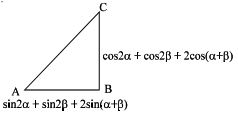
View full question & answer→MCQ 4951 Mark
Extreame value of $1 + 4\, sin \theta + 3 \,cos \theta$ is
- A
$-3$
- B
$-4$
- C
$6$
- ✓
બંને $(b)$ અને $(c)$
AnswerCorrect option: D. બંને $(b)$ અને $(c)$
d
$E = 1 + 4\, sin\, \theta + 3 \,cos\, \theta\,\Rightarrow E_{max} = 1+5 = 6$ ; $E_{min} = 1- 5$ $= -4$
View full question & answer→MCQ 4961 Mark
Given equation $4x^2 + 4(a -1)x + (1 -2a) = 0$ has roots $sin\,\theta$ and $cos\,\theta\,(0<\theta<\frac{\pi}{2})$, then maximum value of $(a + sin\,\theta)$ is-
- A
$\frac{2-\sqrt 3}{2}$
- ✓
$\frac{1}{2}$
- C
$\frac{1-\sqrt 3}{2}$
- D
$\frac{\sqrt 3}{2}$
AnswerCorrect option: B. $\frac{1}{2}$
b
$\sin \theta+\cos \theta=1-a$ .....$(1)$
and $\sin \theta \cdot \cos \theta=\frac{1-2 a}{4}$ ....$(2)$
$(1) \Rightarrow 1+2 \sin \theta \cos \theta=(1-a)^{2}$
$\Rightarrow 1+\frac{1-2 a}{2}=(1-a)^{2} \Rightarrow 2 a^{2}-2 a-1=0$
$\Rightarrow a=\frac{1 \pm \sqrt{3}}{2}$
but $a=\frac{1-\sqrt{3}}{2} \because \theta \in\left(0, \frac{\pi}{2}\right)$
Now $(2) \Rightarrow \sin \theta . \cos \theta=\frac{1-(1-\sqrt{3})}{4}$
$\Rightarrow 2 \sin \theta \cos \theta=\frac{\sqrt{3}}{2} \Rightarrow \sin 2 \theta=\frac{\sqrt{3}}{2}$
$\Rightarrow \theta=30^{\circ}$ or $60^{\circ}$
$\Rightarrow$ maximum value of
$a+\sin \theta=\frac{1-\sqrt{3}}{2}+\frac{\sqrt{3}}{2}=\frac{1}{2}$
View full question & answer→MCQ 4971 Mark
Number of integral values of $\lambda$ for which $f (x)=\sqrt {ln(2\lambda cos\,x+5)}$ is defined for all $x \in R$ is
Answera
$f(x) = \sqrt {\ell n(2\lambda \cos x + 5)} $
Nece. condition $2 \lambda \cos x+5 \geq 1$
$\Rightarrow \lambda \cos x>-2 \forall x \in R . $
$\lambda=0, \pm 1, \pm 2$
View full question & answer→MCQ 4981 Mark
Which of the following is true ?
- A
$sin\ 95 > sin\ 63 > sin\ 1$
- B
$sin\ 95 > sin\ 1 > sin\ 63$
- ✓
$sin\ 1 > sin\ 95 > sin\ 63$
- D
$sin\ 1 > sin\ 63 > sin\ 95$
AnswerCorrect option: C. $sin\ 1 > sin\ 95 > sin\ 63$
c
$1 > 95\ -\ 30 \pi > 63 - 20 \pi $
$sin\ 1 > sin\ 95 > sin\ 63$
View full question & answer→MCQ 4991 Mark
If $12a + 5b = 9$, where $a, b$ $\in$ $R$, then minimum value of $a^2 + b^2$ is -
- A
$\frac{{31}}{9}$
- B
$\frac{{169}}{81}$
- ✓
$\frac{{81}}{169}$
- D
$\frac{{9}}{13}$
AnswerCorrect option: C. $\frac{{81}}{169}$
c
$a=r \cos \theta $ and $ b=r \sin \theta$
$r=\frac{9}{(12 \cos \theta+5 \sin \theta)}$
minimum value of $\mathrm{r}=\frac{9}{13}$
$r^{2}=\frac{81}{169}$
View full question & answer→MCQ 5001 Mark
If $\frac{{\sec \,8\theta - 1}}{{\sec \,4\theta - 1}} = \frac{{a + b\,{{\tan }^2}2\theta }}{{1 + c\,{{\tan }^2}\,2\theta + d\,{{\tan }^4}2\theta }}$
(where $\theta \ne \frac{{n\pi }}{{16}},n \in I$ ), then value of $(a -b + c -d)$ is -
Answerb
$\frac{\sec 8 \theta-1}{\sec 4 \theta-1}$
$=\left(\frac{1-\cos 8 \theta}{1-\cos 4 \theta}\right) \frac{\cos 4 \theta}{\cos 8 \theta}=\left(\frac{2 \sin ^{2} 4 \theta}{2 \sin ^{2} 2 \theta}\right) \frac{\cos 4 \theta}{\cos 8 \theta}$
$=\frac{\tan 8 \theta}{\tan 2 \theta}=\frac{2 \tan 4 \theta}{\left(1-\tan ^{2} 4 \theta\right) \tan 2 \theta}$
Use $\tan 4 \theta=\frac{2 \tan 2 \theta}{1-\tan ^{2} 2 \theta}$
View full question & answer→