MCQ
If $\tan \theta + \sec \theta = {e^x},$ then $\cos \theta $ equals
  • A
    $\frac{{({e^x} + {e^{ - x}})}}{2}$
  • $\frac{2}{{({e^x} + {e^{ - x}})}}$
  • C
    $\frac{{({e^x} - {e^{ - x}})}}{2}$
  • D
    $\frac{{({e^x} - {e^{ - x}})}}{{({e^x} + {e^{ - x}})}}$

Answer

Correct option: B.
$\frac{2}{{({e^x} + {e^{ - x}})}}$
b
(b) $\tan \theta + \sec \theta = {e^x}$…..$(i)$

$\therefore \,\,\,\sec \theta - \tan \theta = {e^{ - x}}$…..$(ii)$

From $(i)$ and $(ii),$

$\,2\sec \theta = {e^x} + {e^{ - x}}\,$

$\Rightarrow \,\cos \theta = \frac{2}{{{e^x} + {e^{ - x}}}}.$

Need a full question paper?

Generate a complete, print-ready paper with questions like this in minutes — across 16+ boards, with answer keys.
Start Generating Free

Similar questions

D(2, 1, 0), E(2, 0, 0), F(0, 1, 0) are mid point of the sides BC, CA, AB of $\Delta\text{ABC}$ respectively, The the centroid of $\Delta\text{ABC}$ is:
For $z \in C$ if the minimum value of $(|z-3 \sqrt{2}|+|z-p \sqrt{2} i|)$ is $5 \sqrt{2}$, then a value of $P$ is $.......$
The points $A (a , 0) , B (0 , b) , C (c , 0) \& D (0 , d)$ are such that $ac = bd \,\,\&\,\, a, b, c, d$ are all non-zero. Then the points :
Let $m$ (respectively, $n$ ) be the number of $5$ -digit integers obtained by using the digits $1,2,3,4,5$ with repetitions (respectively, without repetitions) such that the sum of any two adjacent digits is odd. Then $\frac{m}{n}$ is equal to
A lady gives a dinner party for six guests. The number of ways in which they may be selected from among ten friends if two of the friends will not attend the party together is:
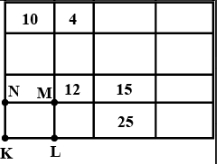
A rectangle is divided into $16$ sub-rectangles as in the figure, the number in each sub-rectangle represents the area of that sub-rectangle. What is the area of the rectangle $K L M N$ ?
If point p lies in first octant, then the sign of x- coordinate will always be:
Consider the numbers 1, 2, 3, 4, 5, 6, 7, 8, 9, 10. If 1 is added to each number, the variance of the numbers so obtained is:
The average of $n$ numbers ${x_1},\,{x_2},\,{x_3},\,......,\,{x_n}$ is $M$. If ${x_n}$ is replaced by $x'$, then new average is
If ${z_1} = 10 + 6i,{z_2} = 4 + 6i$ and $z$ is a complex number such that $amp\left( {\frac{{z - {z_1}}}{{z - {z_2}}}} \right) = \frac{\pi }{4},$ then the value of $|z - 7 - 9i|$ is equal to