MCQ
If $\tan\theta_1\tan\theta_2=\text{k},$ then $\frac{\cos(\theta_1-\theta_2)}{\cos(\theta_1+\theta_2)}=$
  • $\frac{1+\text{k}}{1-\text{k}}$
  • B
    $\frac{1-\text{k}}{1+\text{k}}$
  • C
    $\frac{\text{k}+1}{\text{k}-1}$
  • D
    $\frac{\text{k}-1}{\text{k}+1}$

Answer

Correct option: A.
$\frac{1+\text{k}}{1-\text{k}}$
$\frac{\cos(\theta_1-\theta_2)}{\cos(\theta_1+\theta_2)}$
$=\frac{\cos\theta_1\cos\theta_2+\sin\theta_1\sin\theta_2}{\cos\theta_1\cos\theta_2-0\sin\theta_1\sin\theta_2}$
Dividing numerator and denominator by $\cos\theta_1\cos\theta_2,$ we get:
$\frac{1+\tan\theta_1\tan\theta_2}{1-\tan\theta_1\tan\theta_2}$
$=\frac{1+\text{k}}{1-\text{k}}$

Need a full question paper?

Generate a complete, print-ready paper with questions like this in minutes — across 16+ boards, with answer keys.

Start Generating Free

Similar questions

Consider the following lists:

$List-I$ $List-II$
($I$) $\left\{x \in\left[-\frac{2 \pi}{3}, \frac{2 \pi}{3}\right]: \cos x+\sin x=1\right\}$ ($P$) has two elements 
($II$) $\left\{x \in\left[-\frac{5 \pi}{18}, \frac{5 \pi}{18}\right]: \sqrt{3} \tan 3 x=1\right\}$ ($Q$) has three elements
($III$) $\left\{x \in\left[-\frac{6 \pi}{5}, \frac{6 \pi}{5}\right]: 2 \cos (2 x)=\sqrt{3}\right\}$ ($R$) has four elements
($I$) $\left\{x \in\left[-\frac{6 \pi}{5}, \frac{6 \pi}{5}\right]: 2 \cos (2 x)=\sqrt{3}\right\}$ ($S$) has five elements 
($VI$) $\left\{x \in\left[-\frac{7 \pi}{4}, \frac{7 \pi}{4}\right]: \sin x-\cos x=1\right\}$ ($T$) has six elements

The correct option is:

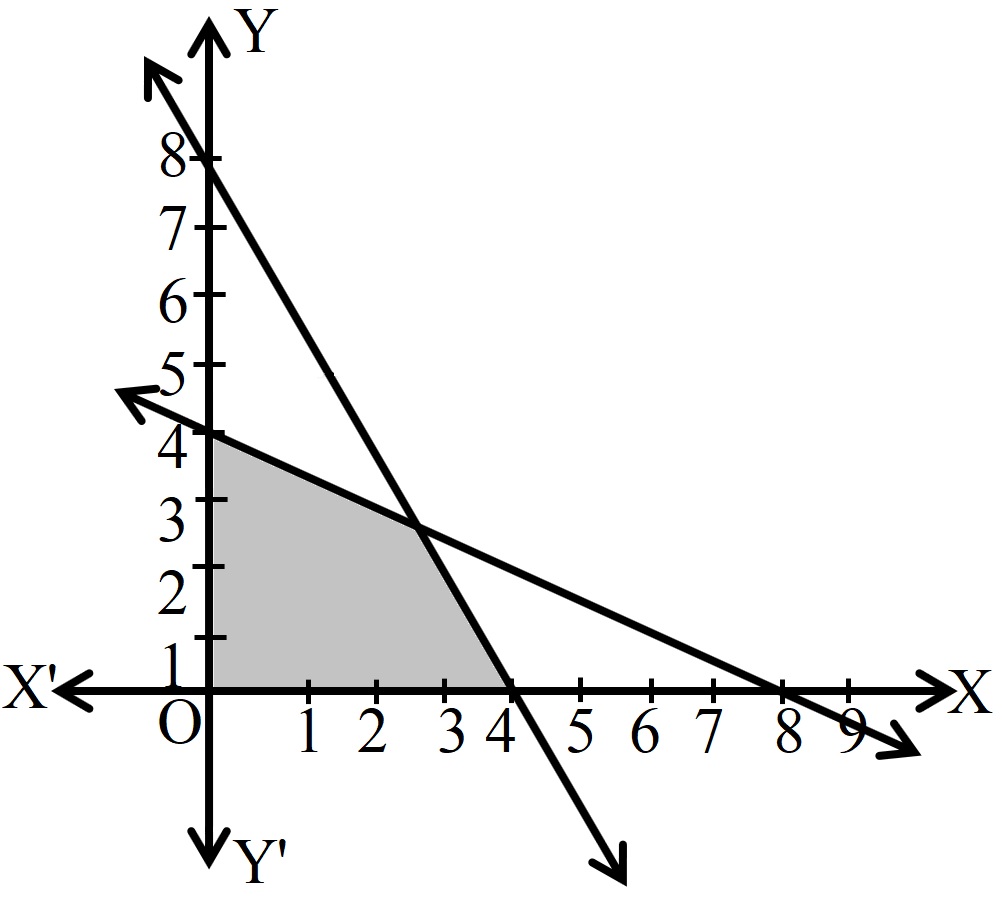
$\text{x} + 2\text{y}\leq8$

$\text{x}\geq0, \text{y}\geq0$
$\text{x}\leq0,\text{y}\leq0$
$ 2\text{x} + \text{y}\leq8$
$4\text{x}+5\text{y}\geq40$
The sum of the coefficients in the expansion of ${(x + y)^n}$ is $4096$. The greatest coefficient in the expansion is
$\mathop {{\rm{lim}}}\limits_{x \to 0} \frac{{{\rm{sin}}\left( {\pi {{\cos }^2}x} \right)}}{{{x^2}}} = $
The value of $p$ and $q(\text{P}\neq0,\ \text{q}\neq0)$ for which $p, q$ are the roots of the equation $x^2 + px + q = 0$ are:
If $A+B+C=90^{\circ}$, then the value of $\tan (B+C)$ is :
The value of $\cos^2\Big(\frac{\pi}{6}+\text{x}\Big)-\sin^2\Big(\frac\pi6-\text{x}\Big)$ is:
The most frequent value in a data set is?
The expression $2\cos \frac{\pi }{{13}}.\cos \frac{{9\pi }}{{13}} + \cos \frac{{3\pi }}{{13}} + \cos \frac{{5\pi }}{{13}}$ is equal to
Two vertices of a triangle are $(5, - 1)$ and $( - 2,3)$. If orthocentre is the origin then coordinates of the third vertex are