Question
If $\tan\theta=\frac{4}{5},$ find the value of $\frac{\cos\theta-\sin\theta}{\cos\theta+\sin\theta}.$
Answer

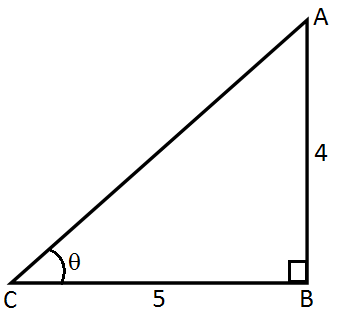
We have, $\tan\theta=\frac{4}{5}$ In $\triangle\text{ABC},$
$\text{AC}^2=\text{AB}^2+\text{BC}^2$ $\Rightarrow\text{AC}^2=(4)^2+(5)^2$ $\Rightarrow\text{AC}^2=16+25$ $\Rightarrow\text{AC}^2=41$ $\Rightarrow\text{AC}=\sqrt{41}$ $\cos\theta=\frac{\text{BC}}{\text{AC}}=\frac{5}{\sqrt{14}}$ and $\sin\theta=\frac{\text{AB}}{\text{AC}}=\frac{4}{\sqrt{41}}$ Now, $\frac{\cos\theta-\sin\theta}{\cos\theta+\sin\theta}=\frac{\frac{5}{\sqrt{41}}-\frac{4}{\sqrt{41}}}{\frac{5}{\sqrt{41}}+\frac{4}{\sqrt{41}}}$ $=\frac{\frac{5-4}{\sqrt{41}}}{\frac{5+4}{\sqrt{41}}}$ $=\frac{1}{9}$

Need a full question paper?

Generate a complete, print-ready paper with questions like this in minutes — across 16+ boards, with answer keys.

Start Generating Free

Similar questions

Find whether the following equations have real roots. If real roots exist, find them.
$8x^2 + 2x - 3 = 0.$
Prove that the area of equilateral triangle described on one side of the square is equal to half of the area of an equilateral triangle described on one of its diagonal.
Solve the following systems of equations:
0.4x + 0.3y = 1.7,
0.7x - 0.2y = 0.8.
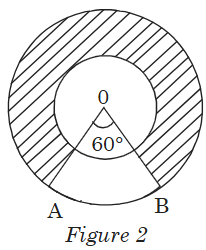
In figure $2$ , two concentric circles with centre $O$, have radii $21 \ cm$ and $42 \ cm .$ If $\angle \text{AOB}=60^{\circ}$, find the area of the shaded region.
Image
Draw a triangle $A B C$ with $B C=7 cm, \angle B =45^{\circ}$ and $\angle C =60^{\circ}$. Then construct another triangle, whose sides are $\frac{3}{5}$ times the corresponding sides of $\triangle A B C$.
AB and CD are common tangents to two circles of equal radii. Prove that AB = CD.
The angle of elevation of the top of a building from the foot of the tower is $30^{\circ}$ and the angle of elevation of the top of the tower from the foot of the building is $45^{\circ}$. If the tower is $30 m$ high, find the height of the building.
Solve the following system of equations by the method of cross-multiplication:
ax + by = a - b,
bx - ay = a + b.
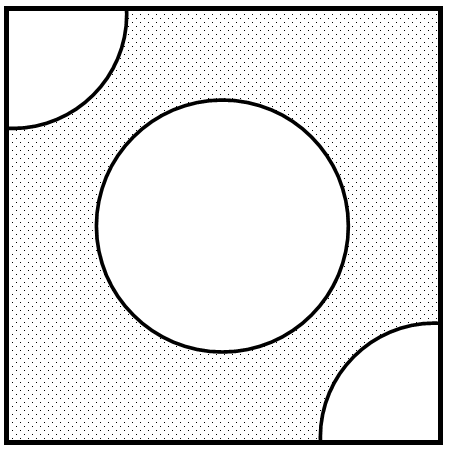
From each of the two opposite corners of a square of side 8cm, a quadrant of a circle of radius $1.4cm$ is cut. Another circle of radius $4.2cm$ is also cut from the centre as shown in the following figure. Find the area of the remaining (Shaded) portion of the square.$\Big(\text{Use }\pi=\frac{22}{7}\Big)$
Determine the values of p for which the quadratic equation $2x^2 + px + 8 = 0$ has real roots.