Question
If $\tan\theta=\frac{\text{a}}{\text{b}},$ show that $\frac{(\text{a}\sin\theta-\text{b}\cos\theta)}{(\text{a}\sin\theta+\text{b}\cos\theta)}=\frac{\big(\text{a}^2-\text{b}^2\big)}{\big(\text{a}^2 +\text{b}^2\big)}.$
Answer

Given:
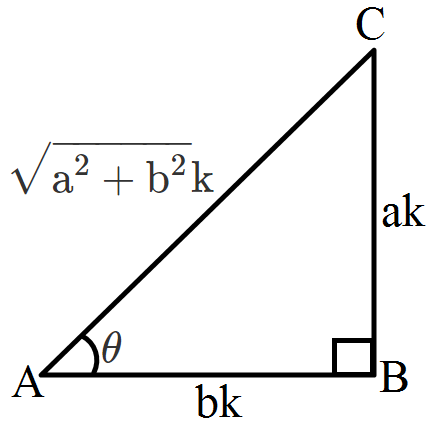
$\tan\theta=\frac{\text{a}}{\text{b}}=\frac{\text{ak}}{\text{bk}}=\frac{\text{BC}}{\text{AB}}$
Let us draw a $\triangle\text{ABC}$ in which $\angle\text{B}=90^\circ$ and $\angle\text{A}=\theta$

By pythagoras theoram, we have
$\text{AC}^2=\text{AB}^2+\text{BC}^2=\text{b}^2\text{k}^2+\text{a}^2\text{k}^2$
$\therefore\text{AC}=\sqrt{\text{a}^2+\text{b}^2}\text{k}$
$\sin\theta=\frac{\text{BC}}{\text{AC}}=\frac{\text{ak}}{\sqrt{\text{a}^2+\text{b}^2}\text{k}}=\frac{\text{a}}{\sqrt{\text{a}^2+\text{b}^2}}$
$\cos\theta=\frac{\text{AB}}{\text{AC}}=\frac{\text{bk}}{\sqrt{\text{a}^2+\text{b}^2}\text{k}}=\frac{\text{b}}{\sqrt{\text{a}^2+\text{b}^2}}$
$\text{L.H.S.}=\frac{\text{a}\sin\theta-\text{b}\cos\theta}{\text{a}\sin\theta+\text{b}\cos\theta}$
$=\frac{\text{a}\frac{\text{a}}{\sqrt{\text{a}^2+\text{b}^2}}-\text{b}.\frac{\text{b}}{\sqrt{\text{a}^2+\text{b}^2}}}{\text{a}\frac{\text{a}}{\sqrt{\text{a}^2+\text{b}^2}}+\text{b}.\frac{\text{b}}{\sqrt{\text{a}^2+\text{b}^2}}}=\frac{\frac{\text{a}^2-\text{b}^2}{\sqrt{\text{a}^2+\text{b}^2}}}{\frac{\text{a}^2+\text{b}^2}{\sqrt{\text{a}^2+\text{b}^2}}}=\frac{\text{a}^2-\text{b}^2}{\text{a}^2+\text{b}^2}$
$=\text{R.H.S.}$

Need a full question paper?

Generate a complete, print-ready paper with questions like this in minutes — across 16+ boards, with answer keys.

Start Generating Free

Similar questions

A building is in the form of a cylinder surmounted by a hemispherical dome. The base diameter of the dome is equal to $\frac{2}{3}$ of the total height of the building. Find the height of the building, if it contains $67 \frac{1}{21} m^3$ of air.
A cylindrical bucket of height 32cm and base radius 18cm is filled with sand. This bucket is emptied on the ground and a conical heap of sand is formed. If the height of the concial heap is 24cm, find the radius and slant height of the heap.
The base $\text{BC}$ of an equilateral triangle $\text{ABC}$ lies on $y-$axis. The co$-$ordinates of point $C$ are $(0,3).$ The origin is the mid$-$point of the base. Find the co$-$ordinates of the point $A$ and $B.$ Also find the co$-$ordinates of another point $D$ such that $\text{BACD}$ is a rhombus.
The corresponding altitudes of two similar triangles are 6cm and 9cm respectively. Find the ratio of their areas.
Solve the following system of equations graphically:
Shade the region between the lines and the y-axis.
3x - 4y = 7,
5x + 2y = 3.
Solve the following systems of equations:
$\frac{1}{2\text{x}}+\frac{1}{3\text{y}}=2$
$\frac{1}{3\text{x}}+\frac{1}{2\text{y}}=\frac{13}{6}$
Solve the following quadratic equation:$4x^2 - 2(a^2 + b^2)x + a^2b^2 = 0$
Construct a triangle with sides 5 cm 6 cm and 7 cm and then another triangle whose sides are $\frac{3}{5}$ of the corresponding sides of the first triangle.
Show that one and only one out of n, (n + 2) and (n + 4) is divisible by 3, where n is any positive integer.
State the SAS-similarity criterion.