Question
If $\text{A}=\begin{bmatrix}0&\text{c}&-\text{b}\\-\text{c}&0&\text{a}\\\text{b}&-\text{a}&0\end{bmatrix}$ and $\text{B}=\begin{bmatrix}\text{a}^2&\text{ab}&\text{ac}\\\text{ab}&\text{b}^2&\text{bc}\\\text{ac}&\text{bc}&\text{c}^2\end{bmatrix},$ show that $AB = BA = O_{3 \times 3}$​​​​​​​

Answer

Here,
$\text{AB}=\begin{bmatrix}0&\text{c}&-\text{b}\\-\text{c}&0&\text{a}\\\text{b}&-\text{a}&0\end{bmatrix}\begin{bmatrix}\text{a}^2&\text{ab}&\text{ac}\\\text{ab}&\text{b}^2&\text{bc}\\\text{ac}&\text{bc}&\text{c}^2\end{bmatrix}$
$\Rightarrow\text{AB}=\begin{bmatrix}0+\text{abc}-\text{abc}&0+\text{b}^2\text{c}-\text{b}^2\text{c}&0+\text{bc}^2-\text{bc}^2\\-\text{a}^2\text{c}+0+\text{a}^2\text{c}&-\text{abc}+0+\text{abc}&-\text{ac}^2+0+\text{ac}^2\\\text{a}^2\text{b}-\text{a}^2\text{b}+0&\text{ab}^2-\text{ab}^2+0&\text{abc}-\text{abc}+0\end{bmatrix}$
$\Rightarrow\text{AB}=\begin{bmatrix}0&0&0\\0&0&0\\0&0&0\end{bmatrix}$
$\Rightarrow\text{AB}=\text{O}_{3\times3}\ \dots(1)$
$\text{BA}=\begin{bmatrix}\text{a}^2&\text{ab}&\text{ac}\\\text{ab}&\text{b}^2&\text{bc}\\\text{ac}&\text{bc}&\text{c}^2\end{bmatrix}\begin{bmatrix}0&\text{c}&-\text{b}\\-\text{c}&0&\text{a}\\\text{b}&-\text{a}&0\end{bmatrix}$
$\Rightarrow\text{BA}=\begin{bmatrix}0-\text{abc}+\text{abc}&\text{a}^2\text{c}+0-\text{a}^2\text{c}&-\text{a}^2\text{b}+\text{a}^2\text{b}+0\\0-\text{b}^2\text{c}+\text{b}^2\text{c}&\text{abc}+0-\text{abc}&-\text{ab}^2+\text{ab}^2+0\\0-\text{bc}^2+\text{bc}^2&\text{ac}^2+0-\text{ac}^2&-\text{abc}+\text{abc}+0\end{bmatrix}$
$\Rightarrow\text{BA}=\begin{bmatrix}0&0&0\\0&0&0\\0&0&0\end{bmatrix}$
$\Rightarrow\text{BA}=\text{O}_{3\times3}\ \dots(2)$
$ \Rightarrow\text{AB}=\text{BA}=0_{3\times3}$ [From eqs. (1) and (2)]

Need a full question paper?

Generate a complete, print-ready paper with questions like this in minutes — across 16+ boards, with answer keys.

Start Generating Free

Similar questions

Form the differential equation of the family of curves represented by the equation (a being the perimeter):$(2\text{x}-\text{a})^2-\text{y}^2=\text{a}^2$
If $\begin{bmatrix}\text{x}&4&1\end{bmatrix}\begin{bmatrix}2&1&2\\1&0&2\\0&2&-4\end{bmatrix}\begin{bmatrix}\text{x}\\4\\-1\end{bmatrix}=0,$ find x.
If a young man drives his vehicle at 25 km/hr, he has to spend Rs. 2 per km on petrol. If he drives it at a faster speed of 40 km/hr, the petrol cost increases to Rs. 5 per km. He has Rs. 100 to spend on petrol and travel within one hour. Express this as an LPP and solve the same.
Evaluate the following integrals:$\int\limits^{{\pi}}_{{-\pi}}\frac{2\text{x}(1+\sin\text{x})}{1+\cos^2\text{x}}\text{ dx}$
A manufacturer produces two types of steel trunks. He has two machines A and B. For completing, the first types of the trunk requires 3 hours on machine A and 3 hours on machine B, whereas the second type of the trunk requires 3 hours on machine A and 2 hours on machine B. Machines A and B can work at most for 18 hours and 15 hours per day respectively. He earns a profit of Rs. 30 and Rs. 25 per trunk of the first type and the second type respectively. How many trunks of each type must he make each day to make maximum profit?
A company produces two types of leather belts, say type A and B. Belt A is a superior quality and belt B is of a lower quality. Profits on each type of belt are Rs. 2 and Rs. 1.50 per belt, respectively. Each belt of type A requires twice as much time as required by a belt of type B. If all belts were of type B, the company could produce 1000 belts per day. But the supply of leather is sufficient only for 800 belts per day (both A and B combined). Belt A requires a fancy buckle and only 400 fancy buckles are available for this per day. For belt of type B, only 700 buckles are available per day.
How should the company manufacture the two types of belts in order to have a maximum overall profit?
Find the points of local maxima or local minima and corresponding local maximum and local minimum values of the following functions. Also, find the points of inflection,
$f(x) = (x - 1)(x - 2)^2$​​​​​​​
Compute the adjoint of the following matrices:$\begin{bmatrix} 1 & 2 & 2 \\ 2 & 1 & 2 \\ 2 & 2 & 1 \end{bmatrix}$
Verify that (adjoint A)A = |A|I = A (adjoint A) for the above matrices.
$\int\sin\text{x}\sqrt{1-\cos2\text{x}}\text{ dx}$
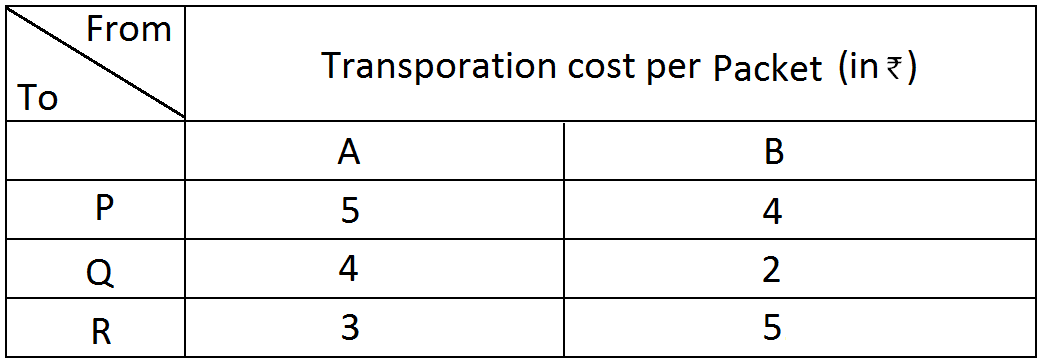
A medical company has factories at two places, A and B. From these places, supply is made to each of its three agencies situated at P, Q and R. The monthly requirements of the agencies are respectively 40, 40 and 50 packets of the medicines, while the production capacity of the factories, A and B, are 60 and 70 packets respectively. The transportation cost per packet from the factories to the agencies are given below:
How many packets from each factory be transported to each agency so that the cost of transportation is minimum? Also find the minimum cost?