Question
If $\text{a}\neq\text{b}\neq\text{c},$ prove that the points $(a, a^2), (b, b^2), (c, c^2)$ can never be collinear.

Answer

Let $A(a, a^2), B(b, b^2), C(c, c^2)$ the given points.
Three points are collinear if area enclosed by three points is zero.
Area of $\triangle\text{ABC}=\frac{1}{2}|\text{x}_1(\text{y}_2-\text{y}_3)+\text{x}_2(\text{y}_3-\text{y}_1)+\text{x}_3(\text{y}_1-\text{y}_2)|$
$=\frac{1}{2}|\text{a}(\text{b}^2-\text{c}^2)+\text{b}(\text{c}^2-\text{a}^2)+\text{c}(\text{a}^2-\text{b}^2)|$
$=\frac{1}{2}|\text{ab}^2-\text{ac}^2+\text{bc}^2-\text{a}^2\text{b}+\text{a}^2\text{c}-\text{b}^2\text{c}|$
$=\frac{1}{2}|(\text{a}^2\text{c}-\text{a}^2\text{b})+(\text{ab}^2-\text{ac}^2)+(\text{bc}^2-\text{b}^2\text{c})|$
$=\frac{1}{2}|(-\text{a}^2)(\text{b}-\text{c})+\text{a}(\text{b}^2-\text{c}^2)-\text{bc}(\text{b}-\text{c})|$
$=\frac{1}{2}|(\text{b}-\text{c})(-\text{a}^2+\text{a}(\text{b}+\text{c})-\text{bc})|$
$=\frac{1}{2}|(\text{b}-\text{c})(-\text{a}^2+\text{ab}+\text{ac}-\text{bc})|$
$=\frac{1}{2}|(\text{b}-\text{c})[(-\text{a})(\text{a}-\text{b})+\text{c}(\text{a}-\text{b})]|$
$=\frac{1}{2}|(\text{b}-\text{c})(\text{c}-\text{a})(\text{a}-\text{b})|$
It is given that $\text{a}\neq\text{b}\neq\text{c}$ Hence area of triangle made by three points is never zero.
Hence given points are never collinear.

Need a full question paper?

Generate a complete, print-ready paper with questions like this in minutes — across 16+ boards, with answer keys.
Start Generating Free

Similar questions

Prove the following trigonometric identities.
$\frac{\sin\text{A}}{\sec\text{A}+\tan\text{A}-1}+\frac{\cos\text{A}}{\text{cosec A}+\cot\text{A}-1}=1$
Show that the polynomial $f(x) = x^4 + 4x^2 + 6$ has no zeroes.
Solve graphically each of the following systems of linear equations. Also, find the coordinates of the points where the lines meet the axis of x in each system.
2x + 3y = 8,
x - 2y = -3.
A box contains cards numbered $3, 5, 7, 9, ....., 35, 37$.
A card is drawn at random form the box. Find the probability that the number on the drawn card is a prime number.
Determine the ratio in which the point P(m, 6) divides the join of A(-4, 3) and B(2, 8). Also, find the value of m.
The difference between squares of two numbers is 120. The square of smaller number is twice the greater number. Find the numbers.
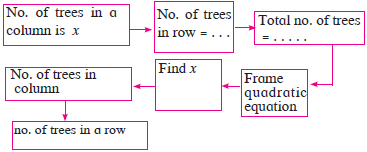
In the orange garden of Mr. Madhusudan there are 150 orange trees. The number of trees in each row is 5 more than that in each column. Find the number of trees in each row and each column with the help of following flow chart.
The following table shows the average rainfall in 150 towns. Show the information by a frequency polygon.
Average rainfall (cm)0-2020-4040-6060-8080-100
No. of towns1412364840
A is elder to B by 2 years. A's father F is twice as old as A and B is twice as old as his sister S. If the ages of the father and sister differ by 40 years, find the age of A.
The maximum temperatures in °C of 30 towns, in the last summer, is shown in the following table. Find the mean of the maximum temperatures.
Max. temp. 24-28 28-32 32-36 36-40 40-44
No. of towns 4 5 7 8 6