Question
If $(\text{cosec }\theta+\sin\theta)=\text{a}^3$ and $(\sec\theta-\cos\theta)=\text{b}^3,$ prove that $\big(\text{a}^2\text{b}^2\big)\big(\text{a}^2+\text{b}^2\big)=1.$

Answer

We have $(\text{cosec }\theta-\sin\theta)=\text{a}^3$ and $(\sec\theta-\cos\theta)=\text{n}$
$\Rightarrow\text{a}^3=\Big(\frac{1}{\sin\theta}-\sin\theta\Big)$
$\Rightarrow\text{a}^3=\frac{\big(1-\sin^2\theta\big)}{\sin\theta}$
$=\frac{\cos^2\theta}{\sin\theta}$
$\therefore\ \text{a}=\frac{\cos^{\frac23}\theta}{\sin^\frac13\theta}$
Again, $(\sec\theta-\cos\theta)=\text{b}^3$
$\Rightarrow\text{b}^3=\Big(\frac{1}{\cos\theta}-\cos\theta\Big)$
$=\frac{\big(1-\cos^2\theta\big)}{\cos\theta}$
$=\frac{\sin^2\theta}{\cos\theta}$
$\therefore\ \text{b}=\frac{\sin^\frac{2}{3}\theta}{\cos^\frac13\theta}$
Now, $\text{LHS}=\text{a}^2\text{b}^2\big(\text{a}^2+\text{b}^2\big)$
$=\text{a}^4\text{b}+\text{a}^2\text{b}^4$
$=\text{a}^3\big(\text{ab}^2\big)+\big(\text{a}^2\text{b}\big)\text{b}^3$
$=\frac{\cos^3\theta}{\sin\theta}\times\Bigg[\frac{\cos^\frac23\theta}{\sin^\frac13\theta}\times\frac{\sin^\frac43\theta}{\cos^\frac23\theta}\Bigg]\\ \ +\frac{\cos^3\theta}{\sin\theta}\times\Bigg[\frac{\cos^\frac23\theta}{\sin^\frac13\theta}\times\frac{\sin^\frac43\theta}{\cos^\frac23\theta}\Bigg]\times\frac{\sin^2\theta}{\cos\theta}$
$=\frac{\cos^2\theta}{\sin\theta}\times\sin\theta+\cos\theta\times\frac{\sin^2\theta}{\cos\theta}$
$=\cos^2\theta+\sin^2\theta=1$
$=\text{RHS}$
Hence proved.

Need a full question paper?

Generate a complete, print-ready paper with questions like this in minutes — across 16+ boards, with answer keys.
Start Generating Free

Similar questions

Construct a $\triangle\text{PQR},$ in which PQ = 6cm, QR = 7cm and PR = 8cm. Then, construct another triangle whose sides are $\frac{4}{5}\text{ times}$ the corresponding sides of $\triangle\text{PQR}.$
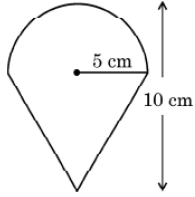
An ice$-$cream filled cone having radius $5 \ cm$ and height $10 \ cm$ is as shown in the figure. Find the volume of the ice$-$cream in $7$ such cones.
Image
Prove the following identities:
$\frac{1-\tan^2\theta}{1+\tan^2\theta}=\big(\cos^2\theta-\sin^2\theta\big)$
A chord of a circle of radius 20cm subtends an angle of 90° at the centre. Find the area of the corresponding major segment of the circle.$(\text{Use }\pi=3.14)$
The present age of a father is three years more than three times the age of the son. Three years hence father's age will be 10 years more than twice the age of the son. Determine their present ages.
A man busy a number of pens for Rs. 180. If he had bought 3 more pens for the same amount, each pen would have cost him Rs. 3 less. How many pens did he buy?
In a flower bed, there are 43 rose plants in the first row, 41 in the second, 39 in the third, and so on. There are 11 rose plants in the last row. How many rows are there flower bed?
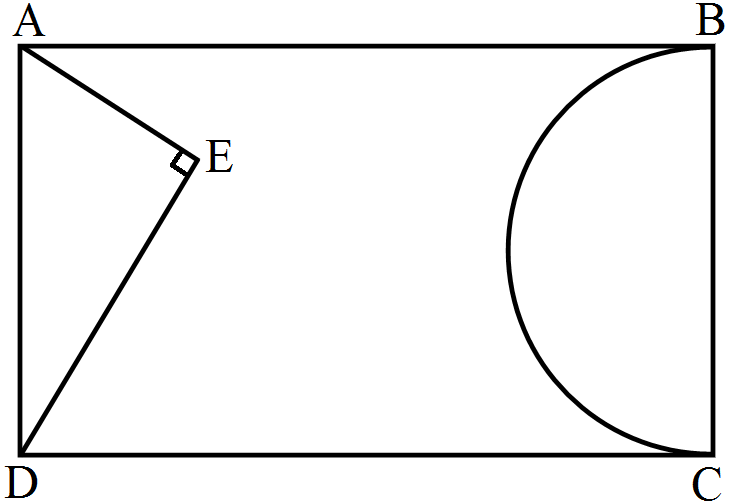
In the given figure, ABCD is a rectangle with $\text{AB}=80\text{cm}$ and $\text{BC}=70\text{cm},$ $\angle\text{AED}=90^\circ$ and $\text{DE}=42\text{cm}$ A semicircle is dn wn, taking BC as diameter. Find the area o the shaded region.
The sum of the digits of a two-digit number is 15. The number obtained by interchanging the digits exceeds the given number by 9. Find the number.
Solve the following quadratic equations by factorization:
$\frac{16}{\text{x}}-1=\frac{15}{\text{x}+1},$ $\text{x}\neq0,-1$