Question
If $\text{cosec}\theta=2,$ show that $\Big(\cot\theta+\frac{\sin\theta}{1+\cos\theta}\Big)=2.$

Answer

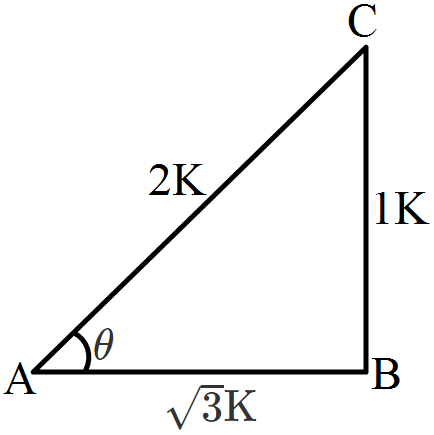
Given: $\text{cosec}\theta=\frac{\text{AC}}{\text{BC}}=\frac21$
Let BC = 1k and AC = 2k Where k is positive Let us draw a
$\triangle\text{ABC}$ in which
$\angle\text{B}=90^\circ$ and $\angle\text{A}=\theta$

By Pythagoras theorem, we have
$(AC)^2 = (AB)^2 + (BC)^2$
$\Rightarrow (AB)^2 = (AC)^2 - (BC)^2$
$=\Big[(2\text{k})^2-(1\text{k})^2\Big]=\big(4\text{k}^2-1\text{k}^2\big)=3\text{k}^2$
$\Rightarrow(\text{AB})=\sqrt{3}\text{k}$
$\sin\theta=\frac{\text{BC}}{\text{AC}}=\frac{1\text{k}}{2\text{k}}=\frac{1}{2}$
$\cos\theta=\frac{\text{AB}}{\text{AC}}=\frac{\sqrt{3}\text{k}}{2\text{k}}=\frac{\sqrt{3}}{2}$
$\cot\theta=\frac{\cos\theta}{\sin\theta}=\Big(\frac{\sqrt{3}}{2}\times\frac21\Big)=\sqrt{3}$
$\Rightarrow\Big[\cot\theta+\frac{\sin\theta}{1+\cos\theta}\Big]\Bigg[\sqrt{3}+\frac{\frac12}{1+\frac{\sqrt{3}}{2}}\Bigg]$
$=\Big(\sqrt{3}+\frac{1}{2+\sqrt{3}}\Big)=\Big(\frac{2\sqrt{3}+3+1}{2+\sqrt{3}}\Big)$
$=\Big(\frac{2\sqrt{3}+4}{2+\sqrt{3}}\Big)=2\Big(\frac{\sqrt{3}+2}{2+\sqrt{3}}\Big)=2$
​​​​​​​Hence, $\Big[\cot\theta+\frac{\sin\theta}{1+\cos\theta}\Big]=2$

Need a full question paper?

Generate a complete, print-ready paper with questions like this in minutes — across 16+ boards, with answer keys.
Start Generating Free

Similar questions

Find the values of k for which the given quadratic equation has real and distinct root:
$kx^2 + 6x + 1 = 0$
Evaluate the following:
If $\sin(\text{A}-\text{B})=\frac12$ and $\cos(\text{A}+\text{B})=\frac12,0^\circ<(\text{A}+\text{B})<90^\circ$ and $\text{A}>\text{B}$ then find A and B.
Express the following as a fraction in simplest form:
$0.\overline{24}$
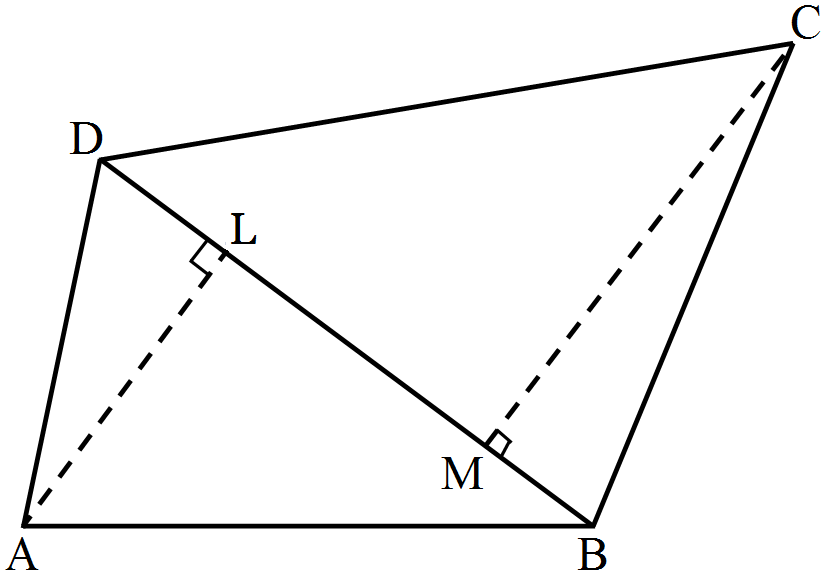
In the given figure, ABCD is a quadrilateral in which diagonal BD = 24cm,$\text{AL}\perp\text{BD}$ and $\text{CM}\perp\text{BD}$ such that AL = 9cm and CM = 12cm. Calculate the area of the quadrilateral.
Find the value of k for which the following system of equations has no solution:
$2x - ky + 3 = 0$
$3x + 2y - 1 = 0$
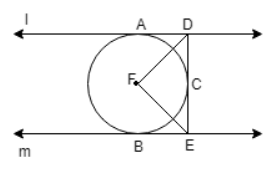
In Fig. $1$ and $m$ are two parallel tangents at $A$ and $B$ . The tangent at $C$ makes an intercept $DE$ between $l$ and $m$ . Prove that $\angle D F E=90^{\circ}$.
Image
In a frequency distribution table with 12 classes, the class width is 2.5 and the lowest class boundary is 8.1, then what is the upper class boundary of the highest class?
A wall 24m, 0.4m thick and 6m high is constructed with the bricks each of dimensions $25\ cm x 16\ cm x 10\ cm$. If the mortar occupies $\Big(\frac{1}{10}\Big)$ of the volume of the wall, then find the number of bricks used in constructing the wall.
If $\cot\theta=\sqrt{3},$ find the value of $\frac{\text{cosec}^2\theta+\cot^2\theta}{\text{cosec}^2\theta-\sec^2\theta}$.
Prove the following trigonometric identities.
$\frac{1}{\sec\text{A}+\tan\text{A}}-\frac{1}{\cos\text{A}}=\frac{1}{\cos\text{A}}-\frac{1}{\sec\text{A}-\tan\text{A}}$