Question
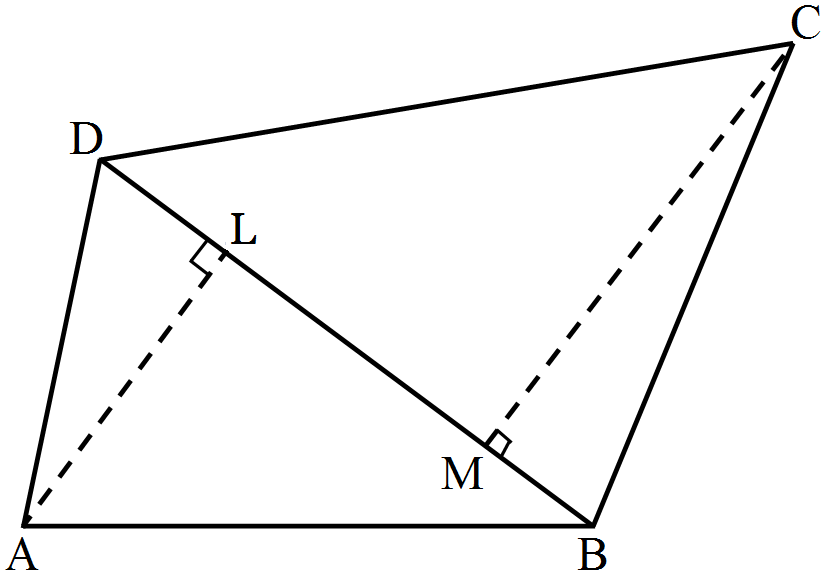
In the given figure, ABCD is a quadrilateral in which diagonal BD = 24cm,$\text{AL}\perp\text{BD}$ and $\text{CM}\perp\text{BD}$ such that AL = 9cm and CM = 12cm. Calculate the area of the quadrilateral.
Answer

Given,
BD = 24cm
AL = 9cm
CM = 12cm
Area of $\triangle\text{BCD}=\frac{1}{2}\times\text{BD}\times\text{CD}$
$=\frac12\times24\times12=144\text{cm}^2$
Area of $\triangle\text{DAB}=\frac{1}{2}\times\text{BD}\times\text{AL}$
$=\frac12\times24\times9=108\text{cm}^2$
Now, area of quadrilateral ABCD = Area of $\triangle\text{BCD}$ + Area of $\triangle\text{DAB}$
$= (144 + 108)cm^2$
$= 252cm^2$​​​​​​​

Need a full question paper?

Generate a complete, print-ready paper with questions like this in minutes — across 16+ boards, with answer keys.
Start Generating Free

Similar questions

Water flows at the rate of $15km/hr$ through a pipe of diameter $14\ cm$ into a cuboidal pond which is $50\ m$ long and $44\ m$ wide. In what time will the level of water in the pond rise by $21\ cm$?
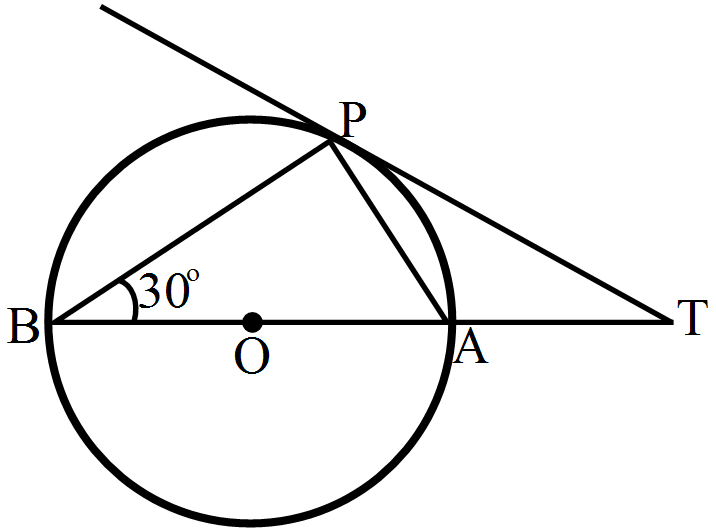
In the given figure, O is the centre of the circle and TP is the tangent to the circle from an external point T. If $\angle\text{PBT} = 30^\circ,$prove that
BA : AT = 2 : 1.
A vertical tower stands on a horizontal plane and is surmounted by a vertical flag-staff. At a point on the plane 70 metres away from the tower, an observer notices that the angles of elevation of the top and the bottom of the flagstaff are respectively 60° and 45°. Find the height of the flag-staff and that of the tower.
Two dice are thrown simultaneously. What is the probability that:
  1. $5$ will not come up on either of them?
  2. $5$ will come up on at least one?
  3. $5$ will come up at both dice?
Solve the following quadratic equations by factorization:
$x^2 + 2ab = (2a + b)x$
Solve the following quadratic equations by factorization:
$\text{x}-\frac{1}{\text{x}}=3,\text{x}\neq0$
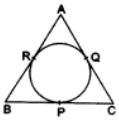
In the given figure, the incircle $-$ of $\triangle A B C$ touches the sides $BC, CA$ and $AB $ at $P, Q$ and $R$ respectively. Prove that $(AR + BP + CQ) = (AQ + BR + CP) =\frac{1}{2}($ perimeter of $\triangle A B C)$.
Image
An aeroplane leaves an airport and flies due north at a speed of 1000km/hr. At the same time, another aeroplane leaves the same airport and flies due west at a speed of 1200km/hr. How far apart will be the two planes after $1\frac{1}{2}$ hours?
If $\alpha$ and $\beta$ are roots of the quadratic equation $x^2-7 x+10=0$, find the quadratic equation whose roots are $\alpha^2$ and $\beta^2$.
The sum of digits of a two number is 15. The number obtained by reversing the order of digits of the given number exceeds the given number by 9. Find the given number.