MCQ
If $\text{f(x)}=\begin{vmatrix}0&\text{x}-\text{a}&\text{x}-\text{b}\\\text{x}+\text{a}&0&\text{x}-\text{c}\\\text{x}+\text{b}&\text{x}+\text{c}&0\end{vmatrix},$ then:
  • A
    f(a) = 0
  • B
    f(b) = 0
  • f(0) = 0
  • D
    f(1) = 0

Answer

Correct option: C.
f(0) = 0
Let $\text{f(x)}=\begin{vmatrix}0&\text{x}-\text{a}&\text{x}-\text{b}\\\text{x}+\text{a}&0&\text{x}-\text{c}\\\text{x}+\text{b}&\text{x}+\text{c}&0\end{vmatrix}$

Now, $\text{f(a)}=\begin{vmatrix}0&\text{a}-\text{a}&\text{a}-\text{b}\\\text{a}+\text{a}&0&\text{a}-\text{c}\\\text{a}+\text{b}&\text{a}+\text{c}&0\end{vmatrix}$

$=\begin{vmatrix}0&0&\text{a}-\text{b}\\2\text{a}&0&\text{a}-\text{c}\\\text{a}+\text{b}&\text{a}+\text{c}&0\end{vmatrix}$

$=(\text{a}-\text{b})(2\text{a}^2+2\text{ac})\neq0$

$\text{f(b)}=\begin{vmatrix}0&\text{b}-\text{a}&\text{b}-\text{b}\\\text{b}+\text{a}&0&\text{b}-\text{c}\\\text{b}+\text{b}&\text{b}+\text{c}&0\end{vmatrix}$

$=\begin{vmatrix}0&\text{b}-\text{a}&0\\\text{b}+\text{a}&0&\text{b}-\text{c}\\2\text{a}&\text{b}+\text{c}&0\end{vmatrix}$

$=(\text{b}-\text{a})(2\text{ab}-2\text{ac})\neq0$

$\text{f(0)}=\begin{vmatrix}0&\text{0}-\text{a}&\text{0}-\text{b}\\\text{0}+\text{a}&0&\text{0}-\text{c}\\\text{0}+\text{b}&\text{0}+\text{c}&0\end{vmatrix}$

$=\begin{vmatrix}0&-\text{a}&-\text{b}\\\text{a}&0&\text{c}\\\text{b}&\text{c}&0\end{vmatrix}$

$=\text{a}(\text{bc})-\text{b}(\text{ac})=0$

Hence, the correct option is (c)

Need a full question paper?

Generate a complete, print-ready paper with questions like this in minutes — across 16+ boards, with answer keys.
Start Generating Free

Similar questions

If $y =\sum \limits_{ k =1}^{6} k \cos ^{-1}\left\{\frac{3}{5} \cos k x -\frac{4}{5} \sin k x \right\}$ then $\frac{ dy }{ dx }$ at $x =0$ is
If $\mathrm{U}_{\mathrm{n}}=\left(1+\frac{1}{\mathrm{n}^{2}}\right)\left(1+\frac{2^{2}}{\mathrm{n}^{2}}\right)^{2} \ldots\left(1+\frac{\mathrm{n}^{2}}{\mathrm{n}^{2}}\right)^{\mathrm{n}}$, then $\lim _{n \rightarrow \infty}\left(U_{n}\right)^{\frac{-4}{n^{2}}}$ is equal to :
Let $\vec{a}, \vec{b}$ and $\vec{c}$ be three vectors such that $|\vec{a}|=\sqrt{3}$ $|\overrightarrow{\mathrm{b}}|=5, \overrightarrow{\mathrm{b}} \cdot \overrightarrow{\mathrm{c}}=10$ and the angle between $\overrightarrow{\mathrm{b}}$ and $\overrightarrow{\mathrm{c}}$ is $\frac{\pi}{3} .$ If $\vec{a}$ is perpendicular to the vector $\overrightarrow{\mathrm{b}} \times \overrightarrow{\mathrm{c}}$ then $|\overrightarrow{\mathrm{a}} \times(\overrightarrow{\mathrm{b}} \times \overrightarrow{\mathrm{c}})|$ is equal to
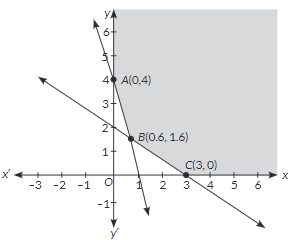
The corner points of the shaded unbounded feasible region of an LPP are $(0,4),(0.6,1.6)$ and $(3,0)$ as shown in the figure. The minimum value of the objective function $Z=4 x+6 y$ occurs at
Image
If for $f(x) = 2x - {x^2}$, Lagrange’s theorem satisfies in $[0, 1]$, then the value of $c \in [0,\,1]$ is
Let $f(x) = \sin x$ and $g(x) = \ln |x|$. If the ranges of the composite functions $fog$ and $gof$ are ${R_1}$ and ${R_2}$ respectively, then
$\int_{}^{} {x{{\cos }^2}} xdx = $
The horizontal force and the force inclined at an angle ${60^o}$ with the vertical, whose resultant is in vertical direction of  $ P $ $kg$, are
Two dice are thrown. If it is known that the sun of the numbers on the dice was less than 6, than the probability of gettinga sum 3, is
The number of arbitrary constants in the particular solution of a differential equation of second order is $($are$):$