Question
If $\text{x}=2+\sqrt{3},$ find the value of $\text{x}^3+\frac{1}{\text{x}^3}.$

Answer

$\text{x}=2+\sqrt{3}$
$\Rightarrow\frac{1}{\text{x}}=\frac{1}{2+\sqrt{3}}$
$=\frac{1}{2+\sqrt{3}}\times\frac{2-\sqrt{3}}{2-\sqrt{3}}$
$=\frac{2-\sqrt{3}}{2^2-\big(\sqrt{3}\big)^2}$
$=\frac{2-\sqrt{3}}{4-3}$
$=2-\sqrt{3}$
$\Rightarrow\text{x}+\frac{1}{\text{x}}=2+\sqrt{3}+2-\sqrt{3}=4$
$\Rightarrow\Big(\text{x}+\frac{1}{\text{x}}\Big)^3=4^3$
$\Rightarrow\Big(\text{x}^3+\frac{1}{\text{x}^3}\Big)+3\times\text{x}\times\frac{1}{\text{x}}\Big(\text{x}+\frac{1}{\text{x}}\Big)=64$
$\Rightarrow\Big(\text{x}^3+\frac{1}{\text{x}^3}\Big)+3\times4=64$
$\Rightarrow\Big(\text{x}^3+\frac{1}{\text{x}^3}\Big)+12=64$
$\Rightarrow\Big(\text{x}^3+\frac{1}{\text{x}^3}\Big)=52$

Need a full question paper?

Generate a complete, print-ready paper with questions like this in minutes — across 16+ boards, with answer keys.

Start Generating Free

Similar questions

The income and expenditure for $5$ years of a family is given in the following data:
Years
$1995–96$
$1996–97$
$1997–98$
$1998–99$
$1999–2000$
Income (Rs. In thousands)
$100$
$140$
$150$
$170$
$210$
Expenditure (Rs. in thousands)
$80$
$130$
$145$
$160$
$190$
Represent the above data by a bar graph.
ABCD is a rhombus in which altitude from D to side AB bisects AB. Find the angles of the rhombus.
Prove that the bisectors of a pair of vertically opposite angles are in the same straight line.
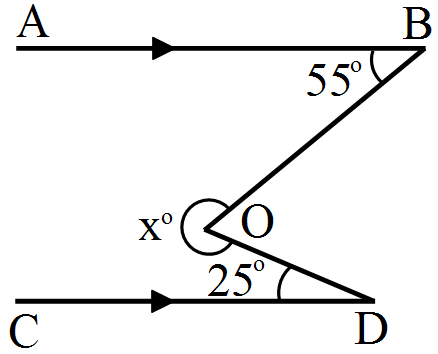
In the figure given below, $AB || CD$. Find the value of $x$ in each case.
Read the following statement: An equilateral triangle is a polygon made up of three line segments out of which two line segments are equal to the third one and all its angles are $60^\circ $ each. Define the terms used in this definition which you feel necessary. Are there any undefined terms in this? Can you justify that all sides and all angles are equal in a equilateral triangle.
The capacity of a closed cylindrical vessel of height $1m$ is $15.4$ litres. Find the area of the metal sheet needed to make it.
$ABCD$ is a square, $X$ and $Y$ are points on sides $AD$ and $BC$ respectively such that $\text{AY}=\text{BX}.$ prove that $\text{BY}=\text{AX}$ and $\angle\text{BAY}=\angle\text{ABX}.$
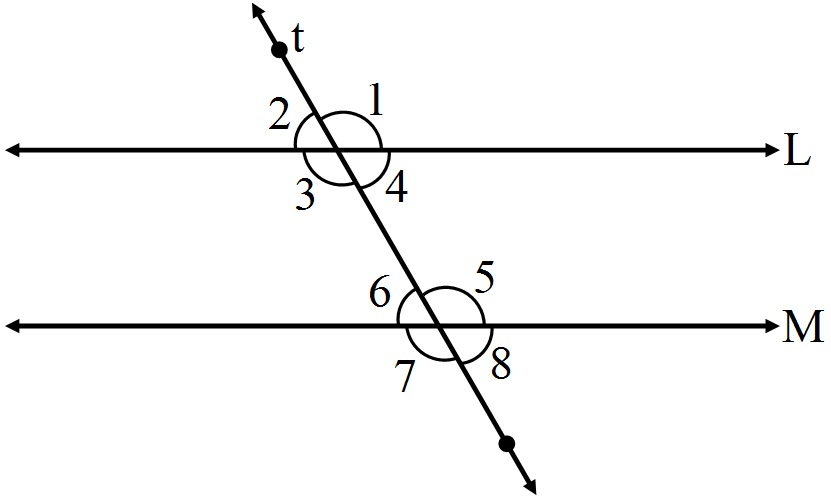
In the given figure, $l || m$ and a transversal $t$ cuts them, If $\angle1=120^\circ,$ find the measure of each of the remaining marked angles.
Prove that the circles described on the four sides of a rhombus as diameters, pass through the point of intersection of its diagonals.
Write the class size and class limits in the following: $47, 52, 57, 62, 67, 72, 78, 82, 87, 92, 97, 102$.