Question 14 Marks
Prove that: $\frac{1}{3+\sqrt{7}}+\frac{1}{\sqrt{7}+\sqrt{5}}+\frac{1}{\sqrt{5}+\sqrt{3}}+\frac{1}{\sqrt{3}+1}=1$
Answer$\text{L.H.S}=\frac{1}{3+\sqrt{7}}+\frac{1}{\sqrt{7}+\sqrt{5}}+\frac{1}{\sqrt{5}+\sqrt{3}}+\frac{1}{\sqrt{3}+1}$
$=\frac{1}{3+\sqrt{7}}\times\frac{3-\sqrt{7}}{3-\sqrt{7}}+\frac{1}{\sqrt{7}+\sqrt{5}}\times\frac{\sqrt{7}-\sqrt{5}}{\sqrt{7}-\sqrt{5}}$
$+\frac{1}{\sqrt{5}+\sqrt{3}}\times\frac{\sqrt{5}-\sqrt{3}}{\sqrt{5}-\sqrt{3}}+\frac{1}{\sqrt{3}+1}\times\frac{\sqrt{3}-1}{\sqrt{3}+1}$
$=\frac{3-\sqrt{7}}{3^2-\big(\sqrt{7}\big)^2}+\frac{\sqrt{7}-\sqrt{5}}{\big(\sqrt{7}\big)^2-\big(\sqrt{5}\big)^2}+\frac{\sqrt{5}-\sqrt{3}}{\big(\sqrt{5}\big)^2-\big(\sqrt{3}\big)^2}+\frac{\sqrt{3}-1}{\big(\sqrt{3}\big)^2-1}$
$=\frac{3-\sqrt{7}}{9-7}+\frac{\sqrt{7}-\sqrt{5}}{7-5}+\frac{\sqrt{5}-\sqrt{3}}{5-3}+\frac{\sqrt{3}-1}{3-1}$
$=\frac{3-\sqrt{7}}{2}+\frac{\sqrt{7}-\sqrt{5}}{2}+\frac{\sqrt{5}-\sqrt{3}}{2}+\frac{\sqrt{3}-1}{2}$
$=\frac{3-\sqrt{7}+\sqrt{7}-\sqrt{5}+\sqrt{5}-\sqrt{3}+\sqrt{3}-1}{2}$
$=\frac{2}{2}$
$=1$
$=\text{R.H.S.}$
View full question & answer→Question 24 Marks
If $\text{x}=\frac{1}{2-\sqrt{3}},$ find the value of $x^3 - 2x^2 - 7x + 5$.
Answer$\text{x}=\frac{1}{2-\sqrt{3}}=\frac{1}{2-\sqrt{3}}\times=\frac{2+\sqrt{3}}{2+\sqrt{3}}=\frac{2+\sqrt{3}}{2^2-\big(\sqrt{3}\big)^2}$
$=\frac{2+\sqrt{3}}{4-3}=2+\sqrt{3}$
Now, $\text{x}^3-2\text{x}^2-7\text{x}+5$
$=\big(2+\sqrt{3}\big)^3-2\big(2+\sqrt{3}\big)^2-7\big(2+\sqrt{3}\big)+5$
$=\Big[2^3+\big(\sqrt{3}\big)^3+3\times2\sqrt{3}\big(2+\sqrt{3}\big)\Big]-2\Big[2^2+2\times2\sqrt{3}+\big(\sqrt{3}\big)^2\Big]-7\times2-7\sqrt{3}+5$
$=\Big[8+3\sqrt{3}+6\sqrt{3}\big(2+\sqrt{3}\big)\Big]-2\Big[4+4\sqrt{3}+3\Big]-14-7\sqrt{3}+5$
$=\Big[8+3\sqrt{3}+12\sqrt{3}+18\Big]-2\Big[7+4\sqrt{3}\Big]-9-7\sqrt{3}$
$=26+15\sqrt{3}-14-8\sqrt{3}-9-7\sqrt{3}$
$=3$
View full question & answer→Question 34 Marks
Find the values of $a$ and $b$ if: $\frac{7+3\sqrt{5}}{3+\sqrt{5}}-\frac{7-3\sqrt{5}}{3-\sqrt{5}}=\text{a}+\text{b}\sqrt{5}$
Answer$\frac{7+3\sqrt{5}}{3+\sqrt{5}}-\frac{7-3\sqrt{5}}{3-\sqrt{5}}$
$=\frac{7+3\sqrt{5}}{3+\sqrt{5}}\times\frac{3-\sqrt{5}}{3-\sqrt{5}}-\frac{7-3\sqrt{5}}{3-\sqrt{5}}\times\frac{3+\sqrt{5}}{3+\sqrt{5}}$
$=\frac{7\big(3-\sqrt{5}\big)+3\sqrt{5}\big(3-\sqrt{5}\big)}{3^2-\big(\sqrt{5}\big)^2}-\frac{7\big(3+\sqrt{5}\big)-3\sqrt{5}\big(3+\sqrt{5}\big)}{3^2-\big(\sqrt{5}\big)^2}$
$=\frac{21-7\sqrt{5}+9\sqrt{5}-15}{9-5}-\frac{21+7\sqrt{5}-9\sqrt{5}-15}{9-5}$
$=\frac{6+2\sqrt{5}}{4}-\frac{6-2\sqrt{5}}{4}$
$=\frac{6+2\sqrt{5}-6+2\sqrt{5}}{4}$
$=\frac{4\sqrt{5}}{4}$
$=\sqrt{5}$
$\therefore \ \frac{7+3\sqrt{5}}{3+\sqrt{5}}-\frac{7-3\sqrt{5}}{3-\sqrt{5}}=0+1\times\sqrt{5}$ Comparing with the given expression,
we get $a = 0$ and $b = 1$ Thus, the values of $a$ and $b$ are $0$ and $1$, respectively.
View full question & answer→Question 44 Marks
If $\text{x}=\frac{5-\sqrt{3}}{5+\sqrt{3}}$ and $\text{y}=\frac{5+\sqrt{3}}{5-\sqrt{3}},$ show that $\text{x}-\text{y}=-\frac{10\sqrt{3}}{11}.$
Answer | $\text{x}=\frac{5-\sqrt{3}}{5+\sqrt{3}}$ | $\text{y}=\frac{5+\sqrt{3}}{5-\sqrt{3}}$ |
| $=\frac{5-\sqrt{3}}{5+\sqrt{3}}\times\frac{5-\sqrt{3}}{5-\sqrt{3}}$ | $=\frac{5+\sqrt{3}}{5-\sqrt{3}}\times\frac{5+\sqrt{3}}{5+\sqrt{3}}$ |
| $=\frac{\big(5-\sqrt{3}\big)^2}{5^2-\big(\sqrt{3}\big)^2}$ | $=\frac{\big(5+\sqrt{3}\big)^2}{5^2-\big(\sqrt{3}\big)^2}$ |
| $=\frac{25-10\sqrt{3}+3}{25-3}$ | $=\frac{25+10\sqrt{3}+3}{25-3}$ |
| $=\frac{28-10\sqrt{3}}{22}$ | $=\frac{28+10\sqrt{3}}{22}$ |
| $=\frac{14-5\sqrt{3}}{11}$ | $=\frac{14+5\sqrt{3}}{11}$ |
$\therefore\text{x}-\text{y}=\frac{14-5\sqrt{3}}{11}-\frac{14+5\sqrt{3}}{11}$
$=\frac{14-5\sqrt{3}-14-5\sqrt{3}}{11}$
$=-\frac{10\sqrt{3}}{11}$
View full question & answer→Question 54 Marks
Locate $\sqrt{8}$ on the number line.
AnswerDraw a number line as shown.
On the number line, take point $O$ corresponding to zero.
Now take point $A$ on number line such that $OA = 2$ units.
Draw perpendicular $AZ$ at $A$ on the number line and cut-off arc $AB = 2$ units.
By Pythagoras Theorem,
$OB^2 = OA^2 + AB^2$
$= 2^2 + 2^2= 4 + 4 = 8$
$\Rightarrow\text{OB}=\sqrt{8}$
Taking $O$ as centre and $\text{OB}=\sqrt{8}$ as radius draw an arc cutting real line at $C.$
Clearly, $\text{OC}=\text{OB}=\sqrt{8}$
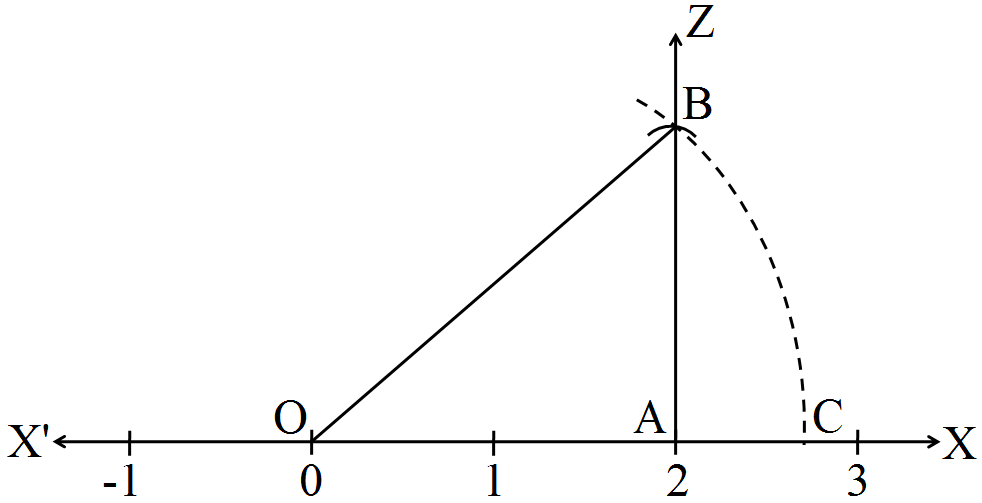
Hence, $C$ represents $\sqrt{8}$ on the number line. View full question & answer→Question 64 Marks
If $\text{x}=9-4\sqrt{5},$ find the value of $\text{x}^2-\frac{1}{\text{x}^2}.$
Answer$\text{x}=9-4\sqrt{5}$
$\Rightarrow\frac{1}{\text{x}}=\frac{1}{9-4\sqrt{5}}=\frac{1}{9-4\sqrt{5}}\times\frac{9+4\sqrt{5}}{9+4\sqrt{5}}\\=\frac{9+4\sqrt{5}}{9^2-\big(4\sqrt{5}\big)^2}=\frac{9+4\sqrt{5}}{81-80}=9+4\sqrt{5}$
$\Rightarrow\text{x}+\frac{1}{\text{x}}=9-4\sqrt{5}+9+4\sqrt{5}=18$
$\Rightarrow\Big(\text{x}+\frac{1}{\text{x}}\Big)^2=18^2=324$
$\Rightarrow\Big(\text{x}^2+\frac{1}{\text{x}^2}\Big)^2+2\times\text{x}\times\frac{1}{\text{x}}=324$
$\Rightarrow\Big(\text{x}^2+\frac{1}{\text{x}^2}\Big)+2=324$
$\Rightarrow\Big(\text{x}^2+\frac{1}{\text{x}^2}\Big)=322$
View full question & answer→Question 74 Marks
If $\text{a}=3-2\sqrt{2},$ find the value of $\text{a}^2-\frac{1}{\text{a}^2}.$
Answer$\text{a}=3-2\sqrt{2}$
$\Rightarrow\text{a}^2=\big(3-2\sqrt{2}\big)^2$
$=3^2-2\times3\times2\sqrt{2}+\big(2\sqrt{2}\big)^2$
$=9-12\sqrt{2}+8$
$=17-12\sqrt{2}$
$\Rightarrow\frac{1}{\text{a}^2}=\frac{1}{17-12\sqrt{2}}$
$=\frac{1}{17-12\sqrt{2}}\times\frac{17+12\sqrt{2}}{17+12\sqrt{2}}$
$=\frac{17+12\sqrt{2}}{17^2-\big(12\sqrt{2}\big)^2}$
$=\frac{17+12\sqrt{2}}{289-288}$
$=17+12\sqrt{2}$
$\Rightarrow\text{a}^2-\frac{1}{\text{a}^2}=\big(17-12\sqrt{2}\big)-\big(17+12\sqrt{2}\big)$
$=17-12\sqrt{2}-17-12\sqrt{2}$
$=-24\sqrt{2}$
View full question & answer→Question 84 Marks
Find rational numbers $a$ and $b$ such that: $\frac{2-\sqrt{5}}{2+\sqrt{5}}=\text{a}\sqrt{5}+\text{b}$
Answer$\frac{2-\sqrt{5}}{2+\sqrt{5}}=\text{a}\sqrt{5}+\text{b}$
we have, $\frac{2-\sqrt{5}}{2+\sqrt{5}}$
$=\frac{2-\sqrt{5}}{2+\sqrt{5}}\times\frac{2-\sqrt{5}}{2-\sqrt{5}}$
$=\frac{\big(2-\sqrt{5}\big)^2}{(2)^2-\big(\sqrt{5}\big)^2}$
$=\frac{(2)^2-2\times2\sqrt{5}+\big(\sqrt{5}\big)^2}{4-5}$
$=\frac{4-4\sqrt{5}+5}{-1}$
$=-\big(-4\sqrt{5}+9\big)$
$=4\sqrt{5}-9$
Now, $\frac{2-\sqrt{5}}{2+\sqrt{5}}=\text{a}\sqrt{5}+\text{b}$
$\Rightarrow4\sqrt{5}-9=\text{a}\sqrt{5}+\text{b}$
$\Rightarrow\text{a}=4$ and $\text{b}=-9$
View full question & answer→Question 94 Marks
If $\text{x}=\frac{5-\sqrt{21}}{2},$ find the value of $\text{x}+\frac{1}{\text{x}}.$
Answer$\text{x}=\frac{5-\sqrt{21}}{2}$
$\Rightarrow\frac{1}{\text{x}}=\frac{2}{5-\sqrt{21}}$
$=\frac{2}{5-\sqrt{21}}\times\frac{5+\sqrt{21}}{5+\sqrt{21}}$
$=\frac{2\big(5+\sqrt{21}\big)}{5^2-\big(\sqrt{21}\big)^2}$
$=\frac{2\big(5+\sqrt{21}\big)}{25-21}$
$=\frac{2\big(5+\sqrt{21}\big)}{4}$ $=\frac{5+\sqrt{21}}{2}$
$\Rightarrow\text{x}+\frac{1}{\text{x}}=\frac{5-\sqrt{21}}{2}+\frac{5+\sqrt{21}}{2}$
$=\frac{5-\sqrt{21}+5-\sqrt{21}}{2}$
$=\frac{10}{2}$ $=5$
View full question & answer→Question 104 Marks
Represent $\big(1+\sqrt{9.5}\big)$ on the number line.
AnswerDraw a line segment $OB = 9.5$ units and extend it to $C$ such that $BC = 1$ unit.
Find the midpoint $D$ of $OC$. With $D$ as centre and $DO$ as radius, draw a semicircle.
Now, draw $\text{BE}\perp\text{AC},$ intersecting the semicircle at $E$.
Then, $\text{BE}=\sqrt{9.5}\ \text{units}.$ With $B$ as centre and $BE$ as radius, draw an arc, meeting $AC$ produced at $F$.
Then,$\text{BF}=\text{BE}=\sqrt{10.5}\ \text{units}.$
Extend $BF$ to $G$ such that $FG = 1$ unit.
Then, $\text{BG}=\big(1+\sqrt{9.5}\big)$
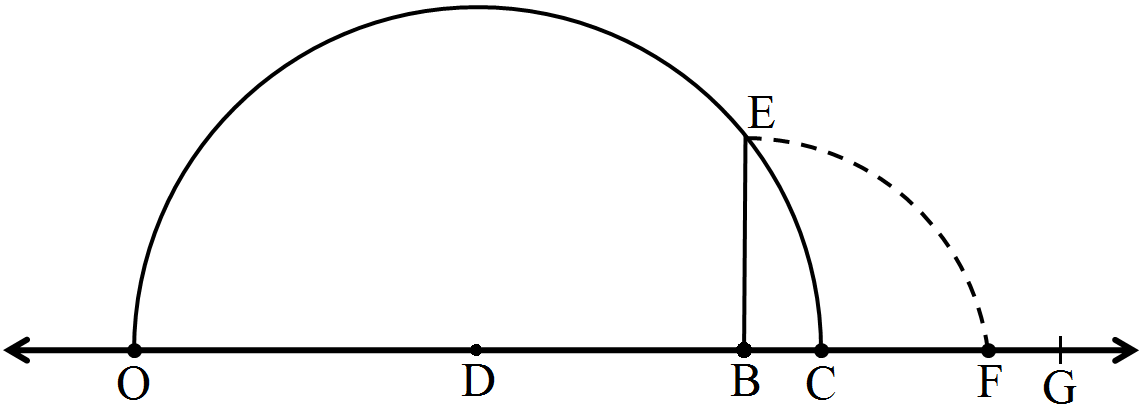
View full question & answer→Question 114 Marks
Simplify by rationalising the denominator: $\frac{7\sqrt{3}-5\sqrt{2}}{\sqrt{48}+\sqrt{18}}$
Answer$\frac{7\sqrt{3}-5\sqrt{2}}{\sqrt{48}+\sqrt{18}}$
$=\frac{7\sqrt{3}-5\sqrt{2}}{\sqrt{16\times3}+\sqrt{9\times2}}$
$=\frac{7\sqrt{3}-5\sqrt{2}}{4\sqrt{3}+3\sqrt{2}}$
$=\frac{7\sqrt{3}-5\sqrt{2}}{4\sqrt{3}+3\sqrt{2}}\times\frac{4\sqrt{3}-3\sqrt{2}}{4\sqrt{3}-3\sqrt{2}}$ $=\frac{7\sqrt{3}\times4\sqrt{3}-7\sqrt{3}\times3\sqrt{2}-5\sqrt{2}\times4\sqrt{3}+5\sqrt{2}\times3\sqrt{2}}{\big(4\sqrt{3}\big)^2-\big(3\sqrt{2}\big)^2}$
$=\frac{28\times3-21\sqrt{6}-20\sqrt{6}+15\times2}{16\times3-9\times2}$
$=\frac{84-41\sqrt{6}+30}{48-18}$
$=\frac{114-41\sqrt{6}}{30}$
View full question & answer→Question 124 Marks
It being given that $\sqrt{3}=1.732,\sqrt{5}=2.236,\sqrt{6}=2.449$ and $\sqrt{10}=3.162,$ find to three places of decimal, the value of the following:
$\frac{3+\sqrt{5}}{3-\sqrt{5}}$
Answer $\frac{3+\sqrt{5}}{3-\sqrt{5}}$
$=\frac{3+\sqrt{5}}{3-\sqrt{5}}\times\frac{3+\sqrt{5}}{3+\sqrt{5}}$
$=\frac{\big(3+\sqrt{5}\big)^2}{(3)^2-\big(\sqrt{5}\big)^2}$
$=\frac{(3)^2+2\times3\sqrt{5}+\big(\sqrt{5}\big)^2}{9-5}$
$=\frac{9+6\sqrt{5}+5}{4}$
$=\frac{14+6\sqrt{5}}{4}$
$=\frac{7+3\sqrt{5}}{2}$
$=\frac{7+3\times2.236}{2}$
$=\frac{7+6.708}{2}$
$=\frac{13.708}{2}$
$=6.854$
View full question & answer→Question 134 Marks
Represent $\sqrt{4.7}$ geometrically on the number line.
AnswerDraw a line segment $AB = 4.7$ units and extend it to $C$ such that $BC = 1$ unit.
Find the midpoint $O$ of $AC$. With $O$ as centre and $OA$ as radius, draw a semicircle.
Now, draw $\text{BD}\perp\text{AC},$ intersecting the semicircle at $D$.
Then, $\text{BD}=\sqrt{4.7}\text{units}.$ With $B$ as centre and $BD$ as radius, draw an arc, meeting $AC$ produced at $E$.
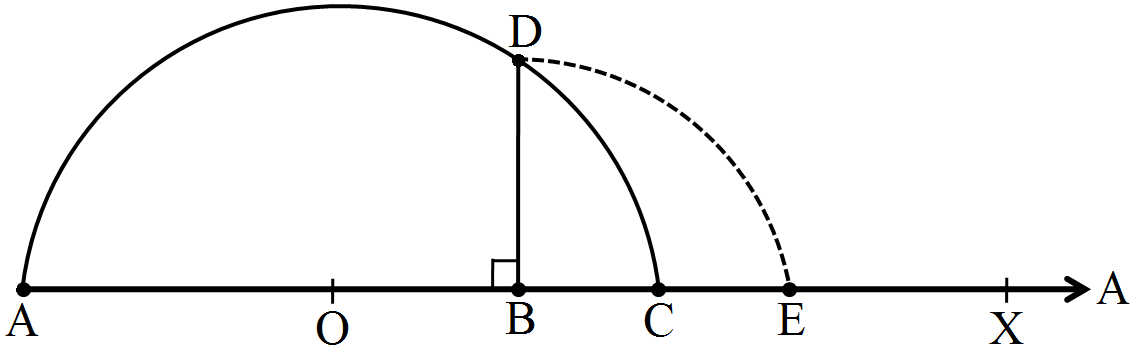
Then, $\text{BE}=\text{BD}=\sqrt{4.7}\ \text{units}.$ View full question & answer→Question 144 Marks
Find rational numbers $a$ and $b$ such that: $\frac{5+2\sqrt{3}}{7+4\sqrt{3}}=\text{a}+\text{b}\sqrt{3}$
Answer$\frac{5+2\sqrt{3}}{7+4\sqrt{3}}=\text{a}+\text{b}\sqrt{3}$
we have, $\frac{5+2\sqrt{3}}{7+4\sqrt{3}}$ $=\frac{5+2\sqrt{3}}{7+4\sqrt{3}}\times\frac{7-4\sqrt{3}}{7-4\sqrt{3}}$
$=\frac{5\times7-5\times4\sqrt{3}+2\sqrt{3}\times7-2\sqrt{3}\times4\sqrt{3}}{(7)^2-\big(4\sqrt{3}\big)^2}$
$=\frac{35-20\sqrt{3}+14\sqrt{3}-8\times3}{49-16\times3}$
$=\frac{35-6\sqrt{3}-24}{49-48}$ $=\frac{11-6\sqrt{3}}{1}$
$=11-6\sqrt{3}$
Now, $\frac{5+2\sqrt{3}}{7+4\sqrt{3}}=\text{a}+\text{b}\sqrt{3}$
$\Rightarrow\text{a}=11$ and $\text{b}=-6$
View full question & answer→Question 154 Marks
Represent $\sqrt{5}$ on the number line.
AnswerDraw a number line as shown.
On the number line, take point $O$ corresponding to zero.
Now take point $A$ on number line such that $OA = 2$ units.
Draw perpendicular $AZ$ at $A$ on the number line and cut-off arc $AB = 1$ unit.
By Pythagoras Theorem,
$OB^2 = OA^2 + AB^2 = 2^2 + 1^2= 4 + 1 = 5$
$\Rightarrow\text{OB}=\sqrt{5}$
Taking $O$ as centre and $\text{OB}=\sqrt{5}$ as radius draw an arc cutting real line at $C$.
Clearly, $\text{OC}=\text{OB}=\sqrt{5}$
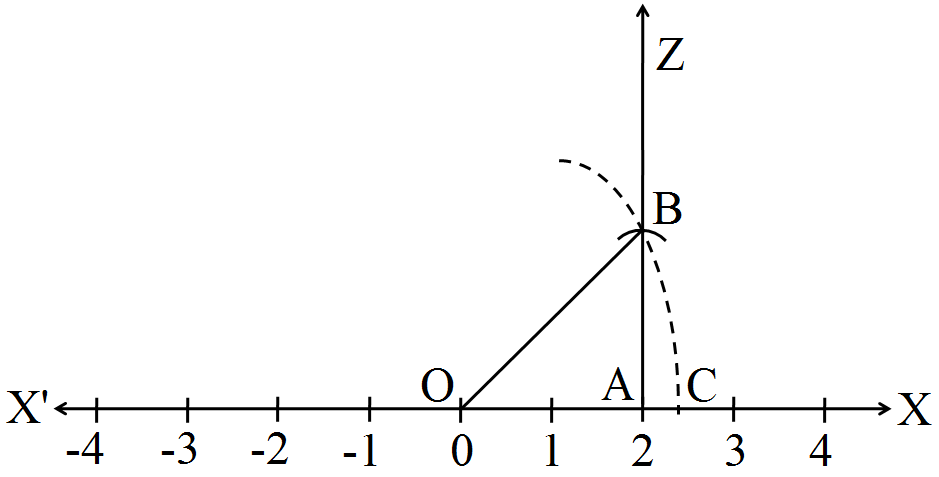
Hence, $C$ represents $\sqrt{5}$ on the number line. View full question & answer→Question 164 Marks
Simplify $\frac{\sqrt{13}-\sqrt{11}}{\sqrt{13}+\sqrt{11}}+\frac{\sqrt{13}+\sqrt{11}}{\sqrt{13}-\sqrt{11}}$
Answer$\frac{\sqrt{13}-\sqrt{11}}{\sqrt{13}+\sqrt{11}}+\frac{\sqrt{13}+\sqrt{11}}{\sqrt{13}-\sqrt{11}}$
$=\frac{\sqrt{13}-\sqrt{11}}{\sqrt{13}+\sqrt{11}}\times\frac{\sqrt{13}-\sqrt{11}}{\sqrt{13}-\sqrt{11}}+\frac{\sqrt{13}+\sqrt{11}}{\sqrt{13}-\sqrt{11}}\times\frac{\sqrt{13}+\sqrt{11}}{\sqrt{13}+\sqrt{11}}$
$=\frac{\big(\sqrt{13}-\sqrt{11}\big)^2}{\big(\sqrt{13}\big)^2-\big(\sqrt{11}\big)^2}+\frac{\big(\sqrt{13}+\sqrt{11}\big)^2}{\big(\sqrt{13}\big)^2-\big(\sqrt{11}\big)^2}$
$=\frac{13+11-2\times\sqrt{13}\times\sqrt{11}}{13-11}+\frac{13+11+2\times\sqrt{13}\times\sqrt{11}}{13-11}$
$=\frac{24-2\sqrt{143}}{2}+\frac{24+2\sqrt{143}}{2}$
$=\frac{24-2\sqrt{143}+24+2\sqrt{143}}{2}$
$=\frac{48}{2}$ $=24$
View full question & answer→Question 174 Marks
Find rational numbers $a$ and $b$ such that: $\frac{\sqrt{3}+\sqrt{2}}{\sqrt{3}-\sqrt{2}}=\text{a}+\text{b}\sqrt{6}$
Answer$\frac{\sqrt{3}+\sqrt{2}}{\sqrt{3}-\sqrt{2}}=\text{a}+\text{b}\sqrt{6}$
we have, $\frac{\sqrt{3}+\sqrt{2}}{\sqrt{3}-\sqrt{2}}$
$=\frac{\sqrt{3}+\sqrt{2}}{\sqrt{3}-\sqrt{2}}\times\frac{\sqrt{3}+\sqrt{2}}{\sqrt{3}+\sqrt{2}}$
$=\frac{\big(\sqrt{3}+\sqrt{2}\big)^2}{\big(\sqrt{3}\big)^2-\big(\sqrt{2}\big)^2}$
$=\frac{\big(\sqrt{3}\big)^2+2\times\sqrt{2}\times\sqrt{3}+\big(\sqrt{2}\big)^2}{3-2}$
$=\frac{3+2\sqrt{6}+2}{1}$
$=5+2\sqrt{6}$
Now, $\frac{\sqrt{3}+\sqrt{2}}{\sqrt{3}-\sqrt{2}}=\text{a}+\text{b}\sqrt{6}$
$\Rightarrow\text{a}=5$ and $\text{b}=2$
View full question & answer→Question 184 Marks
Simplify: $\frac{2\sqrt{6}}{{\sqrt2}+\sqrt{3}}+\frac{6\sqrt{2}}{{\sqrt6}+\sqrt{3}}-\frac{8\sqrt{3}}{{\sqrt6}+\sqrt{2}}$
Answer$\frac{2\sqrt{6}}{{\sqrt2}+\sqrt{3}}+\frac{6\sqrt{2}}{{\sqrt6}+\sqrt{3}}-\frac{8\sqrt{3}}{{\sqrt6}+\sqrt{2}}$
$=\frac{2\sqrt{6}}{{\sqrt2}+\sqrt{3}}\times\frac{{\sqrt2}-\sqrt{3}}{{\sqrt2}-\sqrt{3}}+\frac{6\sqrt{2}}{{\sqrt6}+\sqrt{3}}\times\frac{{\sqrt6}-\sqrt{3}}{{\sqrt6}-\sqrt{3}}-\frac{8\sqrt{3}}{{\sqrt6}+\sqrt{2}}\times\frac{{\sqrt6}-\sqrt{2}}{{\sqrt6}-\sqrt{2}}$
$=\frac{2\sqrt{6}\times\sqrt{3}-2\sqrt{6}\times\sqrt{2}}{\big(\sqrt{3}\big)^2-\big(\sqrt{2}\big)^2}+\frac{6\sqrt{2}\times\sqrt{6}-6\sqrt{2}\times\sqrt{3}}{\big(\sqrt{6}\big)^2-\big(\sqrt{3}\big)^2}-\frac{8\sqrt{3}\times\sqrt{6}-8\sqrt{3}\times\sqrt{2}}{\big(\sqrt{6}\big)^2-\big(\sqrt{2}\big)^2}$
$=\frac{2\sqrt{18}-2\sqrt{12}}{3-2}+\frac{6\sqrt{12}-6\sqrt{6}}{6-3}-\frac{8\sqrt{18}-8\sqrt{6}}{6-2}$
$=2\sqrt{18}-2\sqrt{12}+\frac{6\sqrt{12}-6\sqrt{6}}{3}-\frac{8\sqrt{18}-8\sqrt{6}}{4}$
$=2\sqrt{18}-2\sqrt{12}+2\sqrt{12}-2\sqrt{6}-2\sqrt{18}+2\sqrt{6}$
$=0$
View full question & answer→Question 194 Marks
Represent $\sqrt{10.5}$ on the number line.
AnswerDraw a line segment $OB = 10.5$ units and extend it to $C$ such that $BC = 1$ unit.
Find the midpoint $D$ of $OC$. With $D$ as centre and $DO$ as radius, draw a semicircle.
Now, draw $\text{BE}\perp\text{AC},$ intersecting the semicircle at $E$.
Then, $\text{BE}=\sqrt{10.5}\ \text{units}.$ With $B$ as centre and $BE$ as radius, draw an arc, meeting $AC$ produced at $F$.
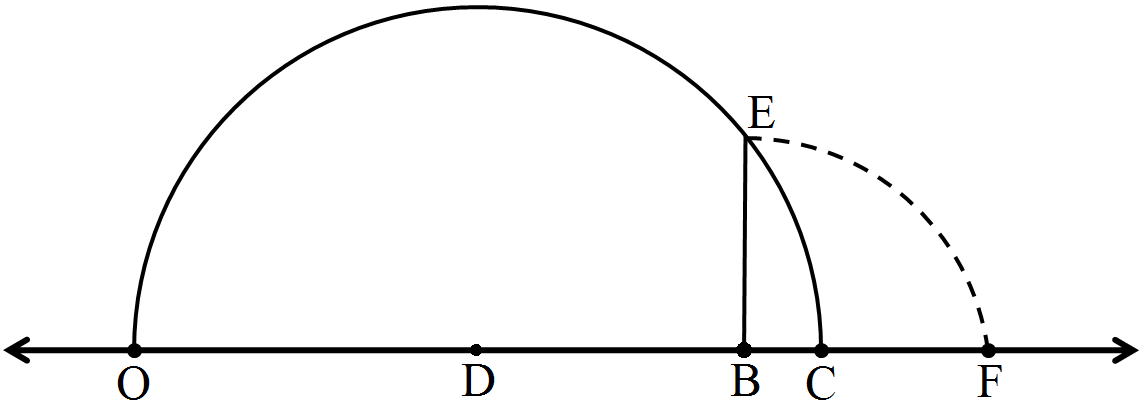
Then, $\text{BF}=\text{BE}=\sqrt{10.5}\text{units}.$ View full question & answer→Question 204 Marks
Find rational numbers $a$ and $b$ such that: $\frac{\sqrt{2}-1}{\sqrt{2}+1}=\text{a}+\text{b}\sqrt{2}$
Answer$\frac{\sqrt{2}-1}{\sqrt{2}+1}=\text{a}+\text{b}\sqrt{2}$
we have, $\frac{\sqrt{2}-1}{\sqrt{2}+1}$
$=\frac{\sqrt{2}-1}{\sqrt{2}+1}\times\frac{\sqrt{2}-1}{\sqrt{2}-1}$
$=\frac{\big(\sqrt{2}-1\big)^2}{\big(\sqrt{2}\big)^2-(1)^2}$
$=\frac{\big(\sqrt{2}\big)^2-2\sqrt{2}+1}{2-1}$
$=\frac{2-2\sqrt{2}+1}{1}$
$=3-2\sqrt{2}$
Now, $\frac{\sqrt{2}-1}{\sqrt{2}+1}=\text{a}+\text{b}\sqrt{2}$
$\Rightarrow3-2\sqrt{2}=\text{a}+\text{b}\sqrt{2}$
$\Rightarrow\text{a}=3$ and $\text{b}=-2$
View full question & answer→Question 214 Marks
It being given that $\sqrt{3}=1.732,\sqrt{5}=2.236,\sqrt{6}=2.449$ and $\sqrt{10}=3.162,$ find to three places of decimal, the value of the following: $\frac{\sqrt{5}+\sqrt{2}}{\sqrt{5}-\sqrt{2}}$
Answer$\frac{\sqrt{5}+\sqrt{2}}{\sqrt{5}-\sqrt{2}}$
$=\frac{\sqrt{5}+\sqrt{2}}{\sqrt{5}-\sqrt{2}}\times\frac{\sqrt{5}+\sqrt{2}}{\sqrt{5}+\sqrt{2}}$
$=\frac{\big(\sqrt{5}+\sqrt{2}\big)^2}{\big(\sqrt{5}\big)^2-\big(\sqrt{2}\big)^2}$
$=\frac{\big(\sqrt{5}\big)^2+2\times\sqrt{5}\times\sqrt{2}+\big(\sqrt{2}\big)^2}{5-2}$
$=\frac{5+2\sqrt{10}+2}{3}$
$=\frac{7+2\sqrt{10}}{3}$
$=\frac{7+2\times3.162}{3}$
$=\frac{7+6.324}{3}$
$=\frac{13.324}{3}
$ $=4.441$
View full question & answer→Question 224 Marks
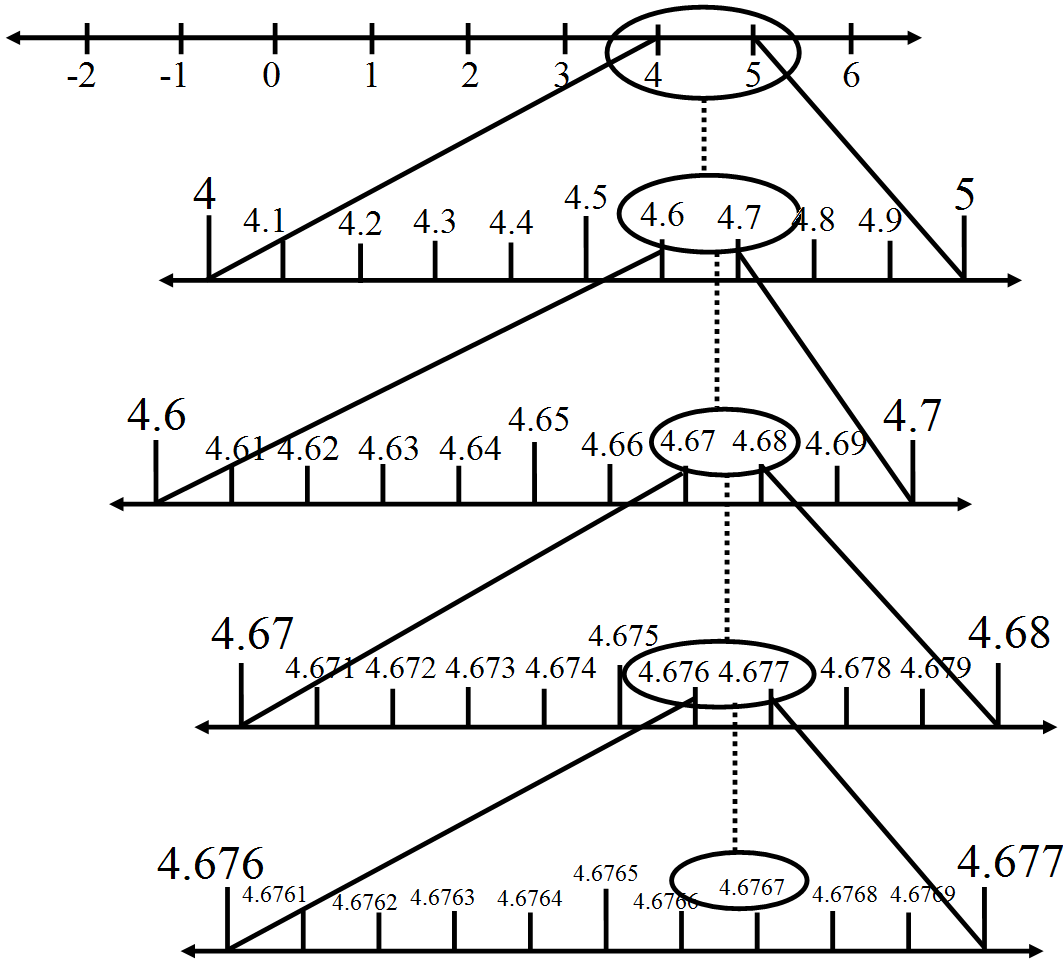
Visualize the representation of $4.\overline{67}$ on the number line up to $4$ decimal places.
Answer$4.\overline{67}=4.67676767...=4.6767$ (upto $4$ decimal places)
View full question & answer→Question 234 Marks
Simplify:
$\frac{2+\sqrt{3}}{2-\sqrt{3}}+\frac{2-\sqrt{3}}{2+\sqrt{3}}+\frac{\sqrt{3}-1}{\sqrt{3}+1}$
Answer $\frac{2+\sqrt{3}}{2-\sqrt{3}}+\frac{2-\sqrt{3}}{2+\sqrt{3}}+\frac{\sqrt{3}-1}{\sqrt{3}+1}$
$=\frac{2+\sqrt{3}}{2-\sqrt{3}}\times\frac{2+\sqrt{3}}{2+\sqrt{3}}\times\frac{2+\sqrt{3}}{2-\sqrt{3}}+\frac{2-\sqrt{3}}{2-\sqrt{3}}+\frac{\sqrt{3}-1}{\sqrt{3}+1}\times\frac{\sqrt{3}-1}{\sqrt{3}-1}$
$=\frac{\big(2+\sqrt{3}\big)^2}{2^2-\big(\sqrt{3}\big)^2}+\frac{\big(2-\sqrt{3}\big)^2}{2^2-\big(\sqrt{3}\big)^2}+\frac{\big(\sqrt{3}-1\big)^2}{\big(\sqrt{3}\big)^2-1}$
$=\frac{2^2+2\times2\sqrt{3}+\big(\sqrt{3}\big)^2}{4-3}+\frac{2^2-2\times2\sqrt{3}+\big(\sqrt{3}\big)^2}{4-3}+\frac{\big(\sqrt{3}\big)^2-2\sqrt{3}+1}{3-1}$
$=\frac{4+4\sqrt{3}+3}{1}+\frac{4-4\sqrt{3}+3}{1}+\frac{3-2\sqrt{3}+1}{2}$
$=7+4\sqrt{3}+7-4\sqrt{3}+\frac{4-2\sqrt{3}}{2}$
$=14+2-\sqrt{3}$
$=16-\sqrt{3}$
View full question & answer→Question 244 Marks
Visualize the representation of $3.765$ on the number line using successive magnification.
View full question & answer→Question 254 Marks
If $\frac{9^\text{n}\times3^2\times\Big(3^\frac{-\text{n}}{2}\Big)^{-2}-(27)^\text{n}}{3^{3\text{m}}\times2^3}=\frac{1}{27},$ prove that m - n = 1.
Answer $\frac{9^\text{n}\times3^2\times\Big(3^\frac{-\text{n}}{2}\Big)^{-2}-(27)^\text{n}}{3^{3\text{m}}\times2^3}=\frac{1}{27}$
$\Rightarrow\frac{3^{2\text{n}}\times3^2\times\Big(\frac{1}{3^\frac{\text{n}}{2}}\Big)^{-2}-(3^3)^\text{n}}{3^{3\text{m}}\times8}=\frac{1}{3^3}$
$\Rightarrow\frac{3^{2\text{n}+2}\Big(3^{\frac{\text{n}}{2}}\Big)^2-3^{3\text{n}}}{3^{3\text{m}}\times8}=\frac{1}{3^3}$
$\Rightarrow\frac{3^{2\text{n}+2}\times3^\text{n}-3^{3\text{n}}}{3^{3\text{m}}\times8}=\frac{1}{3^3}$
$\Rightarrow\frac{3^{2\text{n}+2+\text{n}}-3^{3\text{n}}}{3^{3\text{m}}\times8}=\frac{1}{3^3}$
$\Rightarrow\frac{3^{3\text{n}+2}-3^{3\text{n}}}{3^{3\text{m}}\times8}=\frac{1}{3^3}$
$\Rightarrow\frac{3^{3\text{n}}(3^2-1)}{3^{3\text{m}}\times8}=\frac{1}{3^3}$
$\Rightarrow\frac{3^{3\text{n}}\times8}{3^{3\text{m}}\times8}=\frac{1}{3^3}$
$\Rightarrow\frac{1}{3^{3\text{m}-3\text{n}}}=\frac{1}{3^3}$
$\Rightarrow3\text{m}-3\text{n}=3$
$\Rightarrow\text{m}-\text{n}=1$
View full question & answer→Question 264 Marks
Rationalise the denominator of the following:
$\frac{4}{2+\sqrt{3}+\sqrt{7}}$
Answer $\frac{4}{2+\sqrt{3}+\sqrt{7}}$
$=\frac{4}{\big(2+\sqrt{3}\big)+\sqrt{7}}\times\frac{\big(2+\sqrt{3}\big)-\sqrt{7}}{\big(2+\sqrt{3}\big)-\sqrt{7}}$
$=\frac{4\big(2+\sqrt{3}-\sqrt{7}\big)}{\big(2+\sqrt{3}\big)^2-\big(\sqrt{7}\big)^2}$
$=\frac{8+4\sqrt{3}-4\sqrt{7}}{4+4\sqrt{3}+3-7}$
$=\frac{8+4\sqrt{3}-4\sqrt{7}}{4\sqrt{3}}$
$=\frac{8+4\sqrt{3}-4\sqrt{7}}{4\sqrt{3}}\times\frac{\sqrt{3}}{\sqrt{3}}$
$=\frac{8\sqrt{3}+12-4\sqrt{21}}{12}$
$=\frac{2\sqrt{3}+3-\sqrt{21}}{3}$
View full question & answer→Question 274 Marks
Represent $\sqrt{7.28}$ geometrically on the number line.
Answer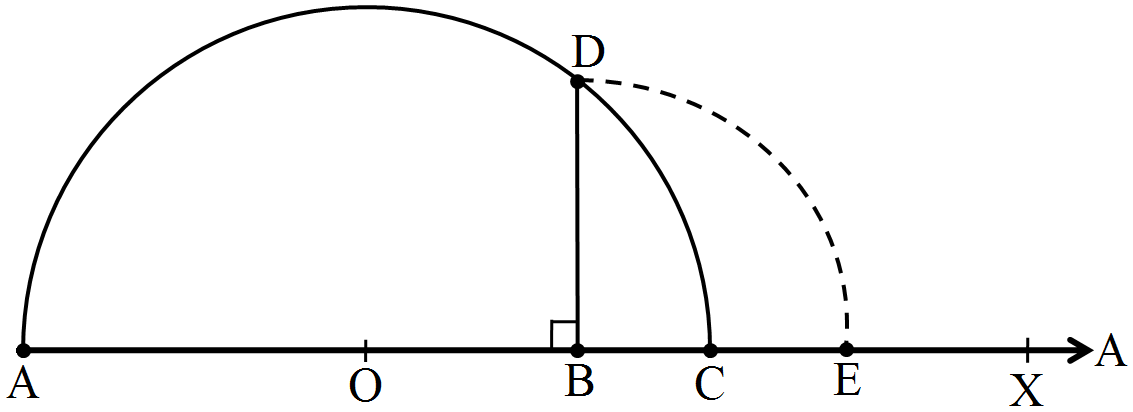
Draw a line segment $AB = 7.28$ units and extend it to $C$ such that $BC = 1$ unit.
Find the midpoint $O$ of $AC$. With $O$ as centre and $OA$ as radius, draw a semicircle.
Now, draw $\text{BD}\perp\text{AC},$ intersecting the semicircle at $D$.
Then, $\text{BD}=\sqrt{7.28}\ \text{units}.$
With $D$ as centre and $BD$ as radius, draw an arc, meeting $AC$ produced at $E$.
Then, $\text{BE}=\text{BD}=\sqrt{7.28}\ \text{units}.$ View full question & answer→Question 284 Marks
Locate $\sqrt{3}$ on the number line.
AnswerDraw a number line as shown.
On the number line, take point $O$ corresponding to zero.
Now take point $A$ on number line such that $OA = 1$ unit.
Draw perpendicular $AZ$ at $A$ on the number line and cut-off arc $AB = 1$ unit.
By Pythagoras Theorem, $OB^2 = OA^2 + AB^2 = 1^2 + 1^2= 1 + 1 = 2$
$\Rightarrow\text{OB}=\sqrt{2}$ Taking $O$ as centre and $\text{OB}=\sqrt{2}$ as radius draw an arc cutting real line at $C$.
Clearly, $\text{OC}=\text{OB}=\sqrt{2}$
Thus, $C$ represents $\sqrt{2}$ on the number line.
Now, draw perpendicular $CY$ at $C$ on the number line and cut-off arc $CE = 1$ unit. By Pythagoras Theorem, $\text{OE}^2=\text{OC}^2+\text{CE}^2$
$=\big(\sqrt{2}\big)^2+1^2=2+1=3$
$\Rightarrow\text{OE}=\sqrt{3}$
Taking $O$ as centre and $\text{OE}=\sqrt{3}$ as radius draw an arc cutting real line at $D$.
Clearly, $\text{OD}=\text{OE}=\sqrt{3}$
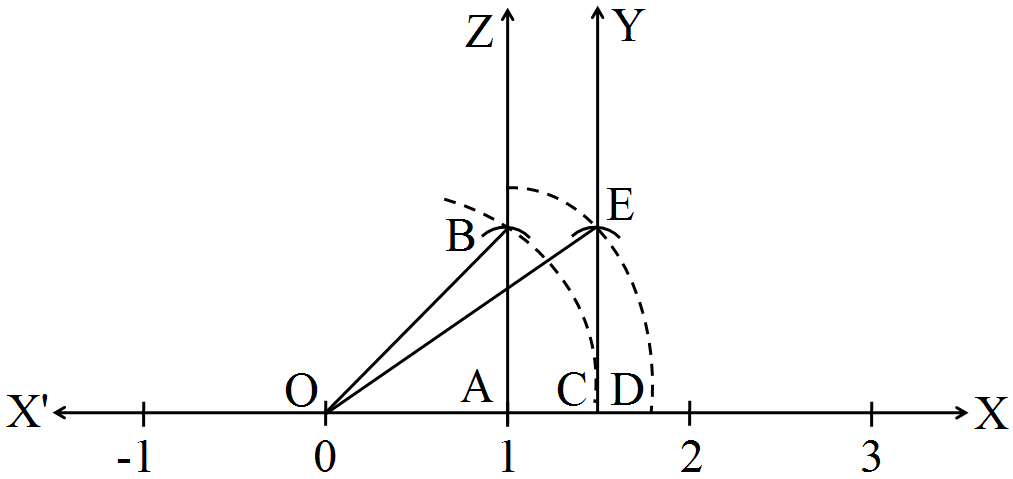
Hence, $D$ represents $\sqrt{3}$ on the number line. View full question & answer→Question 294 Marks
Express in the form of $\frac{\text{p}}{\text{q}}:0.\overline{38}+1.\overline{27}.$
AnswerLet $0.\overline{38}=\text{x}$ $1.\overline{27}=\text{y}$
$\text{x}=0.3838 \ ...(\text{i})$
Multiply with $100$ as there are $2$ repeating digits after decimals $100x = 38.3838 ...(ii)$
Subtracting $(i)$ from $(ii)$ we get $99\text{x}=38$
$\Rightarrow\text{x}=\frac{38}{99}$
Similarly, we take $y = 1.2727 ...(iii)$
Multiply $y$ with $100$ as there are $2$ repeating digits after decimal.
$100y = 127.2727 ...(iv)$
Subtract $(iii)$ from $(iv)$ we get $99\text{y}=126$
$\Rightarrow\text{y}=\frac{126}{99}$
Now, $\text{x}+\text{y}=\frac{38}{99}+\frac{126}{99}=\frac{164}{99}$
View full question & answer→Question 304 Marks
Evaluate $\frac{15}{\sqrt{10}+\sqrt{20}+\sqrt{40}-\sqrt{5}-\sqrt{80}},$ it being given that $\sqrt{5}=2.236$ and $\sqrt{10}=3.162$
Answer$\frac{15}{\sqrt{10}+\sqrt{20}+\sqrt{40}-\sqrt{5}-\sqrt{80}}$
$=\frac{15}{\sqrt{10}+\sqrt{4\times5}+\sqrt{4\times10}-\sqrt{5}-\sqrt{16\times5}}$
$=\frac{15}{\sqrt{10}+2\sqrt{5}+2\sqrt{10}-\sqrt{5}-4\sqrt{5}}$
$=\frac{15}{3\sqrt{10}-3\sqrt{5}}$
$=\frac{5}{\sqrt{10}-\sqrt{5}}$
$=\frac{5}{\sqrt{10}-\sqrt{5}}\times\frac{\sqrt{10}+\sqrt{5}}{\sqrt{10}+\sqrt{5}}$
$=\frac{5\big(\sqrt{10}+\sqrt{5}\big)}{\big(\sqrt{10}\big)^2-\big(\sqrt{5}\big)^2}$
$=\frac{5\big(\sqrt{10}+\sqrt{5}\big)}{10-5}$
$=\frac{5\big(\sqrt{10}+\sqrt{5}\big)}{5}$
$=\sqrt{10}+\sqrt{5}$
$=3.162+2.236$ $=5.398$
View full question & answer→Question 314 Marks
Rationalise the denominator of the following:
$\frac{1}{\sqrt{7}+\sqrt{6}-\sqrt{13}}$
Answer $\frac{1}{\sqrt{7}+\sqrt{6}-\sqrt{13}}$
$=\frac{1}{\big(\sqrt{7}+\sqrt{6}\big)-\sqrt{13}}\times\frac{\big(\sqrt{7}+\sqrt{6}\big)+\sqrt{13}}{\big(\sqrt{7}+\sqrt{6}\big)+\sqrt{13}}$
$=\frac{\big(\sqrt{7}+\sqrt{6}\big)+\sqrt{13}}{\big(\sqrt{7}+\sqrt{6}\big)^2-\big(\sqrt{13}\big)^2}$
$=\frac{\sqrt{7}+\sqrt{6}+\sqrt{13}}{\big(7+6+2\sqrt{42}\big)-13}$
$=\frac{\sqrt{7}+\sqrt{6}+\sqrt{13}}{13+2\sqrt{42}-13}$
$=\frac{\sqrt{7}+\sqrt{6}+\sqrt{13}}{2\sqrt{42}}$
$=\frac{\sqrt{7}+\sqrt{6}+\sqrt{13}}{2\sqrt{42}}\times\frac{\sqrt{42}}{\sqrt{42}}$
$=\frac{\sqrt{7\times42}+\sqrt{6\times42}+\sqrt{13\times42}}{2\big(\sqrt{42}\big)^2}$
$=\frac{\sqrt{7\times7\times6}+\sqrt{6\times6\times7}+\sqrt{546}}{2\times42}$
$=\frac{7\sqrt{6}+6\sqrt{7}+\sqrt{546}}{84}$
View full question & answer→Question 324 Marks
If $\text{a}=\frac{\sqrt{3}-\sqrt{2}}{\sqrt{3}+\sqrt{2}}$ and $\text{b}=\frac{\sqrt{3}+\sqrt{2}}{\sqrt{3}-\sqrt{2}},$ find the value of $a^2 + b^2 - 5ab$.
Answer
| $\text{a}=\frac{\sqrt{3}-\sqrt{2}}{\sqrt{3}+\sqrt{2}}$ |
$\text{b}=\frac{\sqrt{3}+\sqrt{2}}{\sqrt{3}-\sqrt{2}}$ |
| $=\frac{\sqrt{3}-\sqrt{2}}{\sqrt{3}+\sqrt{2}}\times\frac{\sqrt{3}-\sqrt{2}}{\sqrt{3}-\sqrt{2}}$ |
$=\frac{\sqrt{3}+\sqrt{2}}{\sqrt{3}-\sqrt{2}}\times\frac{\sqrt{3}+\sqrt{2}}{\sqrt{3}+\sqrt{2}}$ |
| $=\frac{\big(\sqrt{3}-\sqrt{2}\big)^2}{\big(\sqrt{3}\big)^2-\big(\sqrt{2}\big)^2}$ |
$=\frac{\big(\sqrt{3}+\sqrt{2}\big)^2}{\big(\sqrt{3}\big)^2-\big(\sqrt{2}\big)^2}$ |
| $=\frac{3+2-2\sqrt{6}}{3-2}$ |
$=\frac{3+2-2\sqrt{6}}{3-2}$ |
| $=5-2\sqrt{6}$ |
$=5+2\sqrt{6}$ |
| $\Rightarrow\text{a}^2=\big(5-2\sqrt{6}\big)^2$ |
$\Rightarrow\text{a}^2=\big(5+2\sqrt{6}\big)^2$ |
| $=25-20\sqrt{6}+24$ |
$=25+20\sqrt{6}+24$ |
| $=49-20\sqrt{6}$ |
$=49+20\sqrt{6}$ |
$\therefore \ \text{a}^2+\text{b}^2-5\text{ab}=\big(49-20\sqrt{6}\big)+\\\big(49+20\sqrt{6}\big)-5\times\frac{\sqrt{3}-\sqrt{2}}{\sqrt{3}+\sqrt{2}}\times\frac{\sqrt{3}+\sqrt{2}}{\sqrt{3}-\sqrt{2}}$
$=98-5$
$=93$ View full question & answer→Question 334 Marks
Locate $\sqrt{10}$ on the number line.
AnswerDraw a number line as shown.
On the number line, take point $O$ corresponding to zero.
Now take point $A$ on number line such that $OA = 3$ units.
Draw perpendicular $AZ$ at $A$ on the number line and cut-off arc $AB = 1$ unit.
By Pythagoras Theorem, $OB^2 = OA^2 + AB^2 = 3^2 + 1^2= 9 + 1 = 10 \Rightarrow\text{OB}=\sqrt{10}$
Taking $O$ as centre and $\text{OB}=\sqrt{10}$ as radius draw an arc cutting real line at $C$.
Clearly, $\text{OC}=\text{OB}=\sqrt{10}$
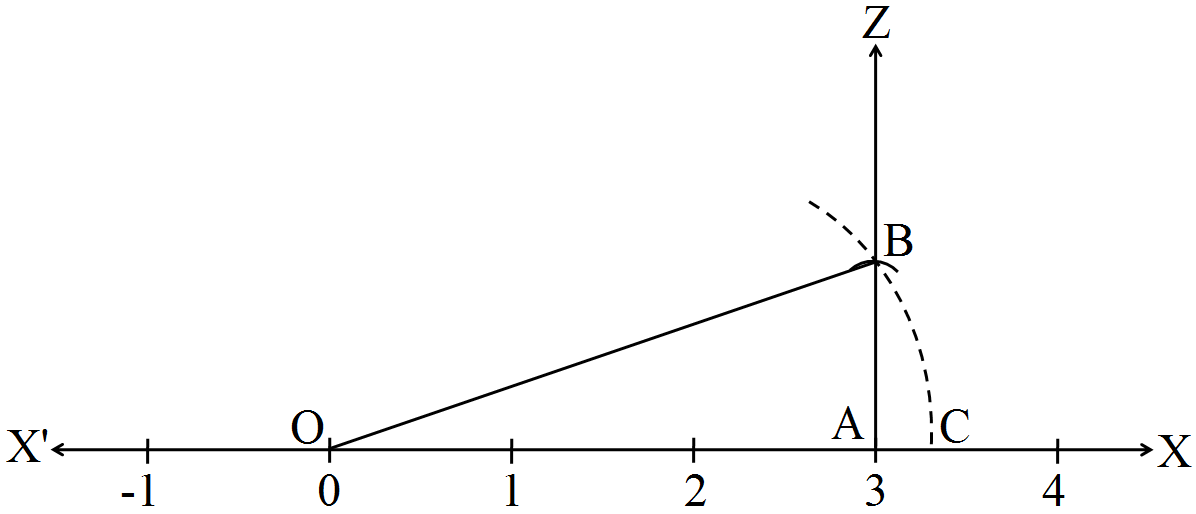
Hence, $C$ represents $\sqrt{10}$ on the number line. View full question & answer→Question 344 Marks
Express $2.\overline{36}+0.\overline{23}$ as a fraction in simplest form.
AnswerGiven: $2.\overline{36}+0.\overline{23}$
Let $\text{x}=2.\overline{36} \ ...(\text{i})$
$\text{y}=0.\overline{23} \ ...(\text{ii})$
First we take $x$ and convert it into $\frac{\text{p}}{\text{q}}$ $100x = 236.3636 ...(iii)$
Subtracting $(i)$ from $(iii)$ we get $99\text{x}=234$
$\Rightarrow\text{x}=\frac{234}{99}$
Similarly, multiply $y$ with $100$ as there are $2$ decimal places which are repeating themselves.
$100y = 23.2323 ...(iv)$
Subtracting $(ii)$ from $(iv)$ we get $99\text{y}=23$
$\Rightarrow\text{y}=\frac{23}{99}$
Adding $x$ and $y$ we get $2.\overline{36}+0.\overline{23}=\text{x}+\text{y}=\frac{234}{99}+\frac{23}{99}=\frac{257}{99}$
View full question & answer→Question 354 Marks
Given, $\sqrt{2}=1.414$ and $\sqrt{6}=2.449,$ find the value of $\frac{1}{\sqrt{3}-\sqrt{2}-1}$ correct to $3$ places of decimal.
AnswerGiven, $\sqrt{2}=1.414$ and $\sqrt{6}=2.449,$ $\frac{1}{\sqrt{3}-\sqrt{2}-1}$
$=\frac{1}{\big(\sqrt{3}-\sqrt{2}\big)-1}\times\frac{\big(\sqrt{3}-\sqrt{2}\big)+1}{\big(\sqrt{3}-\sqrt{2}\big)+1}$
$=\frac{\sqrt{3}-\sqrt{2}+1}{\big(\sqrt{3}-\sqrt{2}\big)^2-1^2}$ $=\frac{\sqrt{3}-\sqrt{2}+1}{3+2-2\sqrt{6}-1}$
$=\frac{\sqrt{3}-\sqrt{2}+1}{4-2\sqrt{6}}$
$=\frac{\sqrt{3}-\sqrt{2}+1}{4-2\sqrt{6}}\times\frac{4+2\sqrt{6}}{4+2\sqrt{6}}$
$=\frac{4\sqrt{3}+2\sqrt{18}-4\sqrt{2}-2\sqrt{12}+4+2\sqrt{6}}{4^2-\big(2\sqrt{6}\big)^2}$
$=\frac{4\sqrt{3}+6\sqrt{2}-4\sqrt{2}-4\sqrt{3}+4+2\sqrt{6}}{16-24}$
$=\frac{2\sqrt{2}+4+2\sqrt{6}}{-8}$
$=-\frac{11.726}{8}$
$=-1.466$
View full question & answer→Question 364 Marks
If $\text{x}=2+\sqrt{3},$ find the value of $\text{x}^3+\frac{1}{\text{x}^3}.$
Answer$\text{x}=2+\sqrt{3}$
$\Rightarrow\frac{1}{\text{x}}=\frac{1}{2+\sqrt{3}}$
$=\frac{1}{2+\sqrt{3}}\times\frac{2-\sqrt{3}}{2-\sqrt{3}}$
$=\frac{2-\sqrt{3}}{2^2-\big(\sqrt{3}\big)^2}$
$=\frac{2-\sqrt{3}}{4-3}$
$=2-\sqrt{3}$
$\Rightarrow\text{x}+\frac{1}{\text{x}}=2+\sqrt{3}+2-\sqrt{3}=4$
$\Rightarrow\Big(\text{x}+\frac{1}{\text{x}}\Big)^3=4^3$
$\Rightarrow\Big(\text{x}^3+\frac{1}{\text{x}^3}\Big)+3\times\text{x}\times\frac{1}{\text{x}}\Big(\text{x}+\frac{1}{\text{x}}\Big)=64$
$\Rightarrow\Big(\text{x}^3+\frac{1}{\text{x}^3}\Big)+3\times4=64$
$\Rightarrow\Big(\text{x}^3+\frac{1}{\text{x}^3}\Big)+12=64$
$\Rightarrow\Big(\text{x}^3+\frac{1}{\text{x}^3}\Big)=52$
View full question & answer→Question 374 Marks
Simplify: $\frac{4+\sqrt{5}}{4-\sqrt{5}}+\frac{4-\sqrt{5}}{4+\sqrt{5}}$
AnswerFor rationalising the denominator of $a$ number, we multilply its numerator and denominator by its rationalising factor.
If $a$ and $b$ are integers, then $\big(\text{a}+\sqrt{\text{b}}\big)$ and $\big(\text{a}-\sqrt{\text{b}}\big)$ are rationalising factor of each other, as $\big(\text{a}+\sqrt{\text{b}}\big)\big(\text{a}-\sqrt{\text{b}}\big)=\big(\text{a}^2-\text{b}\big),$ which is rational.
Let us rationalise the denominator of the first term on the left hand side.
We have, $\frac{4+\sqrt{5}}{4-\sqrt{5}}=\frac{4+\sqrt{5}}{4-\sqrt{5}}\times\frac{4+\sqrt{5}}{4+\sqrt{5}}$
$=\frac{\big(4+\sqrt{5}\big)^2}{(4)^2-\big(\sqrt{5}\big)^2}$
$=\frac{(4)^2+2(4)\big(\sqrt{5}\big)+\big(\sqrt{5}\big)^2}{16-5}$
$\frac{4+\sqrt{5}}{4-\sqrt{5}}=\frac{16+8\sqrt{5}+5}{11}=\frac{21+8\sqrt{5}}{11} \ ...(1)$
Now consider the denominator of the second term on the left hand side:
$\frac{4-\sqrt{5}}{4+\sqrt{5}}=\frac{4-\sqrt{5}}{4+\sqrt{5}}\times\frac{4-\sqrt{5}}{4-\sqrt{5}}$
$=\frac{\big(4-\sqrt{5}\big)^2}{(4)^2-\big(\sqrt{5}\big)^2}$
$=\frac{(4)^2-2(4)\big(\sqrt{5}\big)+\big(\sqrt{5}\big)^2}{16-5}$
$\frac{4-\sqrt{5}}{4+\sqrt{5}}=\frac{16-8\sqrt{5}+5}{11}=\frac{21-8\sqrt{5}}{11} \ ...(2)$
Adding equations $(1)$ and $(2)$, we have,
$\therefore \ \frac{4+\sqrt{5}}{4-\sqrt{5}}+\frac{4-\sqrt{5}}{4+\sqrt{5}}=\frac{21+8\sqrt{5}}{11}=\frac{21-8\sqrt{5}}{11}$
$=\frac{21+8\sqrt{5}+21-8\sqrt{5}}{11}=\frac{42}{11}$
View full question & answer→Question 384 Marks
Prove that: $\frac{1}{1+\sqrt{2}}+\frac{1}{\sqrt{2}+\sqrt{3}}+\frac{1}{\sqrt{3}+\sqrt{4}}+\frac{1}{\sqrt{4}+\sqrt{5}}\\+\frac{1}{\sqrt{5}+\sqrt{6}}+\frac{1}{\sqrt{6}+\sqrt{7}}+\frac{1}{\sqrt{7}+\sqrt{8}}+\frac{1}{\sqrt{8}+\sqrt{9}}=2$
Answer$\text{L.H.S.}=\frac{1}{1+\sqrt{2}}+\frac{1}{\sqrt{2}+\sqrt{3}}+\frac{1}{\sqrt{3}+\sqrt{4}}+\frac{1}{\sqrt{4}+\sqrt{5}}\\+\frac{1}{\sqrt{5}+\sqrt{6}}+\frac{1}{\sqrt{6}+\sqrt{7}}+\frac{1}{\sqrt{7}+\sqrt{8}}+\frac{1}{\sqrt{8}+\sqrt{9}}$
$=\frac{1}{1+\sqrt{2}}\times\frac{1-\sqrt{2}}{1-\sqrt{2}}+\frac{1}{\sqrt{2}+\sqrt{3}}\times\frac{\sqrt{2}-\sqrt{3}}{\sqrt{2}-\sqrt{3}}+\frac{1}{\sqrt{3}+\sqrt{4}}\\\times\frac{\sqrt{3}-\sqrt{4}}{\sqrt{3}-\sqrt{4}}+\frac{1}{\sqrt{4}+\sqrt{5}}\times\frac{\sqrt{4}-\sqrt{5}}{\sqrt{4}-\sqrt{5}}+\frac{1}{\sqrt{5}+\sqrt{6}}\times\frac{\sqrt{5}-\sqrt{6}}{\sqrt{5}-\sqrt{6}}\\+\frac{1}{\sqrt{6}+\sqrt{7}}\times\frac{\sqrt{6}-\sqrt{7}}{\sqrt{6}-\sqrt{7}}+\frac{1}{\sqrt{7}+\sqrt{8}}\times\frac{\sqrt{7}-\sqrt{8}}{\sqrt{7}-\sqrt{8}}+\frac{1}{\sqrt{8}+\sqrt{9}}\times\frac{\sqrt{8}-\sqrt{9}}{\sqrt{8}-\sqrt{9}}$
$=\frac{1-\sqrt{2}}{1-\big(\sqrt{2}\big)^2}+\frac{\sqrt{2}-\sqrt{3}}{\big(\sqrt{2}\big)^2-\big(\sqrt{3}\big)^2}+\frac{\sqrt{3}-\sqrt{4}}{\big(\sqrt{3}\big)^2-\big(\sqrt{4}\big)^2}\\+\frac{\sqrt{4}-\sqrt{5}}{\big(\sqrt{4}\big)^2-\big(\sqrt{5}\big)^2}+\frac{\sqrt{5}-\sqrt{6}}{\big(\sqrt{5}\big)^2-\big(\sqrt{6}\big)^2}+\frac{\sqrt{6}-\sqrt{7}}{\big(\sqrt{6}\big)^2-\big(\sqrt{7}\big)^2}\\+\frac{\sqrt{7}-\sqrt{8}}{\big(\sqrt{7}\big)^2-\big(\sqrt{8}\big)^2}+\frac{\sqrt{8}-\sqrt{9}}{\big(\sqrt{8}\big)^2-\big(\sqrt{9}\big)^2}$
$=\frac{1-\sqrt{2}}{1-2}+\frac{\sqrt{2}-\sqrt{3}}{2-3}+\frac{\sqrt{3}-\sqrt{4}}{3-4}+\frac{\sqrt{4}-\sqrt{5}}{4-5}\\\frac{\sqrt{5}-\sqrt{6}}{5-6}+\frac{\sqrt{6}-\sqrt{7}}{6-7}+\frac{\sqrt{7}-\sqrt{8}}{7-8}+\frac{\sqrt{8}-\sqrt{9}}{8-9}$
$=\frac{1-\sqrt{2}}{-1}+\frac{\sqrt{2}-\sqrt{3}}{-1}+\frac{\sqrt{3}-\sqrt{4}}{-1}+\frac{\sqrt{4}-\sqrt{5}}{-1}\\\frac{\sqrt{5}-\sqrt{6}}{-1}+\frac{\sqrt{6}-\sqrt{7}}{-1}+\frac{\sqrt{7}-\sqrt{8}}{-1}+\frac{\sqrt{8}-\sqrt{9}}{-1}$
$=-1+\sqrt{2}-\sqrt{2}+\sqrt{3}-\sqrt{3}+\sqrt{4}-\sqrt{4}+\sqrt{5}-\sqrt{5}\\+\sqrt{6}-\sqrt{6}+\sqrt{7}-\sqrt{7}+\sqrt{8}-\sqrt{8}+\sqrt{9}-\sqrt{9}$
$=-1+3$ $=2$
$=\text{R.H.S.}$
View full question & answer→Question 394 Marks
If $\text{p}=\frac{3-\sqrt{5}}{3+\sqrt{5}}$ and $\text{q}=\frac{3+\sqrt{5}}{3-\sqrt{5}},$ find the value of $p^2 + q^2$.
Answer
| $\text{p}=\frac{3-\sqrt{5}}{3+\sqrt{5}}$ |
$\text{q}=\frac{3+\sqrt{5}}{3-\sqrt{5}}$ |
| $=\frac{3-\sqrt{5}}{3+\sqrt{5}}\times\frac{3-\sqrt{5}}{3-\sqrt{5}}$ |
$=\frac{3+\sqrt{5}}{3-\sqrt{5}}\times\frac{3+\sqrt{5}}{3+\sqrt{5}}$ |
| $=\frac{\big(3-\sqrt{5}\big)^2}{3^2-\big(\sqrt{5}\big)^2}$ |
$=\frac{\big(3+\sqrt{5}\big)^2}{3^2-\big(\sqrt{5}\big)^2}$ |
| $=\frac{9+5-6\sqrt{5}}{9-5}$ |
$=\frac{9+5+6\sqrt{5}}{9-5}$ |
| $=\frac{14-6\sqrt{5}}{4}$ |
$=\frac{14+6\sqrt{5}}{4}$ |
| $=\frac{7-3\sqrt{5}}{2}$ |
$=\frac{7+3\sqrt{5}}{2}$ |
$\therefore \ \text{p}^2+\text{q}^2=\Big(\frac{7-3\sqrt{5}}{2}\Big)^2+\Big(\frac{7+3\sqrt{5}}{2}\Big)^2$
$=\frac{94-42\sqrt{5}}{4}+\frac{94+42\sqrt{5}}{4}$
$=\frac{47-21\sqrt{5}}{2}+\frac{47+21\sqrt{5}}{2}$
$=\frac{47-21\sqrt{5}+47+21\sqrt{5}}{2}$
$=\frac{94}{2}$
$=47$ View full question & answer→Question 404 Marks
If $\text{a}=\frac{\sqrt{5}+\sqrt{2}}{\sqrt{5}-\sqrt{2}}$ and $\text{b}=\frac{\sqrt{5}-\sqrt{2}}{\sqrt{5}+\sqrt{2}},$ show that $3\text{a}^2+4\text{ab}-3\text{b}^2=4+\frac{56}{3}\sqrt{10}.$
Answer
| $\text{a}=\frac{\sqrt{5}+\sqrt{2}}{\sqrt{5}-\sqrt{2}}$ |
$\text{b}=\frac{\sqrt{5}-\sqrt{2}}{\sqrt{5}+\sqrt{2}}$ |
| $=\frac{\sqrt{5}+\sqrt{2}}{\sqrt{5}-\sqrt{2}}\times\frac{\sqrt{5}+\sqrt{2}}{\sqrt{5}+\sqrt{2}}$ |
$=\frac{\sqrt{5}-\sqrt{2}}{\sqrt{5}+\sqrt{2}}\times\frac{\sqrt{5}-\sqrt{2}}{\sqrt{5}-\sqrt{2}}$ |
| $=\frac{\big(\sqrt{5}+\sqrt{2}\big)^2}{\big(\sqrt{5}\big)^2-\big(\sqrt{2}\big)^2}$ |
$=\frac{\big(\sqrt{5}-\sqrt{2}\big)^2}{\big(\sqrt{5}\big)^2-\big(\sqrt{2}\big)^2}$ |
| $=\frac{5+2\sqrt{10}+2}{5-2}$ |
$=\frac{5-2\sqrt{10}+2}{5-2}$ |
| $=\frac{7+2\sqrt{10}}{3}$ |
$=\frac{7-2\sqrt{10}}{3}$ |
| Now, |
|
| $\text{a}^2=\Big(\frac{7+2\sqrt{10}}{3}\Big)^2$ |
$\text{b}^2=\Big(\frac{7-2\sqrt{10}}{3}\Big)^2$ |
| $=\frac{49+28\sqrt{10}+40}{9}$ |
$=\frac{49-28\sqrt{10}+40}{9}$ |
| $=\frac{89+28\sqrt{10}}{9}$ |
$=\frac{89-28\sqrt{10}}{9}$ |
$\text{L.H.S.}=3\text{a}^2+4\text{ab}-3\text{b}^2$
$=3\times\frac{89+28\sqrt{10}}{9}+4\times\frac{\sqrt{5}+\sqrt{2}}{\sqrt{5}-\sqrt{2}}\times\frac{\sqrt{5}-\sqrt{2}}{\sqrt{5}+\sqrt{2}}-3\times\frac{89-28\sqrt{10}}{9}$
$=\frac{89+28\sqrt{10}}{3}+4-\frac{89-28\sqrt{10}}{3}$
$=4-\frac{89+28\sqrt{10}-89+28\sqrt{10}}{3}$
$=4+\frac{56}{3}\sqrt{10}$
$=\text{R.H.S.}$ View full question & answer→Question 414 Marks
Rationalise the denominator of the following: $\frac{3}{\sqrt{3}+\sqrt{5}-\sqrt{2}}$
Answer$\frac{3}{\sqrt{3}+\sqrt{5}-\sqrt{2}} $
$=\frac{3}{\big(\sqrt{3}+\sqrt{5}\big)-\sqrt{2}}\times\frac{\big(\sqrt{3}+\sqrt{5}\big)+\sqrt{2}}{\big(\sqrt{3}+\sqrt{5}\big)+\sqrt{2}} $
$=\frac{3\big(\sqrt{3}+\sqrt{5}+\sqrt{2}\big)}{\big(\sqrt{3}+\sqrt{5}\big)^2-\big(\sqrt{2}\big)^2} $
$=\frac{3\sqrt{3}+3\sqrt{5}+3\sqrt{2}}{\big(3+5+2\sqrt{15}\big)-2} $
$=\frac{3\sqrt{3}+3\sqrt{5}+3\sqrt{2}}{8+2\sqrt{15}-2} $
$=\frac{3\sqrt{3}+3\sqrt{5}+3\sqrt{2}}{6+2\sqrt{15}} $
$=\frac{3\sqrt{3}+3\sqrt{5}+3\sqrt{2}}{6+2\sqrt{15}}\times\frac{6-2\sqrt{15}}{6-2\sqrt{15}} $
$=\frac{18\sqrt{3}-6\sqrt{45}+18\sqrt{5}-6\sqrt{75}+18\sqrt{2}-6\sqrt{30}}{6^2-\big(2\sqrt{15}\big)^2} $ $=\frac{18\sqrt{3}-6\sqrt{9\times5}+18\sqrt{5}-6\sqrt{25\times3}+18\sqrt{2}-6\sqrt{30}}{36-30} $
$=\frac{18\sqrt{3}-18\sqrt{5}+18\sqrt{5}-30\sqrt{3}+18\sqrt{2}-6\sqrt{30}}{-24} $
$=\frac{-12\sqrt{3}+18\sqrt{2}-6\sqrt{30}}{-24}$
$=\frac{-6\big(2\sqrt{3}-3\sqrt{2}+\sqrt{30}\big)}{-24}$
$=\frac{2\sqrt{3}-3\sqrt{2}+\sqrt{30}}{4}$
View full question & answer→