Question
If $\text{x}=\frac{\sqrt3+1}{2},$ find the value of $4\text{x}^3+2\text{x}^2-8\text{x}+7.$

Answer

We have, $\text{x}=\frac{\sqrt3+1}{2}$ It can be simplified as$2\text{x}-1=\sqrt3$
On squaring both sides, we get$(2\text{x}-1)^2=\big(\sqrt3\big)^2$
$(2\text{x})^2+1-2\times2\text{x}=3$
$4\text{x}^2+1-4\text{x}=3$
$4\text{x}^2-4\text{x}-2=0$
The given equation can be rewritten as. $4\text{x}^3+2\text{x}^2-8\text{x}+7\\ \ =\text{x}(4\text{x}^2-4\text{x}-2)+\frac{6}{4}(4\text{x}^2-4\text{x}-2)+3+7$
Therefore, we have$4\text{x}^3+2\text{x}^2-8\text{x}+7=\text{x}(0)+\frac{6}{4}(0)+3+7$
$=3+7$
$=10$
Hence, the value of given expression is 10.

Need a full question paper?

Generate a complete, print-ready paper with questions like this in minutes — across 16+ boards, with answer keys.
Start Generating Free

Similar questions

The students of Vidyalaya were asked to participate in a competition for making and decorating pen holders in the shape of a cylinder with a base, using cardboard. Each pen holder was to be of radius 3cm and height 10.5cm. The Vidyalaya was to supply the competitors with cardboard. If there were 35 competitors, how much cardboard was required to be bought for the competition?
If $a, b, c, d$ are in proportion, then prove that : $\frac{ a ^2+ ab + b ^2}{ a ^2- ab + b ^2}=\frac{ c ^2+ cd + d ^2}{c^2- cd + d ^2}$
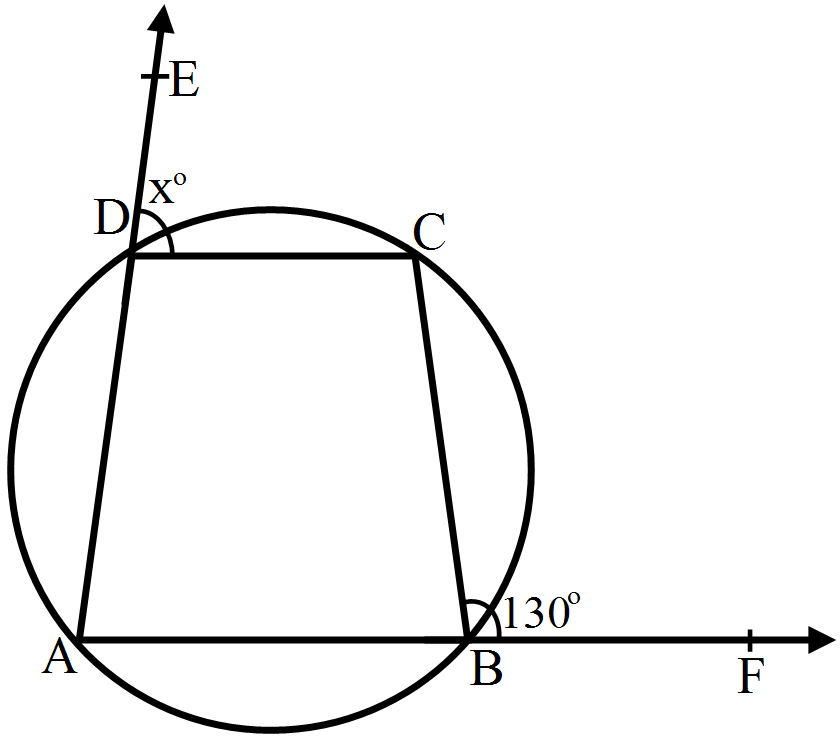
In the given figure, sides AD and AB of cyclic quadrilateral ABCD are produced to E and Frespectively. If $\angle\text{CBF}=130^\circ$ and $\angle\text{CDE}=\text{x}^\circ,$ find the value of x.
Solve the following equations:$8^{\text{x}+1}=16^{\text{y}+2}$ and $\Big(\frac{1}{2}\Big)^{3+\text{x}}=\Big(\frac{1}{4}\Big)^{3\text{y}}$
On a semi-circle with AB as diameter, a point C is taken, so that $\text{m}\big(\angle\text{CAB}\big)=30^\circ.$ Find $\text{m}\big(\angle\text{ACB}\big)$ and $\text{m}\big(\angle\text{ABC}\big).$
Why do we group data?
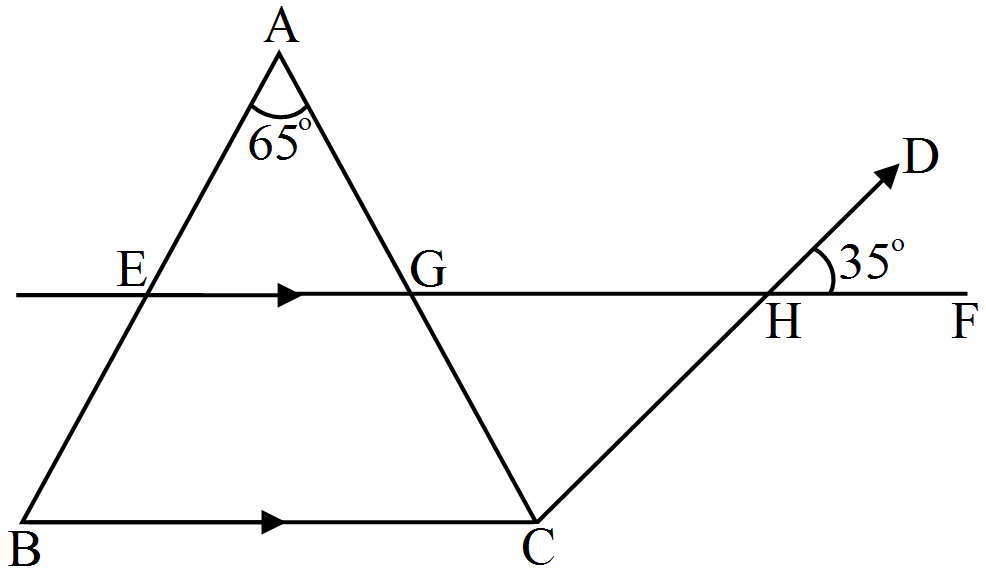
In the given figure, if $\text{AB }||\text{ CD},\text{EF }||\text{ BC},\angle\text{BAC}=65^\circ$ and $\angle\text{DHF}=35^\circ,$ find $\angle\text{AGH}.$
The base BC of $\triangle\text{ABC}$ is divided at D such that $\text{BD}=\frac{1}{2}\text{DC}.$ Prove that $\text{ar}(\triangle\text{ABD})=\frac{1}{3}\times\text{ar}(\triangle\text{ABC}).$
Evaluate:
$(28)^3 + (-15)^3 + (-13)^3$
ABC is a triangle in which BE and CF are, respectively, the perpendiculals to the side AC and AB. if $\text{BE}=\text{CF},$ prove that $\triangle\text{ABC}$ is isosceles.