MCQ
If the capacitors having capacitance C1 and C2 are connected in parallel then their effective capacitance is given by:
- AC = C1 - C2
- BC = C1 + C2
- C1/C = 1/C1 + 1/C2
- D1/C = 1/C1 - 1/C2
Generate a complete, print-ready paper with questions like this in minutes — across 16+ boards, with answer keys.
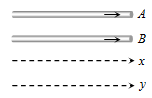
A and B are two conductors carrying a current i in the same direction. x and y are two electron beams moving in the same direction
|
(a) There will be repulsion between A and B attraction between x and y |
|
(b) There will be attraction between A and B, repulsion between x and y |
|
(c) There will be repulsion between A and B and also x and y |
|
(d) There will be attraction between A and B and also x and y |
The device that does not work on the principle of mutual induction is
|
(a) Induction coil |
(b) Motor |
(c) Tesla coil |
(d) Transformer |
Hubble's law is related with
|
(a) Comet |
(b) Speed of galaxy |
(c) Black hole |
(d) Planetary motion |
Figure given below shows two identical parallel plate capacitors connected to a battery with switch S closed. The switch is now opened and the free space between the plate of capacitors is filled with a dielectric of dielectric constant 3. What will be the ratio of total electrostatic energy stored in both capacitors before and after the introduction of the dielectric

|
(a) 3 : 1 |
(b) 5 : 1 |
(c) 3 : 5 |
(d) 5 : 3 |
An electron, a proton, a deuteron and an alpha particle, each having the same speed are in a region of constant magnetic field perpendicular to the direction of the velocities of the particles. The radius of the circular orbits of these particles are respectively Re, Rp, Rd and Ra. It follows that
|
(a) |
(b) |
(c) |
(d) |
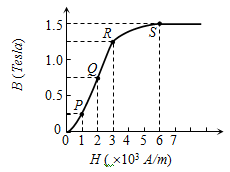
The basic magnetization curve for a ferromagnetic material is shown in figure. Then, the value of relative permeability is highest for the point
|
(a) P |
(b) Q |
(c) R |
(d) S |


