MCQ
If the current is doubled, the deflection is also doubled in:
- AA tangent galvanometer.
- BA moving-coil galvanometer.
- CBoth.
- DNone.
Explanation:
The current and deflection dependence of a moving coil galvanometer is given by
$\text{i}=\frac{\text{k}}{\text{nAB}}\theta\Rightarrow\text{i}\propto\theta$
Therefore, if we double the current, the deflection also gets doubled.
However, in a tangent galvanometer,
$\text{i}\propto\tan\theta$; that is, there is no direct relation between $\theta$ and current.Hence, the correct option is (b).
Generate a complete, print-ready paper with questions like this in minutes — across 16+ boards, with answer keys.
The electrochemical equivalent of magnesium is 0.126 mg/C. A current of 5 A is passed in a suitable solution for 1 hour. The mass of magnesium deposited will be
|
(a) 0.0378 gm |
(b) 0.227 gm |
(c) 0.378 gm |
(d) 2.27 gm |
Holes are charge carriers in
|
(a) Intrinsic semiconductors |
(b) P-type semiconductors |
|
(c) Metals |
(d) a, b |
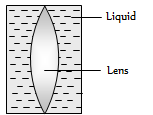
Shown in the figure here is a convergent lens placed inside a cell filled with a liquid. The lens has focal length + 20 cm when in air and its material has refractive index 1.50. If the liquid has refractive index 1.60, the focal length of the system is
|
(a) + 80 cm |
(b) – 80 cm |
(c) – 24 cm |
(d) –100 cm |
A proton of mass m and charge +e is moving in a circular orbit in a magnetic field with energy 1 MeV. What should be the energy of α - particle (mass = 4m and charge = + 2e), so that it can revolve in the path of same radius
|
(a) 1 MeV |
(b) 4 MeV |
(c) 2 MeV |
(d) 0.5 MeV |
Which of the following isotopes is normally fissionable ?
|
(a) |
(b) |
(c) |
(d) |