If the displacement equation of a particle be represented by $y = A\sin PT + B\cos PT$, the particle executes
Easy


Download our appand get started for free
Experience the future of education. Simply download our apps or reach out to us for more information. Let's shape the future of learning together!No signup needed.*
Similar Questions
- 1A particle excutes $SHM$ on a straight line path. The amplitude of oscillation is $2\,cm$. When the displacement of the particle from the mean position is $1\,cm$, the numerical value of magnitude of acceleration is equal to the numerical value of magnitude of velocity. The frequency of $SHM$ is (in $second^{-1}$)View Solution
- 2Two particles are executing S.H.M. The equation of their motion are ${y_1} = 10\sin \left( {\omega \,t + \frac{{\pi T}}{4}} \right),$ ${y_2} = 25\sin \,\left( {\omega \,t + \frac{{\sqrt 3 \pi T}}{4}} \right)$. What is the ratio of their amplitudeView Solution
- 3A uniform cylinder of length $L$ and mass $M$ having cross-sectional area $A$ is suspended, with its length vertical, from a fixed point by a massless spring, such that it is half submerged in a liquid of density $\sigma $ at equilibrium position. When the cylinder is given a downward push and released, it starts oscillating vertically with a small amplitude. The time period $T$ of the oscillations of the cylinder will beView Solution
- 4A particle executing simple harmonic motion along $Y- $axis has its motion described by the equation $y = A\sin (\omega \,t) + B$. The amplitude of the simple harmonic motion isView Solution
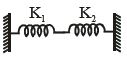
- 5View SolutionThe effective spring constant of two spring system as shown in figure will be
- 6For a simple pendulum, a graph is plotted between its kinetic energy $(KE)$ and potential energy $(PE)$ against its displacement $d.$ Which one of the following represents these correctly ? (graphs are schematic and not drawn to scale)View Solution
- 7A sphere of radius $r$ is kept on a concave mirror of radius of curvature $R$. The arrangement is kept on a horizontal table (the surface of concave mirror is frictionless and sliding not rolling). If the sphere is displaced from its equilibrium position and left, then it executes $S.H.M.$ The period of oscillation will beView Solution
- 8The maximum velocity and the maximum acceleration of a body moving in a simple harmonic oscillator are $2\,m/s$ and $4\,m/{s^2}.$ Then angular velocity will be ..... $rad/sec$View Solution
- 9The phase of a particle executing simple harmonic motion is $\frac{\pi }{2}$ when it hasView Solution
- 10View SolutionTime period of a simple pendulum will be double, if we