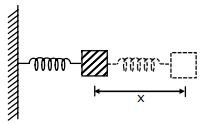
The maximum velocity and the maximum acceleration of a body moving in a simple harmonic oscillator are $2\,m/s$ and $4\,m/{s^2}.$ Then angular velocity will be ..... $rad/sec$
Easy
Download our app for free and get started
(d) ${v_{\max }} = a\omega $ and ${A_{\max }} = a{\omega ^2}$
==> $\omega = \frac{{{A_{\max }}}}{{{v_{\max }}}} = \frac{4}{2} = 2\,rad/sec$

Download our appand get started for free
Experience the future of education. Simply download our apps or reach out to us for more information. Let's shape the future of learning together!No signup needed.*
Similar Questions
- 1A linear harmonic oscillator of force constant $2 \times 10^6\,Nm^{-1}$ and amplitude $0.01\, m$ has a total mechanical energy of $160\, J.$ ItsView Solution
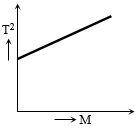
- 2The graph shown was obtained from experimental measurements of the period of oscillations $T$ for different masses $M$ placed in the scale pan on the lower end of the spring balance. The most likely reason for the line not passing through the origin is that theView Solution
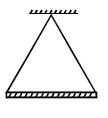
- 3A rod of mass $m$ and length $l$ is suspended from ceiling with two string of length $l$ as shown. When the rod is given a small push in the plane of page and released time period is $T_1$ and when the rod is given a push perpendicular to plane time period of oscillation is $T_2$ . The ratio $\frac{{T_1^2}}{{T_2^2}}$ isView Solution
- 4What is the maximum acceleration of the particle doing the $SHM$ $y = 2\sin \left[ {\frac{{\pi t}}{2} + \phi } \right]$ where $2$ is in $cm$View Solution
- 5A mass m is suspended from a spring of length l and force constant $K$. The frequency of vibration of the mass is ${f_1}$. The spring is cut into two equal parts and the same mass is suspended from one of the parts. The new frequency of vibration of mass is ${f_2}$. Which of the following relations between the frequencies is correctView Solution
- 6View SolutionWhen the displacement is half the amplitude, the ratio of potential energy to the total energy is
- 7View SolutionIn case of a simple pendulum, time period versus length is depicted by
- 8View SolutionTo make the frequency double of a spring oscillator, we have to
- 9A pendulum bob has a speed of $3\, {m} / {s}$ at its lowest position. The pendulum is $50 \,{cm}$ long. The speed of bob, when the length makes an angle of $60^{\circ}$ to the vertical will be $ .......\,{m} / {s}$ $\left(g=10 \,{m} / {s}^{2}\right)$View Solution
- 10The motion of a mass on a spring, with spring constant ${K}$ is as shown in figure. The equation of motion is given by $x(t)= A sin \omega t+ Bcos\omega t$ with $\omega=\sqrt{\frac{K}{m}}$ Suppose that at time $t=0$, the position of mass is $x(0)$ and velocity $v(0)$, then its displacement can also be represented as $x(t)=C \cos (\omega t-\phi)$, where $C$ and $\phi$ areView Solution