Question
If the displacement of a body is zero, is distance necessarily zero? Answer with one example.

Answer

No, because the distance covered by an object is the path length of the path covered by the object. The displacement of an object is given by the change in position between the initial position and final position. e.g. A boy starts from his home and moves towards market along a straight path. Then, he returns to home from the same path. Here, displacement is zero but distance is non-zero.

Need a full question paper?

Generate a complete, print-ready paper with questions like this in minutes — across 16+ boards, with answer keys.
Start Generating Free

Similar questions

A cyclist speeding at 18 km/h on a level road takes a sharp circular turn of radius 3 m without reducing the speed. The co-efficient of static friction
between the tyres and the road is 0.1. Will the cyclist slip while taking the turn?
If $\overrightarrow{\text{A}}\times\overrightarrow{\text{B}}=0,$ can you say that:
  1. $\overrightarrow{\text{A}}=\overrightarrow{\text{B}}$
  2. $\overrightarrow{\text{A}}\neq\overrightarrow{\text{B}}$
In a double slit interference experiment, the separation between the slits is $1.0\ mm$, the wavelength of light used is $5.0 \times 10^{-7}m$ and the distance of the screen from the slits is $1.0m.$
  1. Find the distance of the centre of the first minimum from the centre of the central maximum.
  2. How many bright fringes are formed in one centimeter width on the screen?
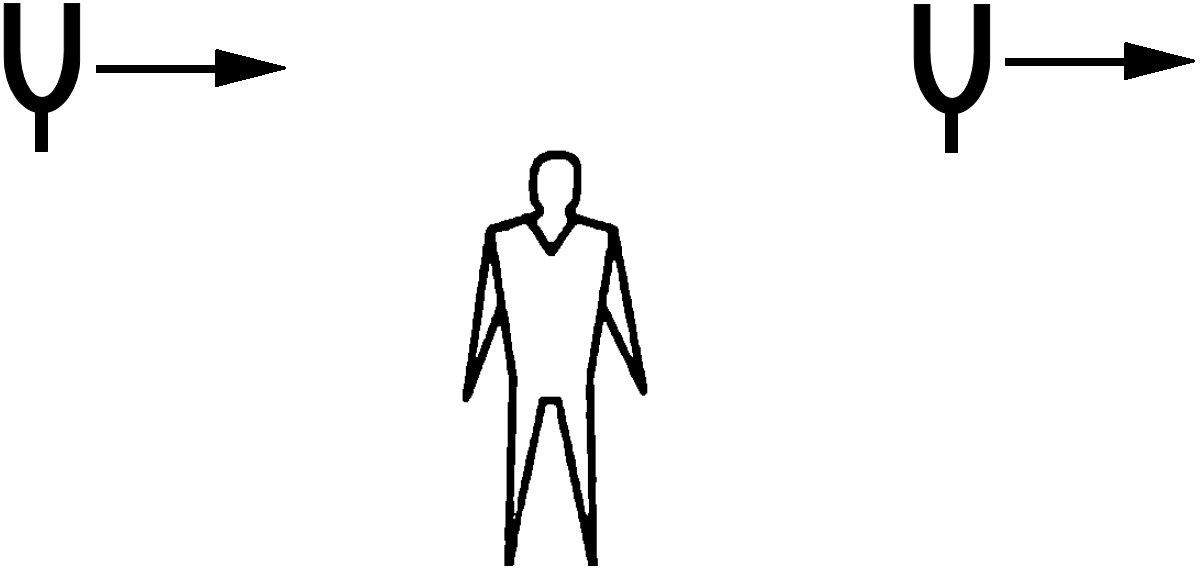
Figure, shows a person standing somewhere in between two identical tuning forks, each vibrating at 512Hz. If both the tuning fbrks move towards right at a speed of 5.5m/s, find the number of beats heard by the listener. Speed of sound in air = 330m/s.
Temperature in the freezer of a refrigerator is being maintained at $-13^\circ C$ and room temperature on a particular day was $42^\circ C$. Calculate the coefficient of performance of the refrigerator.
Air gets thinner as we go up in the atmosphere. Will the velocity of sound change?
The velocity of a particle is given by equation $v=4+2\left(C_1+C_2 t\right)$ where, $C$, and $C$, are constant. Find the initial velocity and acceleration of the particle.
A pendulum clock giving correct time at a place where $\mathrm{g}=9.800 \mathrm{~m} / \mathrm{s}^2$ is taken to another place where it loses 24 seconds during 24 hours. Find the value of $g$ at this new place.
Assuming that the critical velocity $v _{ C }$ of a viscous liquid flowing through a capillary tube depends only upon the radius $r$ of the tube, density $\rho$ and the coefficient of viscosity $\eta$ of the liquid, find the expression for critical velocity.
Near the bank of a river the velocity of water is less but is more in the centre, why?