MCQ
If the equation for the displacement of a particle moving on a circular path is given by $(\theta ) = 2{t^3} + 0.5$, where $\theta $ is in radians and $t$ in seconds, then the angular velocity of the particle after $2 \,sec$ from its start is ......... $rad/sec$
  • A
    $8$
  • B
    $12$
  • $24$
  • D
    $36$

Answer

Correct option: C.
$24$
c
(c) $\omega = \frac{{d\theta }}{{dt}} = \frac{d}{{dt}}(2{t^3} + 0.5) = 6{t^2}$

at $t =2 \,s$, $\omega = 6 \times {(2)^2} = 24\,rad/s$

Need a full question paper?

Generate a complete, print-ready paper with questions like this in minutes — across 16+ boards, with answer keys.

Start Generating Free

Similar questions

If capillary experiment is performed in vacuum then for a liquid there
A cubical block of mass $M$ and edge a slides down a rough inclined plane of inclination $\theta$ with a uniform velocity. The torque of the normal force on the block about its centre has a magnitude:
The dimensional formula of Avagadro's number is:
The number of molecules per unit volume in the sample is $20.$ The mass of each molecule is $10-20\ kg.$ The mean of speed squared is $4\ m^2/s^2$. What is the value of internal energy of the gas? Assume volume of container is $0.02m^3$.
A swimmer swims in still water at a speed $= 5\,\, km/hr$. He enters a $200\,\, m$ wide river, having river flow speed $= 4\,\, km/hr$ at point A and proceeds to swim at an angle of $127^o$ (sin $37^o = 0.6$) with the river flow direction.Another point $B$ is located directly across Aon the other side. The swimmer lands on the other bank at a point $C$, from which he walks the distance $CB$ with a speed $= 3\,\, km/hr.$ The total time in which he reachrs from $A$ to $B$ is..........$minutes$
The acceleration of a train travelling with speed of $400 \,m/s$ as it goes round a curve of radius $160\,m$, is
A body of mass $1\, kg$ is under a force, which causes a displacement in it is given by $x = \frac{{{t^3}}}{3}$ (in $m$). Find the work done by the force in first second ............ $\mathrm{J}$
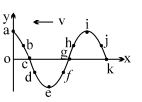
The figure represents the instantaneous picture of a longitudinal harmonic wave travelling along the negative $x$-axis. Identify the correct statement $(s)$ related to the movement of the points shown in the figure. The points moving opposite to the direction of propagation are
Two persons $A$ and $B$ perform same amount of work in moving a body through a certain distance ${d}$ with application of forces acting at angle $45^{\circ}$ and $60^{\circ}$ with the direction of displacement respectively. The ratio of force applied by person $A$ to the force applied by person $B$ is $\frac{1}{\sqrt{x}}$. The value of $x$ is ...... .
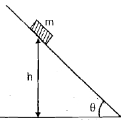
A block of mass $m$ is sliding down an inclined plane with constant speed.At a certain instant $t_0$, its height above the ground is $h$. The coefficient of kinetic friction between the block and the plane is $\mu$. If the block reaches the ground at a later instant $t_g$, then the energy dissipated by friction in the time interval $\left(t_g-t_0\right)$ is