MCQ
If the external force acting on a system have zero resultant, the centre of mass:
  • A
    Must not move.
  • B
    Must not accelerate.
  • C
    May move.
  • D
    May accelerate.

Answer

  1. Must not accelerate.
  2. May move.

Explanation:

If the external force acting on a system has zero resultant,

then, acceleration of centre of mass $=\frac{\overrightarrow{\text{F}}_{\text{net}}}{\text{M}}=0.$

However, it may move uniformly with constant velocity.

Need a full question paper?

Generate a complete, print-ready paper with questions like this in minutes — across 16+ boards, with answer keys.

Start Generating Free

Similar questions

A body of mass $10\, kg$ is released from a tower of height $20\,m$ and body acquires a velocity of $10\,ms^{-1}$ after falling through the distance $20\,m$ . The work done by the push of the air on the body is:- ................. $\mathrm{J}$  (Take $g = 10\, m/s^2$ )
The equation of displacement of two waves are given as ${y_1} = 10\sin \left( {3\pi t + \frac{\pi }{3}} \right)$; ${y_2} = 5(\sin 3\pi t + \sqrt 3 \cos 3\pi t)$. Then what is the ratio of their amplitudes
For an ideal gas
A spherical ball of density $\rho$ and radius $0.003$ $m$ is dropped into a tube containing a viscous fluid filled up to the $0$ $ cm$ mark as shown in the figure. Viscosity of the fluid $=$ $1.260$ $N.m^{-2}$ and its density $\rho_L=\rho/2$ $=$ $1260$ $kg.m^{-3}$. Assume the ball reaches a terminal speed by the $10$ $cm$ mark. The time taken by the ball to traverse the distance between the $10$ $cm$ and $20$ $cm$ mark is

( $g$ $ =$ acceleration due to gravity $= 10$ $ ms^{^{-2}} )$
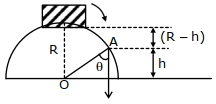
A small block slides down from the top of hemisphere of radius $R=3\, {m}$ as shown in the figure. The height $'h'$ at which the block will lose contact with the surface of the sphere is $.............  \;\;m$. (Assume there is no friction between the block and the hemisphere)
A thin horizontal circular disc is rotating about a vertical axis passing through its centre. An insect is at rest at a point near the rim of disc. The insect now moves along a diameter of the disc to reach its other end. During the journey of the insect, the angular speed of the disc
A force of $- P \hat{k}$ acts on the origin of the coordinate system. The torque about the point $(2,-3)$ is $P(a \hat{i}+b \hat{j})$, the ratio of $\frac{a}{b}$ is $\frac{x}{2}$. The value of $x$ is
Water has been filled in a vertical capillary tube upto the top after closing its lower end by a finger. If the finger is removed we shall observe that : ( $T = 70 \,\,dyne/cm,$  radus of capillary $r = 1\,\,mm$ and $g = 980\,\,cm/sec^2$ )
A particle is moving on a circular path of radius $r$ with uniform speed $v$. What is the displacement of the particle after it has described an angle of $60^o$ ?
A hollow sphere of mass $m$ and radius $R$ is rolling downward on a rough inclined plane of inclination $\theta$. If the coefficient of friction between the hollow sphere and incline is $\mu$, then ........