MCQ
If the external forces acting on a system have zero resultant, the centre of mass:
  • A
    May move.
  • B
    May accelerate.
  • C
    Must not move.
  • A and B both

Answer

Correct option: D.
A and B both
Explanation:
When external forces acting on a system have zero resultant, the centre of mass may move with a constant velocity i.e. it must not accelerate.

Need a full question paper?

Generate a complete, print-ready paper with questions like this in minutes — across 16+ boards, with answer keys.

Start Generating Free

Similar questions

One mole of an ideal gas at temperature $T_1$ expends according to the law $\frac{P}{{{V^2}}} =a$ (constant). The work  done by the gas till temperature of gas becomes $T_2 $ is 
An object of mass $m$ is projected with a momentum $p$ at such an angle that its maximum height is $\frac{1}{4}$ th of its horizontal range. Its minimum kinetic energy in its path will be
A $60\; HP$ electric motor lifts an elevator having a maximum total load capacity of $2000\; \mathrm{kg}$. If the frictional force on the elevator is $4000 \;\mathrm{N}$. the speed of the elevator at full load is close to ..............  $\mathrm{m} / \mathrm{s}$

$\left(1 \;\mathrm{HP}=746 \;\mathrm{W}, \mathrm{g}=10\; \mathrm{ms}^{-2}\right)$

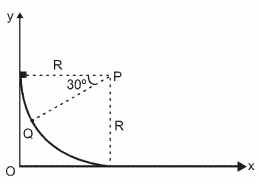
$40 \ m$. The block slides along the track without toppling and a frictional force acts on it in the direction opposite to the instantaneous velocity. The work done in overcoming the friction up to the point $Q$, as shown in the figure below, is $150 \ J$. (Take the acceleration due to gravity, $g =10 \ m s ^{-2}$ )

$1.$ The speed of the block when it reaches the point $Q$ is :

$(A)$ $5 \ ms ^{-1}$ $(B)$ $10 \ ms ^{-1}$$(C)$ $10 \sqrt{3} \ ms ^{-1}$ $(D)$ $20 \ ms ^{-1}$

$2.$ The magnitude of the normal reaction that acts on the block at the point $Q$ is :

$(A)$ $7.5 \ N$ $(B)$ $8.6 \ N$ $(C)$ $11.5 \ N$ $(D)$ $22.5 \ N$

Give the answer question $1$ and $2.$
Two uniform solid balls of same density and of radii $r$ and $2r$ are dropped in air and fall vertically downwards. The terminal velocity of the ball with radius $r$ is $1\,cm\,s^{-1}$ , then find the terminal velocity of the ball of radius $2r$ (neglect bouyant force on the balls.) ........... $cm\,s^{-1}$
The internal energy of an ideal gas depends on:
Which of the following statements can be suitable?
Two projectiles $A$ and $B$ are thrown with initial velocities of $40\,m / s$ and $60\,m / s$ at angles $30^{\circ}$ and $60^{\circ}$ with the horizontal respectively. The ratio of their ranges respectively is $\left( g =10\,m / s ^2\right)$
The value of escape velocity on a certain planet is $2 \,km/s$. Then the value of orbital speed for a satellite orbiting close to its surface is
The internal energy of $2$ moles of a mono atomic gas is: