If the force constant of a wire is $K,$ the work done in increasing the length of the wire by $l$ is
Medium


Download our appand get started for free
Experience the future of education. Simply download our apps or reach out to us for more information. Let's shape the future of learning together!No signup needed.*
Similar Questions
- 1The extension of a wire by the application of load is $3$ $mm.$ The extension in a wire of the same material and length but half the radius by the same load is..... $mm$View Solution
- 2View SolutionThe breaking stress of a wire depends upon
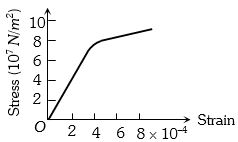
- 3Which one of the following is the Young’s modulus $($in $N/m^2)$ for the wire having the stress-strain curve shown in the figureView Solution
- 4The extension of a wire by the application of load is $3$ $mm.$ The extension in a wire of the same material and length but half the radius by the same load is..... $mm$View Solution
- 5A steel wire of diameter $0.5 mm$ and Young's modulus $2 \times 10^{11} N m ^{-2}$ carries a load of mass $M$. The length of the wire with the load is $1.0 m$. A vernier scale with $10$ divisions is attached to the end of this wire. Next to the steel wire is a reference wire to which a main scale, of least count $1.0 mm$, is attached. The $10$ divisions of the vernier scale correspond to $9$ divisions of the main scale. Initially, the zero of vernier scale coincides with the zero of main scale. If the load on the steel wire is increased by $1.2 kg$, the vernier scale division which coincides with a main scale division is. . . . Take $g =10 m s ^{-2}$ and $\pi=3.2$.View Solution
- 6The density of a metal at normal pressure is $\rho$. Its density when it is subjected to an excess pressure $p$ is $\rho^{\prime}$ If $B$ is Bulk modulus of the metal, the ratio of $\frac{{\rho '}}{\rho }$ isView Solution
- 7A rubber cord catapult has cross-sectional area $25\,m{m^2}$ and initial length of rubber cord is $10\,cm.$ It is stretched to $5\,cm.$ and then released to project a missile of mass $5gm.$ Taking ${Y_{rubber}} = 5 \times {10^8}N/{m^2}$ velocity of projected missile is ......... $ms^{-1}$View Solution
- 8$A$ current of $(2.5 \pm 0.05)$ $A$ flows through a wire and develops a potential difference of $(10 \pm 0.1)$ $\mathrm{volt}.$ Resistance of the wire in $\mathrm{ohm},$ isView Solution
- 9The force required to stretch a steel wire of $1\,c{m^2}$ cross-section to $1.1$ times its length would be $(Y = 2 \times {10^{11}}\,N{m^{ - 2}})$View Solution
- 10If one end of a wire is fixed with a rigid support and the other end is stretched by a force of $10 \,N,$ then the increase in length is $0.5\, mm$. The ratio of the energy of the wire and the work done in displacing it through $1.5\, mm$ by the weight isView Solution