MCQ
If the fundamental frequency of string is $220 \,cps$, the frequency of fifth harmonic will be ......... $cps$
  • A
    $44$
  • B
    $55$
  • $1100$
  • D
    $440$

Answer

Correct option: C.
$1100$
c
(c)

$f_5=5\times f_1=5\times 220=1100\;cps$

Need a full question paper?

Generate a complete, print-ready paper with questions like this in minutes — across 16+ boards, with answer keys.

Start Generating Free

Similar questions

Neglecting the air resistance, the time of flight of a projectile is determined by
Two particles are simultaneously projected in opposite directions horizontally from a given point in space, where gravity $g$ is uniform. If $u_1$ and $u_2$ be their initial speeds, then the time $t$ after which their velocities are mutually perpendicular is given by
Consider the following statements for air molecules in an air tight container :

$(I)$ The average speed of molecules is larger than root mean square speed.

$(II)$ Mean free path of molecules is larger than the mean distance between molecules.

$(III)$ Mean free path of molecules increases with temperature.

$(IV)$ The rms speed of nitrogen is smaller than oxygen molecule.

Which of the above statements are correct?
A truck is moving on the horizontal road with constant speed $v.$  A ball is thrown from the truck vertical up at speed  $u$  $w.r.t.$  truck. What is distance traversed by the truck when ball returns on the truck
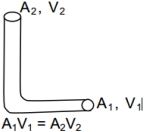
A liquid enter at point $A_{1}$ with speed $3.5 m / s$ and leaves at point $A _{2} .$ Then find out the height attained by the liquid above point $A _{2}$ (in $cm$)
A sphere of relative density $\sigma$ and diameter $D$ has concentric cavity of diameter $d$. The ratio of $\frac{D}{d}$, if it just floats on water in a tank is:
If two forces of $5 \,N$ each are acting along $X$ and $Y$ axes, then the magnitude and direction of resultant is
If a satellite of mass $400 \,kg$ revolves around the earth in an orbit with speed $200 \,m / s$ then its potential energy is .......... $MJ$
If $\mathrm{n}$ is the number density and $\mathrm{d}$ is the diameter of the molecule, then the average distance covered by a molecule between two successive collisions (i.e. mean free path) is represented by :
A force $\vec{F}=4 t^3$ is applied on an object for the first two seconds. The linear momentum of object will increase.