MCQ
Consider the following statements for air molecules in an air tight container :

$(I)$ The average speed of molecules is larger than root mean square speed.

$(II)$ Mean free path of molecules is larger than the mean distance between molecules.

$(III)$ Mean free path of molecules increases with temperature.

$(IV)$ The rms speed of nitrogen is smaller than oxygen molecule.

Which of the above statements are correct?

  • Only statement $II$ is correct
  • B
    Statements $II$ and $III$ are correct
  • C
    Statements $II$ and $IV$ are correct
  • D
    Statements $I, II$ and $IV$ are correct
Answer

Correct option: A.
Only statement $II$ is correct
a
$(a)$ Average speed is related to the rms speed as

$\bar{c}=\sqrt{\frac{8}{3 \pi}} \cdot c_{ rms }$

$\Rightarrow \bar{c} < c_{ rms }$

So, statement $1$ is incorrect.

Mean free path of molecules is larger than mean distance between molecules.

So, statement $II$ is correct.

Mean free path decreases with temperature as collision frequency increases with temperature. So, statement $III$ is incorrect.

As, $c_{ rms } \propto \frac{1}{\sqrt{M}} \Rightarrow rms$ speed of nitrogen molecule is higher than that of oxygen molecule at same temperature. So, statement $IV$ is incorrect.

Need a full question paper?

Generate a complete, print-ready paper with questions like this in minutes — across 16+ boards, with answer keys.

Start Generating Free

Similar questions

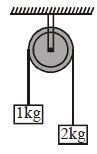
Two unequal masses are connected on two sides of light string passing over a light and smooth pulley as shown in the figure. The system is released from rest. The larger mass is stopped $1\, sec$ after the system is set into motion and then released. The time elapsed before the string is tight again $(g = 10\, m/sec^2)$
Consider the following two statements:
$A.$ Linear momentum of the system remains constant.
$B.$ Centre of mass of the system remains at rest.
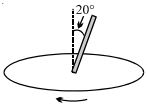
$A$ uniform rod is fixed to a rotating turntable so that its lower end is on the axis of the turntable and it makes an angle of $20^o$ to the vertical. (The rod is thus rotating with uniform angular velocity about a vertical axis passing through one end.) If the turntable is rotating clockwise as seen from above. Is there a torque acting on it, and if so in what direction?
Two moles of monoatomic gas is expanded from $(P_0, V_0)$ to $(P_0 , 2V_0)$ under isobaric condition. Let $\Delta Q_1$, be the heat given to the gas, $\Delta W_1$ the work done by the gas and $\Delta U_1$ the change in internal energy. Now the monoatomic gas is replaced by a diatomic gas. Other conditions remaining the same. The corresponding values in this case are $\Delta Q_2 , \Delta W_2 , \Delta U_2$ respectively, then
A tuning fork gives $4$ beats with $50 cm$ length of a sonometer wire. If the length of the wire is shortened by $1 cm$, the number of beats is still the same. The frequency of the fork is
Consider a uniform wire of mass $M$ and length $L$. It is bent into a semicircle. Its moment of inertia about a line perpendicular to the plane of the wire passing through the centre is :
The maximum and minimum distances of a comet from the sun are $8 \times {10^{12}}\,m$ and $1.6 \times {10^{12}}\,m$. If its velocity when nearest to the sun is $60\, m/s$, what will be its velocity in $m/s$ when it is farthest 
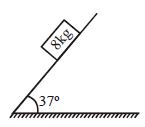
A block of mass $8\, kg$ is at rest on a rough inclined plane as shown in figure. The magnitude of net force exerted by the surface on the block will be ......... $N$
Temperature remaining constant, the pressure of gas is decreased by $20\%$. The percentage change in volume:
An object is projected upwards with a velocity of $100 \,m/s$. It will strike the ground after (approximately)........$sec$