MCQ
If the ionization potential of $Li^{+2}$ is $122.4\, eV.$ What is the $5^{th}$ $I.P.$ of carbon ........... $\mathrm{V}$
- A$979.2$
- B$97.92$
- C$48.96$
- ✓$489.6$
Mathematically,
$I \cdot E \cdot=E_{\infty}-E_{1}$
Energy associated to the $n^{t h}$ - energy level will be:
$E_{n}=\frac{E_{o} \times Z^{2}}{n^{2}}$
For ground state energy level of $L i^{2+}-i o n, n=1$ and $Z=3$
lonization energy $=122.4$ eV (given)
Putting the values in equation $1,$ we get
$122.4 e V=0-\frac{E_{o} \times 3^{2}}{1^{2}}$
$E_{o}=-13.6 \mathrm{eV}$
Now, we have to calculate the sixth ionization potential for carbon, we must know the principle quantum number for this atom.
Atomic number of Carbon $=6$
And we are asked to find the 6 th ionization potential which means that 5 electrons are already released and the electronic configuration for $C^{5+}$ is $1 s^{2}$
So, the principle quantum number for the 6 th ionization step $=1$
Putting the values in equation $1,$ we get $E_{1}=\frac{-13.6 \mathrm{eV} \times(6)^{2}}{(1)^{2}}=-489.6 \mathrm{eV}$
$E_{1}=-489.6 \mathrm{eV}$
Therefore, 6 th ionization potential for carbon atom is $-489.6 \mathrm{eV}$.
Generate a complete, print-ready paper with questions like this in minutes — across 16+ boards, with answer keys.
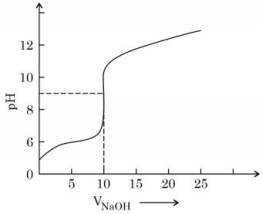
The number of following statements which is/are correct about phenolphthalein is $.....$.
$A$. It can be used as an indicator for the titration of weak acid with weak base.
$B$. It begins to change colour at $pH =8.4$
$C$. It is a weak organic base
$D$. It is colourless in acidic medium