MCQ
What will happen when $\ce{CH_3​COONa}$ is added to an aqueous solution of $\ce{CH_3​COOH}$?
  • A
    The $pH$ of the solution decreases.
  • The $pH$ of the solution increases.
  • C
    The $pH$ of the solution remains unaltered.
  • D
    An acidic salt is produced.

Answer

Correct option: B.
The $pH$ of the solution increases.
$\text{CH}_3\text{​COOH}⇋\text{CH}_3\text{​COO}^−+\text{H}^+$
If $\ce{CH_3COONa}$ is added, equilibrium will shift backward due to the common ion effect. $H^+$ will decrease.

Need a full question paper?

Generate a complete, print-ready paper with questions like this in minutes — across 16+ boards, with answer keys.

Start Generating Free

Similar questions

Consider the following reactions in which all the reactants and products are in gaseous state

${\text{2PQ}} \rightleftharpoons {{\text{P}}_2}{\text{  +  }}{{\text{Q}}_2}\,;\,\,\,\,{{\text{K}}_1}{\text{ =  2}}{\text{.5 }} \times \,{\text{1}}{{\text{0}}^5}\,$

${\text{PQ + }}\frac{1}{2}{R_2} \rightleftharpoons PQR\,;\,\,\,\,{{\text{K}}_2}{\text{ =  5 }} \times \,{\text{1}}{{\text{0}}^{ - 3}}\,$

The value of equilibrium constant for reaction

$\frac{1}{2}{{\text{P}}_2}{\text{ + }}\frac{1}{2}{{\text{Q}}_2}{\text{ + }}\frac{1}{2}{R_2} \rightleftharpoons PQR\,$ is

Which of the following sets of quantum numbers is not allowed
For the reaction $FeCO_{3(s)} \to FeO_{(s)} + CO_{2(g)}$ $\Delta H = 82.8\,kJ$ at $25\,^oC$. What is $\Delta U$ at $25\,^oC$ ? .....$kJ$
The number of endothermic process/es from the following is

$A.$ $I _2( g ) \rightarrow 2 I ( g )$

$B.$ $HCl ( g ) \rightarrow H ( g )+ Cl ( g )$

$C.$ $H _2 O ( l ) \rightarrow H _2 O ( g )$

$D.$ $C ( s )+ O _2( g ) \rightarrow CO _2( g )$

$E.$ Dissolution of ammonium chloride in water
Bond order is a concept in the molecular orbital theory. It depends on the number of electrons in the bonding and antibonding orbitals. Which of the following statements is true about it ? The bond order
The elements which occupy the peaks of ionisation energy curve, are
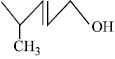
$IUPAC$ name of the below compound is :
Which of the following does not belong to homologous series of alkanes?
When $3, 3-$dimethyl$-2-$butanol is heated with ${H_2}S{O_4}$ the major product obtained is
Which has maximum dipole moment and can show optical isomerism