If the length of a stretched string is shortened by $40\%$ and the tension is increased by $44\%$, then the ratio of the final and initial fundamental frequencies is
Medium
Download our app for free and get started
(a) Fundamental frequency in case of string is
$n = \frac{1}{{2l}}\sqrt {\frac{T}{m}} \Rightarrow n \propto \frac{{\sqrt T }}{l} \Rightarrow \frac{{n'}}{n} = \sqrt {\frac{{T'}}{T}} \times \frac{l}{{l'}}$
putting $T' = T + 0.44T = \frac{{144}}{{100}}T$ and $l' = l - 0.4l = \frac{3}{5}l$
We get $\frac{{n'}}{n} = \frac{2}{1}$.

Download our appand get started for free
Experience the future of education. Simply download our apps or reach out to us for more information. Let's shape the future of learning together!No signup needed.*
Similar Questions
- 1A transverse wave travels on a taut steel wire with a velocity of ${v}$ when tension in it is $2.06 \times 10^{4} \;\mathrm{N} .$ When the tension is changed to $T$. the velocity changed to $\frac v2$. The value of $\mathrm{T}$ is close toView Solution
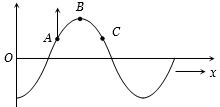
- 2A wave is travelling along a string. At an instant, shape of the string is as shown in fig. At this instant, point $A$ is moving upwards. Which of the following statements is/are correctView Solution
- 3Two waves are simultaneously passing through a string and their equations are :View Solution
${y}_{1}={A}_{1} \sin {k}({x}-v {t}), {y}_{2}={A}_{2} \sin {k}\left({x}-{vt}+{x}_{0}\right) .$ Given amplitudes ${A}_{1}=12\, {mm}$ and ${A}_{2}=5\, {mm}$ ${x}_{0}=3.5\, {cm}$ and wave number ${k}=6.28\, {cm}^{-1}$. The amplitude of resulting wave will be $......\,{mm}$
- 4Two sinusoidal waves given below are superposedView Solution
$y_1=A \sin \left(k x-\omega t+\frac{\pi}{6}\right), \quad y_2=A \sin \left(k x-\omega t-\frac{\pi}{6}\right)$
The equation of resultant wave is
- 5A hospital uses an ultrasonic scanner to locate tumours in a tissue. What is the wavelength of sound in the tissue in which the speed of sound is $1.7\; km s ^{-1}$ ? The operating frequency of the scanner is $4.2 \;MHz$View Solution
- 6A table is revolving on its axis at $5$ revolutions per second. A sound source of frequency $1000 Hz$ is fixed on the table at $70 cm$ from the axis. The minimum frequency heard by a listener standing at a distance from the table will be .... $Hz$ (speed of sound $= 352 m/s$)View Solution
- 7A student performed the experiment to measure the speed of sound in air using resonance air-column method. Two resonances in the air-column were obtained by lowering the water level. The resonance with the shorter air-column is the first resonance and that with the longer air-column is the second resonance. Then,View Solution
$(A)$ the intensity of the sound heard at the first resonance was more than that at the second resonance
$(B)$ the prongs of the tuning fork were kept in a horizontal plane above the resonance tube
$(C)$ the amplitude of vibration of the ends of the prongs is typically around $1 \mathrm{~cm}$
$(D)$ the length of the air-column at the first resonance was somewhat shorter than $1 / 4$ th of the wavelength of the sound in air
- 8The tension of a stretched string is increased by $69\%$. In order to keep its frequency of vibration constant, its length must be increased by .... $\%$View Solution
- 9In an experiment to determine the velocity of sound in air at room temperature using a resonance is observed when the air column has a length of $20.0 \,cm$ for a tuning fork of frequency $400 \,Hz$ is used. The velocity of the sound at room temperature is $336 \,ms ^{-1}$. The third resonance is observed when the air column has a length of ......... $cm$View Solution
- 10Two factories are sounding their sirens at $800\, Hz$ . A man goes from one factory to other at a speed of $2\,m/s$. The velocity of sound is $320\, m/s$. The number of beats heard by the person in one second will beView Solution