Question
Two sinusoidal waves given below are superposed

$y_1=A \sin \left(k x-\omega t+\frac{\pi}{6}\right), \quad y_2=A \sin \left(k x-\omega t-\frac{\pi}{6}\right)$

The equation of resultant wave is

Answer

(b)

$y=y_1+y_2$

or $y=A \sin \left(k x-\omega t+\frac{\pi}{6}\right)+A \sin \left(k x-\omega t-\frac{\pi}{6}\right)$

or $y=2 A \sin (k x-\omega t) \cdot \cos \left(\frac{\left(\frac{\pi}{6}+\frac{\pi}{6}\right)}{2}\right)$

or $y^{\prime}=2 A \frac{\sqrt{3}}{2} \sin (k x-\omega t)$

$\therefore y^{\prime}=A \sqrt{3} \sin (k x-\omega t)$

Need a full question paper?

Generate a complete, print-ready paper with questions like this in minutes — across 16+ boards, with answer keys.
Start Generating Free

Similar questions

The current sensitivity of moving coil galvanometer is increased by $25 \%$. This increase is achieved only by changing in the number of turns of coils and area of cross section of the wire while keeping the resistance of galvanometer coil constant. The percentage change in the voltage sensitivity will be $...........\%$
A bar magnet having a magnetic moment of $2 \times 10^4 \,\,JT^{-1}$ is free to rotate in a horizontal plane. A horizontal magnetic field $B = 6  \times 10^{-4 } \,\,T$ exists in the space. The work done in taking the magnet slowly from a direction parallel to the field to a direction $60^o $ from the field is.....$J$
Using equipartition of energy, the specific heat (in $J\, kg^{-1}\, K^{-1}$ ) of aluminium at room temperature can be estimated to be ( atomic weight of aluminium $= 27$)
A $2\,kg$ chain is in the form of a heap. Its length is $2\,m$. Its one end is being pulled at constant speed of $2\,m/s$ horizontally. The power delivered to the chain is (in $W$).
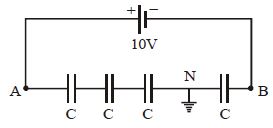
Four identical capacitors are connected in series with a $10\,V$ battery as shown. The point $N$ is earthed. The potentials of points $A$ and $B$ are
The mean life time of a radionuclide, if its activity decrease by $4\%$ for every $1h$ , would be  .......... $h$ [product is non-radioactive i.e. stable]
An electron, accelerated by a potential difference $V$, has de Broglie wavelength $\lambda$ . If the electron is accelerated by a potential difference $4V$, its de Broglie wavelength will become $\frac{\lambda }{n}$ where $n=$
$1\  mole$ of a gas with $\gamma$ = $7/5$ is mixed with $1\  mole$ of a gas with $\gamma$ = $5/3$, then the value of $\gamma$  for the resulting mixture is
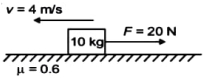
A block of mass $10 kg$ is moving on a rough surface as shown in figure. The frictional force acting on block is ...... $N$
A man of weight $80\, kg$ is standing in an elevator which is moving with an acceleration of $6\,\,m/{s^2}$ in upward direction. The apparent weight of the man will be  ......... $N$ $(g = 10\,m/{s^2})$