If the length of a wire is made double and radius is halved of its respective values. Then, the Young's modules of the material of the wire will :
JEE MAIN 2022, Easy


Download our appand get started for free
Experience the future of education. Simply download our apps or reach out to us for more information. Let's shape the future of learning together!No signup needed.*
Similar Questions
- 1A steel wire of diameter $0.5 mm$ and Young's modulus $2 \times 10^{11} N m ^{-2}$ carries a load of mass $M$. The length of the wire with the load is $1.0 m$. A vernier scale with $10$ divisions is attached to the end of this wire. Next to the steel wire is a reference wire to which a main scale, of least count $1.0 mm$, is attached. The $10$ divisions of the vernier scale correspond to $9$ divisions of the main scale. Initially, the zero of vernier scale coincides with the zero of main scale. If the load on the steel wire is increased by $1.2 kg$, the vernier scale division which coincides with a main scale division is. . . . Take $g =10 m s ^{-2}$ and $\pi=3.2$.View Solution
- 2The ratio of lengths of two rods $A$ and $B$ of same material is $1 : 2$ and the ratio of their radii is $2 : 1$, then the ratio of modulus of rigidity of $A$ and $B$ will beView Solution
- 3The upper end of a wire of radius $4\, mm$ and length $100\, cm$ is clamped and its other end is twisted through an angle of $30°$. Then angle of shear is ..... $^o$View Solution
- 4Column$-II$ is related to Column$-I$. Join them appropriately :View Solution
Column $-I$ Column $-II$ $(a)$ When temperature raised Young’s modulus of body $(i)$ Zero $(b)$ Young’s modulus for air $(ii)$ Infinite $(iii)$ Decreases $(iv)$Increases - 5View SolutionModulus of rigidity of a liquid
- 6View SolutionThe Bulk Modulus for an incompressible liquid is
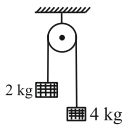
- 7Two blocks of mass $2 \mathrm{~kg}$ and $4 \mathrm{~kg}$ are connected by a metal wire going over a smooth pulley as shown in figure. The radius of wire is $4.0 \times 10^{-5}$ $\mathrm{m}$ and Young's modulus of the metal is $2.0 \times 10^{11} \mathrm{~N} / \mathrm{m}^2$. The longitudinal strain developed in the wire is $\frac{1}{\alpha \pi}$. The value of $\alpha$ is [Use $\mathrm{g}=10 \mathrm{~m} / \mathrm{s}^2$ )View Solution
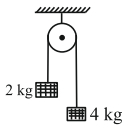
- 8Two blocks of mass $2 \mathrm{~kg}$ and $4 \mathrm{~kg}$ are connected by a metal wire going over a smooth pulley as shown in figure. The radius of wire is $4.0 \times 10^{-5}$ $\mathrm{m}$ and Young's modulus of the metal is $2.0 \times 10^{11} \mathrm{~N} / \mathrm{m}^2$. The longitudinal strain developed in the wire is $\frac{1}{\alpha \pi}$. The value of $\alpha$ is [Use $\mathrm{g}=10 \mathrm{~m} / \mathrm{s}^2$ )View Solution
- 9A steel rod of length $1\,m$ and cross sectional area $10^{-4}\,m ^2$ is heated from $0^{\circ}\,C$ to $200^{\circ}\,C$ without being allowed to extend or bend. The compressive tension produced in the rod is $........\times 10^4\,N$ (Given Young's modulus of steel $=2 \times 10^{11}\,Nm ^{-2}$, coefficient of linear expansion $=10^{-5}\, K ^{-1}$.View Solution
- 10A rod is fixed between two points at $20°C$. The coefficient of linear expansion of material of rod is $1.1 \times {10^{ - 5}}/^\circ C$ and Young's modulus is $1.2 \times {10^{11}}\,N/m$. Find the stress developed in the rod if temperature of rod becomes $10°C$View Solution