The upper end of a wire of radius $4\, mm$ and length $100\, cm$ is clamped and its other end is twisted through an angle of $30°$. Then angle of shear is ..... $^o$
Medium
Download our app for free and get started
(b) Angle of shear $\varphi = \frac{{r\theta }}{L}$$ = \frac{{4 \times {{10}^{ - 1}}}}{{100}} \times {30^o} = {0.12^o}$

Download our appand get started for free
Experience the future of education. Simply download our apps or reach out to us for more information. Let's shape the future of learning together!No signup needed.*
Similar Questions
- 1A copper wire $(Y = 1 \times 10^{11}\, N/m^2)$ of length $6\, m$ and a steel wire $(Y = 2 \times 10^{11}\, N/m^2)$ of length $4\, m$ each of cross section $10^{-5}\, m^2$ are fastened end to end and stretched by a tension of $100\, N$. The elongation produced in the copper wire is ......... $mm$View Solution
- 2A rubber cord $10\, m$ long is suspended vertically. How much does it stretch under its own weight $($Density of rubber is $1500\, kg/m^3, Y = 5×10^8 N/m^2, g = 10 m/s^2$$)$View Solution
- 3A copper solid cube of $60\,\, mm$ side is subjected to a pressure of $2.5 \times 10^7\, Pa$. If the bulk modulus of copper is $1.25 \times 10^{11}\, N/m^2$, the change in the volume of cube isView Solution
- 4The upper end of a wire of radius $4\, mm$ and length $100\, cm$ is clamped and its other end is twisted through an angle of $60^o$. Then angle of shear is .......... $^o$View Solution
- 5A $100\,m$ long wire having cross-sectional area $6.25 \times 10^{-4}\,m ^2$ and Young's modulus is $10^{10}\,Nm ^{-2}$ is subjected to a load of $250\,N$, then the elongation in the wire will be :View Solution
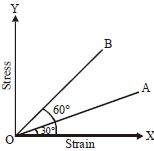
- 6The stress versus strain graphs for wires of two materials $A$ and $B$ are as shown in the figure. If $Y_A$ and $Y_B$ are the Young's modulus of the materials, thenView Solution
- 7If the breaking force for a given wire is $F$, then the breaking force of two wires of same magnitude will beView Solution
- 8Consider two wires of same material having their ratio of radii to be $2: 1$. If these two wires are stretched by equal force, then the ratio of stress produced in them isView Solution
- 9A metal rod of cross-sectional area $10^{-4} \,m ^{2}$ is hanging in a chamber kept at $20^{\circ} C$ with a weight attached to its free end. The coefficient of thermal expansion of the rod is $2.5 \times 10^{-6} \,K ^{-1}$ and its Young's modulus is $4 \times 10^{12} \,N / m ^{2}$. When the temperature of the chamber is lowered to $T$, then a weight of $5000 \,N$ needs to be attached to the rod, so that its length is unchanged. Then, $T$ is ............ $^{\circ} C$View Solution
- 10Longitudinal stress of $1\,kg/m{m^2}$ is applied on a wire. The percentage increase in length is $(Y = {10^{11}}\,N/{m^2})$View Solution