If the length of rod $A$ is $3.25 \pm 0.01 \,cm$ and that of $B$ is $4.19 \pm 0.01\, cm $ then the rod $B$ is longer than rod $A$ by
Easy


Download our appand get started for free
Experience the future of education. Simply download our apps or reach out to us for more information. Let's shape the future of learning together!No signup needed.*
Similar Questions
- 1In equation $y=x^2 \cos ^2 2 \pi \frac{\beta \gamma}{\alpha}$, the units of $x, \alpha, \beta$ are $m , s ^{-1}$ and $\left( ms ^{-1}\right)^{-1}$ respectively. The units of $y$ and $\gamma$ areView Solution
- 2The period of a body under SHM i.e. presented by $T = {P^a}{D^b}{S^c}$; where $P$ is pressure, $D$ is density and $S$ is surface tension. The value of $a,\,b$ and $c$ areView Solution
- 3The unit of permittivity of free space ${\varepsilon _0}$ isView Solution
- 4In a practical unit if the unit of mass becomes double and that of unit of time becomes half, then $8$ joule will be equal to .............. unit of work.View Solution
- 5View SolutionWhich relation is wrong
- 6A screw gauge has some zero error but its value is unknown. We have two identical rods. When the first rod is inserted in the screw, the state of the instrument is shown by diagram $(I).$ When both the rods are inserted together in series then the state is shown by the diagram $(II).$ What is the zero error of the instrument ? .......... $mm$View Solution
$1\,M.S.D. = 100\, C.S.D. = 1\, mm $
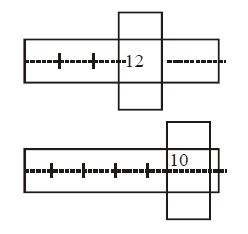
- 7The pitch and the number of divisions, on the circular scale, for a given screw gauge are $0.5\,mm$ and $100$ respectively. When the screw gauge is fully tightened without any object, the zero of its circular scale lies $3$ divisions below the mean line. The readings of the main scale and the circular scale for a thin sheet, are $5.5\,mm$ and $48$ respectively, the thickness of this sheet isView Solution
- 8If the units of force, energy and velocity are respectively $10\, N, 100\, J, 5\, m/s$, then the units of length, mass and time will beView Solution
- 9View SolutionWhich of the following is a derived unit
- 10The percentage error in measurement of mass and speed are $3\%$ and $2\%$ then error in kinetic energy will be .......... $\%$View Solution