MCQ
If the length of the pendulum in pendulum clock increases by $0.1\, \%$, then the error in time per day is: (in $s$)
  • A
    $86.4$
  • B
    $4.32$
  • $43.2$
  • D
    $8.64$

Answer

Correct option: C.
$43.2$
c
${T}=2 \pi \sqrt{\frac{\ell}{g}}$

$\frac{\Delta {T}}{{T}}=\frac{1}{2} \frac{\Delta \ell}{\ell}$

$\Delta {T}=\frac{1}{2} \times \frac{0.1}{100} \times 24 \times 3600$

$\Delta {T}=43.2$

Need a full question paper?

Generate a complete, print-ready paper with questions like this in minutes — across 16+ boards, with answer keys.
Start Generating Free

Similar questions

$A$ thin uniform rod of mass $M$ and length $L$ has its moment of inertia $I_1$ about its perpendicular bisector. The rod is bend in the form of a semicircular arc. Now its moment of inertia through the centre of the semi circular arc and perpendicular to its plane is $I_2$. The ratio of $I_1 : I_2$ will be
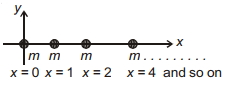
A large number of identical point masses $m$ are placed along $x$-axis, at $x=0,1,2,4$, The magnitude of gravitational force on mass at origin $(x=0)$, will be ............
A steady electric current is flowing through a cylindrical conductor.
  1. The electric field at the axis of the conductor is zero.
  2. The magnetic field at the axis of the conductor is zero.
  3. The electric field in the vicinity of the conductor is zero.
  4. The magnetic field in the vicinity of the conductor is zero.
The length of a cylinder is measured with a metre rod having least count $0.1 \;cm$. Its diameter is measured with vernier calipers having least count $0.01\; cm$. If the length and diameter of the cylinder are $5.0\; cm$ and $2.00\; cm$, respectively, then the percentage error in the calculated value of volume will be
An Indian rubber cord $L$ metre long and area of cross-section $A$ $metr{e^2}$ is suspended vertically. Density of rubber is $D$ $kg/metr{e^3}$ and Young's modulus of rubber is $E$ $newton/metr{e^2}$. If the wire extends by $l$ metre under its own weight, then extension $l$ is
At what distance from the centre of the earth, the value of acceleration due to gravity $g$ will be half that on the surface ($R =$ radius of earth)
A thin uniform bar lies on a frictionless horizontal surface and is free to move in any way on the surface. Its mass is $0.300\, kg$ and length is $2 \,m$ . Two particles each of mass $0.100\, kg$ are moving on the same surface and towards the two ends of the bar in the direction perpendicular to the bar such that one with velocity $10\, m/s$ towards one end and the other with velocity $5\, m/s$ towards the other end. If collision between particles and bar is completely elastic and both particles strike with the bar simultaneously. The velocity of centre of mass of the bar after the collision is ...... $m/s$
Column $I$ describe some situations in which a small object moves. Column $II$ describes some characteristics of these motions. Match the situation in Column $I$ with the characteristics in Column $II$ and indicate your answer by darkening appropriate bubbles in the $4 \times 4$ matrix given in the $ORS$.
Column $I$ Column $II$
$(A)$ The object moves on the $\mathrm{x}$-axis under a conservative force in such a way that its "speed" and "position" satisfy $v=c_1 \sqrt{c_2-x^2}$, where $\mathrm{c}_1$ and $\mathrm{c}_2$ are positive constants. $(p)$ The object executes a simple harmonic motion.
$(B)$ The object moves on the $\mathrm{x}$-axis in such a way that its velocity and its displacement from the origin satisfy $\mathrm{v}=-\mathrm{kx}$, where $\mathrm{k}$ is a positive constant. $(q)$ The object does not change its direction.
$(C)$ The object is attached to one end of a massless spring of a given spring constant. The other end of the spring is attached to the ceiling of an elevator. Initially everything is at rest. The elevator starts going upwards with a constant acceleration a. The motion of the object is observed from the elevator during the period it maintains this acceleration. $(r)$ The kinetic energy of the object keeps on decreasing.
$(D)$ The object is projected from the earth's surface vertically upwards with a speed $2 \sqrt{\mathrm{GM}_e / R_e}$, where, $M_e$ is the mass of the earth and $R_e$ is the radius of the earth. Neglect forces from objects other than the earth. $(s)$ The object can change its direction only once.
The sum of three forces ${\vec F_1} = 100\,N,{\vec F_2} = 80\,N$ and ${\vec F_3} = 60\,N$ acting on a particle is zero. The angle between $\vec F_1$ and $\vec F_2$ is nearly .......... $^o$
Two sine waves travel in the same direction in a medium. The amplitude of each wave is a and the phase difference between the two waves is $120^\circ.$ The resultant amplitude will be: