Question
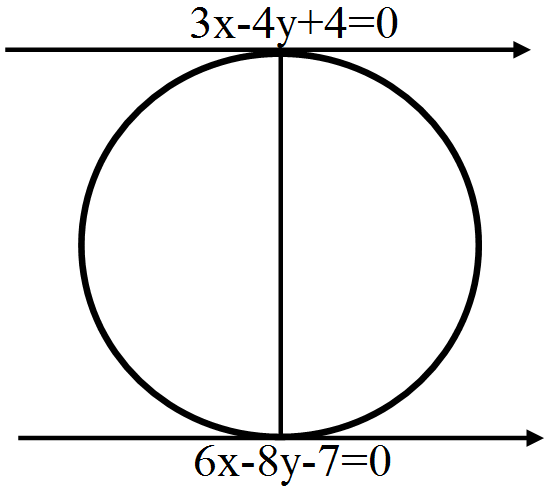
If the lines 3x - 4y + 4 = 0 and 6x - 8y - 7 = 0 are tangents to a circle, then find the radius of the circle.
Answer

Slope of 3x - 4y + 4 = 0 is $\frac{4}{3}$ Slope of 6x - 8y -7 = 0 is $\frac{8}{6}=\frac{4}{3}$ Slope of 3x - 4y + 4 = 0 and 6x - 8y - 7 = 0 are same. Hence two lines are parallel and are shown in figure. Rewriting 6x - 8y - 7 = 0, we get, $\Bigg|\frac{4+\frac{7}{2}}{\sqrt{9+16}}\Bigg|$ $\Big|\frac{15}{10}\Big|$ $=\frac{3}{4}$ Units

Need a full question paper?

Generate a complete, print-ready paper with questions like this in minutes — across 16+ boards, with answer keys.

Start Generating Free

Similar questions

In the triangle ABC with vertices A (2, 3), B (4, -1) and C (1, 2), find the equation and the length of the altitude from the vertex A.
In a G.P. the $3^{rd}$ term is 24 and the 6th term is 192. Find the 10th term.
If $\text{a}\cos2\text{x}+\text{b}\sin2\text{x}=\text{c}$ has $\alpha$ and $\beta$ as its roots, then prove that, $\tan\alpha+\tan\beta=\frac{2\text{b}}{\text{a+c}}$
For three sets A, B and C, show that.
$\text{A}\cap\text{B}=\text{A}\cap\text{C}$ need not imply B = C.
Prove that the area of the parallelogram formed by the lines 3x - 4y + a = 0, 3x - 4y + 3a= 0, 4x - 3y - a = 0 and 4x - 3y - 2a = 0 is $\frac{2\text{a}^2}{7}$ sq.units.
Find the sum of the following geometric series:$(\text{x}+\text{y})+(\text{x}^2+\text{xy}+\text{y}^2)+(\text{x}^3+\text{x}^2\text{y}+\text{xy}^2+\text{y})+\ ...\text{ to n terms;}$
If A and B are mutually exclusive events such that P(A) = 0.35 and P(B) = 0.45, find:
  1. $\text{P}(\text{A}\cup\text{B})$
  2. $\text{P}({\text{A}}\cap{\text{B}})$
  3. $\text{P}({\text{A}}\cap\overline{\text{B}})$
  4. $\text{P}(\overline{\text{A}}\cap\overline{\text{B}})$
Prove that $\Bigg|\sqrt{\frac{1-\sin\text{x}}{1+\sin\text{x}}}+\sqrt{\frac{1+\sin\text{x}}{1-\sin\text{x}}}\Bigg|$ $=-\frac{2}{\cos\text{x}},$ where $\frac{\pi}{2}<\text{x}<\pi$
Evaluate the following limit: $\lim\limits_{\text{x}\rightarrow1}\frac{\sqrt{3+\text{x}}-\sqrt{5-\text{x}}}{\text{x}^2-1}$
Prove that: $\frac{\cos3\text{A}+2\cos5\text{A}+\cos7\text{A}}{\cos\text{A}+2\cos3\text{A}+\cos5\text{A}}=\frac{\cos5\text{A}}{\cos3\text{A}}$