Question 14 Marks
Find the equation of the circle which passes through the points $(2, 3)$ and $(4,5)$ and the centre lies on the straight line $y - 4x + 3 = 0$
AnswerFind the equation of the circle which passes through the point (2, 3) and ( 4, 5) and the centre lies on the straight line y - 4x + 3 = 0. Let the equation of required circle be $x^2 + y^2 + 2gx+ 2fy + c = 0$ which passes through the point (2, 3) and ( 4, 5) .
$\therefore$ 13 + 4g + 6f + c = 0 ......... (1) 41 + 8g +10f + c = 0 ........... (2) Centre (-g, -f) lies on y - 4x + 3 = 0 -f + 4g = -3 .......... (3) Subtracting (1) from (2), we get 28 + 4g + 4f = 0 ........ (4) Solving (3) and (4) we get, f = -5 and g = -2 Substituting values off and g in (2) we get, 41 - 16 - 50 + c = 0 c = 25 $\therefore$ The required equation of the circle is, $x^2 + y^2 - 4x - 10y + 25 = 0$.
View full question & answer→Question 24 Marks
Show that the point $(\text{x},\ \text{y})$ given by $\text{x}=\frac{2\text{at}}{1+\text{t}^2}$ and $\text{y}=\text{a}\Big(\frac{1-\text{t}^2}{1+\text{t}^2}\Big)$2 lies on a circle for all real values of t such that $-1\leq\text{t}\leq1,$ where a is any given real number.
Answer$\text{x}=\frac{2\text{at}}{1+\text{t}^2},\text{y}=\text{a}\Big(\frac{1-\text{t}^2}{1+\text{t}}\Big)$ $\text{x}^2+\text{y}^2=\frac{4\text{a}^2\text{t}^2}{(1+\text{t}^2)^2}+\frac{\text{a}^2(1-\text{t}^2)^2}{(1+\text{t}^2)^2}$ $=\frac{4\text{a}^2\text{t}^2+\text{a}^2(1-2\text{t}^2+\text{a}^2)\text{t}^4}{(1+\text{t}^2)^2}$ $=\frac{4\text{a}^2\text{t}^2+\text{a}^2-2\text{a}^2\text{t}^2+\text{a}^2\text{t}^4}{(1+\text{t}^2)^2}$ $=\frac{2\text{a}^2\text{t}^2+\text{a}^2+\text{a}^2\text{t}^2}{(1+\text{t}^2)^2}$ $=\frac{\text{a}^2(1+2\text{t}^2+\text{t}^2)}{(1+\text{t}^2)^2}$ $\text{x}^2+\text{y}^2=\text{a}^2$ is equation of a circle.
View full question & answer→Question 34 Marks
Find the equation of the circle which circumscribes the triangle formed by the lines $y = x + 2, 3y = 4x$ and $2y = 3x$.
AnswerSolving equations y = x + 2 and 3y = 4x we get, x = 6 and y = 8 Solving equations y = x + 2 and 2y = 3x we get, x = 4 and y = 6 Solving equations 3y = 4x and 2y = 3x we get, x = 0 and y = 0 So, the vertices of the triangle are (6, 8), ( 4, 6) and (0, 0). Let $x^2 + y^2 + 2gx + 2fy + c = 0$ be the required cirde which circumscribes the triangle .
$\therefore$ x2 + y2 + 2gx + 2fy + c = 0 passes through ( 6, 8), (4, 6) and (0, 0). 12g + 16f + c = -100 ....... (1) 8g + 12f + C = -52 .......... (2) C = 0 ....... (3) Solving (i), (ii) and (iii) we get f = 11 and g = -23 $\therefore$ The required equation of the circle is, $x^2 + y^2 - 46x + 22y = 0$.
View full question & answer→Question 44 Marks
Prove that the centres of the three circles $x^2+ y^2 - 4x - 6y - 12 = 0, x^2 + y^2 + 2x + 4y - 10 = 0$ and $x^2 + y^2 - 10x - 16y - 1 = 0$ are collinear.
AnswerThe given equation of circle are. $x^2 + y^2 - 4x - 6y - 12 = 0 .......... (1) x^2 + y^2 + 2x + 4y - 10 = 0 ......... (2) x^2 + y^2 - 10x - 16y - 1 = 0 ........ (3)$ Let $C_1 C_2$ & $C_3$ are the centres of (1) (2) & (3)
$\therefore C_1= (-g, -f) = (2, 3) C_2 = (-g, -f) = (-1, -2) C_3 = (-g, -r) = (5, 8) C_1 C_2$ & $C_3$ will be collinear if ar $(\Delta\text{C}_1\ \text{C}_2\ \text{C}_3)=\bar0$ $(\Delta\text{C}_1\text{C}_2\text{C}_3)=\frac{1}{2}\begin{vmatrix}\text{x}_1&\text{y}_1&1\\\text{x}_2&\text{y}_2&1\\\text{x}_3&\text{y}_3&1\end{vmatrix}=\frac{1}{2}\begin{vmatrix}2&3&1\\-1&-2&1\\5&8&1\end{vmatrix}\\=\frac{1}{2}\begin{vmatrix}2&3&1\\-3&-5&0\\3&5&0\end{vmatrix}\begin{matrix}\text{R}_2\rightarrow\text{R}_2-\text{R}_3\\\text{R}_3\rightarrow\text{R}_3-\text{R}_1 \end{matrix}$ $=\frac{1}{2}(-15+15)=\frac{1}{2}\times0=0$
$\therefore C_1 C_2$ & $C_3$ are collinear
View full question & answer→Question 54 Marks
Find the equation of the circle the end points of whose diameter are the centres of the circles $x^2+y^2+6 x-14 y-1$ $=0$ and $x^2+y^2-4 x+10 y-2=0$.
AnswerGiven: $x^2+y^2+6 x-14 y-1=0$ ........ (1) And, $x^2+y^2-4 x+10 y-2=0$ ........(2) Equations (1) and (2) can be rewritten as follows: $(x+3)^2+(y-7)^2=59$ And, $(x-2)^2+(y+5)^2=31$ Thus, the centres of the circles are $(-3,7)$ and $(2,-5)$.
Hence, the equation of the circle, the end points of whose diameter are the centres of the given circles, is $(x+3)(x-$ 2) $+(y-7)(y+5)=0$, i.e. $x^2+y^2+x-2 y-41=0$
View full question & answer→Question 64 Marks
The sides of a square are $x = 6, x = 9, y = 3$ and $y = 6$. Find the equation of a circle drawn on the diagonal of the square as its diameter.
AnswerLet the sides $A B, B C, C D$ and $D A$ of the square $A B C D$ be represented by the equations $y=3, x=6, y=6$ and $x=9$ respectively. Then, coordinates are $A(6,3), B(9,3), C(9,6)$ and $D(6,6)$. The equation of the circle with diagonal $A C(x-$ $6)(x-9)+(4-3)(4-6)=0 $
$\Rightarrow x^2-6 x-9 x+54+y^2-3 y-6 y+18=0 $
$\Rightarrow x^2+y^2-15 x-9 y+72=0$ The equation of the circle with diagonal $B D$ as diameter is $(x-9)(x-6)+(y-3)(y-6)=$
$\Rightarrow x^2-9 x-6 x+54+y^2-3 y-6 y+18=0 $
$\Rightarrow$ $x^2+y^2-15 x-9 y+72=0 x^2+y^2-15 x-9 y+72=0$
View full question & answer→Question 74 Marks
Find the equation of the circle, the end points of whose diameter are $(2, -3)$ and $(-2, 4)$. Find its centre and radius.
Answer$(2,-3)$ and $(-2,4)$ are the ends points of the diameter of a circle. The equation of this circle is $(x-2)(x+2)+(y+3)(y-4)=0 . \Rightarrow x^2-4+y^2-4 y+3 y-12=0 \Rightarrow x^2+y^2-y-16=0$...... (1) Equation
(1) can be rewritten as $\text{x}^2+\Big(\text{y}-\frac{1}{2}\Big)^2-\frac{1}{4}-16=0$
$\Rightarrow\text{x}^2+\Big(\text{y}-\frac{1}{2}\Big)^2=\frac{65}{4}$
$\therefore$ Centre is $\Big(0,\ \frac{1}{2}\Big)$ and radius is $\frac{\sqrt{65}}{2}.$
View full question & answer→Question 84 Marks
Prove that the radii of the circles $x^2 + y^2 = 1, x^2 + y^2 - 2x − 6y - 6 = 0$ and $x^2 + y^2 - 4x - 12y - 9 = 0$ are in A.P.
AnswerThe given equation of circle are.$x^2 + y^2 = 1 .......... (1)$
$x^2 + y^2 + 2x + 6y - 6 = 0 ......... (2)$
$x^2 + y^2 - 4x - 12y - 9 = 0 ......... (3)$
Respectively If a, b, care in AP, then b $\frac{\text{a}+\text{c}}{2}$
Let $C_1 C_2$ & $C_3$ are the centres of (1) (2) & (3)
For $a = 1, b = 4, c = 7, \frac{1+7}{2}=4\text{b,}$ therefore $1, 4, 7$ or The centres of the three circles lie In AP.
$\therefore R_1= 1$
$R_2$ = $\sqrt{\text{g}^2+\text{f}^2-\text{c}}=\sqrt{1^2+3^2+6}=\sqrt{16}=4$
$R_3$ = $\sqrt{\text{g}^2+\text{f}^2+\text{c}}=\sqrt{2^2+6^2+9}=\sqrt{49}=7$
View full question & answer→Question 94 Marks
Find the equation of the circle concentric with the circle $x^2 + y^2 - 6x + 12y + 15 = 0$ and double of its area.
AnswerThe given equation of cirde is $x^2+ y^2 - 6x + 12y + 15 = o$ ......... (1) $\therefore$ centre= $(-g, -1) = (3,-6)$ Radius $\sqrt{\text{g}^2+\text{f}^2-\text{c}}=\sqrt{9+36-15}=\sqrt{30}$
Now, The required equation of cirde in coocenmc with(1) Which means both have same centre (3, -6) Also, Area of required cirde = 2 × Area of (1) $\pi\text{r}^2=2\times\pi(\sqrt{30})^2$ $\Rightarrow\text{R}^2=60$ $\Rightarrow\text{R}=2\sqrt{15}$ Thus, The required circle is $(x-3)^2 + (y +6)^2=60 x^2 + y^2 - 6x +12y - 15 = O$
View full question & answer→Question 104 Marks
Find the equation to the circle which passes through the points $(1, 1) (2, 2)$ and whose radius is $1$. Show that there are two such circles.
AnswerLet $x^2 + y^2 + 2gx + 2fy + c = 0$ ........(1) be the required cirde.
Now (1) passes through $\text{P}=(1,\ 1)\&\ \theta(2,\ 2)$
$\therefore$ 1 + 1 + 2g + 2f + C = 0 ........... (2) 4 + 4 + 4g + 4f + c = 0 ............... (3) Also racius = 1 $\Rightarrow\sqrt{\text{g}^2+\text{f}^2-\text{c}}=1$
$\Rightarrow\text{g}^2+\text{f}^2-\text{c}1\ .......(4)$ from (2) & (4) $\text{g}+\text{f}+\frac{\text{c}}{2}=-1\ \&$ $\text{g}+\text{f}+\frac{\text{c}}{4}=-2$ on subtraction and $\text{g}+\text{f}=-3\ ........(4)$ From (4) $\text{g}^2+\text{f}^2=5$ $\big\{\therefore(\text{g}+\text{f})^2=\text{g}^2+\text{f}^2+2\text{g}\text{f}\big\}$
$\therefore2\text{gf}=4$ $\Rightarrow9=5+2\text{gf}$ $\text{gf}=2$ so, $(\text{g}-\text{f})^2=\text{g}+\text{f})^2-4\text{gf}=9-8=1$ $\therefore\text{g}-\text{f}=\pm1\ .........\ (4)$ Solving (5) & (6) we get $\text{g}=-1$ or $-2\ \&$ $\text{f}=-2$ or $-1$ Thus, required circle $\text{x}^2+\text{y}^2-2\text{x}-4\text{y}+4=0$ $\text{x}^2+\text{y}^2-4\text{x}-2\text{y}+4=0$
View full question & answer→Question 114 Marks
Find the equation of the circle which circumscribes the triangle formed by the lines $x + y = 2, 3x - 4y = 6$ and $x - y = 0$.
AnswerThe given equation of lines x + y = 2 ......... (1) 3x - 4y = 6 ....... (2) x - y = 0 ........... (3) Let A, B & C are the point of intersection of lines (1) & (2), (2) & (3) and (3) & (1) respectively
$\therefore$ A = (2, 0), B = (-6, -6) & C = (1, 1) Let $x^2 + y^2+ 2gx + 2fy + c = 0 ........$ (A) be the circle that circum scnbinq $\Delta\text{ABC}$
$\therefore$ 4 + 4g + c = 0 ........ (4) 36 + 36 + 12g + 12f + c = 0 ........ (5) 1 + 1 + 2g + 2f + c = 0 ....... (4) Solving (4), (5) & (6) we get, g = 2, f = 3 & c = -12 from (A), The required cirde is $x^2 + y^2 - 4x + 6y - 12 = 0$
View full question & answer→Question 124 Marks
Find the equations of the circles passing through two points on y-axis at distances $3$ from the origin and having radius $5$.
AnswerLet the required equation of the circle be $(x - h)^2 + (y - k)^2 = a^2$ The circle passes through the points $(0, 3)$ and $(0, -3)$.
$\therefore (0 - h)^2 + (3 - k)^2 = a2 ........ (1)$ And, $(0 - h)^2 + (-3 - k)^2 =a^2 ....... (2)$ Solving (1) and (2), we get: $k = 0$ Given: Radius = 5
$\therefore a^2 = 25$ So, from equation (2), we have: $h^2 + 9 = 25 \Rightarrow h = ±4$
Hence, the required equation is $(x ± 4)^2 + y^2 = 25$, which can be rewritten as $x^2 ± 8x + y^2 − 9 = 0$
View full question & answer→Question 134 Marks
Find the equations of the circles touching y-axis at $(0, 3)$ and making an intercept of $8$ units on the x-axis.
AnswerCase I: The centre lies in first quadrant.
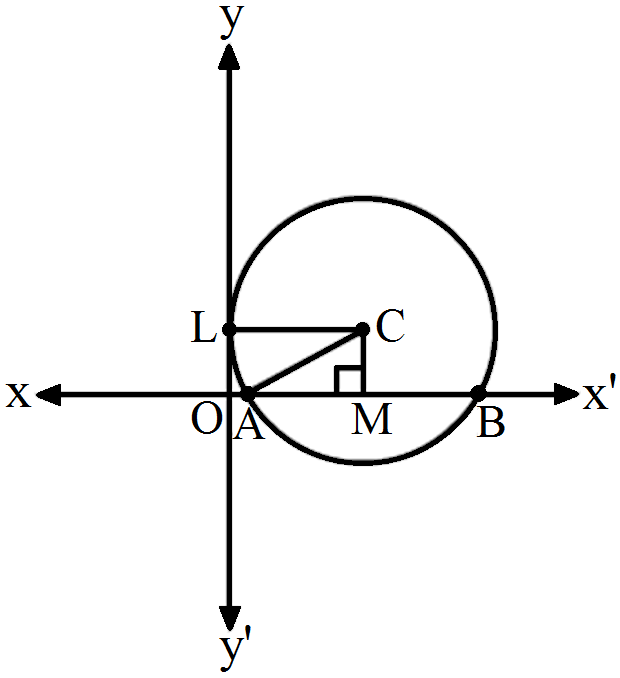
Let the required equation be $(x-h)^2+(y-k)^2=a^2$ Here, $A B=8$ units and $L\left(0, \ln \triangle C A M \Rightarrow C A^2=C M^2+A M^2 \Rightarrow\right.$ $C A^2=3^2+4^2 \Rightarrow C A=5 \Rightarrow C L=C A=5 \therefore$ Coordinates of the centre $=(5,3)$ And, radius of the circle $=5(x-5)^2+(y$ $-3)^2=25$, i.e. $x^2+y^2-10 x-6 y=-9$ Case II: The centre lies in the second quadrant.
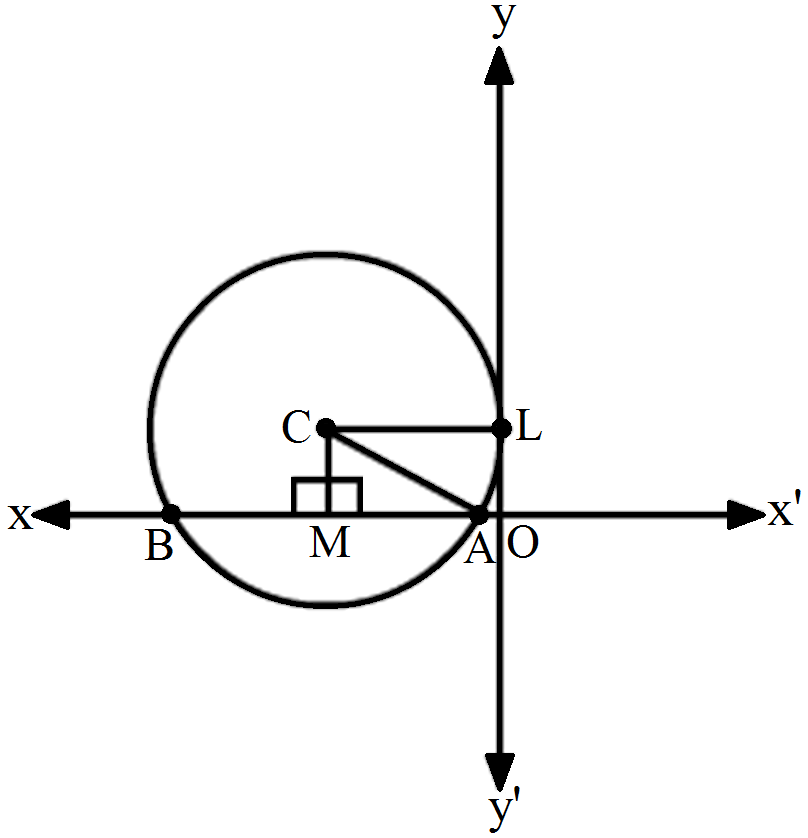
Coordinates of the centre = $(-5, 3)$ And, radius of the circle = $5 (x - 5)^2 + (y - 3)^2 = 25, i.e. x^2 + y^2 - 10x - 6y= -9$ View full question & answer→Question 144 Marks
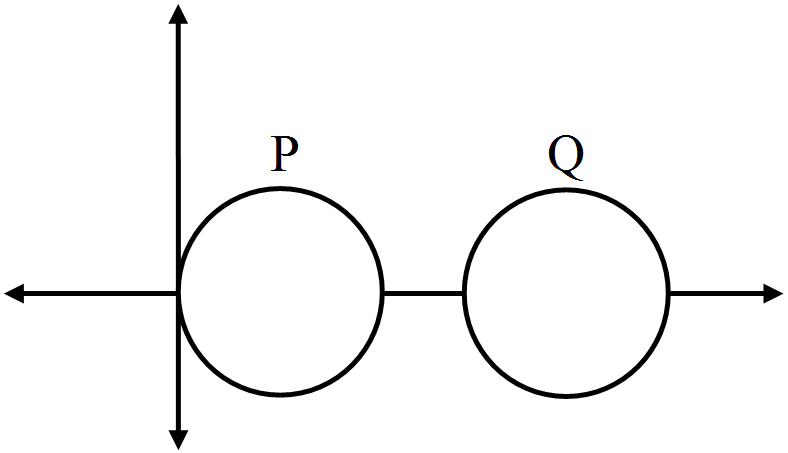
The circle $x^2 + y^2 - 2x - 2y + 1 = 0$ is rolled along the positive direction of x-axis and makes one complete roll. Find its equation in new-position.
AnswerGiven circle is $x^2 + y^2 - 2x - 2y + 1 = 0$ Rewriting the equation, we get,
$x^2 - 2x + 1 + y^2 - 2y + 1 = 1$
$(x - 1)^2 +(y - 1)^2 = 1 ........ (1)$
The given circle has its centre at (1, 1) and radius = 1 from (1).
When circle is rolled on x-axis, it center moves horizontally through distance Figure shows circle with centre (1, 1) at P.
After rolling it on X-axis, it takes the position Q.
The coordinates of it's centre become $=(1,\ 1+2\pi)$
Radius of the circle at Q = 1,
Hence, equation of new circle is.
$[\text{x}-(1+2\pi)^2]+(\text{y}-1)^2$ View full question & answer→Question 154 Marks
A circle whose centre is the point of intersection of the lines 2x - 3y + 4 = 0 and 3x + 4y - 5 = 0 passes through the origin. Find its equation.
Answerwe heve, $2\text{x}-3\text{y}=-4\ .......(1)$ $3\text{x}+4\text{y}=5\ .........(2)$ The point of intersection of (1) & (2) is $\text{p}\Big(\frac{-1}{17},\ \frac{66}{51}\Big)$ or $\text{p}\Big(\frac{-1}{17},\ \frac{22}{17}\Big)$ According to the equation centre $=\Big(\frac{-1}{17},\ \frac{22}{17}\Big)$ Also, the cirde passes through 0 (0, 0) $\therefore\ \text{r}=\text{OC}=\sqrt{\Big(0+\frac{1}{17}\Big)^2+\Big(0-\frac{22}{17}\Big)^2}$ $=\sqrt{\frac{1}{289}+\frac{484}{289}}=\frac{\sqrt{485}}{17}$ Thus, the required equation of circle is $\Big(\text{x}+\frac{1}{17}\Big)^2+\Big(\text{y}-\frac{22}{17}\Big)^2=\frac{485}{289}$
View full question & answer→Question 164 Marks
A circle of radius 4 units touches the coordinate axes in the first quadrant. Find the equations of its images with respect to the line mirrors x = 0 and y = 0.
AnswerWe are given that a circle has radius 4 and touches the coordinate axes in $1^{\text {st }}$ quadrant. Thus the centre $=(4,4)$ Now $C_2$ and $C_3$ are the images of $C_1$ with respect toy $=0$ and $=0$ So, for $C_2$ Centre $=(-4,4)$ and radius $=4$ Thus the equation of circle $C 2$ is $(x+4)^2+(Y-4)^2=4^2=x^2+y^2+8 x-8 y+16=0$ And for $C_3$ centre $=(4,-4)$ and radius $=4$ Thus, the equation of circle $C_3$ is $(x-4)^2(y+4)^2=4^2 \Rightarrow x^2+y^2-8 x+8 y+16=0$
View full question & answer→Question 174 Marks
If a circle passes through the point (0, 0),(a, 0),(0, b) then find the coordinates of its centre.
AnswerConsider the following figure. 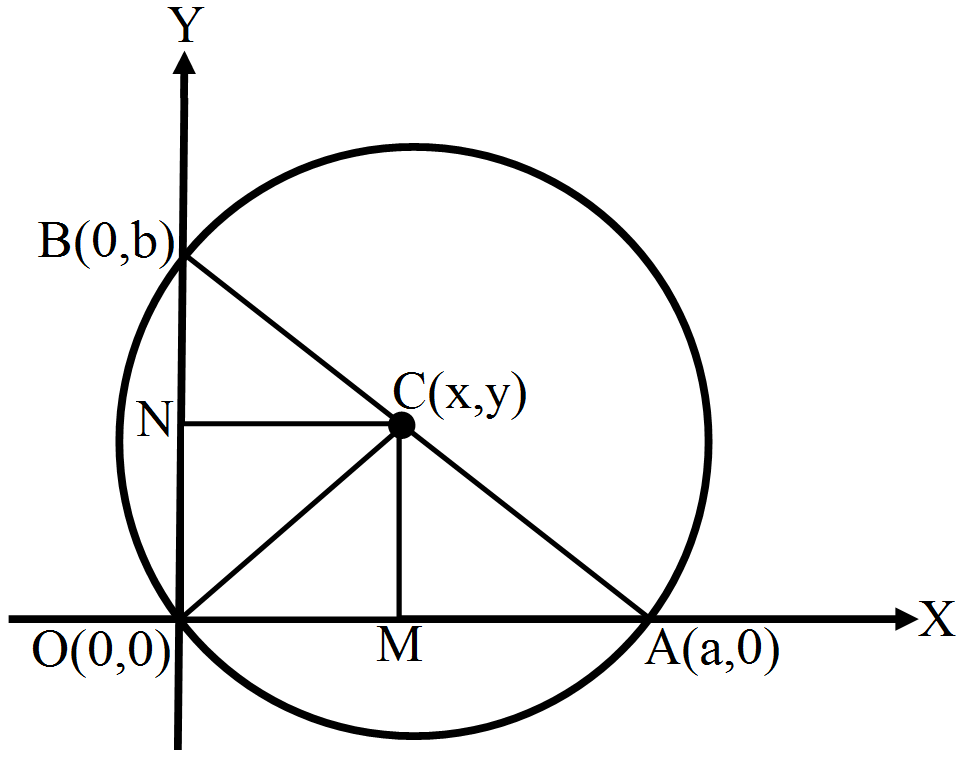 In the above diagram, CA, CO and CB are equal radii of the circle and hence we have, CA = CO = CB = r. Also the triangle $\Delta\text{OCA}$ is an isosceles triangle, and CM is the perpendicular bisector to the base OA. Hence $\text{CM}=\frac{\text{a}}{\text{2}}$ Similarly, CN is the perpendirular bisector to the base OB Thus, $\text{ON}=2$ Thus, from the diagram it is dear that $\text{CM}=\text{x}=\frac{\text{a}}{2}$ and $\text{ON}=\text{y} =\frac{\text{b}}{2}$ Hence the centre of the circle is c $\Big(\frac{\text{a}}{2},\ \frac{\text{b}}{2}\Big)$
 View full question & answer→Question 184 Marks
One diameter of the circle circumscribing the rectangle ABCD is 4y = x + 7. If the coordinates of Aand B are (-3, 4) and (5, 4) respectively, find the equation of the circle.
AnswerThe centre O Ii es on the I ine x - 4y = -7 and the perpendicular bi sector MO of AB. The coordinates of Mare (1, 4). Thus, the equation of MO is x = 1 Point of intersection of x - 4y = -7 and x = 1 is 0 = (1, 2) Also the radius of ci rel e is $\text{AO}=\sqrt{(1+3)^2+(2-4)^2}$ $=\sqrt{16+4}=\sqrt{20}=2\sqrt{5}$ Thus the equation of circle is $(\text{x}-1)^2+(\text{y}-2)^2=20$ $\Rightarrow\text{x}^2+\text{y}^2-2\text{x}-4\text{y}-15=0$
View full question & answer→Question 194 Marks
Find the equation of the circle concentric with $x^2 + y^2 - 4x - 6y - 3 = 0$ and which touches the y-axis.
AnswerThe given equabon of cir de is $x^2 + y^2 - 4x - 6y - 3 = 0$ ......... (1)
$\therefore$ centre = (-9, -f) = (2, 3) The required circle is oonc:entric with (1) so, they have same centre = (2, 3) Also, the required cirde touchesy - axis at A
$\therefore$ CA = redius = 2
$\therefore$ equation of cirde is $(x - 2)^2 + (y - 3)^2 = 4 \Rightarrow x^2 + y^2-4x - 6y + 9 = 0$
View full question & answer→Question 204 Marks
Find the equation of the circle which passes through the origin and cuts off chords of lengths $4$ and $6$ on the positive side of the x-axis and y-axis respectively.
AnswerWe have a circle thet passes through origin $O(0,0)$ and cut of on mtersept of length 4 units on $x$-axis Be 6 units on $y$-axis. That is, $O A=4 O B=6 C$ - be the centre of the cirde and $C M \& C N$ are perpendicular line drawn on $O A \& 08$ respectively. Coordinates of $A=(4,0) \& B=(0,6)$
$\therefore$ Coordinates of $M=(2,0) \& N=(0,3)$ Thus coordinates of $C=$ $(2,3)$ Now in $\triangle O C M O C^2=\mathrm{OM}^2+\mathrm{CM}^2=2^2+3^2[\because \mathrm{CM}=\mathrm{ON}=3]=4+9$
$\therefore \mathrm{OC}=\sqrt{3}$ Thus, the required cirde is $(x-2)^2+(y-3)^2=13 x^2+y^2-4 x-6 y=0$
View full question & answer→Question 214 Marks
If the lines 3x - 4y + 4 = 0 and 6x - 8y - 7 = 0 are tangents to a circle, then find the radius of the circle.
AnswerSlope of 3x - 4y + 4 = 0 is $\frac{4}{3}$ Slope of 6x - 8y -7 = 0 is $\frac{8}{6}=\frac{4}{3}$ Slope of 3x - 4y + 4 = 0 and 6x - 8y - 7 = 0 are same. Hence two lines are parallel and are shown in figure. 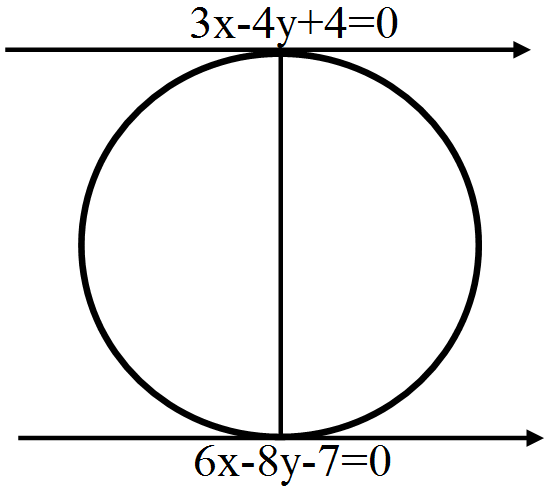 Rewriting 6x - 8y - 7 = 0, we get, $\Bigg|\frac{4+\frac{7}{2}}{\sqrt{9+16}}\Bigg|$ $\Big|\frac{15}{10}\Big|$ $=\frac{3}{4}$ Units
 View full question & answer→Question 224 Marks
If the line $2x - y + 1 = 0$ touches the circle at the point $(2, 5)$ and the centre of the circle lies on the line $x + y - 9 = 0$. Find the equation of the circle.
AnswerThe line 2x - y + 1 = 0 touches the circle at A (2, 5). The centre of circle lies on the line m : x + y = 9.
Now AO is perpendicular to 2x - y + 1 = 0
$\therefore$ equation of AO is x + 2y = d ........ (3) But AO passes through A (2, 5)
$\therefore d = 12$
$\therefore$ equation of AO is x + 2y = 12 ........ (4)
The point of intersection of x + y = 9 and x + 2y = 12 is (6, 3) which is the centre of the circle. Radius $=\text{AO}=\sqrt{(6-2)^2(3-5)^2}=\sqrt{16+4}=\sqrt{20}$ Hence, equation of circle is $(x - 6)^2+ (y - 3)^2 = 20$
View full question & answer→Question 234 Marks
Find the equation of the circle whose diameter is the line segment joining $(-4, 3)$ and $(12, -1)$. Find also the intercept made by it on y-axis.
AnswerIt is given that the end points of the diameter of the circle are $(-4,3)$ and $(12,-1) . $
$\therefore$ Required equation of circle: ( $x+$ 4) $(x-12)+(y-3)(y+1)$ or $x^2+y^2-8 x-2 y-51=0 \ldots \ldots$. (1) Putting $x=0$ in (1): $y^2-2 y-51=0 \Rightarrow y^2-2 y-51=0$ $\Rightarrow \mathrm{y}=1 \pm 2 \sqrt{3}$
Hence, the intercepts made by it on the y -axis is $1+2 \sqrt{3}-1+2 \sqrt{13}=4 \sqrt{13}$
View full question & answer→Question 244 Marks
Find the equation of the circle which passes through the points $(2, 3)$ and $(4,5)$ and the centre lies on the straight line $y - 4x + 3 = 0$
AnswerFind the equation of the circle which passes through the point (2, 3) and ( 4, 5) and the centre lies on the straight line y - 4x + 3 = 0. Let the equation of required circle be $x^2 + y^2 + 2gx+ 2fy + c = 0$ which passes through the point (2, 3) and ( 4, 5) .
$\therefore$ 13 + 4g + 6f + c = 0 ......... (1) 41 + 8g +10f + c = 0 ........... (2) Centre (-g, -f) lies on y - 4x + 3 = 0 -f + 4g = -3 .......... (3) Subtracting (1) from (2), we get 28 + 4g + 4f = 0 ........ (4) Solving (3) and (4)
we get, f = -5 and g = -2 Substituting values off and g in (2) we get, 41 - 16 - 50 + c = 0 c = 25 $\therefore$ The required equation of the circle is, $x^2 + y^2 - 4x - 10y + 25 = 0$.
View full question & answer→Question 254 Marks
Show that the point $(\text{x},\ \text{y})$ given by $\text{x}=\frac{2\text{at}}{1+\text{t}^2}$ and $\text{y}=\text{a}\Big(\frac{1-\text{t}^2}{1+\text{t}^2}\Big)$2 lies on a circle for all real values of t such that $-1\leq\text{t}\leq1,$ where a is any given real number.
Answer$\text{x}=\frac{2\text{at}}{1+\text{t}^2},\text{y}=\text{a}\Big(\frac{1-\text{t}^2}{1+\text{t}}\Big)$ $\text{x}^2+\text{y}^2=\frac{4\text{a}^2\text{t}^2}{(1+\text{t}^2)^2}+\frac{\text{a}^2(1-\text{t}^2)^2}{(1+\text{t}^2)^2}$ $=\frac{4\text{a}^2\text{t}^2+\text{a}^2(1-2\text{t}^2+\text{a}^2)\text{t}^4}{(1+\text{t}^2)^2}$ $=\frac{4\text{a}^2\text{t}^2+\text{a}^2-2\text{a}^2\text{t}^2+\text{a}^2\text{t}^4}{(1+\text{t}^2)^2}$ $=\frac{2\text{a}^2\text{t}^2+\text{a}^2+\text{a}^2\text{t}^2}{(1+\text{t}^2)^2}$ $=\frac{\text{a}^2(1+2\text{t}^2+\text{t}^2)}{(1+\text{t}^2)^2}$ $\text{x}^2+\text{y}^2=\text{a}^2$ is equation of a circle.
View full question & answer→Question 264 Marks
Find the equation of the circle which circumscribes the triangle formed by the lines $y = x + 2, 3y = 4x$ and $2y = 3x.$
AnswerSolving equations y = x + 2 and 3y = 4x we get, x = 6 and y = 8 Solving equations y = x + 2 and 2y = 3x we get, x = 4 and y = 6 Solving equations 3y = 4x and 2y = 3x we get, x = 0 and y = 0 So, the vertices of the triangle are (6, 8), ( 4, 6) and (0, 0). Let $x^2 + y^2 + 2gx + 2fy + c = 0$ be the required cirde which circumscribes the triangle .
$\therefore$ x2 + y2 + 2gx + 2fy + c = 0 passes through ( 6, 8), (4, 6) and (0, 0). 12g + 16f + c = -100 ....... (1) 8g + 12f + C = -52 .......... (2) C = 0 ....... (3) Solving (i), (ii) and (iii) we get f = 11 and g = -23
$\therefore$ The required equation of the circle is, $x^2 + y^2 - 46x + 22y = 0$.
View full question & answer→Question 274 Marks
Prove that the centres of the three circles $x^2+ y^2 - 4x - 6y - 12 = 0, x^2 + y^2 + 2x + 4y - 10 = 0$ and $x^2 + y^2 - 10x - 16y - 1 = 0$ are collinear.
AnswerThe given equation of circle are. $x^2 + y^2 - 4x - 6y - 12 = 0 .......... (1) x^2 + y^2 + 2x + 4y - 10 = 0 ......... (2) x^2 + y^2 - 10x - 16y - 1 = 0 ........ (3)$ Let $C_1 C_2$ & $C_3$ are the centres of (1) (2) & (3) $\therefore C_1= (-g, -f) = (2, 3) C_2 = (-g, -f) = (-1, -2) C_3 = (-g, -r) = (5, 8) C_1 C_2$ & $C_3$ will be collinear if ar $(\Delta\text{C}_1\ \text{C}_2\ \text{C}_3)=\bar0$ $(\Delta\text{C}_1\text{C}_2\text{C}_3)=\frac{1}{2}\begin{vmatrix}\text{x}_1&\text{y}_1&1\\\text{x}_2&\text{y}_2&1\\\text{x}_3&\text{y}_3&1\end{vmatrix}=\frac{1}{2}\begin{vmatrix}2&3&1\\-1&-2&1\\5&8&1\end{vmatrix}\\=\frac{1}{2}\begin{vmatrix}2&3&1\\-3&-5&0\\3&5&0\end{vmatrix}\begin{matrix}\text{R}_2\rightarrow\text{R}_2-\text{R}_3\\\text{R}_3\rightarrow\text{R}_3-\text{R}_1 \end{matrix}$ $=\frac{1}{2}(-15+15)=\frac{1}{2}\times0=0$
$\therefore C_1 C_2$ & $C_3$ are collinear
View full question & answer→Question 284 Marks
Find the equation of the circle the end points of whose diameter are the centres of the circles $x^2+y^2+6 x-14 y-1$ $=0$ and $x^2+y^2-4 x+10 y-2=0$.
AnswerGiven: $x^2+y^2+6 x-14 y-1=0$ ............ (1) And, $x^2+y^2-4 x+10 y-2=0$ .......... (2) Equations (1) and (2) can be rewritten as follows: $(x+3)^2+(y-7)^2=59$ And, $(x-2)^2+(y+5)^2=31$
Thus, the centres of the circles are $(-3,7)$ and $(2,-5)$. Hence, the equation of the circle, the end points of whose diameter are the centres of the given circles, is $(x+3)(x-$ 2) $+(y-7)(y+5)=0$, i.e. $x^2+y^2+x-2 y-41=0$
View full question & answer→Question 294 Marks
The sides of a square are $x = 6, x = 9, y = 3$ and $y = 6$. Find the equation of a circle drawn on the diagonal of the square as its diameter.
AnswerLet the sides $A B, B C, C D$ and $D A$ of the square $A B C D$ be represented by the equations $y=3, x=6, y=6$ and $x=9$ respectively. Then, coordinates are $A(6,3), B(9,3), C(9,6)$ and $D(6,6)$. The equation of the circle with diagonal $A C(x-$ 6) $(x-9)+(4-3)(4-6)=0 \Rightarrow x^2-6 x-9 x+54+y^2-3 y-6 y+18=0 \Rightarrow x^2+y^2-15 x-9 y+72=0$ The equation of the circle with diagonal $B D$ as diameter is $(x-9)(x-6)+(y-3)(y-6)=\Rightarrow x^2-9 x-6 x+54+y^2-3 y-6 y+18=0 \Rightarrow$ $x^2+y^2-15 x-9 y+72=0 x^2+y^2-15 x-9 y+72=0$
View full question & answer→Question 304 Marks
Find the equation of the circle, the end points of whose diameter are $(2, -3)$ and $(-2, 4)$. Find its centre and radius.
Answer$(2, -3)$ and $(-2, 4)$ are the ends points of the diameter of a circle. The equation of this circle is $(x - 2)(x + 2) + (y + 3)(y - 4) = 0. \Rightarrow x^2 - 4 + y^2- 4y + 3y - 12 = 0 \Rightarrow x^2 + y^2 - y - 16 = 0 ....... (1)$ Equation (1) can be rewritten as $\text{x}^2+\Big(\text{y}-\frac{1}{2}\Big)^2-\frac{1}{4}-16=0$
$\Rightarrow\text{x}^2+\Big(\text{y}-\frac{1}{2}\Big)^2=\frac{65}{4}$
$\therefore$ Centre is $\Big(0,\ \frac{1}{2}\Big)$ and radius is $\frac{\sqrt{65}}{2}.$
View full question & answer→Question 314 Marks
Prove that the radii of the circles $x^2 + y^2 = 1, x^2 + y^2 - 2x − 6y - 6 = 0$ and $x^2 + y^2 - 4x - 12y - 9 = 0$ are in A.P.
AnswerThe given equation of circle are. $x^2+y^2=1$ .......... (1)
$x^2+y^2+2 x+6 y-6=0$ .......... (2)
$x^2+y^2-4 x-12 y-9=0$ .......... (3)
Respectively If $a, b$, care in $A P$, then $b \frac{a+c}{2}$
Let $C_1 C_2 \& C_3$ are the centres of (1) (2) \& (3)
For $\mathrm{a}=1, \mathrm{~b}=4, \mathrm{c}=7, \frac{1+7}{2}=4 \quad \mathrm{~b}$, therefore 1, 4, 7 or The centres of the three circles lie In AP.
$\therefore \mathrm{R}_1=1$
$R_2 = \sqrt{\text{g}^2+\text{f}^2-\text{c}}=\sqrt{1^2+3^2+6}=\sqrt{16}=4$
$R_3 = \sqrt{\text{g}^2+\text{f}^2+\text{c}}=\sqrt{2^2+6^2+9}=\sqrt{49}=7$
View full question & answer→Question 324 Marks
Find the equation of the circle concentric with the circle $x^2 + y^2 - 6x + 12y + 15 = 0$ and double of its area.
AnswerThe given equation of cirde is $x^2+ y^2 - 6x + 12y + 15 = o$ ......... (1)
$\therefore$ centre= (-g, -1) = (3,-6) Radius $\sqrt{\text{g}^2+\text{f}^2-\text{c}}=\sqrt{9+36-15}=\sqrt{30}$ Now, The required equation of cirde in coocenmc with(1) Which means both have same centre (3, -6) Also, Area of required cirde = 2 × Area of (1) $\pi\text{r}^2=2\times\pi(\sqrt{30})^2$ $\Rightarrow\text{R}^2=60$ $\Rightarrow\text{R}=2\sqrt{15}$ Thus, The required circle is $(x-3)^2 + (y +6)^2=60 x^2 + y^2 - 6x +12y - 15 = O$
View full question & answer→Question 334 Marks
Find the equation to the circle which passes through the points (1, 1) (2, 2) and whose radius is 1. Show that there are two such circles.
AnswerLet $x^2 + y^2 + 2gx + 2fy + c = 0$ ........(1) be the required cirde. Now (1) passes through $\text{P}=(1,\ 1)\&\ \theta(2,\ 2)$ $\therefore$ 1 + 1 + 2g + 2f + C = 0 ........... (2) 4 + 4 + 4g + 4f + c = 0 ............... (3) Also racius = 1 $\Rightarrow\sqrt{\text{g}^2+\text{f}^2-\text{c}}=1$ $\Rightarrow\text{g}^2+\text{f}^2-\text{c}1\ .......(4)$ from (2) & (4) $\text{g}+\text{f}+\frac{\text{c}}{2}=-1\ \&$ $\text{g}+\text{f}+\frac{\text{c}}{4}=-2$ on subtraction and $\text{g}+\text{f}=-3\ ........(4)$ From (4) $\text{g}^2+\text{f}^2=5$ $\big\{\therefore(\text{g}+\text{f})^2=\text{g}^2+\text{f}^2+2\text{g}\text{f}\big\}$ $\therefore2\text{gf}=4$ $\Rightarrow9=5+2\text{gf}$ $\text{gf}=2$ so, $(\text{g}-\text{f})^2=\text{g}+\text{f})^2-4\text{gf}=9-8=1$ $\therefore\text{g}-\text{f}=\pm1\ .........\ (4)$ Solving (5) & (6) we get $\text{g}=-1$ or $-2\ \&$ $\text{f}=-2$ or $-1$ Thus, required circle $\text{x}^2+\text{y}^2-2\text{x}-4\text{y}+4=0$ $\text{x}^2+\text{y}^2-4\text{x}-2\text{y}+4=0$
View full question & answer→Question 344 Marks
Find the equation of the circle which circumscribes the triangle formed by the lines $x + y = 2, 3x - 4y = 6$ and $x - y = 0$.
AnswerThe given equation of lines x + y = 2 ......... (1) 3x - 4y = 6 ....... (2) x - y = 0 ........... (3) Let A, B & C are the point of intersection of lines (1) & (2), (2) & (3) and (3) & (1) respectively
$\therefore$ A = (2, 0), B = (-6, -6) & C = (1, 1) Let $x^2 + y^2+ 2gx + 2fy + c = 0$ ........ (A) be the circle that circum scnbinq $\Delta\text{ABC}$
$\therefore$ 4 + 4g + c = 0 ........ (4) 36 + 36 + 12g + 12f + c = 0 ........ (5) 1 + 1 + 2g + 2f + c = 0 ....... (4) Solving (4), (5) & (6) we get, g = 2, f = 3 & c = -12 from (A), The required cirde is $x^2 + y^2 - 4x + 6y - 12 = 0$
View full question & answer→Question 354 Marks
Find the equations of the circles passing through two points on y-axis at distances $3$ from the origin and having radius $5$.
AnswerLet the required equation of the circle be $(x-h)^2+(y-k)^2=a^2$ The circle passes through the points $(0,3)$ and $(0,-3)$.
$\therefore(0-h)^2+(3-k)^2=a 2$ ........ (1) And, $(0-h)^2+(-3-k)^2=a^2$ ........ (2) Solving (1) and (2), we get: $\mathrm{k}=0$ Given: Radius = $5 $
$\therefore a^2=25$ So, from equation (2), we have: $h^2+9=25 \Rightarrow h= \pm 4$
Hence, the required equation is $(x \pm 4)^2+y^2=25$, which can be rewritten as $x^2 \pm 8 x+y^2-9=0$
View full question & answer→Question 364 Marks
Find the equations of the circles touching y-axis at $(0, 3)$ and making an intercept of $8$ units on the x-axis.
AnswerCase I: The centre lies in first quadrant.
Let the required equation be $(\mathrm{x}-\mathrm{h})^2+(\mathrm{y}-\mathrm{k})^2=\mathrm{a}^2$ Here, $\mathrm{AB}=8$ units and $\mathrm{L}\left(0, \ln \triangle \mathrm{CAM} \Rightarrow \mathrm{CA}^2=\mathrm{CM}^2+\mathrm{AM}^2 \Rightarrow\right.$ $C A^2=3^2+4^2 \Rightarrow C A=5 \Rightarrow C L=C A=5$
$\therefore$ Coordinates of the centre $=(5,3)$ And, radius of the circle $=5(x-5)^2+(y$ $-3)^2=25$, i.e. $x^2+y^2-10 x-6 y=-9$ Case II: The centre lies in the second quadrant.
Coordinates of the centre $=(-5,3)$ And, radius of the circle $=5(x-5)^2+(y-3)^2=25$, i.e. $x^2+y^2-10 x-6 y=-9$ View full question & answer→Question 374 Marks
The circle $x^2 + y^2 - 2x - 2y + 1 = 0$ is rolled along the positive direction of x-axis and makes one complete roll. Find its equation in new-position.
AnswerGiven circle is $x^2+y^2-2 x-2 y+1=0$ Rewriting the equation, we get
$x^2-2 x+1+y^2-2 y+1=1$
$(x-1)^2+(y-1)^2=1 \ldots \ldots . .$(1)
The given circle has its centre at (1, 1) and radius = 1 from (1).
When circle is rolled on x-axis, it center moves horizontally through distance Figure shows circle with centre (1, 1) at P.
After rolling it on X-axis, it takes the position Q.
The coordinates of it's centre become $=(1,\ 1+2\pi)$
Radius of the circle at Q = 1,
Hence, equation of new circle is.
$[\text{x}-(1+2\pi)^2]+(\text{y}-1)^2$ View full question & answer→Question 384 Marks
A circle whose centre is the point of intersection of the lines 2x - 3y + 4 = 0 and 3x + 4y - 5 = 0 passes through the origin. Find its equation.
Answerwe heve, $2\text{x}-3\text{y}=-4\ .......(1)$ $3\text{x}+4\text{y}=5\ .........(2)$ The point of intersection of (1) & (2) is $\text{p}\Big(\frac{-1}{17},\ \frac{66}{51}\Big)$ or $\text{p}\Big(\frac{-1}{17},\ \frac{22}{17}\Big)$ According to the equation centre $=\Big(\frac{-1}{17},\ \frac{22}{17}\Big)$ Also, the cirde passes through 0 (0, 0) $\therefore\ \text{r}=\text{OC}=\sqrt{\Big(0+\frac{1}{17}\Big)^2+\Big(0-\frac{22}{17}\Big)^2}$ $=\sqrt{\frac{1}{289}+\frac{484}{289}}=\frac{\sqrt{485}}{17}$ Thus, the required equation of circle is $\Big(\text{x}+\frac{1}{17}\Big)^2+\Big(\text{y}-\frac{22}{17}\Big)^2=\frac{485}{289}$
View full question & answer→Question 394 Marks
A circle of radius $4$ units touches the coordinate axes in the first quadrant. Find the equations of its images with respect to the line mirrors $x = 0$ and $y = 0$.
AnswerWe are given that a circle has radius 4 and touches the coordinate axes in $1^{\text {st }}$ quadrant. Thus the centre $=(4,4)$ Now $C_2$ and $C_3$ are the images of $C_1$ with respect toy $=0$ andx $=0$ So, for $C_2$ Centre $=(-4,4)$ and radius $=4$ Thus the equation of circle $C 2$ is $(x+4)^2+(Y-4)^2=4^2$
$\Rightarrow x^2+y^2+8 x-8 y+16=0$ And for $C_3$ centre $=(4,-4)$ and radius $=4$ Thus, the equation of circle $C_3$ is $(x-4)^2(y+4)^2=4^2$
$\Rightarrow x^2+y^2-8 x+8 y+16=0$
View full question & answer→Question 404 Marks
If a circle passes through the point (0, 0),(a, 0),(0, b) then find the coordinates of its centre.
AnswerConsider the following figure. In the above diagram, CA, CO and CB are equal radii of the circle and hence we have, CA = CO = CB = r. Also the triangle $\Delta\text{OCA}$ is an isosceles triangle, and CM is the perpendicular bisector to the base OA. Hence $\text{CM}=\frac{\text{a}}{\text{2}}$ Similarly, CN is the perpendirular bisector to the base OB Thus, $\text{ON}=2$ Thus, from the diagram it is dear that $\text{CM}=\text{x}=\frac{\text{a}}{2}$ and $\text{ON}=\text{y} =\frac{\text{b}}{2}$ Hence the centre of the circle is c $\Big(\frac{\text{a}}{2},\ \frac{\text{b}}{2}\Big)$ View full question & answer→Question 414 Marks
One diameter of the circle circumscribing the rectangle ABCD is 4y = x + 7. If the coordinates of Aand B are (-3, 4) and (5, 4) respectively, find the equation of the circle.
AnswerThe centre O Ii es on the I ine x - 4y = -7 and the perpendicular bi sector MO of AB. The coordinates of Mare (1, 4). Thus, the equation of MO is x = 1 Point of intersection of x - 4y = -7 and x = 1 is 0 = (1, 2) Also the radius of ci rel e is $\text{AO}=\sqrt{(1+3)^2+(2-4)^2}$ $=\sqrt{16+4}=\sqrt{20}=2\sqrt{5}$ Thus the equation of circle is $(\text{x}-1)^2+(\text{y}-2)^2=20$ $\Rightarrow\text{x}^2+\text{y}^2-2\text{x}-4\text{y}-15=0$
View full question & answer→Question 424 Marks
Find the equation of the circle concentric with $x^2 + y^2 - 4x - 6y - 3 = 0$ and which touches the y-axis.
AnswerThe given equabon of cir de is $x^2 + y^2 - 4x - 6y - 3 = 0$ ......... (1)
$\therefore$ centre = (-9, -f) = (2, 3) The required circle is oonc:entric with (1) so, they have same centre = (2, 3) Also, the required cirde touchesy - axis at A
$\therefore$ CA = redius = 2
$\therefore$ equation of cirde is $(x - 2)^2 + (y - 3)^2 = 4 \Rightarrow x^2 + y^2-4x - 6y + 9 = 0$
View full question & answer→Question 434 Marks
Find the equation of the circle which passes through the origin and cuts off chords of lengths $4$ and $6$ on the positive side of the x-axis and y-axis respectively.
AnswerWe have a circle thet passes through origin $O(0,0)$ and cut of on mtersept of length 4 units on $x$-axis Be 6 units on $y$-axis. That is, $O A=4 O B=6 C-$ be the centre of the cirde and $C M$ & $C N$ are perpendicular line drawn on $O A \& 08$ respectively. Coordinates of $\mathrm{A}=(4,0) \& B=(0,6)$
$\therefore$ Coordinates of $\mathrm{M}=(2,0) \& \mathrm{~N}=(0,3)$ Thus coordinates of $\mathrm{C}=$ $(2,3)$ Now in $\triangle \mathrm{OCM} \mathrm{~OC}^2=\mathrm{OM}^2+\mathrm{CM}^2=2^2+3^2[\because \mathrm{CM}=\mathrm{ON}=3]=4+9 \therefore \mathrm{OC}=\sqrt{3}$ Thus, the required cirde is $(x-2)^2+(y-3)^2=13 x^2+y^2-4 X-6 y=0$
View full question & answer→Question 444 Marks
If the lines 3x - 4y + 4 = 0 and 6x - 8y - 7 = 0 are tangents to a circle, then find the radius of the circle.
AnswerSlope of 3x - 4y + 4 = 0 is $\frac{4}{3}$ Slope of 6x - 8y -7 = 0 is $\frac{8}{6}=\frac{4}{3}$ Slope of 3x - 4y + 4 = 0 and 6x - 8y - 7 = 0 are same. Hence two lines are parallel and are shown in figure. Rewriting 6x - 8y - 7 = 0, we get, $\Bigg|\frac{4+\frac{7}{2}}{\sqrt{9+16}}\Bigg|$ $\Big|\frac{15}{10}\Big|$ $=\frac{3}{4}$ Units View full question & answer→Question 454 Marks
If the line $2x - y + 1 = 0$ touches the circle at the point $(2, 5)$ and the centre of the circle lies on the line $x + y - 9 = 0$. Find the equation of the circle.
AnswerThe line 2x - y + 1 = 0 touches the circle at A (2, 5). The centre of circle lies on the line m : x + y = 9. Now AO is perpendicular to 2x - y + 1 = 0
$\therefore$ equation of AO is x + 2y = d ........ (3) But AO passes through A (2, 5)
$\therefore$ d = 12 $\therefore$ equation of AO is x + 2y = 12 ........ (4) The point of intersection of x + y = 9 and x + 2y = 12 is (6, 3) which is the centre of the circle.
Radius $=\text{AO}=\sqrt{(6-2)^2(3-5)^2}=\sqrt{16+4}=\sqrt{20}$ Hence, equation of circle is $(x - 6)^2+ (y - 3)^2 = 20$
View full question & answer→Question 464 Marks
Find the equation of the circle whose diameter is the line segment joining $(-4, 3)$ and $(12, -1)$. Find also the intercept made by it on y-axis.
AnswerIt is given that the end points of the diameter of the circle are $(-4,3)$ and $(12,-1) .$
$\therefore$ Required equation of circle: $(x+$ 4) $(x-12)+(y-3)(y+1)$ or $x^2+y^2-8 x-2 y-51=0 \ldots \ldots$. (1) Putting $x=0$ in (1): $y^2-2 y-51=0 \Rightarrow y^2-2 y-51=0$
$\Rightarrow \mathrm{y}=1 \pm 2 \sqrt{3}$
Hence, the intercepts made by it on the y -axis is $1+2 \sqrt{3}-1+2 \sqrt{13}=4 \sqrt{13}$
View full question & answer→