MCQ
If the monochromatic source in Young's double slit experiment is replaced by white light, then
  • A
    There will be a central dark fringe surrounded by a few coloured fringes
  • There will be a central bright white fringe surrounded by a few coloured fringes
  • C
    All bright fringes will be of equal width
  • D
    Interference pattern will disappear

Answer

Correct option: B.
There will be a central bright white fringe surrounded by a few coloured fringes
b
At central point on screen, path difference is zero for all wavelength. So, central bright fringe is white and other fringes depend on wavelength as $\beta=\frac{\lambda D}{d}$.

Therefore, other fringes will be coloured.

Need a full question paper?

Generate a complete, print-ready paper with questions like this in minutes — across 16+ boards, with answer keys.

Start Generating Free

Similar questions

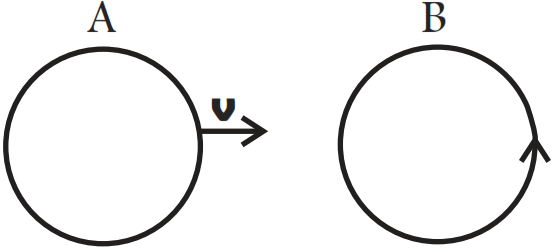
There are two coils $A$ and $B$ as shown in Fig. A current starts flowing in $B$ as shown, when $A$ is moved towards $B$ and stops when $A$ stops moving. The current in $A$ is counterclockwise. $B$ is kept stationary when $A$ moves. We can infer that:
The half-life of $\mathrm{Bi}^{210}$ is 5 days. What time is taken by $(7 / 8)^{\mathrm{th}}$ part of the sample to decay
A $10 \;eV$ electron is circulating in a plane at right angles to a uniform field at magnetic induction $10^{-4} \;W b / m^{2}(=1.0$ gauss), the orbital radius of electron is ........ $cm$
A metal rod of length $10\ cm$ and a rectangular cross$-$section of $1\text{cm}\times\frac{1}{2}\text{cm}$ is connected to a battery across opposite faces. The resistance will be:
A galvanometer gives full scale deflection with $0.006$ A current. By connecting it to a $4990 \ \Omega$ resistance, it can be converted into a voltmeter of range $0-30 \ V$. If connected to a $\frac{2 n }{249} \Omega$ resistance, it becomes an ammeter of range $0-1.5 \ A$. The value of $n$ is:
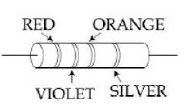
A resistance is shown in the figure. Its value and tolerance are given respectively by
The vacancy created due to the absence of an electron in the valence band of a semiconductor is called a $.........$
When a charge of $3\, coulomb$ is placed in a uniform electric field, it experiences a force of $3000\, Newton$. Within this field, potential difference between two points separated by a distance of $1\, cm$ is........$volts$
If two charged particles of same mass and charge are projected in a uniform electric field with the same speed, then?
A concave and convex lens have the same focal length of $20 cm$ and are put into contact to form a lens combination. The combination is used to view an object of $5 cm$ length kept at $20 cm $ from the lens combination. As compared to the object, the image will be