MCQ
If the nuclear force between two protons, two neutrons and between proton and neutron is denoted by $F _{p p}, F _{n n}$ and $F _{p n}$ respectively, then
  • A
    $F_{pp} <  F_{pn} =  F_{nn}$
  • B
    $F_{pp}  > F_{pn}  =  F_{nn}$
  • $F_{pp} =  F_{pn}  =  F_{nn}$
  • D
    $F_{pp}  < F_{pn}  <  F_{nn}$

Answer

Correct option: C.
$F_{pp} =  F_{pn}  =  F_{nn}$
c
Nuclear force is the same between any two nucleons

Need a full question paper?

Generate a complete, print-ready paper with questions like this in minutes — across 16+ boards, with answer keys.

Start Generating Free

Similar questions

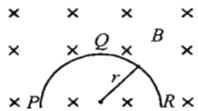
A thin semicircular conducting ring $(PQR)$ of radius $r$ is falling with its plane vertical in a horizontal magnetic field $B,$ as shown in the figure.The potential difference developed across the ring when its speed is $v,$ is 
A liquid drop at temperature $t,$ isolated from its surroundings, breaks into a number of droplets. The temperature of the droplets will be
Which of the following represents the dimensions of Farad
The voltage of an $ac$ source varies with time according to the equation $V = 100\sin \,\left( {100\pi t} \right)\cos \,\left( {100\pi t} \right)$ where $t$ is in seconds and $V$ is in volts. Then
A hydrogen atom in is ground state absorbs $10.2\;eV$ of energy. The angular momentum of electron of the hydrogen atom will increase by the value of ............... $\times 10^{-34} \; J {s}$ (Given, Plank's constant $\left.=6.6 \times 10^{-34} Js \right)$
The specific heat capacity of a metal at low temperature $(T)$ is given as $C_p=32\left(\frac{ T }{400}\right)^{3}\;kJ\,k ^{-1}\, kg ^{-1}$. A $100\; g$ vessel of this metal is to be cooled from $20 \;K$ to $4\; K$ by a special refrigerator operating at room temperature $27^\circ c$). The amount of work required to cool the vessel is
What will be the ratio of de-Broglie wavelengths of proton and $\alpha - $ particle of same energy
$NPN$ transistor are preferred to $PNP$ transistor because they have
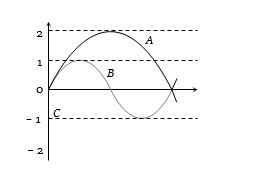
The displacement-time graphs for two sound waves $A$ and $B$ are shown in the figure, then the ratio of their intensities ${I_A}/{I_B}$ is equal to
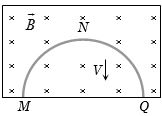
A thin semicircular conducting ring of radius $R$ is falling with its plane vertical in a horizontal magnetic induction $B$. At the position $MNQ$, the speed of the ring is $V$ and the potential difference developed across the ring is