If the period of oscillation of mass $m$ suspended from a spring is $2\, sec$, then the period of mass $4m$ will be .... $\sec$
AIIMS 1998, Medium


Download our appand get started for free
Experience the future of education. Simply download our apps or reach out to us for more information. Let's shape the future of learning together!No signup needed.*
Similar Questions
- 1Speed $v$ of a particle moving along a straight line, when it is at a distance $x$ from a fixed point on the line is given by $v^2 = 108 - 9x^2$ (all quantities in $S.I.$ unit). ThenView Solution
- 2A $1.00 \times 10^{-20} \,kg$ particle is vibrating under simple harmonic motion with a period of $1.00 \times 10^{-5} \,s$ and with a maximum speed of $1.00 \times 10^3 \,m / s$. The maximum displacement of particle from mean position is .......... $mm$View Solution
- 3View SolutionA chimpanzee swinging on a swing in a sitting position, stands up suddenly, the time period will
- 4A mass at the end of a spring executes harmonic motion about an equilibrium position with an amplitude $A.$ Its speed as it passes through the equilibrium position is $V.$ If extended $2A$ and released, the speed of the mass passing through the equilibrium position will beView Solution
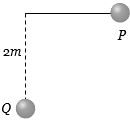
- 5A pendulum of length $2\,m$ lift at $P$. When it reaches $Q$, it losses $10\%$ of its total energy due to air resistance. The velocity at $Q$ is .... $m/sec$View Solution
- 6The bob of a simple pendulum of mass m and total energy $E$ will have maximum linear momentum equal toView Solution
- 7Infinite springs with force constant $k$, $2k$, $4k$ and $8k$.... respectively are connected in series. The effective force constant of the spring will beView Solution
- 8The oscillation of a body on a smooth horizontal surface is represented by the equation $x= Acos$$\omega t$View Solution
where $x=$ displacement at time $t$
$\omega =$ frequency of oscillation
Which one of the following graphs shows correctly the variation $a$ with $t$ ?
Here $a=$ acceleration at time $t$
$T=$ time period
- 9The height of a swing changes during its motion from $0.1\, m$ to $2.5\, m$. The minimum velocity of a boy who swings in this swing is ..... $m/s$View Solution
- 10The time period of a simple pendulum is $2\, sec$. If its length is increased $4$ times, then its period becomes ..... $\sec$View Solution