MCQ
If the phase difference between the two wave is 2$\pi $ during superposition, then the resultant amplitude is
  • Maximum
  • B
    Minimum
  • C
    Maximum or minimum
  • D
    None of the above

Answer

Correct option: A.
Maximum
a
(a) Phase difference is $2\pi $ means constrictive interference so resultant amplitude will be maximum.

Need a full question paper?

Generate a complete, print-ready paper with questions like this in minutes — across 16+ boards, with answer keys.
Start Generating Free

Similar questions

A uniform copper rod of length $50 \,cm$ and diameter $3.0 \,mm$ is kept on a frictionless horizontal surface at $20^{\circ} C$. The coefficient of linear expansion of copper is $2.0 \times 10^{-5} \,K ^{-1}$ and Young's modulus is $1.2 \times 10^{11} \,N / m ^2$. The copper rod is heated to $100^{\circ} C$, then the tension developed in the copper rod is .......... $\times 10^3 \,N$
The vector product of two vectors a and b is a vector c such that c is perpendicular to the plane containing a and b and the direction is given by:
A block of mass $m$ is placed on a smooth wedge of inclination $\theta $. The whole system is accelerated horizontally so that the block does not slip on the wedge. The force exerted by the wedge on the block ($g$ is acceleration due to gravity) will be
Two capillary tubes of the same length but different radii $r‌‌_1 $ and $r_2$  are fitted in parallel to the bottom of a vessel. The pressure head is $ P. $ What should be the radius of a single tube that can replace the two tubes so that the rate of flow is same as before
What average horsepower is developed by an  $80 \;kg $ man while climbing in $10\; s$  a flight of stairs that rises $6 m$  vertically ..............$HP$
Which of the following statements is incorrect during propagation of a plane progressive mechanical wave ?
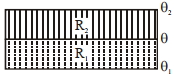
The temperature $\theta$ at the junction of two insulating sheets, having thermal resistances $R _{1}$ and $R _{2}$ as well as top and bottom temperatures $\theta_{1}$ and $\theta_{2}$ (as shown in figure) is given by
The driver of a car travelling at velocity $v$ suddenly see a broad wall in front of him at a distance $d$. He should
The equation for an ideal gas is $PV = RT,$ where $V$ represents the volume of
$A$ and $B$ are two inclined vectors. $R$ is their sum. Choose the correct figure for the given description.