MCQ
If the potential at each point on a conductor is same to each other, then:
  • A
    Electric lines of force may begin or end on the same conductor.
  • No electric lines of force may begin or end on the same conductor.
  • C
    The electric field inside the conductor may be non-zero.
  • D
    None of the above.

Answer

Correct option: B.
No electric lines of force may begin or end on the same conductor.

Electric field lines explain the orientation of the electric field in the region and it points tangential to the point at which it is drawn. Thus at any point, the tangent to the electric field line matches the direction of the electric field.
The density of the field lines at a point determines the strength of the electric field at that point.
Therefore, if the potential at each point of the conductor is the same, then it means that there are no electric lines that may begin or end on the conductor.

Need a full question paper?

Generate a complete, print-ready paper with questions like this in minutes — across 16+ boards, with answer keys.

Start Generating Free

Similar questions

Neglecting variation of mass with velocity, the wavelength associated with an electron having a kinetic energy $E$ is proportional to
From Ampere's circuital law for a long straight wire of circular cross-section carrying a steady current, the variation of magnetic field in the inside and outside region of the wire is :
move in opposite direction with speed ratio $1: 2$

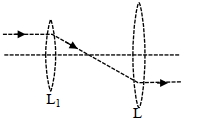
The following figure represents two biconvex lenses $L_1$ and $L_2$ having focal length $10 \mathrm{~cm}$ and $15 \mathrm{~cm}$ respectively. The distance between $\mathrm{L}_1 \& \mathrm{~L}_2$ is :

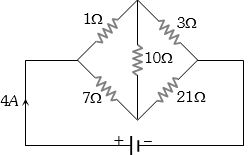
In the circuit shown in figure, the current drawn from the battery is $4\,A$. If $10 \,\Omega$ resistor is replaced by $20\,\Omega$ resistor, then current drawn from the circuit will be .............. $A$
A charge particle $q_0$ of mass $m_0$ is projected along the $y-$axis at $t = 0$ from origin with a velocity $V_0.$ If a uniform electron field $E_0$ also exists along the $x-$ axis, then the time at which de-broglie wavelength of the particle  becomes half of the initial value is
When light is incident on a diffraction grating the zero order principal maximum will be
 
Assertion : Short wave bands are used for transmission of ratio waves to a large distance
Reason : Short waves are reflected by ionosphere
A light ray is incident on the surface of a sphere of refractive index $n$ at an angle of incidence $\theta_0$. The ray partially refracts into the sphere with angle of refraction $\phi_0$ and then partly reflects from the back surface. The reflected ray then emerges out of the sphere after a partial refraction. The total angle of deviation of the emergent ray with respect to the incident ray is $\alpha$. Match the quantities mentioned in $List-I$ with their values in $List-II$ and choose the correct option.
$List-I$ $List-II$
($P$) If $n=2$ and $\alpha=180^{\circ}$, then all the possible values of $\theta_0$ will be ($1$) $30^{\circ}$ and $0^{\circ}$
($Q$) If $n=\sqrt{3}$ and $\alpha=180^{\circ}$, then all the possible values of $\theta_0$ will be ($2$) $60^{\circ}$ and $0^{\circ}$
($R$) If $n=\sqrt{3}$ and $\alpha=180^{\circ}$, then all the possible values of $\phi_0$ will be ($3$) $45^{\circ}$ and $0^{\circ}$
($S$) If $n=\sqrt{2}$ and $\theta_0=45^{\circ}$, then all the possible values of $\alpha$ will be ($4$) $150^{\circ}$
  ($5$) $0^{\circ}$
A solenoid $($air core$)$ ahs $400$ turns, is $20 \ cm$ long and has a cross section of $4 \ cm^2$. Then the coefficient of self induction is approximately
Consider the following statements A to B and identify the correct answer
A. Polarised light can be used to study the helical surface of nucleic acids.
B. Optics axis is a direction and not any particular line in the crystal