If the ratio of coefficient of thermal conductivity of silver and copper is $10 : 9$ , then the ratio of the lengths upto which wax will melt in Ingen Hausz experiment will be
Medium


Download our appand get started for free
Experience the future of education. Simply download our apps or reach out to us for more information. Let's shape the future of learning together!No signup needed.*
Similar Questions
- 1Certain substance emits only the wavelengths ${\lambda _1},\;{\lambda _2},\;{\lambda _3}$ and ${\lambda _4}$ when it is at a high temperature. When this substance is at a colder temperature, it will absorb only the following wavelengthsView Solution
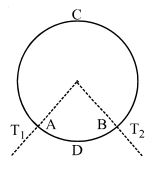
- 2Aring consisting of two parts $ADB$ and $ACB$ of same conductivity $k$ carries an amount of heat $H$. The $ADB$ part is now replaced with another metal keeping the temperatures $T_1$ and $T_2$ constant. The heat carried increases to $2H$. What $ACB$ should be the conductivity of the new$ADB$ part? Given $\frac{{ACB}}{{ADB}}= 3$View Solution
- 3A spherical black body with a radius of $12\ cm$ radiates $450\ watt$ power at $500\ K$. If the radius were halved and the temperature doubled, the power radiated in watt would beView Solution
- 4View SolutionWhich of the following statements is true/correct
- 5Two rods one made of copper and other made of steel of the same length and same cross sectional area are joined together. The thermal conductivity of copper and steel are $385\,J\,s ^{-1}\,K ^{-1}\,m ^{-1}$ and $50\,J\,s ^{-1}\,K ^{-1}\,m ^{-1}$ respectively. The free ends of copper and steel are held at $100^{\circ}\,C$ and $0^{\circ}\,C$ respectively. The temperature at the junction is, nearly $.......^{\circ}\,C$View Solution
- 6Two identical beakers $A$ and $B$ contain equal volumes of two different liquids at $60\,^oC$ each and left to cool down. Liquid in $A$ has density of $8 \times10^2\, kg / m^3$ and specific heat of $2000\, Jkg^{-1}\,K^{-1}$ while liquid in $B$ has density of $10^3\,kgm^{-3}$ and specific heat of $4000\,JKg^{-1}\,K^{-1}$ . Which of the following best describes their temperature versus time graph schematically? (assume the emissivity of both the beakers to be the same)View Solution
- 7The sun radiates electromagnetic energy at the rate of $3.9 \times 10^{26}\,W$. It's radius is $6.96 \times 10^8\,m$. The intensity of sun light at the solar surface will be (in $W/m^2$)View Solution
- 8Two thermometers $A$ and $B$ are exposed in sun light. The valve of $A$ is painted black, But that of $B$ is not painted. The correct statement regarding this case isView Solution
- 9A black body radiates $ 20\,W$ at temperature ${227^o}C$. If temperature of the black body is changed to ${727^o}C$ then its radiating power will be ..... $W$View Solution
- 10$A$ cylinder of radius $R$ made of a material of thermal conductivity ${K_1}$ is surrounded by a cylindrical shell of inner radius $R$ and outer radius $2R$ made of material of thermal conductivity ${K_2}$. The two ends of the combined system are maintained at two different temperatures. There is no loss of heat across the cylindrical surface and the system is in steady state. The effective thermal conductivity of the system isView Solution