Question
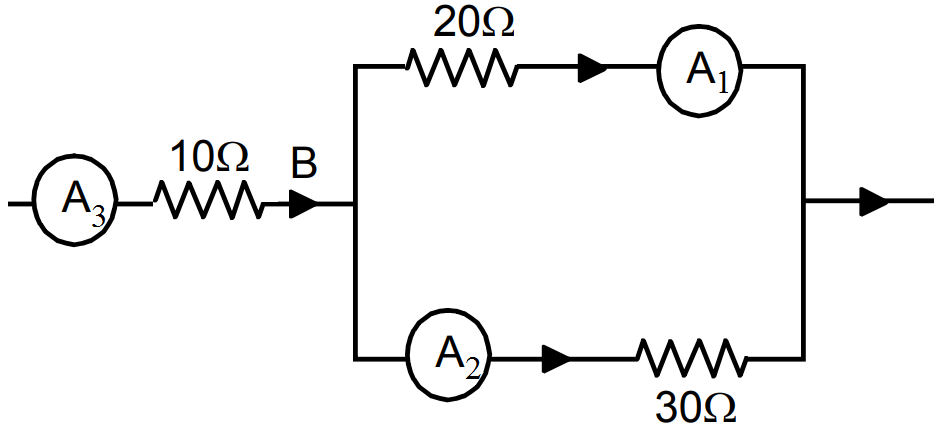
If the reading of the ammeter, $A_1$ in the figure. is 2.4A, what will be the readings of ammeters $A_2$ and $A_3$? Neglect the resistances of the ammeters.
Answer

$A_1 = 2.4A$

 Since $A_1$ and $A_2$ are in parallel,$\Rightarrow20\times2.4=30\times\text{X}$
$\Rightarrow\text{x}=\frac{20\times2.4}{30}=1.6\text{A}.$
Reading in Ammeter $A_2$ is 1.6A.$\text{A}_3=\text{A}_1+\text{A}_2=2.4+1.6=4.0\text{A}.$

Need a full question paper?

Generate a complete, print-ready paper with questions like this in minutes — across 16+ boards, with answer keys.
Start Generating Free

Similar questions

An object falling through a fluid is observed to have acceleration given by a = g - bv where g = gravitational acceleration and b is constant. After a long time of release, it is observed to fall with constant speed. What must be the value of constant speed?
What is thermal expansion of gases? Prove that the value of volume coefficient and pressure coefficient are equal.
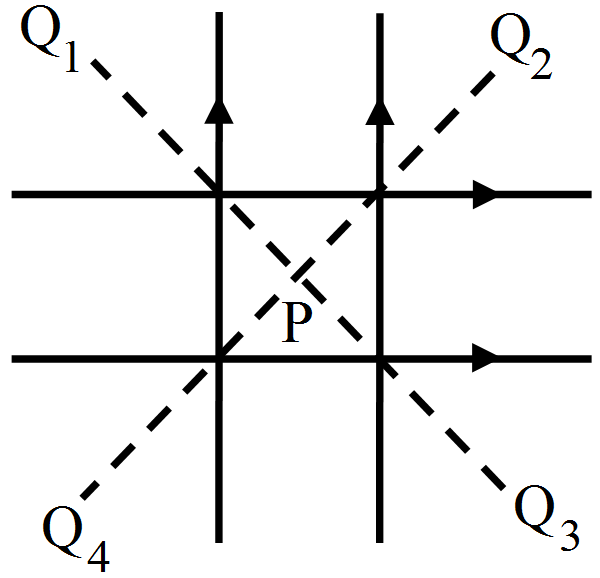
Four long, straight wires, each carrying a current of $5.0A$, are placed in a plane as shown in figure. The points of intersection form a square of side $5.0cm$.
  1. Find the magnetic field at the centre P of the square.
  2. $Q_1, Q_2, Q_3,$ and $Q_4$ are points situated on the diagonals of the liquare and at a distance from P that is equal to the length of the diagonal of the square. Find the magnetic fields at these points.
Consider a one-dimensional motion of a particle with total energy E. There are four regions A, B, C and D in which the relation between potential energy V, kinetic energy (K) and total energy E is as given below: Region A : V > E Region B : V < E Region C : K > E Region D : V > K State with reason in each case whether a particle can be found in the given region or not.
Write the definition of vector product. Explain the applications of vector product in physics.
Figure shows a smooth track which consists of a straight inclined part of length $1$ joining smoothly with the circular part. A particle of mass $m$ is projected up the incline from its bottom.
  1. Find the minimum projection$-$speed $v_0$, for which the particle reaches the top of the track.
  2. Assuming that the projection$-$speed is $2v_0$ and that the block does not lose contact with the track before reaching its top, find the force acting on it when it reaches the top.
  3. Assuming that the projection$-$speed is only slightly greater than $v_0$, where will the block lose contact with the track?
A spring balance has a scale that reads from $0$ to $50kg$. The length of the scale is $20cm$. A body suspended from this balance, when displaced and released, oscillates with a period of $0.6s$. What is the weight of the body?
Consider the situation of the previous problem. Consider the fastest electron emitted parallel to the large metal plate. Find the displacement of this electron parallel to its initial velocity before it strikes the large metal plate.
What is gravitational potential? Derive the formula for gravitational potential due to a ponit mass and also draw the graph.
Prove that closed argon pipe produced only odd harmonics whereas both odd and even harmonic are produced in an open argon pipe.