Question
Four long, straight wires, each carrying a current of $5.0A$, are placed in a plane as shown in figure. The points of intersection form a square of side $5.0cm$.
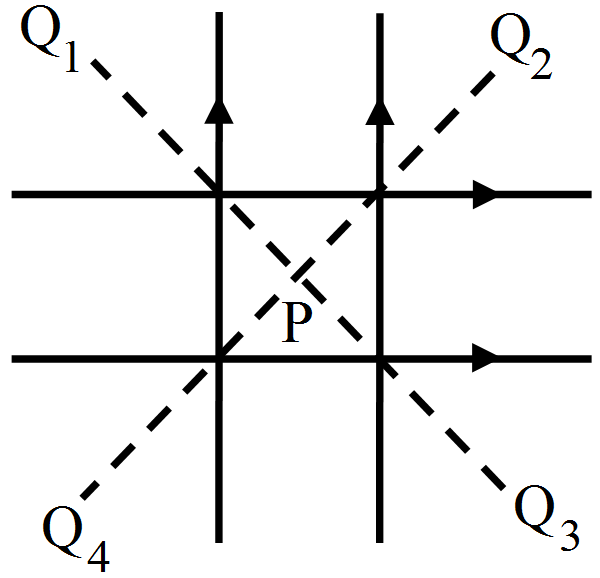
  1. Find the magnetic field at the centre P of the square.
  2. $Q_1, Q_2, Q_3,$ and $Q_4$ are points situated on the diagonals of the liquare and at a distance from P that is equal to the length of the diagonal of the square. Find the magnetic fields at these points.
Answer


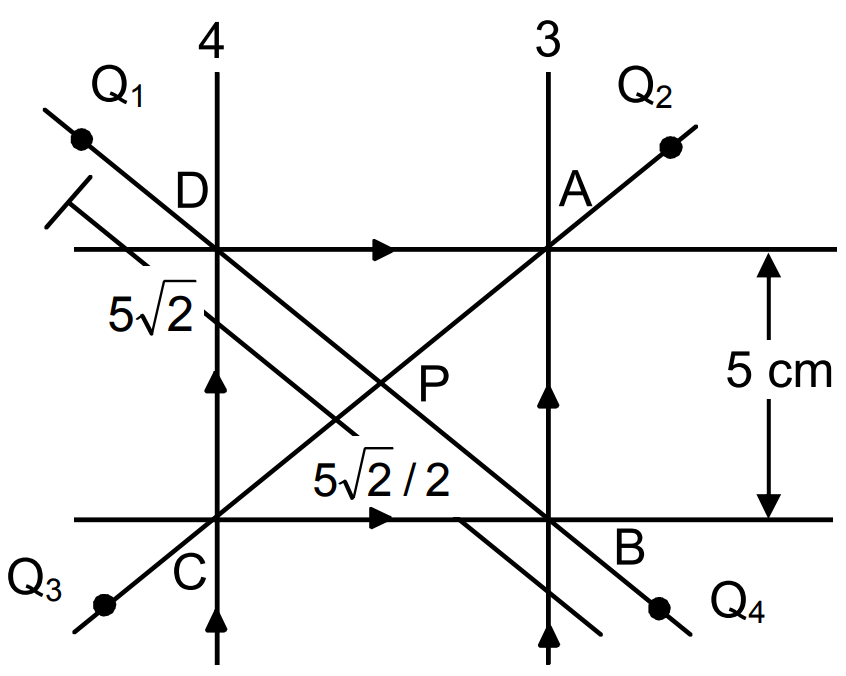
  1. For each of the wire
Magnitude of magnetic field
$=\frac{\mu_0\text{i}}{4\pi\text{r}}(\sin45^\circ+\sin45^\circ)=\frac{\mu_0\times5}{4\pi\Big(\frac{5}{2}\Big)}=\frac{2}{\sqrt2}$
For AB $\odot$ for BC $\odot$ for CD $\otimes$ and for DA $\otimes.$
The two $\odot$ and $2\otimes$ fields cancel each other. Thus $B_{net} = 0$
  1.  
At point $Q_1$,
Due to (1) $\text{B}=\frac{\mu_0\text{i}}{2\pi\times2.5\times10^{-2}}=\frac{4\pi\times5\times2\times10^{-7}}{2\pi\times5\times10^{-2}}=4\times10^{-5}\odot$
Due to (2) $\text{B}=\frac{\mu_0\text{i}}{2\pi\times\Big(\frac{15}{2}\Big)\times10^{-2}}=\frac{4\pi\times5\times2\times10^{-7}}{2\pi\times5\times10^{-2}}=\Big(\frac{4}{3}\Big)\times10^{-5}\odot$
Due to (3) $\text{B}=\frac{\mu_0\text{i}}{2\pi\times\Big(5+\frac{5}{2}\Big)\times10^{-2}}=\frac{4\pi\times5\times2\times10^{-7}}{2\pi\times15\times10^{-2}}=\Big(\frac{4}{3}\Big)\times10^{-5}\odot$
Due to (4) $\text{B}=\frac{\mu_0\text{i}}{2\pi\times2.5\times10^{-2}}=\frac{4\pi\times5\times2\times10^{-7}}{2\pi\times5\times10^{-2}}=4\times10^{-5}\odot$
$\text{B}_\text{net}=\Big[4+4+\Big(\frac{4}{3}\Big)+\Big(\frac{4}{3}\Big)\Big]\times10^{-5}$
$=\frac{32}{3}\times10^{-5}=10.6\times10^{-5}\approx1.1\times10^{-4}\text{T}$
At point $Q_2$,
Due to (1) $\frac{\mu_0\text{i}}{2\pi\times(2.5)\times10^{-2}}\odot$
Due to (2) $\frac{\mu_0\text{i}}{2\pi\times\Big(\frac{15}{2}\Big)\times10^{-2}}\odot$
Due to (3) $\text{B}=\frac{\mu_0\text{i}}{2\pi\times(2.5)\times10^{-2}}\otimes$
Due to (4) $\frac{\mu_0\text{i}}{2\pi\times\Big(\frac{15}{2}\Big)\times10^{-2}}\otimes$
At point $Q_3$,
Due to (1) $\frac{4\pi\times10^{-7}\times5}{2\pi\times\Big(\frac{15}{2}\Big)\times10^{-2}}=\frac{4}{3}\times10^{-5}\otimes$
Due to (2) $\frac{4\pi\times10^{-7}\times5}{2\pi\times\Big(\frac{5}{2}\Big)\times10^{-2}}=4\times10^{-5}\otimes$
Due to (3) $\frac{4\pi\times10^{-7}\times5}{2\pi\times\Big(\frac{5}{2}\Big)\times10^{-2}}=4\times10^{-5}\otimes$
Due to (4) $\frac{4\pi\times10^{-7}\times5}{2\pi\times\Big(\frac{15}{2}\Big)\times10^{-2}}=\frac{4}{3}\times10^{-5}\otimes$
$\text{B}_\text{net}=\Big[4+4+\Big(\frac{4}{3}\Big)+\Big(\frac{4}{3}\Big)\Big]\times10^{-5}$
$=\frac{32}{3}\times10^{-5}=10.6\times10^{-5}\approx1.1\times10^{-4}\text{T}$
For $Q_4​​​​​​​$,
Due to (1) $\frac{4}{3}\times10^{-5}\otimes$
Due to (2) $4\times10^{-5}\otimes$
Due to (3) $\frac{4}{3}\times10^{-5}\otimes$
Due to (4) $4\times10^{-5}\otimes$
$\text{B}_\text{net}=0$

Need a full question paper?

Generate a complete, print-ready paper with questions like this in minutes — across 16+ boards, with answer keys.

Start Generating Free

Similar questions

A mica strip and a polysterene strip are fitted on the two slits of a double slit apparatus. The thickness of the strips is $0.50mm$ and the separation between the slits is $0.12cm$. The refractive index of mica and polysterene are $1.58$ and $1.55$ respectively for the light of wavelength $590nm$ which is used in the experiment. The interference is observed on a screen a distance one meter away.
  1. What would be the fringe-width?
  2. At what distance from the centre will the first maximum be located?
You are riding in an automobile of mass 3000 kg . Assuming that you are examining the oscillation characteristics of its suspension system. The suspension sags 15 cm when the entire automobile is placed on it. Also, the amplitude of oscillation decreases by $50 \%$ during one complete oscillation. Estimate the values of
a. the spring constant $k$ and
b. the damping constant b for the spring and shock absorber system of one wheel, assuming that each wheel supports 750 kg .
A current of 1.0A is established in a tightly wound solenoid of radius 2cm having 1000 turns/ metre. Find the magnetic energy stored in each metre of the solenoid.
Derive the expression for excess pressure inside:
  1. A liquid drop.
  2. A liquid bubble.
  3. An air bubble.
An ideal gas at pressure $2.5 \times 10^5Pa$ and temperature $300K$ occupies $100cc$. It is adiabatically compressed to half its original volume. Calculate,
  1. The final pressure.
  2. The final temperature.
  3. The work done by the gas in the process. Take $\gamma=1.5.$
A car moving along a straight highway with speed of $126km\ h^{–1}$ is brought to a stop within a distance of $200m$. What is the retardation of the car (assumed uniform), and how long does it take for the car to stop?
A bullet fired at an angle of $30°$ with the horizontal hits the ground $3.0km$ away. By adjusting its angle of projection, can one hope to hit a target $5.0km$ away? Assume the muzzle speed to be fixed, and neglect air resistance.
(i) What is escape velocity? Prove that the velocity required to escape from earth's gravity is 11.2 km/s. Find the value of escape velocity for the moon.
(ii) Calculate the value of escape velocity required to make an object situated at a height h above the earth's surface
Consider a non-conducting plate of radius r and mass m that has a charge q distributed uniformly over it. The plate is rotated about its axis with an angular speed $\omega.$ Show that the magnetic moment $\mu$ and the angular momentum of the plate are related as $\mu=\frac{\text{q}}{2\text{m}}\text{l}.$
A uniform rod pivoted at its upper end hangs vertically. It is displaced through an angle of 60° and then released. Find the magnitude of the force acting on a particle of mass dm at the tip of the rod when the rod makes an angle of 37° with the vertical.