Question
If the separation between the slits in a Young's double slit experiment is increased, what happens to the fringe-width? If the separation is increased too much, will the fringe pattern remain detectable?

Answer

The fringe width in Young's double slit experiment depends on the separation of the slits.
$\text{x}=\frac{\lambda\text{D}}{\text{d}},$
where
$\lambda$ = wavelength
x = fringe width
D = distance between slits and screen
d = separation between slits
On increasing d, fringe width decreases. If the separation is increased too much, the fringes will merge with each other and the fringe pattern won't be detectable.

Need a full question paper?

Generate a complete, print-ready paper with questions like this in minutes — across 16+ boards, with answer keys.
Start Generating Free

Similar questions

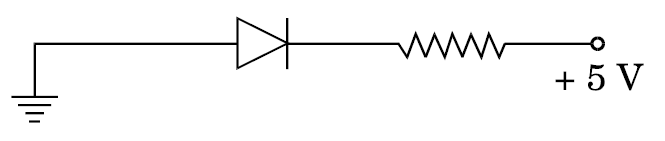
  1. In the following diagram, is the junction diode forward biased or reverse biased?
  1. Draw the circuit diagram of a full wave rectifier and state how it works.
Suppose a monochromatic X-ray beam of wavelength 100pm is sent through a Young's double slit and the interference pattern is observed on a photographic plate placed 40cm away from the slit. What should be the separation between the slits so that the successive maxima on the screen are separated by a distance of 0.1mm?
A parallel-plate capacitor of plate-area A and plate separation d is joined to a battery of emf $\epsilon$ and internal resistance R at t = 0. Consider a plane surface of area $\frac{\text{A}}{2}$ parallel to the plates and situated symmetrically between them. Find the displacement current through this surface as a function of time.
Derive the equation for the torque acting on a current carrying loop placed at an angle $\theta$ with uniform magnetic field $(\vec{B})$.
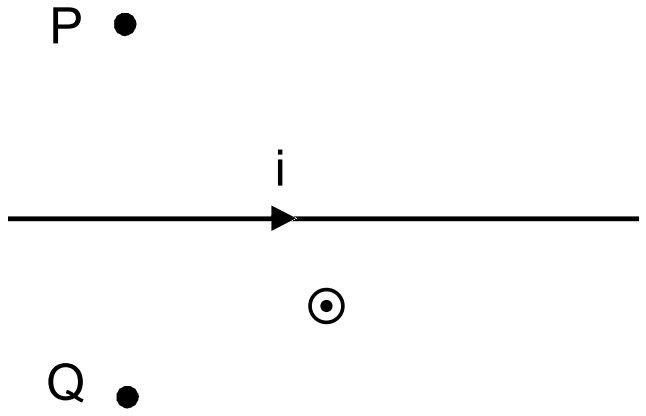
A long, straight wire carrying a current of $1.0A$ is placed horizontally in a uniform magnetic field $B = 1.0 \times 10^{-5}T$ pointing vertically upward figure. Find the magnitude of the resultant magnetic field at the points $P$ and $Q,$ both situated at a distance of $2.0\ cm$ from the wire in the same horizontal plane.
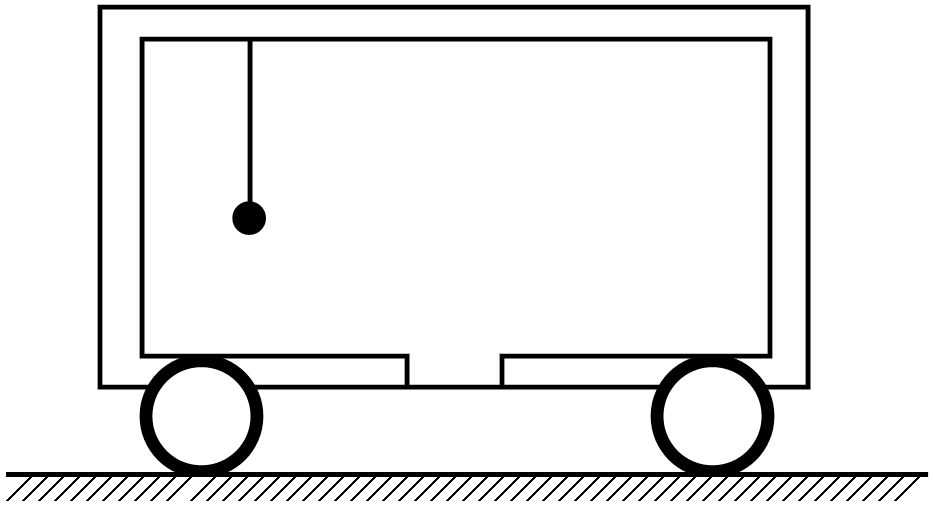
A cart of mass M is at rest on a frictionless horizontal surface and a pendulum bob of mass m hangs from the roof of the cart. The string breaks, the bob falls on the floor, makes several collisions on the floor and finally lands up in a small slot made in the floor. The horizontal distance between the string and the slot is L. Find the displacement of the cart during this process.
Obtain the relationship between object distance $(u),$ image distance $(v)$ and focal length $(f)$ for a concave mirror. Obtain $\frac{1}{f}=\frac{1}{v}+\frac{1}{u}$ formula for a concave mirror.
  1. Write the principle of working of a metre bridge.
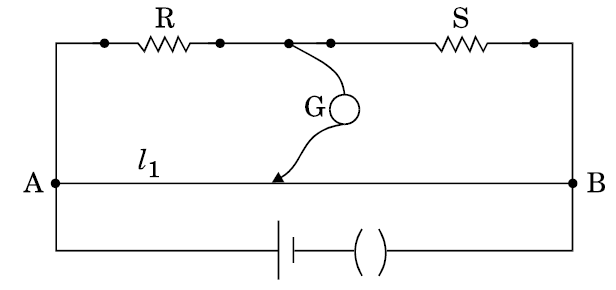
  2. In a metre bridge, the balance point is found at a distance $l_1$ with resistances R and S as shown in the figure.

An unknown resistance X is now connected in parallel to the resistance S and the balance point is found at a distance $l_2$. Obtain a formula for X in terms of $l_1$, $l_2$ and S.
Calculate the energy that can be obtained from $1\ kg$ of water through the fusion reaction
$^2H + ^2H \rightarrow ^3H + p.$
Assume that $1.5 \times 10^{-2}\%$ of natural water is heavy water $D_2O ($by number of molecules$)$ and all the deuterium is used for fusion.
  1. Identify the part of the electromagnetic spectrum used in $(i)$ radar and $(ii)$ eye surgery. Write their frequency range.
  2. Prove that the average energy density of the oscillating electric field is equal to that of the oscillating magnetic field.