Question
Derive the equation for the torque acting on a current carrying loop placed at an angle $\theta$ with uniform magnetic field $(\vec{B})$.
Answer

Image
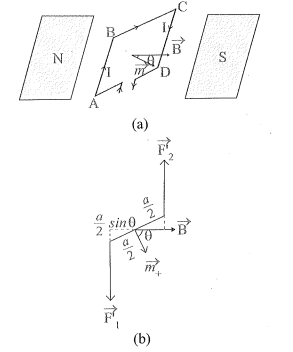
→As shown in the figure (a), the coil is placed in such a way that the magnetic field marks an angle $\theta$ with normal to the coil.
→The current passing through the coil is I. The length and width of the coil are $a$ and $b$ respectively.
→The force on the arm BC of the coil due to the current is $F _1= I a B \cos \theta$ and the force on the $\operatorname{arm} AD$ is $F _2= I a B \cos \theta$.
→Since, both these forces are equal, opposite and act along the axis of the coil, the resultant force and torque is zero.
→Similarly, the force acting perpendicular to the side AB and CD of the coil is $F _1{ }^{\prime}= F _2{ }^{\prime}= I b B$ respectively.
→Since, these two forces are equal in magnitude and opposite to each other the net force is zero. But they are non collinear, they form a couple, so a torque is exerted on the coil.
→From the figure (b) the torque acting on the coil.
$\begin{aligned}
\tau & =\left( F _1{ }^{\prime}\right) \frac{a}{2} \sin \theta+\left( F _2{ }^{\prime}\right)\left(\frac{a}{2}\right) \sin \theta \\
\therefore \tau & = I b B\left(\frac{a}{2}\right) \sin \theta+ I b B\left(\frac{a}{2}\right) \sin \theta \\
\therefore \quad \tau & =2 I b B \frac{a}{2} \sin \theta \\
\therefore \tau & = IB (a b) \sin \theta
\end{aligned}$
But $a b= A$ is the area of the rectangle.
$\therefore \tau= IAB \sin \theta$
→Vector form, $\vec{\tau}=I \vec{A} \times \vec{B}$
→But the magnetic dipole moment $\vec{m}= I \overrightarrow{ A }$
→The direction of the magnetic dipole moment is in the direction of area vector.
→Thus, torque acting on the coil $\vec{\tau}=\vec{m} \times \overrightarrow{ B } \ldots$
→If there are N turns in the coil then the torque is $\tau= NIAB \sin \theta$
Where, NIA $=m$ (magnetic moment)

Need a full question paper?

Generate a complete, print-ready paper with questions like this in minutes — across 16+ boards, with answer keys.

Start Generating Free

Similar questions

Find the Q-value and the kinetic energy of the emitted α-particle in the $\alpha $-decay of
  1.  $^{226}_{88}\text{Ra}$ and  
  2. $^{220}_{86}\text{Rn}.$
Given
$\text{m}(^{226}_{88}\text{Ra})=226.02540\text{ u}.$ $\text{m}(^{222}_{86}\text{Rn})=222.01750\text{ u}.$
$\text{m}(^{222}_{86}\text{Rn})=220.01137\text{ u}.$ $\text{m}(^{216}_{84}\text{Po})=216.00189\text{ u}.$
Show that $\text{AB} + \overline{\text{AB}}$ is always 1.
A $60\mu F$ capacitor is connected to a $110V, 60Hz$ ac supply. Determine the rms value of the current in the circuit.
A car moves with a speed of $54\ km/h$ towards a cliff. The horn of the car emits sound of frequency $400\ Hz$ at a speed of $3.35m/s.$
Write the summary of experimental studies of the photoelectric effect.
###
Write the characteristics of photoelectric effect.
Indium antimonide has a band gap of 0.23eV between the valence and the conduction band. Find the temperature at which kT equals the band gap.
Suppose an attractive nuclear force acts between two protons which may be written as $\text{F}=\text{Ce}^{-\text{kr}}/\text{r}^2.$
  1. Write down the dimensional formulae and appropriate $SI$ units of $C$ and $k.$
  2. Suppose that $k = 1$ fermi$^{-1}$ and that the repulsive electric force between the protons is just balanced by the attractive nuclear force when the separation is $5$ fermi. Find the value of $C.$
(i) If $f=0.5 m$ for a glass lens, what is the power of the lens? (ii) The radii of curvature of the faces of a double convex lens are $10 cm$ and $15 cm$. Its focal length is $12 cm$. What is the refractive index of glass? (iii) A convex lens has $20 cm$ focal length in air. What is focal length in water? (Refractive index of air-water $=1.33$, refractive index for air-glass $=1.5$.)
What is the nature of electromagnetic waves?
Two parallel wires carry equal currents of 10A along the same direction and are separated by a distance of 2.0cm. Find the magnetic field at a point which is 2.0cm away from each of these wires