If the speed of the wave shown in the figure is $330m/s$ in the given medium, then the equation of the wave propagating in the positive $x-$direction will be (all quantities are in $M.K.S.$ units)
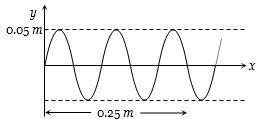
Medium


Download our appand get started for free
Experience the future of education. Simply download our apps or reach out to us for more information. Let's shape the future of learning together!No signup needed.*
Similar Questions
- 1Select the correct statement about the reflection and refraction of a wave at the interface between the medium $1$ and $2$ theView Solution
- 2$16$ tunning forks are arranged in the order of increasing frequencies. Any two successive forks give $8$ beats per sec when sounded together. If the frequency of the last fork is twice the first, then the frequency of the first fork isView Solution
- 3A source of sound of frequency $450$ cycles/sec is moving towards a stationary observer with $34\, m/sec$ speed. If the speed of sound is $340\, m/sec,$ then the apparent frequency will be ..... $cycles/sec$View Solution
- 4View SolutionThe particles of a medium vibrate about their mean positions whenever a wave travels through that medium. The phase difference between the vibrations of two such particles
- 5If the density of oxygen is $16$ times that of hydrogen, what will be the ratio of their corresponding velocities of sound wavesView Solution
- 6The minimum distance of reflector surface from the source for listening the echo of sound is ..... $m$View Solution
- 7The string of a violin has a frequency of $440 \,cps$. If the violin string is shortened by one fifth, its frequency will be changed to ........... $cps$View Solution
- 8A stationary source emits sound waves of frequency $500\, Hz$. Two observers moving along a line passing through the source detect sound to be of frequencies $480\, Hz$ and $530\, Hz$. Their respective speeds are, in $m\,s^{-1}$ (Given speed of sound $= 300\, m/s$)View Solution
- 9A tuning fork gives $4$ beats with $50 cm$ length of a sonometer wire. If the length of the wire is shortened by $1 cm$, the number of beats is still the same. The frequency of the fork isView Solution
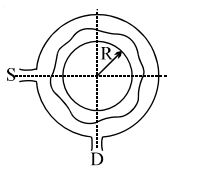
- 10A narrow tube is bent in the form of a circle of radius $R,$ as shown in the figure. Two small holes $S$ and $D$ are made in the tube at the positions right angle to each other. A source placed at $S$ generated a wave of intensity $I_0$ which is equally divided into two parts : One part travels along the longer path, while the other travels along the shorter path. Both the part waves meet at the point $D$ where a detector is placed The maximum intensity produced at $D$ is given byView Solution